EQ Quiz
An EQ quiz is a quick way to see how you notice, express, and regulate emotions when life feels calm or pressured. Macaron turns that snapshot into a clearer read on strengths, friction points, and practical areas to improve.
EQ Quiz
This EQ quiz is a quick self-reflection on how you notice, express, and manage emotions in everyday situations. It highlights patterns in self-awareness, empathy, communication, and stress response so you can spot what feels steady and what may need more practice.
This is a self-reflection tool, not a diagnosis or clinical assessment.
Please answer every question before viewing your result.
This quiz is for self-reflection only and cannot tell you whether you have a mental health condition or relationship problem. If the questions bring up intense distress, ongoing conflict, or thoughts of harming yourself or someone else, please reach out to a trusted person, a licensed professional, or local emergency support right away.
How Emotional Intelligence Shows Up in Real Life
An EQ quiz is useful when you want a fast, practical read on how you handle emotions, pressure, empathy, and communication in everyday situations. Searchers often use the term to mean a self-check rather than a formal psychological evaluation, so the most helpful version is one that feels concrete and easy to relate to. Macaron keeps the focus on lived behavior, which makes the result easier to understand and act on.
Macaron frames the quiz around recognizable moments instead of abstract theory. That matters because emotional intelligence usually shows up in small behaviors, like whether you pause before reacting, notice tension in a conversation, or recover quickly after conflict. Those details are often more revealing than a broad label, especially for people who want to understand how they come across at work, at home, or in stressful conversations.
In many EQ quiz results, the real value is not a single score but the pattern underneath it. A useful result can show whether your strengths are more about self-awareness, emotional control, or reading other people, and where pressure tends to expose gaps. That pattern-based view is more helpful than treating EQ as a fixed trait, because it points to habits you can actually change over time. For a related Macaron page, see AI Story App - Macaron at https://macaron.im/ai-story-app.
This page is designed for people who want insight they can actually use. If you are trying to understand your communication style, your reactions under stress, or why certain conversations go sideways, an EQ quiz can give you a starting point without pretending to be a diagnosis. Macaron is especially useful when you want a quick reflection tool that still gives enough detail to guide a next step.
The goal is reflection with context. Emotional intelligence is broad, and different quizzes emphasize different abilities, so Macaron focuses on the everyday skills most people are really looking for when they search for an EQ quiz: awareness, regulation, empathy, and better responses in real life. That makes it a practical fit for users who want self-understanding first, then a small action they can try immediately.
How Emotional Intelligence Shows Up in Real Life
An EQ quiz is most useful when it reflects situations you actually face, not just abstract personality language. Macaron focuses on everyday moments such as noticing your own feelings before you speak, staying composed when a conversation gets heated, or picking up on another person's tone when the words alone are not enough. It also helps reveal whether you tend to recover quickly after conflict or stay stuck in the emotional aftershock. That makes the result easier to connect to real relationships, work conversations, and stressful decisions. The tradeoff is that a short quiz cannot capture every nuance, but it can still surface the habits that matter most day to day.
What This EQ Quiz Checks in a Few Minutes
The quiz is organized around the core parts of emotional intelligence that most people expect an EQ quiz to cover: self-awareness, emotional regulation, empathy, communication habits, and stress response. That structure matters because users often search for an EQ quiz when they want to know more than just whether they are 'good with emotions.' They want to know which skill is strongest, which one breaks down under pressure, and which area would be the most practical place to improve first. Macaron keeps the check-in short while still making the result specific enough to act on, which is useful for busy users who want clarity without a long assessment.
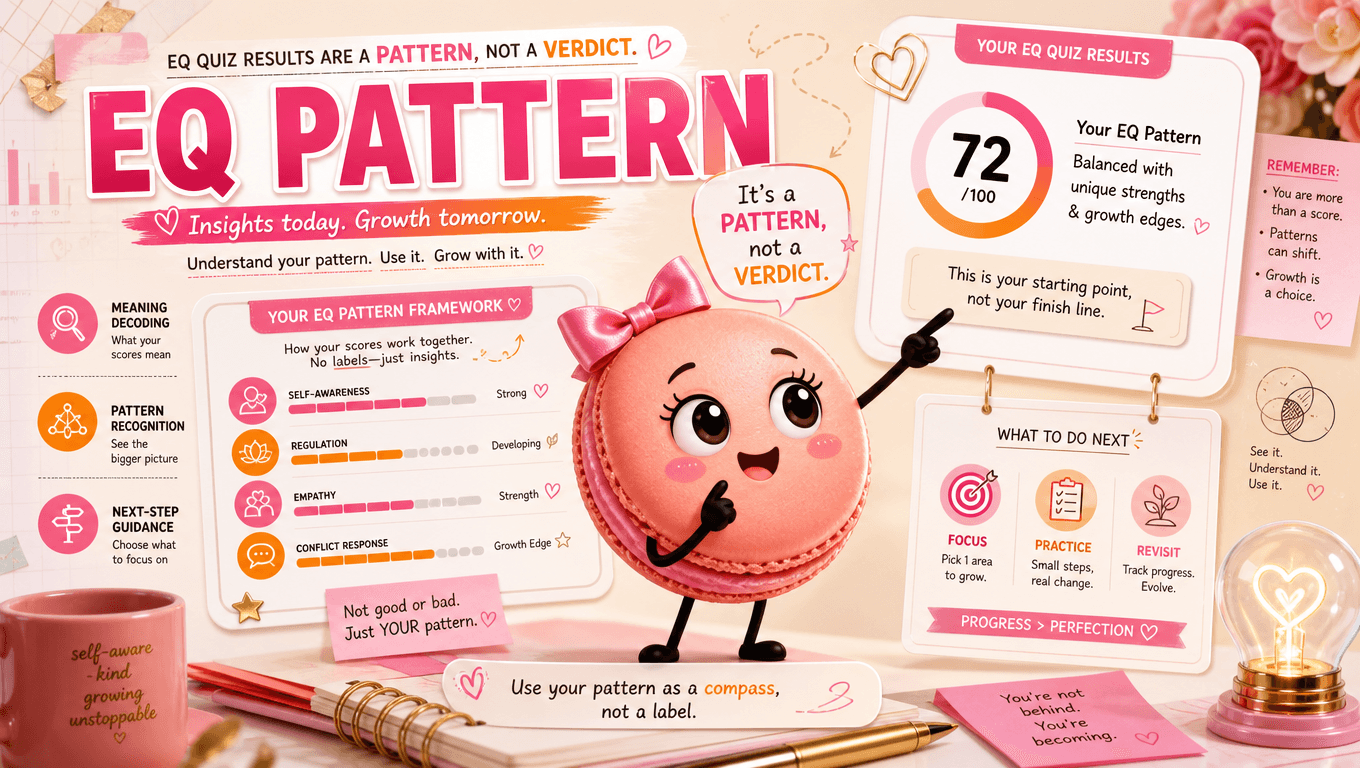
Reading Your EQ Quiz Result in a Useful Way
Your result should be read as a pattern, not a verdict. If one area stands out, it may point to a habit that is steady in calm settings but less reliable during conflict, criticism, or fatigue. For example, someone may be self-aware but still struggle to regulate reactions, or they may be empathetic but become defensive when they feel misunderstood. Macaron is designed to help you notice those differences so you can focus on the most relevant next step instead of treating the score as a fixed label. That approach is especially helpful for people who want practical self-improvement rather than a personality type.
More About EQ Quiz
An EQ quiz works best when it maps to situations people already recognize. Instead of asking only whether you think you are emotionally intelligent, it should surface how you behave when you are interrupted, criticized, misunderstood, or trying to stay calm in a tense exchange. That makes the result more grounded and easier to compare with real life. Macaron leans into that practical framing, which helps users see emotional intelligence as a set of observable habits rather than a vague self-image.
The quiz structure should make it easier to interpret the result without overreading it. Many popular EQ tests break emotional intelligence into separate dimensions, and that approach helps users see whether the issue is self-awareness, self-management, social awareness, or communication under pressure. Macaron follows that logic because it gives people a clearer map of where they are strong and where they may need more practice. The tradeoff is that a compact quiz is less detailed than a long-form assessment, but it is faster to complete and easier to revisit.
A good result should point to patterns, not labels. If someone scores lower in one area, that does not mean they lack emotional intelligence overall. It may simply mean that one skill, such as pausing before reacting or reading another person's tone, is less consistent right now. That distinction matters because users often come to an EQ quiz looking for a judgment when what they really need is a starting point. Macaron keeps the emphasis on what is changeable, which makes the result more actionable. Another useful Macaron comparison is How to Use AI as a Personal Assistant: 30 Prompts That Actually Work at https://macaron.im/blog/ai-personal-assistant-prompts.
Macaron also treats the quiz as a bridge to action. The most useful EQ quiz experiences do not stop at a score. They suggest small habits, like brief check-ins, calmer pauses, or better listening resets, because emotional intelligence usually improves through repeated practice rather than one big insight. This is where Macaron is more practical than many static quizzes: it connects reflection to a next step that fits into normal routines, which is especially helpful for users who want to improve communication or stress response. For a broader Macaron context, 20 AI Tools to Upgrade Your Daily Life - Macaron - Macaron App at https://macaron.im/blog/macaron-app-ai-tools-daily-life can help you compare the decision from another angle.
Because emotional reflection can be personal, the page also needs clear boundaries. An EQ quiz can support self-understanding, but it should not be mistaken for therapy, diagnosis, or crisis care. That distinction helps users trust the tool for what it is and seek human support when they need it. Competitor apps may offer longer psychometric-style tests or broader benchmarking, which can be useful for users who want more formal measurement, while Macaron is better for quick insight and practical follow-through.
Practical Ways to Improve Emotional Intelligence
Macaron turns the EQ quiz into something more useful than a one-time score by suggesting small, repeatable habits. That can include short reflection prompts, one-minute emotional check-ins, pausing before replying, resetting after tense conversations, or practicing more attentive listening when emotions run high. These kinds of actions matter because emotional intelligence usually improves through pattern changes, not through willpower alone. The point is to make the next step feel realistic enough to use in daily life, especially in moments where pressure tends to override intention. For users who want a simple starting point, this is often more helpful than a long explanation.
If You Need Immediate Support
This EQ quiz is a self-reflection tool, not a substitute for professional help. If your emotional distress feels overwhelming, if you feel unsafe, or if you are having thoughts of self-harm, the right next step is to contact crisis support immediately rather than continue with a quiz. In the United States, you can call or text 988. In the United Kingdom and Ireland, Samaritans can be reached at 116 123. If you are elsewhere, findahelpline.com can help you locate local support. If there is immediate danger, contact emergency services right away. The quiz is best used when you are stable enough to reflect safely.
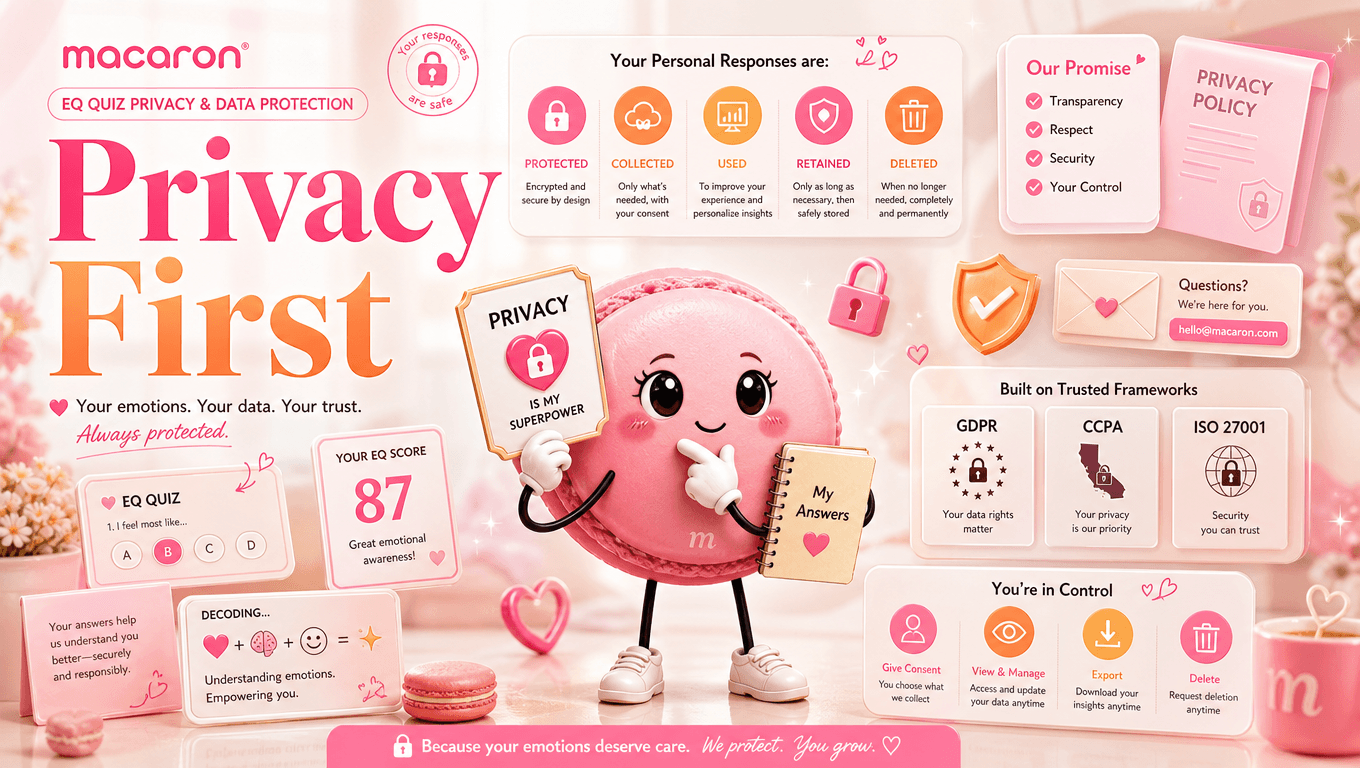
Your Responses and Privacy
Emotional reflection data is sensitive. Macaron is provided by MINDAI PTE. LTD., and its official Privacy Policy explains how information is collected, used, disclosed, protected, and retained. Review the policy for details on collection, use, retention, deletion, and privacy requests. Privacy contact: contact@macaron.im. This matters because users often share personal reactions, relationship patterns, and stress responses in an EQ quiz, so privacy clarity is part of the product experience rather than a legal footnote.
Frequently Asked Questions
This EQ quiz focuses on the parts of emotional intelligence people usually mean when they search for one: self-awareness, emotional regulation, empathy, communication, and what happens to those skills under pressure. In practice, that means it looks at how you notice feelings, how you respond when tension rises, and whether you can stay thoughtful instead of reactive. It is meant to give you a clearer picture of emotional patterns in everyday life, not to reduce you to a single score.
Start with the area that feels most familiar in your day-to-day life or most disruptive when things get stressful. That is usually the clearest signal of where the quiz is pointing. If one part of the result feels especially accurate, it may be the best place to begin because it is already affecting your relationships, work, or mood. The goal is not to fix everything at once, but to identify the most useful first step.
If the questions or your result bring up discomfort, it is okay to pause. An EQ quiz can surface real patterns, and sometimes that feels more personal than expected. Take a break, ground yourself, and come back only if it feels manageable. If the experience feels overwhelming, unsafe, or connected to thoughts of self-harm, stop using the quiz and reach out to a licensed professional or crisis support right away.
An EQ quiz usually gives you a quicker snapshot of emotional patterns, while a longer EQ assessment tends to explore those patterns in more detail. Short quizzes are often better for self-checking, awareness, and getting a starting point. Longer assessments may include more items, more nuanced scoring, or a broader breakdown of strengths and weaknesses. If you want a fast read on how emotional intelligence shows up in daily life, a quiz is often the simpler entry point.
An EQ quiz can be useful for reflection, but it is not a clinical measurement of emotional intelligence. Its accuracy depends on how honestly you answer, how well the questions match your real situations, and whether the quiz is designed around clear dimensions like self-awareness or stress response. Macaron is best used as a practical snapshot that helps you notice patterns, not as a final judgment about your personality or ability.
Yes, especially if you want to understand how you respond to feedback, conflict, or pressure. EQ quizzes are often helpful for spotting habits that affect teamwork, leadership, listening, or emotional recovery after tense conversations. They can also highlight whether you tend to withdraw, react quickly, or miss cues from other people. That said, the quiz is only a starting point; real improvement usually comes from applying the insight in specific situations. For a third-party check, Emotional Intelligence Quiz - Greater Good Science Center at https://greatergood.berkeley.edu/quizzes/ei_quiz/take_quiz is worth comparing against the page summary.
A good EQ score depends on the quiz design, because different tools use different scales and different definitions of emotional intelligence. Some quizzes emphasize self-awareness more heavily, while others focus on empathy or regulation under stress. Instead of chasing a universal number, it is usually more useful to look at the pattern across categories and ask which area is strongest and which one would benefit from practice. That gives you a clearer path forward than a single score alone. For another outside reference, Test Your Emotional Intelligence | Free EQ Quiz From IHHP at https://ihhp.com/free-eq-quiz/ adds a second perspective.
The most effective way to improve EQ is to practice small behaviors consistently. That might mean pausing before replying, naming your feelings more precisely, checking your assumptions in conflict, or listening longer before responding. Macaron is designed to support that kind of follow-through by turning reflection into a practical next step. If you want deeper change, focus on one habit at a time and use real situations as your practice ground. For outside context, Emotional Intelligence Test / Quiz - Psychology Today at https://www.psychologytoday.com/us/tests/personality/emotional-intelligence-test is a useful reference point.
Read & discover
AI Personal Assistant
Free calculators


