ESFP Compatibility
ESFP compatibility is often easiest to understand as a balance between spark and steadiness. Macaron helps you look at the patterns that keep connection warm, responsive, and emotionally reliable after the first burst of chemistry.
ESFP Compatibility
This short reflection helps you notice what makes ESFP compatibility feel easy, lively, or strained in real life. It focuses on everyday patterns like reassurance, follow-through, flexibility, and emotional pace rather than type labels alone.
This is a self-reflection tool, not a diagnosis or a scientific compatibility test.
Please answer every question before viewing your result.
This reflection is meant to support self-understanding, not to label you or predict relationship success. If relationship stress feels overwhelming, unsafe, or tied to anxiety, trauma, or depression, consider reaching out to a qualified mental health professional or trusted support person.
ESFP Love Style: Fun, Warm, and Present
ESFP compatibility is often described through energy, affection, and shared enjoyment, but the more useful question is whether the relationship can stay steady once everyday life replaces the first rush of novelty. ESFPs usually respond well to warmth, responsiveness, and direct emotional expression, so a strong match is not only about attraction. It also depends on whether both people can keep showing up in ways that feel reassuring, clear, and consistent when the relationship becomes ordinary.
Many people search ESFP compatibility to find the best match, the hardest match, or the type most likely to create an easy bond. That interest makes sense, but it can flatten what compatibility actually means. A pairing that feels exciting may still struggle with planning, conflict, or follow-through, while a quieter pairing may offer more emotional safety. The real value is understanding which dynamics make closeness easier and which ones require more effort.
ESFPs are often seen as spontaneous, affectionate, and experience-oriented, which can make relationships feel vivid and alive. That same preference for immediacy can also create friction if a partner is emotionally distant, slow to respond, or overly rigid about routines and expectations. Compatibility becomes easier when both people know how to keep the bond active through shared experiences, honest reassurance, and repair after tension without making the relationship feel cold or distant. For a related Macaron page, see AI Personal Assistant - Macaron at https://macaron.im/ai-personal-assistant.
Macaron’s ESFP compatibility guidance is built to help you notice those patterns with more precision. Instead of reducing the topic to a simple best-match list, it helps you see where attraction is reinforced by trust, where communication styles create ease or confusion, and where a relationship may need more structure to feel secure. That is especially useful when a connection feels exciting but inconsistent, or when two people care about each other but keep missing each other’s needs.
If you want a practical way to think about ESFP compatibility, fit matters more than perfection. Some relationships work because both people naturally share pace and emotional openness. Others work because differences are balanced by reliability, respect, and a willingness to adapt. This page is meant to help you compare those possibilities more clearly, so compatibility becomes something you can actually use when making relationship decisions.
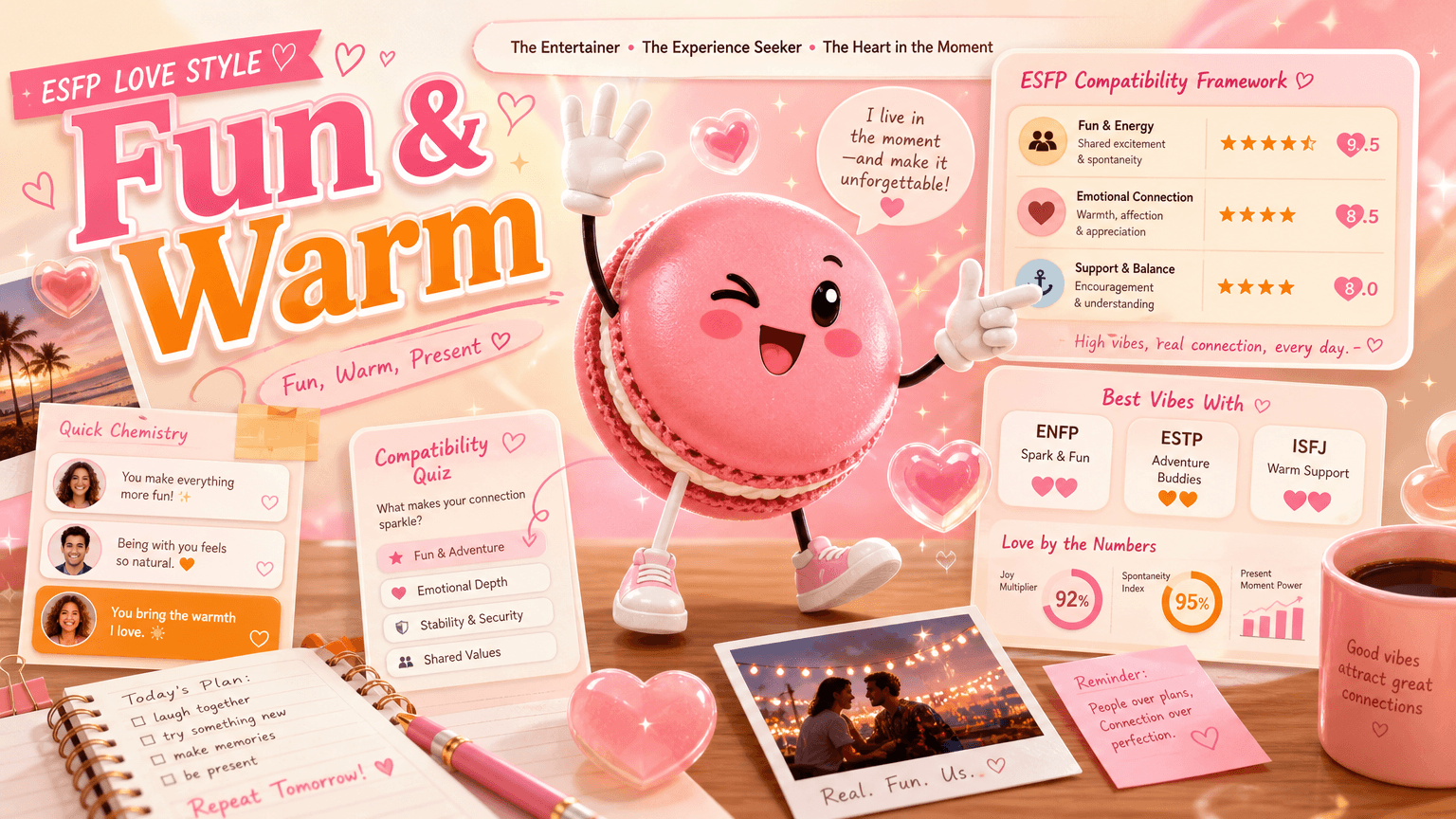
ESFP Love Style: Fun, Warm, and Present
ESFP compatibility often grows in relationships that feel active, affectionate, and emotionally immediate. Many ESFPs respond well to partners who are expressive, present, and willing to share experiences in real time rather than overanalyze every feeling. Common preferences include warmth, spontaneity, physical or verbal affection, and a sense that the relationship is being lived, not just discussed. That said, fun alone is not enough. The strongest ESFP connections usually pair excitement with follow-through, so the relationship still feels dependable when life gets less playful and more routine.
How Macaron’s ESFP Compatibility Insights Support Reflection
Macaron uses ESFP compatibility to help you look at the parts of a relationship that are easy to miss when you only focus on attraction. It can highlight how emotional energy shifts between two people, whether one partner’s reliability supports the other’s need for reassurance, and how conflict changes closeness over time. It also helps you notice whether a relationship feels secure because of genuine trust or only because the connection is currently in a high-energy phase. That makes the insight more useful for everyday decisions, not just personality curiosity.
More About ESFP Compatibility
ESFP compatibility is easiest to understand when you separate chemistry from sustainability. Many pairings can feel exciting at first, especially when there is shared spontaneity, humor, and emotional warmth. The harder question is whether the relationship still feels good when plans change, feelings get hurt, or one person needs more reassurance than the other naturally gives. That distinction matters because a lively start does not always predict a stable bond.
Searches about ESFP compatibility often ask who ESFPs are most compatible with, but the answer depends on what kind of compatibility you mean. Romantic fit, friendship ease, and long-term stability do not always point to the same pattern. A type that feels energizing may not be the same type that feels calming, and a relationship that is easy socially may still need work around conflict, commitment, or emotional follow-through.
Many ESFP compatibility discussions highlight shared sensing styles, complementary energy, or opposite traits that balance each other. Those ideas can be useful, but they can also oversimplify real relationships. In practice, what matters is whether both people can handle emotional pace, directness, and the need for present-moment connection without creating pressure, boredom, or misunderstandings. Compatibility is less about a perfect type formula and more about how two people actually behave together. Another useful Macaron comparison is AI Calorie Tracker: How It Works and Best Options - Macaron at https://macaron.im/blog/ai-calorie-tracker.
Macaron’s approach is useful because it turns ESFP compatibility into something you can reflect on, not just label. It helps you notice recurring patterns such as whether excitement fades when routine starts, whether one person needs more structure than the other can comfortably provide, and whether conflict leads to repair or withdrawal. That makes the insight more grounded in actual relationship behavior and more helpful when you are deciding what to do next. For a broader Macaron context, When Nano Banana Meets Macaron: Next‑Level AI Image Editing ... at https://macaron.im/blog/macaron-ai-essential-personal-assistant-features can help you compare the decision from another angle.
If you are comparing a current relationship, a crush, or a friendship, ESFP compatibility is most helpful when it leads to better questions. Does this connection feel alive and secure? Do both people know how to reassure each other? Can the relationship handle differences without losing warmth? Those details matter because they show whether a bond is simply fun in the moment or genuinely workable over time.
Which Relationship Dynamics Keep ESFPs Connected and Which Ones Create Distance
Some relationship dynamics naturally support ESFPs because they offer warmth, responsiveness, and visible emotional engagement. Others create distance when they feel cold, overly controlled, inconsistent, or hard to read. In practice, ESFP compatibility often depends on whether both people can keep the connection lively without making it unstable. Macaron helps you examine what makes a bond feel immediate and real, where excitement starts to become unreliable, how much reassurance is needed, and which patterns repeat when the fit is not working well. That can clarify whether the issue is chemistry, communication, or a deeper mismatch in pace.
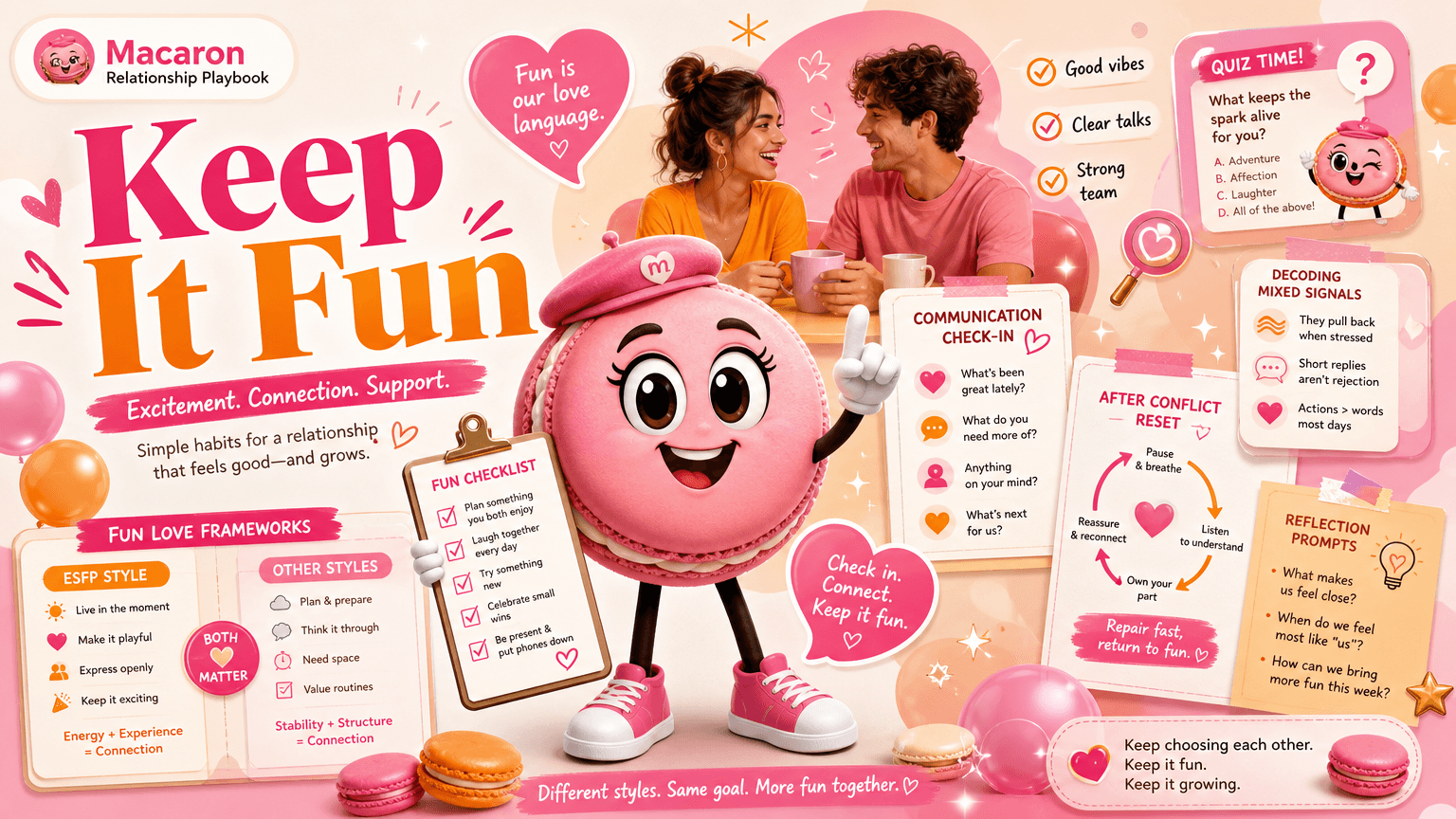
Keep Relationships Exciting and Connected
Macaron turns ESFP compatibility into practical support by helping you think through the habits that keep a relationship both fun and steady. That includes reflection prompts for noticing what energizes the bond, communication check-ins for reducing mixed signals, and emotional clarity tools for understanding what each person actually needs. It can also support conflict resets, which matter when a lively relationship gets derailed by hurt feelings or avoidance. The goal is not to force every relationship into the same shape, but to help you protect both excitement and trust while you decide what kind of connection you want to build.
Frequently Asked Questions
ESFP compatibility tends to stay strong when warmth, responsiveness, and trust are present at the same time. ESFPs often do best when the relationship feels emotionally alive, but that energy needs to be backed by consistency and follow-through. Without that steadiness, the connection can start to feel exciting but uncertain. In practice, the strongest matches usually make room for affection, direct communication, and a sense that both people are actively choosing the relationship.
Use ESFP compatibility insights to check whether the relationship still works once the novelty settles. Early chemistry can make many pairings feel promising, but long-term fit depends on how the two people handle routine, disappointment, and reassurance. Look at whether excitement is supported by reliability, whether communication stays clear when feelings are strong, and whether both people can repair tension without shutting down. That gives you a more realistic picture than the first impression alone.
That usually means the relationship has chemistry, but not enough consistency to feel emotionally safe. In ESFP compatibility terms, the bond may be strong on energy and weak on follow-through, reassurance, or predictable support. A relationship can be enjoyable and still leave one person wondering where they stand. The key question is whether the fun is being matched by trust-building behavior. If not, the issue is often stability, not attraction.
A quick summary can tell you who is often considered a good match, but it usually cannot explain why a specific relationship feels easy, tense, or confusing. Macaron helps turn ESFP compatibility into a more practical reflection on attraction, emotional pace, conflict patterns, and long-term reliability. That matters because two people with the same type pairing can still have very different experiences depending on communication style, maturity, and how they handle stress. The goal is better understanding, not a fixed label.
ESFPs are often described as pairing well with types that can match their energy while also adding steadiness, such as ISFP, ESFJ, and ESTP. Some people also find strong chemistry with more structured or reflective types when there is mutual respect and good communication. The important point is that compatibility depends on the specific relationship, not just the type label. A good match usually balances spontaneity with reliability and keeps emotional connection easy to express.
Two ESFPs can enjoy a lot of shared energy, spontaneity, and emotional openness. That can make the relationship feel lively and easy to start. The tradeoff is that both people may prefer the fun parts of connection and avoid the more structured parts, such as planning, follow-through, or difficult conversations. If both partners are mature and willing to build stability, the match can work well. If not, the relationship may feel exciting but hard to anchor. For a third-party check, ESFP Personality - Romantic Relationships - 16Personalities at https://www.16personalities.com/esfp-relationships-dating is worth comparing against the page summary.
The biggest challenges often come from emotional distance, inconsistency, or a mismatch in pace. ESFPs usually want clear signs of interest and a relationship that feels alive in the present, so partners who are detached, overly rigid, or slow to respond can create frustration. Conflict can also become difficult if one person wants immediate repair while the other needs more time. Compatibility improves when both people can be direct without becoming harsh or avoidant. For another outside reference, ESFP Compatibility Chart: Best Match (Relationships, Love) - Boo at https://boo.world/esfp-personality/esfp-compatibility-chart adds a second perspective.
Not always. A relationship can feel easy as a friendship but require more effort in romance, or feel exciting romantically but be harder to manage day to day. ESFP compatibility changes depending on the context because the needs are different: friendship may rely more on shared fun, while romance often needs more reassurance and consistency. Macaron is useful because it helps you look at those layers separately instead of assuming one label explains everything. For outside context, ESFP Relationships & Compatibility With Other Personality Types at https://www.truity.com/blog/personality-type/esfp/relationships is a useful reference point.
Read & discover
AI Personal Assistant
Free calculators


