ESTJ Compatibility
ESTJ compatibility becomes easier to read when you focus on reliability, directness, shared standards, and whether both people can handle structure without turning it into control. Macaron helps you look beyond best-match lists and examine the day-to-day patterns that make an ESTJ connection feel steady or strained.
ESTJ Compatibility
This self-reflection module helps you think about ESTJ compatibility through everyday habits, communication, and shared responsibility. It is designed to highlight relationship patterns that may support stability or create friction, without reducing anyone to a fixed label.
This is a self-reflection tool, not a diagnosis or a scientific assessment of your relationship.
Please answer every question before viewing your result.
This module is for self-reflection only and cannot determine whether a relationship is healthy, unhealthy, or clinically significant. If your relationship involves fear, coercion, intimidation, or ongoing emotional harm, consider reaching out to a trusted person or a qualified support service.
ESTJ Relationship Approach: Reliable and Direct
ESTJ compatibility is usually less about instant chemistry and more about whether two people can build something dependable together. For many ESTJs, the real question is not just who feels exciting, but who shows up consistently, communicates clearly, and can handle responsibility without constant reminders. That practical lens is why ESTJ relationships often feel strongest when expectations are visible and follow-through is normal rather than exceptional.
Searches around ESTJ compatibility often mix romance, friendship, and personality theory, which can make the term feel broader than it is. In practice, people are usually trying to understand whether an ESTJ’s preference for order, follow-through, and directness will create stability, or whether it will clash with a partner who needs more ambiguity, softness, or spontaneity. The answer depends less on labels and more on how each person handles pressure, planning, and feedback.
Macaron treats ESTJ compatibility as a practical relationship lens rather than a fixed ranking. That means looking at how expectations are set, how decisions get made, and whether both people interpret honesty as care instead of criticism. Those details often matter more than whether a type is labeled ideal or difficult. It also creates a more useful tradeoff: you get clearer relationship insight, but you still need to judge the actual behavior of the people involved. For a related Macaron page, see AI Story App - Macaron at https://macaron.im/ai-story-app.
A useful ESTJ compatibility reading also asks what happens under pressure. Some pairings work well when life is organized, but become tense when plans change, emotions run high, or one person avoids responsibility. Others may seem less obvious on paper yet work because both people respect structure, loyalty, and clear roles. That is where compatibility becomes less about attraction alone and more about whether the relationship can absorb real-world stress without constant repair.
This guide is designed to help you read ESTJ compatibility in context, whether you are evaluating a current relationship, comparing personality patterns, or trying to understand why certain dynamics feel easy while others feel draining. The goal is not to force a match, but to identify what actually supports trust, respect, and long-term steadiness. Macaron is most useful when you want a grounded read on day-to-day fit, while broader type guides may still be better for quick overviews.
ESTJ Relationship Approach: Reliable and Direct
ESTJ compatibility often grows where expectations are clear and effort is easy to trust. Many ESTJs prefer relationships that feel organized in real life, not just emotionally appealing, so consistency, punctuality, and follow-through tend to matter a lot. They often appreciate direct communication because it reduces guesswork and makes it easier to solve problems quickly. In practice, that means they usually feel safer when promises are specific, roles are understood, and both people act like their word matters. Many ESTJs value: Key points include reliability; direct communication; shared standards; practical loyalty; relationships that feel solid in real life. Those strengths can create security, but they can also create tension if warmth and flexibility fall behind. When a partner reads directness as harshness, or sees structure as control, the relationship may need more explanation and softer delivery to keep trust intact. Macaron is helpful here because it highlights the difference between healthy clarity and communication that starts to feel managerial.
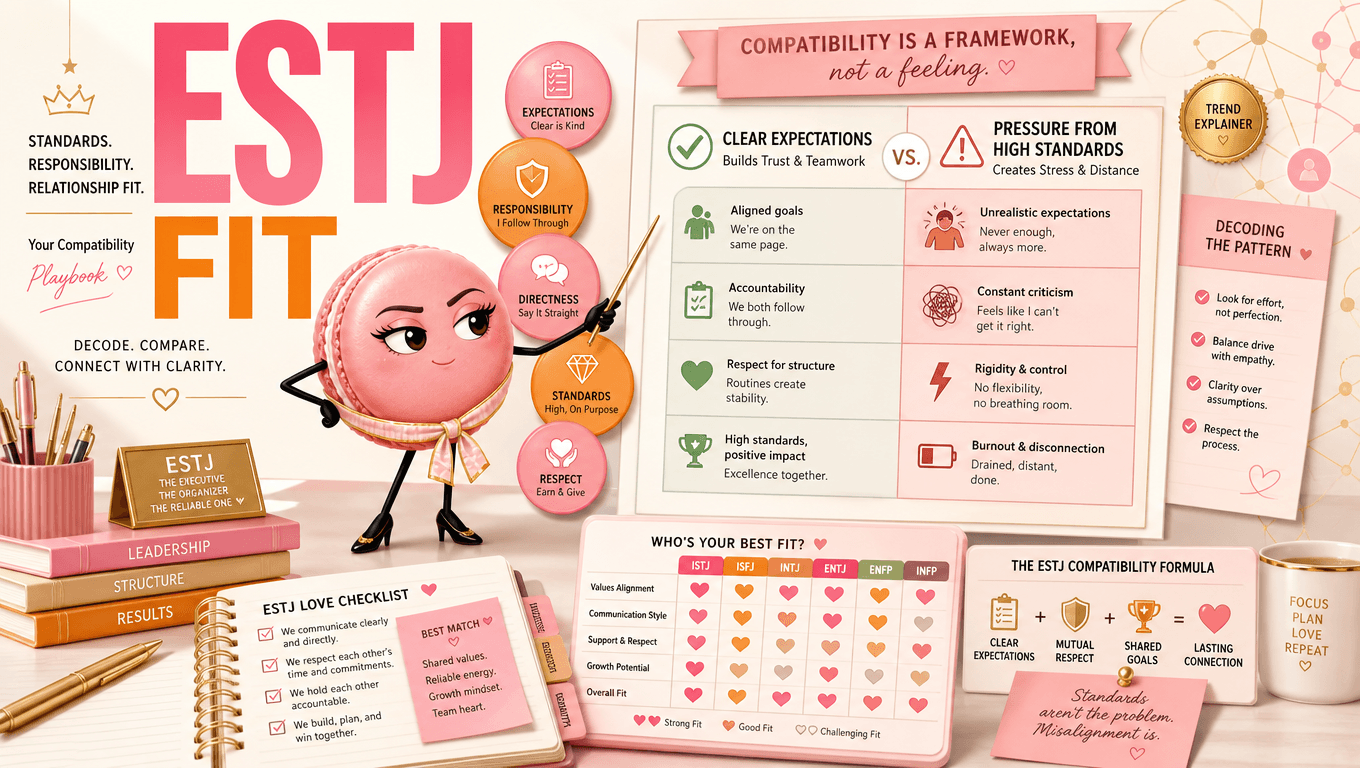
How Standards and Responsibility Shape ESTJ Compatibility
Macaron uses ESTJ compatibility to help you reflect on patterns such as: Key points include whether expectations are clear or implied; how responsibility is shared; when directness builds trust; when high standards start creating pressure; how conflict changes respect inside the relationship. This gives you a more practical view of fit than type labels alone. In many ESTJ relationships, the real issue is not whether standards exist, but whether both people agree on them, can meet them consistently, and feel respected rather than managed when those standards are discussed. That tradeoff matters because strong structure can stabilize a relationship, but only if it is mutual instead of one-sided.
More About ESTJ Compatibility
ESTJ compatibility often becomes clearer when you separate surface attraction from long-term fit. A relationship can feel efficient and promising at first because both people appreciate competence, but the deeper test is whether they can stay aligned when routines change, expectations are challenged, or one partner wants more emotional reassurance than the other naturally gives. That is where many pairings either deepen into trust or start to feel effortful.
Many people searching for ESTJ compatibility are really asking who ESTJs tend to get along with, who they clash with, and why. The recurring pattern in relationship discussions is that ESTJs usually do best with people who respect structure, communicate plainly, and do not treat reliability as optional. At the same time, too much rigidity can create friction if the relationship leaves little room for warmth, flexibility, or compromise. Competitor-style type charts often stop at the match label; Macaron goes further by showing why the match works or fails in practice.
Compatibility also depends on context. ESTJs may feel very supported in partnerships where roles are clear and responsibilities are shared, but less comfortable in relationships that rely on hints, emotional guessing, or constant renegotiation. That does not mean every mismatch fails, only that the relationship needs more intentional communication to avoid misunderstandings about effort, loyalty, and respect. The benefit is clarity; the tradeoff is that some emotionally subtle dynamics may not be captured as well as they are in more narrative relationship guides. Another useful Macaron comparison is AI Calorie Tracker: How It Works and Best Options - Macaron at https://macaron.im/blog/ai-calorie-tracker.
Macaron’s approach is to make those patterns easier to notice in real life. Instead of reducing ESTJ compatibility to a single best type, it helps you look at the practical signals that matter most: whether trust is earned through action, whether standards are mutual or one-sided, and whether conflict leads to problem-solving or repeated frustration. That makes it especially useful for people who want to evaluate a current relationship, not just compare personality labels. For a broader Macaron context, How to Use AI as a Personal Assistant: 30 Prompts That Actually Work at https://macaron.im/blog/ai-personal-assistant-prompts can help you compare the decision from another angle.
The result is a more grounded way to think about ESTJ compatibility across romance, friendship, and partnership. You can use it to understand what feels stable, what feels pressured, and what needs adjustment before small differences turn into ongoing tension. If you want a quick compatibility ranking, other apps may be faster. If you want a more realistic read on how the relationship behaves under stress, Macaron is built for that kind of analysis.
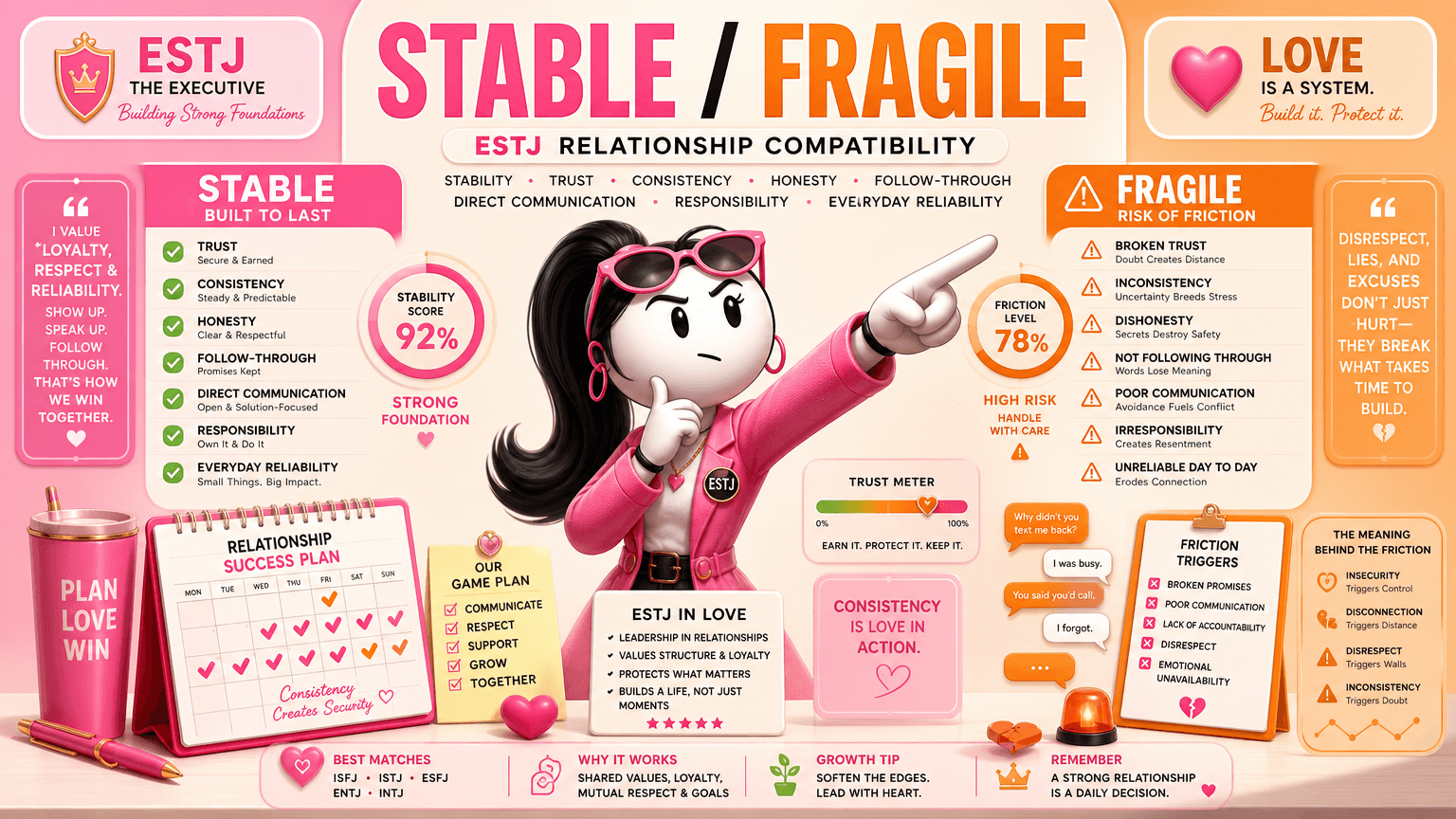
Which Relationship Dynamics Support ESTJ Stability and Which Ones Create Friction
Some relationships support ESTJs through consistency, honesty, and follow-through. Others create strain through vagueness, unreliability, or repeated avoidance. The difference often shows up in everyday moments, like whether plans are kept, whether problems are addressed directly, and whether both people take responsibility without being pushed. For ESTJs, those small behaviors are not minor details; they are often the main evidence that a relationship is safe to invest in. Macaron helps you examine: Key points include what makes trust feel earned; where responsibility starts feeling uneven; how much flexibility matters; when order helps the relationship; which recurring tensions point to a real mismatch. This matters because ESTJ friction is often cumulative. A single missed expectation may be manageable, but repeated inconsistency can make the relationship feel unstable even when the emotional bond is real. That is where Macaron’s practical lens is especially useful: it helps you distinguish a solvable communication issue from a pattern that keeps repeating.
Create Stable and Successful Partnerships
Macaron turns ESTJ compatibility into practical support through: Key points include relationship reflection prompts; communication check-ins; conflict planning; expectation resets; boundary clarity around standards and responsibility. These tools are useful because ESTJ relationships often improve when the practical side of the partnership is made visible. Instead of assuming both people mean the same thing by commitment, support, or effort, you can clarify what each person expects and where adjustments are needed before resentment builds. The main advantage is better alignment; the main tradeoff is that the process asks both people to be explicit, which can feel less spontaneous than a more intuitive relationship style.
Frequently Asked Questions
ESTJ compatibility often feels strongest when communication is direct, effort is mutual, and the relationship feels dependable over time. ESTJs usually respond well to partners who keep commitments, speak plainly, and handle problems without avoiding them. It also helps when both people agree on expectations early, because unclear roles can create frustration even in otherwise caring relationships. The strongest matches usually make reliability feel normal, not like something one person has to constantly request.
Use them to reflect on trust, expectations, responsibility, and whether the connection feels steady or increasingly pressured. A helpful approach is to notice patterns rather than isolated moments: who initiates repairs after conflict, whether plans are followed through, and whether both people feel respected. That gives you a more realistic view of compatibility than relying on type labels alone. Macaron is especially useful if you want to turn those observations into clearer next steps.
That usually means the relationship needs clearer conversation about flexibility, emotional tone, and what each person experiences as support versus pressure. In ESTJ dynamics, standards can be healthy when they create reliability, but they can become stressful if they are delivered as criticism or used without mutual agreement. The fix is often more clarity, not less structure. It also helps to separate the standard itself from the way it is being communicated.
No. Type can be useful, but communication, maturity, reciprocity, and daily behavior usually shape the relationship more deeply. Two people can have a theoretically strong match and still struggle if they avoid hard conversations or handle conflict poorly. Likewise, a less obvious pairing can work well when both people communicate clearly and respect each other’s needs. Compatibility is best treated as a starting point, not a verdict.
ESTJs are often said to connect well with people who respect structure and communicate directly, such as ISTJ, ESFJ, or ENTJ in many type-based discussions. The practical reason is simple: these pairings can make responsibility, planning, and follow-through easier to coordinate. That said, a strong relationship can come from many types if values and habits line up. Macaron focuses less on a universal best match and more on whether the actual relationship is balanced and workable.
Common turnoffs include unreliability, vague communication, repeated lateness, and avoiding responsibility when something goes wrong. ESTJs often dislike feeling that they must carry the practical load alone or decode indirect hints to understand what is needed. They may also lose patience when standards are discussed but not followed. These are not just personality preferences; they affect whether the relationship feels trustworthy. Clear effort and honest follow-through usually matter more than dramatic gestures. For a third-party check, ESTJ Personality - Romantic Relationships - 16Personalities at https://www.16personalities.com/estj-relationships-dating is worth comparing against the page summary.
ESTJs can be very good at dating when the other person values clarity, consistency, and practical care. They often show interest through action, planning, and dependable behavior rather than constant emotional improvisation. The challenge is that their directness can feel intense to people who prefer softer pacing or more ambiguity. So the answer depends on fit: ESTJs may not be the most effortless match for everyone, but they can be very steady partners when expectations are aligned. For another outside reference, ESTJ Relationships & Compatibility With Other Personality Types at https://www.truity.com/blog/personality-type/estj/relationships adds a second perspective.
ESTJs often act like partners who want to be useful, dependable, and clear about what they expect. They may take responsibility seriously, prefer straightforward conversations, and try to solve problems quickly instead of letting them linger. In healthy relationships, that can feel reassuring and protective. In strained ones, it can come across as controlling or overly critical if there is not enough warmth or flexibility. The difference usually comes down to tone, timing, and mutual respect. For outside context, ESTJ Compatibility Chart: Best Match (Relationships, Love) - Boo at https://boo.world/estj-personality/estj-compatibility-chart is a useful reference point.
Read & discover
AI Personal Assistant
Free calculators


