ESTP Compatibility
ESTP compatibility is easiest to understand through pace, directness, independence, and whether the relationship can stay exciting without becoming erratic. This guide focuses on the patterns that shape real-world fit, not just type-match labels.
ESTP Compatibility
This short module helps you reflect on how ESTP-style energy may show up in dating, friendship, and long-term connection. It focuses on pace, freedom, communication, and follow-through so you can notice what helps a relationship feel alive and what starts to wear it down.
This is a self-reflection tool, not a diagnosis or a scientific compatibility test.
Please answer every question before viewing your result.
This module is for reflection and conversation, not for diagnosing personality or predicting relationship outcomes. If a relationship feels unsafe, controlling, or emotionally overwhelming, consider reaching out to a trusted person or a qualified professional for support.
ESTP in Love: Bold, Playful, and Present
ESTP compatibility is often less about finding a perfect type match and more about whether two people can keep pace with each other. ESTPs usually respond well to relationships that feel direct, active, and easy to read, but the same traits that make connection exciting can also create friction when expectations become vague or emotionally heavy. The practical question is not whether the match looks impressive on paper, but whether both people can stay engaged without feeling slowed down, managed, or misunderstood.
A useful way to think about ESTP compatibility is to separate early chemistry from long-term stability. Many pairings feel strong at the start because the energy is immediate, playful, and responsive, yet the real test comes later when routines, reassurance, and follow-through matter more than novelty. That is where a relationship either becomes more dependable or starts to feel like constant improvisation. Macaron helps you notice that shift before you mistake momentum for durability.
This page is designed for people who want a grounded read on ESTP relationships in love or friendship. Instead of treating compatibility as a fixed ranking, it looks at recurring patterns such as freedom, attraction, conflict style, emotional pace, and whether both people can stay engaged without feeling controlled. That makes it more useful if you are deciding whether to invest, slow down, or simply understand why a connection feels easy in some moments and difficult in others. For a related Macaron page, see Macaron App Download (iOS & Android): Official, Safe, and Fast Install at https://macaron.im/blog/macaron-app-download.
Searches about ESTP compatibility often reflect a few different questions at once, such as who ESTPs click with, who they struggle with, and why some relationships feel thrilling but unstable. Those are useful questions, but the answer usually depends on how each person handles honesty, independence, and pressure when the relationship becomes real. A type label can point you in the right direction, but it cannot tell you whether the relationship can handle conflict, boredom, or changing expectations.
Macaron helps turn that ambiguity into something more practical. By focusing on relationship dynamics rather than hype, it gives you a clearer way to notice where a connection is naturally easy, where it needs more care, and where the excitement may be masking a mismatch in pace or expectations. That is the main tradeoff: you get less certainty from a simple compatibility score, but more useful guidance for real decisions about love, friendship, and long-term fit.
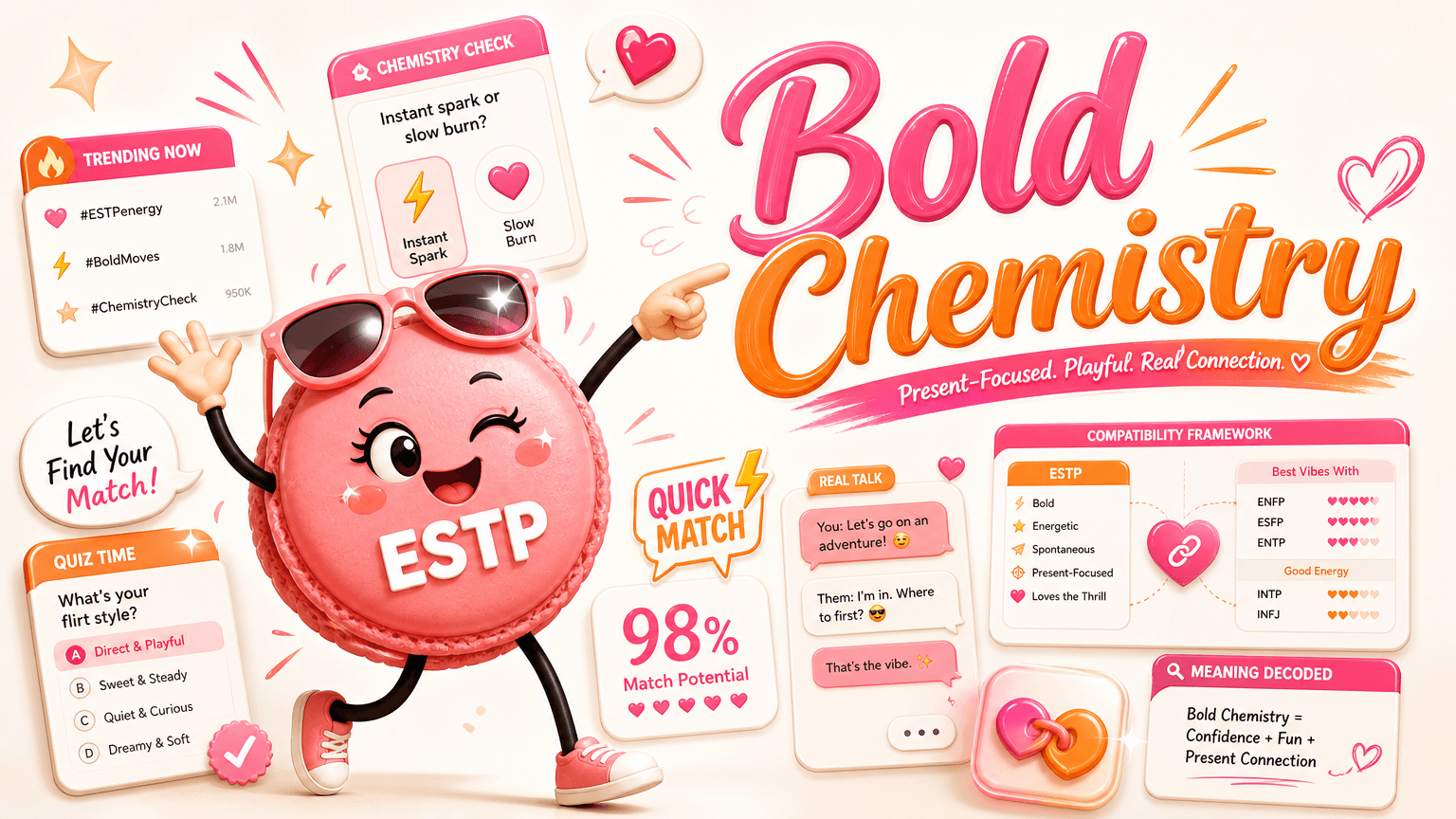
ESTP in Love: Bold, Playful, and Present
ESTP compatibility often shows up as quick chemistry, direct flirting, and a preference for relationships that feel active rather than overly analyzed. Many ESTPs are drawn to partners who can keep the conversation moving, respond honestly, and enjoy shared experiences without turning every moment into a serious emotional review. That said, being present and playful can sometimes make it harder to slow down for repair work, so the best relationships usually balance fun with enough consistency to build trust over time. Macaron is useful here because it helps you separate genuine ease from a connection that only works when everything is light and immediate.
How Emotional Pace and Freedom Affect ESTP Compatibility
Macaron uses ESTP compatibility to examine how quickly a relationship moves from attraction to expectation. For ESTPs, emotional pace matters because too much pressure too soon can make a connection feel restrictive, while too little clarity can make it feel unstable or unclear. This section helps you notice whether independence is being respected, whether direct communication is building trust, and whether the relationship is moving at a speed that supports both excitement and comfort instead of forcing one person to adapt constantly. The tradeoff is that slower, more reflective partners may feel safer to some people but less natural to an ESTP unless both sides agree on how to communicate needs.
More About ESTP Compatibility
ESTP compatibility is often strongest when the relationship feels alive in the present tense. ESTPs tend to notice momentum quickly, so a connection that is responsive, playful, and straightforward can feel especially natural. The challenge is that fast chemistry can also hide differences in emotional needs, planning style, or tolerance for uncertainty, which is why the early spark is only part of the picture. Macaron focuses on those hidden differences so you can tell whether the connection is genuinely easy or simply exciting in the short term.
A lot of ESTP compatibility discussions points to a recurring theme: ESTPs usually prefer partners who are direct, grounded, and able to hold their own. That does not mean every good match looks the same, but it does suggest that passive communication, mixed signals, or overly restrictive dynamics can drain the energy that ESTPs bring into relationships. In practice, the best fit is often someone who can be clear without being rigid, and confident without trying to control the pace of the relationship.
Compatibility also depends on how much freedom each person needs. ESTPs often do best when independence is respected and closeness does not feel like surveillance or pressure. At the same time, too much looseness can create instability, especially if one person wants more reassurance, consistency, or emotional processing than the other naturally offers. Macaron is helpful because it surfaces that tension early, before one partner starts interpreting freedom as distance or interpreting reassurance as restriction. Another useful Macaron comparison is AI Calorie Tracker: How It Works and Best Options - Macaron at https://macaron.im/blog/ai-calorie-tracker.
Another pattern that shows up in ESTP relationship discussions is the difference between excitement and sustainability. Some pairings stay fun because both people are flexible and active, while others become exhausting when conflict repeats, boredom grows, or one partner feels they are always chasing clarity. Macaron helps you look at those tradeoffs more honestly. That is especially valuable because a relationship can be lively and still be draining if the same unresolved issues keep resurfacing without repair. For a broader Macaron context, Best Free AI Calorie Trackers You Can Start Today - Macaron at https://macaron.im/blog/free-ai-calorie-tracker can help you compare the decision from another angle.
The goal is not to label a relationship as good or bad based on type alone. It is to understand how the connection actually behaves under pressure, during routine, and after the novelty wears off. That makes ESTP compatibility more useful as a decision-making tool, especially when you are trying to tell the difference between strong attraction and durable fit. Competitor-style type charts can be faster to scan, but Macaron is better when you want a more realistic read on what the relationship will feel like over time.
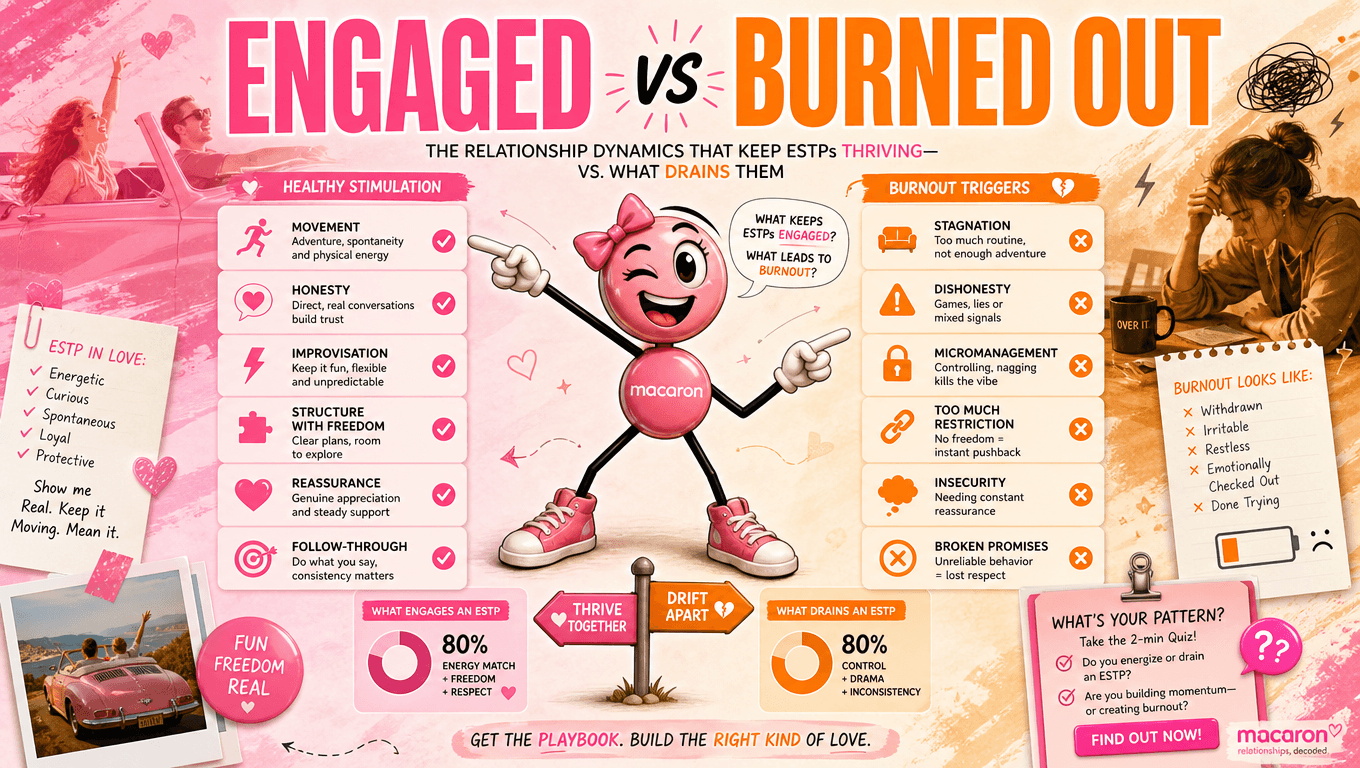
Which Relationship Dynamics Keep ESTPs Engaged and Which Ones Create Burnout
Some dynamics keep ESTPs engaged because they offer movement, honesty, and room to improvise. Others create burnout when the relationship becomes repetitive, controlling, emotionally dense, or full of unresolved uncertainty. Macaron helps you look at the difference between healthy stimulation and constant tension, including whether boredom is really the issue or whether the relationship lacks structure, reassurance, or mutual follow-through. That distinction matters because an ESTP may leave a relationship that feels stagnant, but also one that feels exciting yet emotionally exhausting. The practical value is in spotting whether the problem is pace, communication, or a deeper mismatch in expectations.
Keep the Adventure Alive Without Losing Trust
Macaron turns ESTP compatibility into practical reflection tools that help you keep the relationship lively without letting it become chaotic. The prompts and check-ins are useful for noticing whether both people still feel respected, whether conflict is being repaired quickly enough, and whether independence is being balanced with reliability. This is especially helpful in relationships where chemistry is strong but day-to-day habits are less aligned, because the real question becomes how to preserve momentum without sacrificing trust. Compared with broad compatibility lists, Macaron is better for ongoing self-checks, though a traditional counselor or a deeply reflective partner may still be better for slower emotional processing.
Frequently Asked Questions
The biggest factors are usually pace, honesty, responsiveness, and whether both people can handle closeness without feeling boxed in. ESTPs often do well with partners who communicate clearly, stay flexible, and can enjoy momentum without turning every interaction into pressure. Long-term fit also depends on whether the relationship can handle routine, conflict, and follow-through once the novelty wears off. If those basics are missing, chemistry alone usually is not enough.
Use them to check what happens once the relationship becomes more ordinary. Early chemistry can be real, but it does not always tell you how the pair handles planning, disappointment, reassurance, or repair after conflict. If the connection still feels easy, respectful, and energizing after the initial rush, that is usually a better sign of compatibility than excitement alone. Macaron is especially useful here because it helps you compare the first impression with the relationship’s actual behavior over time.
That often means the relationship has strong chemistry but weak sustainability. The attraction may be real, yet the pace, communication habits, or emotional expectations may be creating more strain than support. In ESTP compatibility terms, that is a sign to look at whether the connection needs clearer boundaries, more consistency, or a more realistic view of what each person can offer. Sometimes the issue is not lack of interest, but a mismatch in how much structure each person needs.
No. Type can explain why two people approach connection differently, but conflict habits usually matter more once the relationship is under stress. How quickly each person repairs, whether they stay direct without becoming harsh, and whether they can compromise without resentment are often stronger predictors of long-term success than the type label itself. A good compatibility read should help you understand those habits, not replace them with a ranking.
Many compatibility guides point to partners who are direct, grounded, and comfortable with action-oriented connection, such as people who can match the ESTP’s pace without becoming controlling. That said, different systems rank types differently, and real relationships depend more on maturity, communication, and shared expectations than on a single best-match list. Macaron avoids treating any one pairing as guaranteed, because a strong fit can come from very different types when the dynamics are healthy.
Yes. In friendship, ESTPs often do well with people who are easy to coordinate with, open to spontaneous plans, and honest when something is off. The same tradeoffs still apply: too much passivity can feel dull, while too much pressure can feel intrusive. Friendship compatibility is often easier than romance because there is less expectation around emotional merging, but it still benefits from clear communication and mutual respect for independence. For a third-party check, ESTP Relationships & Compatibility With Other Personality Types at https://www.truity.com/blog/personality-type/estp/relationships is worth comparing against the page summary.
Common friction points include mixed signals, slow decision-making, repeated emotional processing without action, and partners who expect constant reassurance without giving much freedom in return. ESTPs may also struggle when a relationship becomes too routine or when conflict turns into long, unresolved tension. None of these issues automatically mean a match is bad, but they do show where a relationship may need clearer agreements, better repair habits, or more realistic pacing. For another outside reference, What Types Are Socially Compatible With ESTPs? | C.S. Joseph at https://csjoseph.life/what-types-are-socially-compatible-with-estps/ adds a second perspective.
It depends on what you need. A simple chart is faster if you want a broad overview, but Macaron is better when you want to understand how a relationship actually behaves in daily life. It focuses on pace, trust, conflict, and independence rather than just type labels. The tradeoff is that it asks for more reflection, but that usually produces a more useful answer when you are deciding whether to invest in a connection. For outside context, ESTP Compatibility Chart: Best Match (Relationships, Love) | Boo at https://boo.world/estp-personality/estp-compatibility-chart is a useful reference point.
Read & discover
AI Personal Assistant
Free calculators


