How Does Noom Work
Noom combines calorie tracking with psychology-based lessons and coaching to change eating habits. It is built for users who want structure, reflection, and accountability, but that same structure can feel demanding compared with simpler nutrition tools like Macaron, which focuses on quick, on-demand help instead of a daily curriculum.
Noom's Food Color System Explained
Noom is designed as a behavior-change program, not just a food diary. It combines meal logging, daily lessons, and goal setting to help users notice patterns around hunger, stress, routine, and portion size. The app’s core idea is that sustainable weight loss depends on changing habits and decision-making, not only on choosing a different menu for a few weeks.
When you sign up, Noom asks for details such as age, sex, height, weight, activity level, and weight-loss goals. It uses those inputs to estimate a calorie target and shape the first part of the program. That setup makes the app feel personalized at the start, but the real experience depends on how consistently you log meals, read lessons, and respond to prompts.
The best-known part of Noom is its color system. Foods are grouped as green, yellow, or orange based on calorie density, which means how many calories a food contains relative to its weight or volume. The goal is to steer users toward foods that fill them up for fewer calories, while still allowing higher-calorie foods in reasonable portions. For a related Macaron page, see How Macaron AI Tackles the Problem with Traditional Task Lists at https://macaron.im/blog/macaron-ai-daily-planning-guide.
Noom’s coaching model is meant to add accountability, but the quality of that support can vary. Some users get useful nudges and feel more committed because someone is checking in, while others describe the coaching as light-touch or heavily scripted. That variation matters because the app’s value depends partly on whether you want a guided program or just a tracking tool.
The tradeoff is clear: Noom can be helpful for people who want structure, education, and a reason to pause before eating on autopilot, but it asks for daily attention. If you prefer a lower-friction approach, Macaron is more useful as an on-demand assistant for meal ideas, calorie estimates, and quick planning without a lesson sequence or a heavy logging routine.
Noom's Food Color System Explained
Noom’s traffic-light system is based on calorie density, not a simple good-versus-bad judgment. Green foods tend to be high in water and fiber, such as vegetables, fruit, and some whole grains. Yellow foods include items like lean proteins and dairy, while orange foods cover more calorie-dense choices such as oils, nuts, cheese, and desserts. The system is meant to help users build meals that are filling and easier to stay within budget, but it can feel counterintuitive when nutrient-rich foods like salmon or avocado land in orange. It works best as a portioning framework, not a nutrition scorecard.
Noom's Coaching and Psychology Model
Noom leans on cognitive behavioral therapy ideas to help users notice triggers, habits, and emotional eating patterns. The app delivers short lessons, quizzes, and reflection prompts that try to connect daily choices with bigger behavior loops. Coaching is intended to reinforce those lessons, but the experience varies by plan and by coach workload. Some users appreciate the accountability and the sense that they are working through a program, while others feel the guidance is too generic. The main advantage is structure; the main tradeoff is that the program can feel repetitive if you already understand the basics of calorie balance and habit change.
What Real Users Say About Noom
User feedback on Noom usually falls into two camps. One group likes the clear framework, the daily reminders, and the way the app makes them think before eating. Another group finds the lessons repetitive, the logging tedious, and the coaching less personal than expected. Many people say Noom is most useful during a focused reset period, when they want to build awareness and routines, rather than as a forever app. That makes it appealing for users who need external structure, but less attractive for people who want a lighter tool they can open only when they need help.
More About How Does Noom Work
Noom’s food system is built around calorie density, which is useful for people who want to feel full while eating fewer calories. That makes the app more practical than a strict banned-food diet, because it allows flexibility and still pushes users toward lower-calorie, higher-volume meals. The downside is that the color labels can oversimplify nutrition and confuse users who expect a more traditional healthy-versus-unhealthy breakdown.
The behavioral side of Noom is what separates it from a basic tracker. Daily lessons are meant to teach users how habits form, why cravings happen, and how to interrupt automatic eating patterns. This can be valuable for people who benefit from reflection and repetition, but it also means the app asks for consistent attention. If you want a tool that stays out of the way, Noom may feel like more program than app.
Coaching is one of Noom’s selling points, but it is not always the same experience from one account to another. Some users get timely encouragement and useful accountability, while others mostly receive templated messages or limited back-and-forth. That makes Noom stronger for people who want a guided environment, but weaker for users expecting hands-on, individualized support from a coach who knows their day-to-day context. Another useful Macaron comparison is Meal Planner Based on Calories: Tools That Actually Work - Macaron at https://macaron.im/blog/meal-planner-based-on-calories.
Noom’s flexibility is both a strength and a weakness. Because no foods are fully off-limits, users can learn to fit treats into a calorie budget instead of treating them as failures. That can reduce the all-or-nothing thinking common in dieting. At the same time, people who want simple rules, meal templates, or a more intuitive plan may find the system harder to follow than a straightforward meal tracker or recipe-based app. For a broader Macaron context, What Should I Eat Today? AI Tools That Help You Decide - Macaron at https://macaron.im/blog/what-should-i-eat-today can help you compare the decision from another angle.
Noom has also expanded beyond classic behavior change by adding medication support for qualifying users. That makes the platform broader than it used to be, but it also changes what users should expect from it. For some, the combination of coaching, tracking, and medication support is useful. For others, especially those who only want food guidance, a lighter tool like Macaron may be easier to use because it avoids the ongoing program structure.
A Smarter AI-Powered Alternative
Macaron takes a different approach from Noom by focusing on fast, practical help instead of a daily behavior curriculum. Rather than asking users to complete lessons, quizzes, and repeated food logs, it can generate nutrition tools from a simple prompt. That includes meal planning help, calorie estimates from photos, and quick guidance when you are deciding what to eat. This is especially useful for people who want support in the moment, not another app that requires a long setup or a fixed routine. The tradeoff is that Macaron is less of a coaching program, so users who want a structured behavior-change system may still prefer Noom.
Simple Comparison
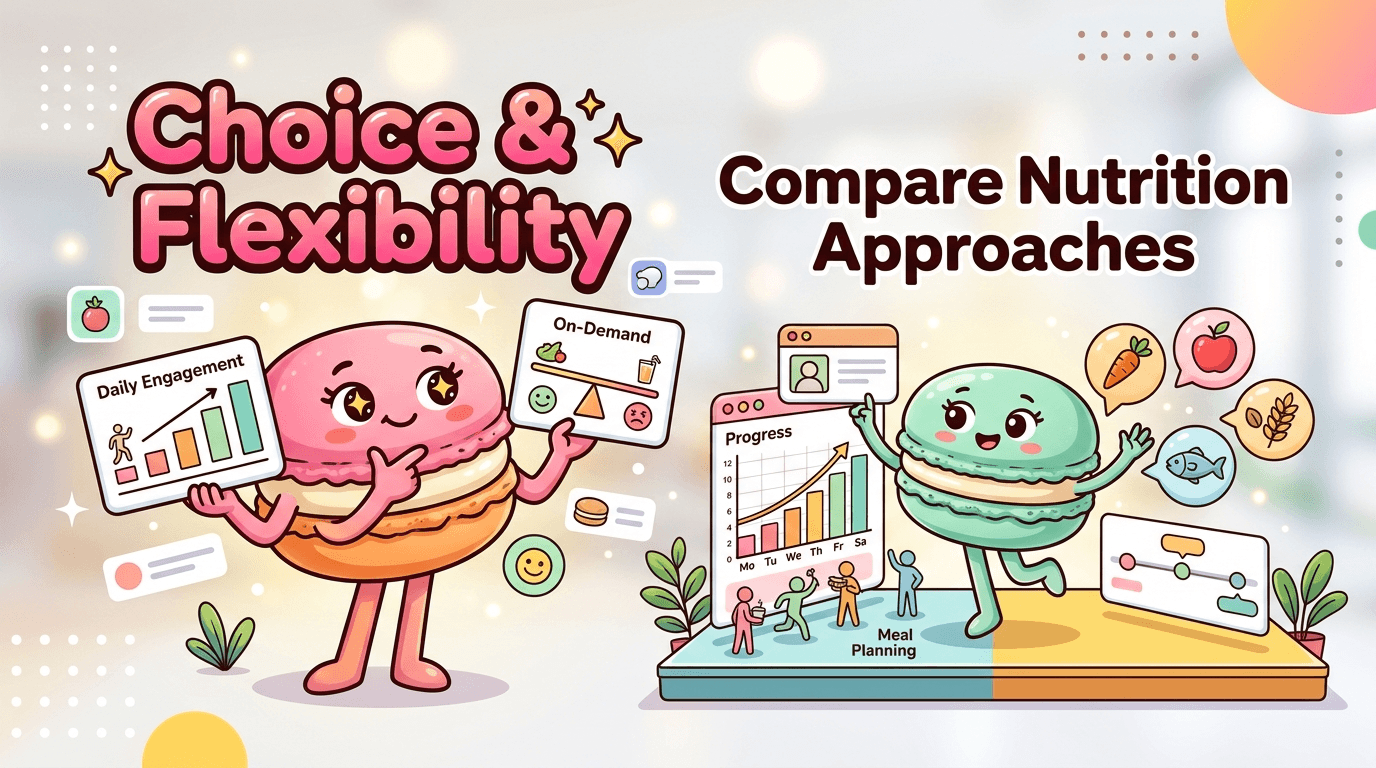
Noom is strongest when you want a guided process that changes how you think about food over time. Macaron is stronger when you want a lighter assistant that helps you make decisions quickly without daily homework. Noom asks for regular engagement, which can be helpful for accountability but tiring if your schedule is already full. Macaron reduces that burden by staying available only when you need it. That makes Noom better for users who need structure and Macaron better for users who want convenience, although Noom still offers more built-in behavior coaching and Macaron is not a full replacement for a formal weight-loss program.
Frequently Asked Questions
Yes, but calorie counting is only part of the system. Noom gives you a daily calorie budget and asks you to log meals, but it frames that process around behavior change rather than strict dieting. The app is trying to teach you how to make repeatable choices, spot triggers, and stay within a target without feeling like every meal is a test.
No, and it is not meant to be. The color system is a practical shortcut based on calorie density, which can help people eat more filling foods and manage portions. But it can also oversimplify nutrition, especially when nutrient-rich foods land in orange. It is best treated as a coaching tool, not a complete nutritional ranking.
Yes, but the experience depends on the plan and the coach. Some users get helpful accountability and timely responses, while others mostly see automated or lightly personalized messages. That inconsistency is one reason people either love the structure or feel disappointed by the support. If you want highly individualized coaching, a dedicated human coach may be better.
Macaron is easier for many people because it does not require daily lessons or a fixed logging routine. You can ask for help when you need it, such as meal ideas or calorie estimates, instead of following a full behavior-change program. That makes it a better fit for users who want convenience, though Noom still offers more built-in structure.
Many people use Noom as a short-to-medium-term reset rather than a permanent app. The program is designed to build awareness and habits over time, so it can be most useful when you are actively trying to change routines. Some users keep using it longer, but others move on once they feel they understand the basics and want less daily friction.
Yes. Noom does not ban foods outright, which is one of its main differences from stricter diets. Instead, it encourages you to balance higher-calorie foods with lower-calorie, higher-volume choices. That flexibility helps many users avoid the all-or-nothing mindset, but it also means you still need to pay attention to portions and total intake. For a third-party check, Noom: Lose weight and keep it off. at https://www.noom.com/?srsltid=AfmBOooe5RK9e1LtuGYnADt29oib5gv6MAzmPD7fCXQFPtdJAJJMQnFx is worth comparing against the page summary.
Noom is best for people who want structure, reminders, and a program that explains the why behind eating habits. It can be especially helpful if you struggle with emotional eating, mindless snacking, or consistency. It is less ideal for users who already know the basics and just want a fast, low-effort way to plan meals or estimate calories. For another outside reference, Noom Diet Review: Follow Our Tester's 12-Month Journey - Healthline at https://www.healthline.com/nutrition/noom-diet-review adds a second perspective.
The biggest downsides are the time commitment, the repetitive lessons, and the uneven coaching experience. Some users also find the color system too simplistic or confusing for certain foods. If you want a tool that stays in the background, Noom can feel heavy. In that case, a simpler assistant like Macaron may be a better fit.com/diet/noom-diet is a useful reference point.com/diet/noom-diet is a useful reference point.com/diet/noom-diet is a useful reference point.com/diet/noom-diet is a useful reference point.com/diet/noom-diet is a useful reference point. For outside context, Noom for Weight Loss: Review - WebMD at https://www.webmd.com/diet/noom-diet is a useful reference point.
Read & discover
AI Personal Assistant
Free calculators


