INFJ Compatibility
INFJ compatibility is best read as a way to understand emotional safety, shared values, and the pace at which trust develops, not as a fixed prediction of who will work out. Macaron helps you make sense of mixed signals, quiet resentment, and the difference between genuine alignment and temporary intensity.
INFJ Compatibility
This module helps you reflect on how a connection feels in practice, especially around trust, pacing, communication, and emotional safety. It is meant to support clearer self-understanding, not to predict whether a relationship will succeed.
This is a self-reflection tool, not a diagnosis or a clinical assessment.
Please answer every question before viewing your result.
This module is for self-reflection only and cannot determine your personality type, relationship fate, or mental health status. If a relationship feels confusing, controlling, or emotionally unsafe, consider talking with a trusted person or a qualified professional for support.
Why Emotional Safety Matters in INFJ Compatibility
INFJ compatibility is most useful when it helps you notice how a relationship actually feels over time, not just how it looks in the first rush of connection. For many people searching this topic, the real question is less about which type is “best” and more about which dynamics create trust, consistency, and enough emotional space to be honest without overexplaining every feeling.
A lot of compatibility advice online repeats the same pairings, especially ENFP, ENTP, ENFJ, INFP, and sometimes INTP. Those patterns can be a useful starting point, but they do not tell you whether a specific relationship will feel steady, reciprocal, or emotionally safe in practice. A promising label can still hide mismatched expectations, uneven effort, or very different communication habits.
Macaron treats INFJ compatibility as a reflection tool for the parts of relationships that are easy to miss at first. That includes tone, pacing, follow-through, how conflict is handled, and whether both people can stay clear when one person is sensitive to ambiguity or mixed signals. It is designed to help you notice patterns before they harden into confusion. For a related Macaron page, see AI Personal Assistant - Macaron at https://macaron.im/ai-personal-assistant.
This matters because INFJ-style preferences are often described in terms of depth and intuition, but the harder issue is usually sustainability. A connection can feel meaningful and intense while still leaving one person under-reassured, quietly overfunctioning, or carrying more emotional labor than they should. The real test is whether the bond stays workable when life gets ordinary, stressful, or emotionally messy.
The goal is not to force a perfect match label onto every relationship. It is to help you read patterns more carefully so you can tell the difference between genuine compatibility, temporary chemistry, and a dynamic that only works when nobody says what they really need. That makes the page useful for dating, friendship, family, and work relationships where emotional tone matters.
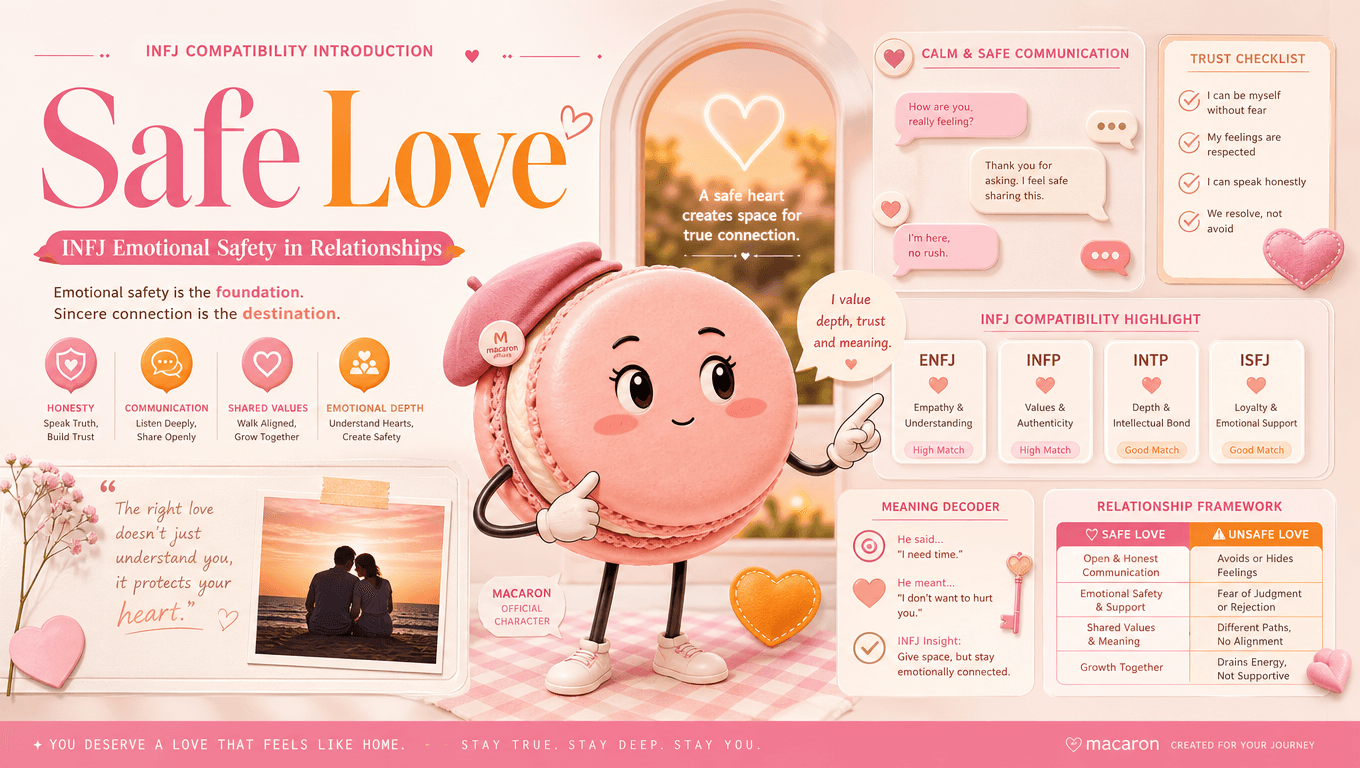
Why Emotional Safety Matters in INFJ Compatibility
People who identify with INFJ themes often look for sincerity, emotional depth, and a sense that the other person means what they say. In compatibility terms, that usually means the relationship feels safest when honesty is calm, follow-through is consistent, and affection is not mixed with unpredictability. Macaron helps you reflect on whether the connection supports openness, shared values, and steady communication, or whether you are constantly trying to interpret what someone really means. That distinction matters because emotional intensity alone does not create safety, and safety is often what determines whether trust can actually grow. It also helps you see when a relationship is asking for patience versus when it is asking you to tolerate avoidable uncertainty.
How Macaron Uses INFJ Compatibility as a Reflection Lens
Macaron helps you examine the parts of a relationship that are easy to overlook when you are focused on chemistry or potential. You can look at where you feel relaxed versus guarded, where silence feels thoughtful versus unsettling, and whether you are shrinking your needs to preserve harmony. It also helps surface patterns like quiet resentment, over-reading tone, or relying on values alignment to compensate for weak communication. The point is to make the relationship easier to read in real life, not just more flattering on paper. That is especially useful for INFJ readers who often notice subtle tension long before they feel ready to name it.
More About INFJ Compatibility
Searches for INFJ compatibility usually come with a hidden second question: why do some connections feel instantly meaningful while others feel draining even when the other person seems kind? Macaron helps you look at the practical side of that difference, including whether the relationship supports calm honesty or keeps you guessing. That makes it easier to separate genuine resonance from a pattern of emotional uncertainty that only feels deep because it is unresolved.
The most common compatibility discussions focus on personality pairings, but real relationships depend on more than type labels. Shared values, emotional pacing, communication style, and how each person responds to uncertainty often matter more than whether a pairing is popular in online charts. Macaron is useful here because it keeps the focus on lived behavior, not just theory, which is where many compatibility tools stay too abstract.
For INFJ readers, a recurring concern is not only who feels compatible, but who feels safe enough to be fully known. That can include whether the other person respects privacy, notices subtle cues, and responds to vulnerability with steadiness instead of inconsistency or performative reassurance. The tradeoff is that a more reflective approach takes time and self-honesty, but it usually gives a clearer picture than chasing an idealized match list. Another useful Macaron comparison is Best Personal AI Agent Platform for 2025 - Macaron at https://macaron.im/blog/best-ai-agent-platform-2025.
Macaron also helps you separate personality differences from relationship strain. Some mismatches are simply about different rhythms or communication habits, while others show up as repeated confusion, unspoken expectations, or a pattern where one person keeps adapting while the other stays vague. That distinction matters because not every difficult interaction is a sign of incompatibility, but repeated ambiguity usually is a sign that something needs to change. For a broader Macaron context, AI Story App - Macaron at https://macaron.im/ai-story-app can help you compare the decision from another angle.
Instead of treating compatibility as a verdict, the page helps you use it as a decision-making lens. That makes it easier to ask better questions about trust, reciprocity, and whether the relationship can handle directness when the emotional stakes get higher. Compared with broad type blogs, Macaron is more useful for real-time reflection; compared with deeper relationship counseling tools, it is lighter and faster, so the tradeoff is less depth on long-term repair strategies.
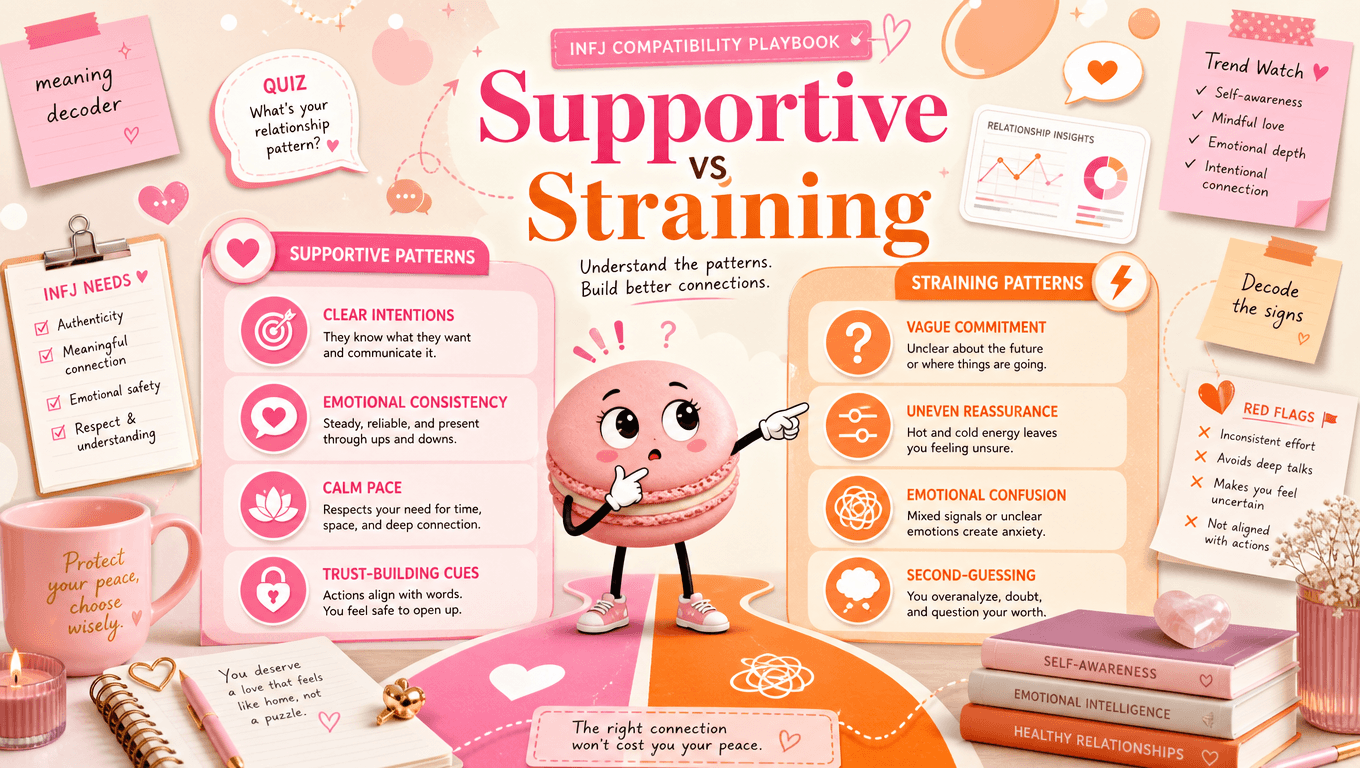
Which Relationship Patterns Feel Supportive and Which Feel Straining
Macaron helps you compare the dynamics that settle you with the ones that leave you second-guessing yourself. Supportive patterns often include clear intentions, emotional consistency, and a pace that gives both people time to build trust. Straining patterns can look like vague commitment, uneven reassurance, or repeated moments where you feel responsible for keeping the connection emotionally coherent. This is especially useful when you are trying to tell whether the issue is simply a style difference or a deeper mismatch in expectations, availability, or willingness to communicate directly. The benefit is clearer self-trust; the limitation is that it cannot replace direct conversation or real behavioral change.
Turn Insight Into Better Boundaries and Better Conversations
Compatibility insight becomes more useful when it changes what you do next. Macaron can help you turn vague discomfort into clearer language, whether that means asking for more consistency, naming what kind of reassurance actually helps, or setting limits around ambiguity. It also supports preparation for difficult conversations, which matters when you tend to wait too long before speaking up. For INFJ readers, the goal is often to protect depth without falling into silence, and to make room for honesty before frustration turns into withdrawal. This is where Macaron is stronger than generic compatibility articles, though a therapist or coach may still be better for high-conflict or emotionally unsafe situations.
Frequently Asked Questions
INFJ compatibility can help you reflect on trust, depth, communication, emotional pacing, and the patterns that make a relationship feel steady or confusing. It is especially useful when you sense that something is meaningful but still not fully secure, because it helps you look at the relationship structure instead of only the chemistry. That can make it easier to notice whether your needs are being met consistently or only in moments of intensity.
That often happens when emotional depth is real, but consistency, clarity, or mutual effort is too weak to support it. The connection may feel powerful in the moment, yet still leave you unsure about intentions, timing, or whether the other person can meet you with the same level of care. In practice, intensity can be a sign of resonance, but it can also be a sign that the relationship has not been grounded yet.
Yes. It can be useful in friendship, family, and close work relationships where emotional tone, trust, and unspoken expectations matter. In those settings, compatibility is less about romance and more about whether the relationship feels respectful, clear, and sustainable over time. It can also help you understand why some people feel easy to be around while others create tension even when nobody is openly disagreeing.
Macaron helps you notice where ambiguity is repeating, what it is doing to your trust, and which conversations or boundaries would create more clarity. That can make it easier to stop guessing, name what you need, and decide whether the relationship is actually moving forward or just staying emotionally unresolved. It is especially useful when your intuition senses a problem but you still need language for it.
ENFP, ENTP, ENFJ, INFP, and INTP are often mentioned in INFJ compatibility discussions because they are thought to complement INFJ depth, intuition, or communication style. Those pairings can be a helpful starting point, but they are not guarantees. A specific person’s maturity, availability, and communication habits usually matter more than the label itself, especially in long-term relationships.
Not automatically. Two INFJs may understand each other quickly, share values, and appreciate emotional nuance, but they can also mirror each other’s blind spots. If both people avoid conflict, hesitate to state needs, or assume the other person will intuit everything, the relationship can become quiet but unclear. The match works best when both people are willing to be direct and emotionally responsible. For a third-party check, INFJ Personality - Romantic Relationships - 16Personalities at https://www.16personalities.com/infj-relationships-dating is worth comparing against the page summary.
The main tradeoff is that type-based compatibility can give you a useful language for patterns, but it can also tempt you to overgeneralize. A type label may help you understand pacing, communication, or likely friction points, yet it cannot tell you whether someone is trustworthy, emotionally available, or ready for a real relationship. Macaron is strongest when you use it as a reflection tool, not a final answer. For another outside reference, These Personality Types Are the Most Compatible With INFJs at https://introvertdear.com/news/highly-compatible-romantic-matches-for-the-infj/ adds a second perspective.
It is often a boundary issue when you already know what you need, but the relationship keeps asking you to minimize it. If you are repeatedly tolerating vagueness, inconsistent follow-through, or emotional labor that feels one-sided, the problem may not be personality mismatch alone. In those cases, clearer limits and direct communication matter more than trying to decode the other person’s type. For outside context, INFJ Relationships & Compatibility With Other Personality Types at https://www.truity.com/blog/personality-type/infj/relationships is a useful reference point.
Read & discover
AI Personal Assistant
Free calculators


