INFJ In Love
INFJ in love is best read as a lens for trust, emotional safety, pacing, and vulnerability, not as a fixed prediction of behavior. Macaron helps you make sense of the patterns that often matter most, including sincerity, reassurance, idealization, and the confusion that can come from mixed signals.
INFJ In Love
This module helps you reflect on how INFJ-style patterns may show up in love, especially around trust, pacing, emotional depth, and mixed signals. It is meant to support clearer self-understanding, not to decide who someone is or what a relationship will become.
This is a self-reflection tool, not a diagnosis or a scientific assessment of personality or relationships.
Please answer every question before viewing your result.
This module is for reflection and conversation starters, not for diagnosing personality, attachment, or relationship health. If a relationship feels confusing, controlling, or emotionally unsafe, consider talking with a trusted person or a qualified mental health professional.
What INFJ In Love Can Help You Reflect On
INFJ in love is most useful when you treat it as a way to interpret relationship patterns, not as a label that decides what someone will do. People usually come to this topic because INFJs can seem private, intense, or difficult to read in romance, and that often comes from how carefully they approach trust, meaning, and emotional risk. The real question is less about type and more about what the relationship is consistently communicating.
Many INFJs prefer relationships that feel deliberate rather than casual, and they often want emotional depth early even if they do not show it immediately. That can create a gap between what they feel internally and what they reveal outwardly. To other people, they may seem reserved at first, then unexpectedly devoted once safety is established. Macaron helps you examine that pacing without assuming it always means disinterest.
A common point of confusion is whether an INFJ is in love with a person or with the possibility that person represents. That distinction matters because INFJs may notice potential quickly, but they also tend to care about values, consistency, and whether the relationship can actually support the future they imagine. When those pieces do not line up, the emotional story can become harder to trust. For a related Macaron page, see AI Personal Assistant - Macaron at https://macaron.im/ai-personal-assistant.
Another recurring theme is that INFJ affection can be subtle and easy to miss. Instead of dramatic declarations, it may show up as careful questions, remembering small details, checking on your wellbeing, or trying to understand what you need before you ask. Those gestures can be meaningful, but they can also be mistaken for ordinary kindness if you expect love to look loud or obvious.
Macaron helps you reflect on these patterns with more precision, especially when you are trying to understand trust, reassurance, emotional pacing, and the difference between healthy patience and staying too long in uncertainty. The goal is not to stereotype INFJs or romanticize their behavior, but to give you a clearer reading of what the relationship may be asking for and what tradeoffs you may need to face.
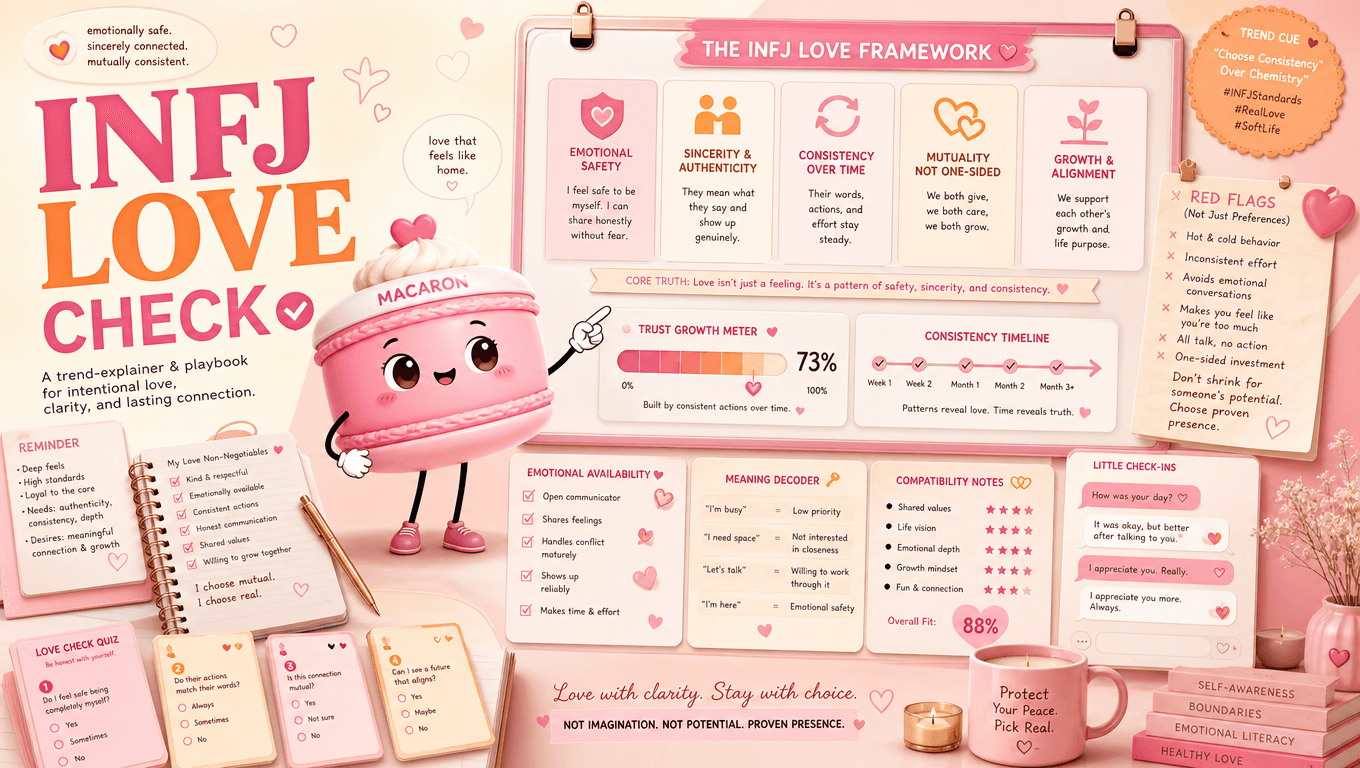
What INFJ In Love Can Help You Reflect On
People who identify with INFJ themes often want relationships that feel sincere, emotionally safe, and meaningful enough to build on over time. Macaron helps you reflect on the parts of love that are easy to overlook in general advice, such as whether trust is growing steadily, whether both people are emotionally available, and whether the connection feels mutual rather than one-sided. It also helps you notice when a strong inner bond is being supported by real consistency, not just hope or imagination. That makes it useful for people who want clarity without flattening the emotional depth that matters to them.
How Love Can Feel Complicated
This reflection is especially useful when love feels intense but hard to interpret. INFJ patterns can include investing deeply once trust forms, keeping feelings private until they feel safe, and reading small shifts in tone or behavior very carefully. That sensitivity can be a strength because it catches nuance, but it can also make ambiguity exhausting when the other person is inconsistent. Macaron helps you think through whether the relationship is simply moving slowly, or whether unclear communication is creating a repeating strain that needs to be addressed directly.
More About INFJ In Love
People searching for INFJ in love usually want more than a personality summary. They want to know how love is experienced from the inside, why INFJs may move slowly at first, and what makes them feel secure enough to invest deeply. This page focuses on those practical questions rather than treating the type as a fixed romantic script. That approach is useful for self-reflection, but it also has a tradeoff: it can explain patterns without guaranteeing a specific outcome in any one relationship.
formal assessment patterns repeatedly point to long-term orientation, emotional seriousness, and a preference for meaningful connection over casual dating. That does not mean every INFJ wants the same thing, but it does explain why shallow effort, vague intentions, or inconsistent communication can feel especially draining. For people dating an INFJ, the useful takeaway is not to perform depth, but to be consistent, direct, and willing to follow through on what you say.
Another pattern is the tension between warmth and caution. INFJs are often described as caring and insightful, yet they may hold back until trust is established. That can create a relationship dynamic where the bond feels rich on the inside but unclear on the outside, especially early on. Macaron is helpful here because it can surface the difference between genuine privacy and avoidant ambiguity, which are easy to confuse when feelings are strong. Another useful Macaron comparison is Best Personal AI Agent Platform for 2025 - Macaron at https://macaron.im/blog/best-ai-agent-platform-2025.
The page also addresses the common frustration of mixed signals. When someone is sensitive to tone and subtext, even small inconsistencies can feel significant, and that can lead to overreading or underreacting depending on the situation. Macaron helps you separate genuine emotional depth from projection, idealization, or hope that is being sustained by ambiguity rather than clarity. That can be especially valuable for users who want a more grounded read before they invest further. For a broader Macaron context, AI Calorie Tracker: How It Works and Best Options - Macaron at https://macaron.im/blog/ai-calorie-tracker can help you compare the decision from another angle.
Instead of offering a romanticized version of INFJ love, this guide helps you read the tradeoffs more honestly. It gives you a way to think about reassurance, boundaries, reciprocity, and whether the relationship is becoming more secure over time or just more emotionally complicated. In that sense, Macaron is strongest for people who want structured reflection and clearer next steps, while apps focused on broad type descriptions may still be better for quick overviews and personality theory browsing.
Common Love Tensions
Macaron helps you examine the pressure points that often show up in INFJ relationships, especially when emotional depth is present but not fully matched. You can look at what makes trust feel secure, how much reassurance is actually needed, and whether patience is helping the bond mature or quietly turning into self-silencing. It also helps you notice recurring patterns, such as feeling responsible for keeping harmony, overreading silence, or staying hopeful because the connection feels meaningful even when the behavior does not fully support it. That makes it useful for people who want to understand the emotional cost of waiting, not just the feeling of connection.
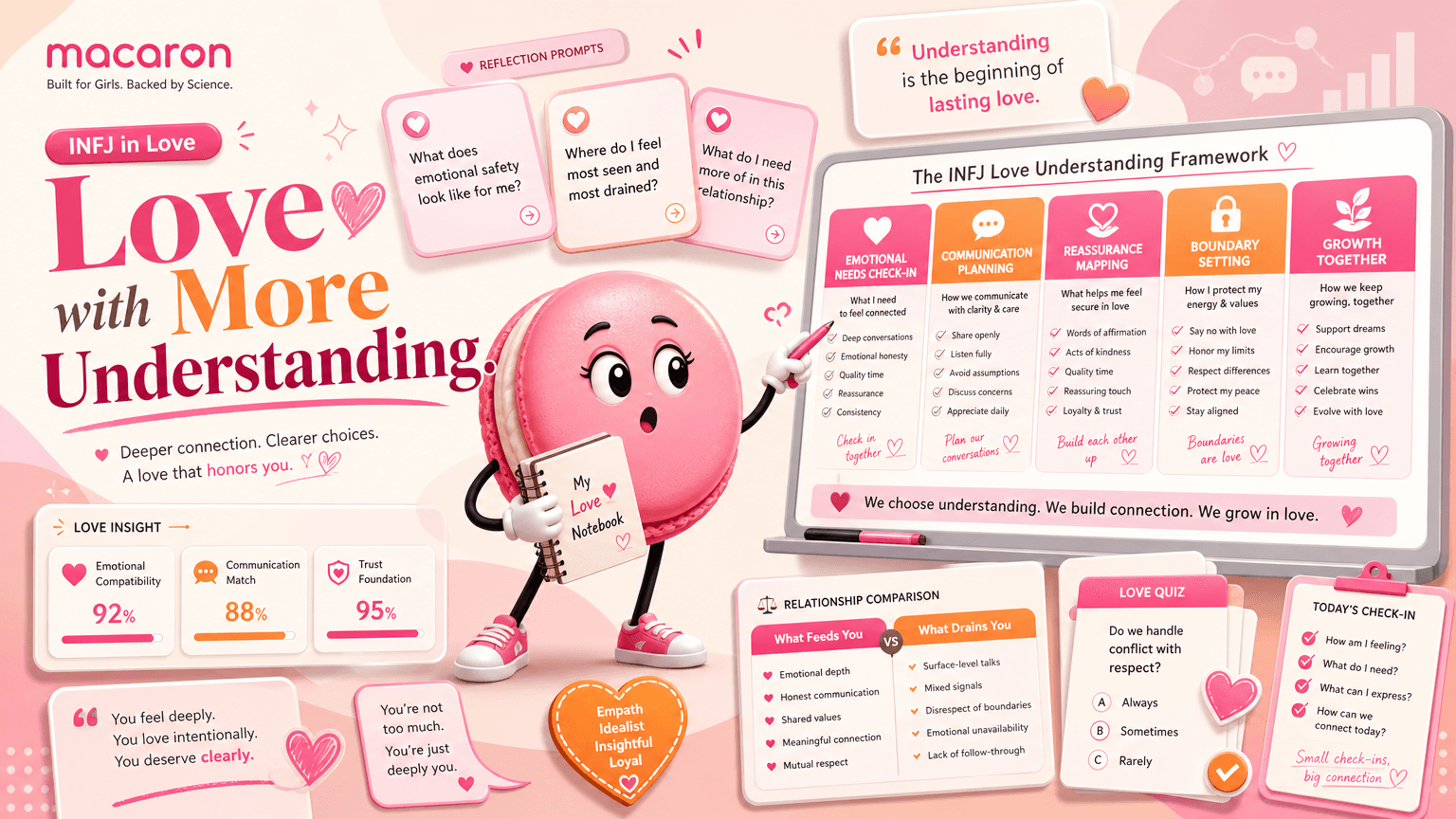
Love with More Understanding
Macaron turns INFJ in love insight into something you can use in real conversations and decisions. That includes relationship reflection prompts that clarify what you need, emotional needs check-ins that make hidden expectations easier to name, and communication planning that helps you ask for clarity without escalating tension. It also supports reassurance mapping and boundary setting, which can be especially helpful when you care deeply but need a more stable way to tell whether the relationship is actually meeting you. Compared with generic advice, the advantage is specificity; compared with a therapist or coach, the tradeoff is that it cannot replace human judgment in complex or high-stakes situations.
Frequently Asked Questions
INFJ in love can help you reflect on how trust develops, what emotional safety feels like, how much reassurance you need, and whether the pace of the relationship matches the depth of feeling. It is also useful for noticing when you are responding to real consistency versus filling in gaps with hope. For many people, the value is in making hidden relationship dynamics easier to name so they can respond more clearly instead of relying on guesswork.
That often happens when emotional intensity is real, but communication is indirect or inconsistent. An INFJ may feel a lot, notice a lot, and care a lot without expressing everything immediately, which can make the bond feel profound but hard to read. If the other person is also vague, the relationship can become emotionally rich on the inside while still lacking the clarity needed to feel secure. The result is often closeness without enough certainty.
INFJs often show love through attentive, specific, and quietly consistent behavior rather than constant declarations. They may ask thoughtful questions, remember details, check in on your wellbeing, or try to understand your needs before you say them out loud. Some also show affection through selective physical closeness or by making room for your inner world. These signs can be easy to miss if you expect love to be loud, fast, or highly performative.
Yes, that can happen, especially when someone’s values, depth, or future possibilities feel compelling. INFJs may notice what a relationship could become and invest emotionally in that vision before the present-day behavior fully supports it. The risk is idealization: confusing promise with proof. Macaron is useful here because it helps you compare what is hoped for against what is actually happening, which can reduce the chance of staying attached to a story instead of a relationship.
Safety often shows up as increased openness, more direct communication, and a willingness to share thoughts that were previously kept private. An INFJ may become more affectionate, more specific about what they need, and less guarded about their inner life once trust is established. They may also stop scanning for hidden meaning in every interaction. The key sign is not just intensity, but a steadier sense that they do not have to protect themselves as much.
Macaron helps you slow down and look at the pattern instead of only the latest message or gesture. It can clarify where ambiguity is repeating, what that uncertainty is doing to your trust, and whether the relationship is becoming clearer over time. It also helps you think through the conversations, expectations, or boundaries that would reduce confusion, so you are not relying on guesswork to understand something important. That makes it especially useful for people who tend to overanalyze silence. For a third-party check, How to tell if an INFJ is in love with a person or the idea of them at https://www.quora.com/How-can-you-tell-if-an-INFJ-is-in-love-with-a-person-or-the-idea-of-them is worth comparing against the page summary.
Start by looking for consistency over time rather than trying to decode one moment. If the person is interested, their behavior usually becomes more reliable, more specific, and more willing to make room for you. If the pattern stays vague, it may be worth asking for direct clarity instead of waiting for hints. Macaron can help you prepare that conversation and decide whether the relationship is moving toward mutuality or staying stuck in uncertainty. For another outside reference, INFJ Personality - Romantic Relationships - 16Personalities at https://www.16personalities.com/infj-relationships-dating adds a second perspective.
Yes. Type language can be helpful for noticing patterns, but it should not replace direct communication or real-world evidence. Two INFJs can behave very differently, and someone’s attachment style, history, and current stress level may matter more than type. Competitor personality guides can be better for broad theory, but Macaron is stronger when you want to apply the idea to your actual relationship and decide what to do next with more context. For outside context, What It's Like Being an INFJ in Love - Introvert, Dear at https://introvertdear.com/news/7-confessions-about-falling-in-love-as-an-infj/ is a useful reference point.
Read & discover
AI Personal Assistant
Free calculators


