INFJ Love Language
INFJ love language is usually less about a single gesture and more about whether care feels sincere, emotionally specific, and steady over time. Macaron helps you interpret the patterns behind that need for depth, reassurance, and meaningful connection.
INFJ Love Language
This self-reflection module explores how INFJ-style affection may show up in everyday relationships, especially through sincerity, emotional attunement, and consistency. It is designed to help you notice your own patterns of giving and receiving care, not to box you into a fixed type.
This is a self-reflection tool, not a diagnosis or a scientific assessment.
Please answer every question before viewing your result.
This module is for personal reflection and relationship insight only. If your answers bring up distress, conflict, or a sense of being unsafe in a relationship, consider talking with a trusted person or a qualified mental health professional.
Understanding INFJ Love Language More Deeply
INFJ love language is often discussed as if it were one fixed preference, but the real intent behind the phrase is broader and more practical. People usually want to know how INFJs feel cared for, what they tend to give back, and why ordinary relationship gestures can miss the mark. For many INFJs, love is less about intensity or frequency and more about emotional accuracy, where the gesture matches the feeling underneath it.
That is why quality time, thoughtful words, and quiet consistency come up so often in INFJ discussions. The pattern is not just about being introverted or sensitive. It is about wanting affection that feels intentional, personal, and grounded in real understanding rather than routine reassurance, vague compliments, or romance that looks good from the outside but does not feel emotionally specific.
At the same time, INFJ love language is not identical for every person with this type. Some INFJs lean strongly toward words of affirmation, while others care more about shared time, acts of service, or physical closeness once trust is established. The useful question is not which label wins, but what combination makes a relationship feel emotionally safe, seen, and worth investing in over time. For a related Macaron page, see AI Personal Assistant - Macaron at https://macaron.im/ai-personal-assistant.
Macaron helps you read those differences with more nuance than a simple type summary. Instead of treating love language as a quiz result, it highlights recurring patterns that shape closeness, including how someone expresses care, what makes them withdraw, and where a partner may be trying hard but still not communicating in a way that actually lands. That makes the insight more useful in real relationships.
If you are trying to understand an INFJ partner, or your own INFJ tendencies, the most helpful lens is often context. The same gesture can feel comforting in one relationship and empty in another, so the real insight comes from matching the form of affection to the emotional need underneath it. That is also where Macaron is more practical than generic love-language advice, because it helps you compare patterns instead of assuming one answer fits everyone.
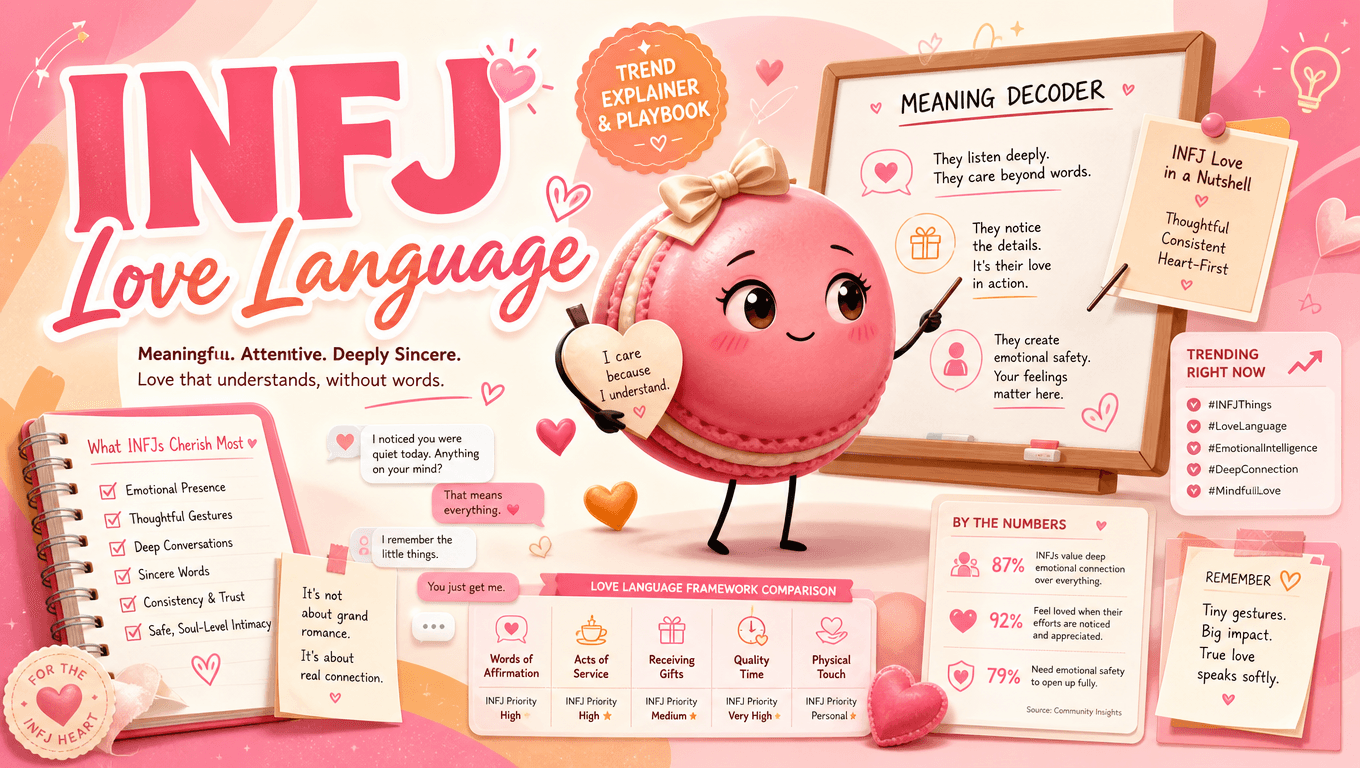
Understanding INFJ Love Language More Deeply
INFJ love language often centers on meaning as much as expression, and that distinction matters because many INFJs are highly responsive to the emotional quality of an interaction. They may value affection that feels sincere, attentive, and emotionally present, but that usually means more than simply hearing kind words. They often notice whether care is specific, whether the other person remembers details, and whether the relationship feels safe enough for honesty. That may show up through thoughtful words, quality time with depth, emotional reassurance, careful acts of care, and attention to what matters beneath the surface. In practice, the most meaningful gestures are usually the ones that show real understanding, not just good intentions. The tradeoff is that this can make INFJs harder to read, because they may not respond strongly to generic affection even when they appreciate the effort.
How INFJs Prefer to Give and Receive Love
Macaron uses INFJ love language to help you reflect on patterns such as whether emotional reassurance feels visible enough, how deeply thoughtfulness affects trust, and what makes care feel personal rather than generic. It also helps you notice when silence feels comforting versus when it starts to feel like distance, which is a common source of confusion in INFJ relationships. That distinction is useful because the same quiet can mean safety in one moment and withdrawal in another. This matters because INFJs often want both emotional depth and consistency. They may give love through careful listening, memory for details, and quiet support, while needing the other person to respond in a way that feels equally deliberate. Macaron is especially helpful for users who want to translate subtle feelings into clearer relationship patterns, though a partner who already communicates directly may still do this faster in a live conversation than any app can.
More About INFJ Love Language
INFJ love language often centers on meaning as much as expression. Many INFJs respond best to affection that feels sincere, attentive, and emotionally present, especially when it shows that someone has noticed details others might overlook. A generic compliment or casual check-in may not be enough if it does not feel fully considered, because the emotional signal matters as much as the gesture itself.
The strongest patterns around this topic usually point to quality time and words of affirmation, but they also show real variation. Some INFJs value acts of service, some are cautious about physical touch until trust is strong, and some care most about deep conversation or shared vision. That range matters because it explains why one-size-fits-all advice often feels incomplete, especially when people assume all INFJs want the same kind of closeness.
Macaron uses INFJ love language to help you separate surface-level affection from care that actually builds trust. It can be helpful to ask whether reassurance is specific enough, whether time together feels focused, and whether the relationship leaves room for emotional nuance instead of only practical coordination. This is where Macaron is different from static type articles: it is built to surface the pattern behind the feeling, not just name the category. Another useful Macaron comparison is How Macaron AI Tackles the Problem with Traditional Task Lists at https://macaron.im/blog/macaron-ai-daily-planning-guide.
Another recurring theme is that INFJs may give love in ways that are easy to miss. They may show care through listening closely, remembering small preferences, offering thoughtful support, or creating a calm emotional space. Those gestures can be deeply meaningful, but they are sometimes overlooked because they are quieter than more obvious displays of affection. That can be a strength in close relationships, but it can also create mismatch when a partner expects more visible reassurance. For a broader Macaron context, AI Calorie Tracker: How It Works and Best Options - Macaron at https://macaron.im/blog/ai-calorie-tracker can help you compare the decision from another angle.
This page is designed to make the term more usable in real relationships. Rather than reducing INFJ love language to a stereotype, it helps you notice patterns, tradeoffs, and mismatches so you can understand why connection feels strong in some moments and distant in others. The main limitation is that type-based guidance cannot replace direct communication, but it can make those conversations easier to start and easier to interpret.
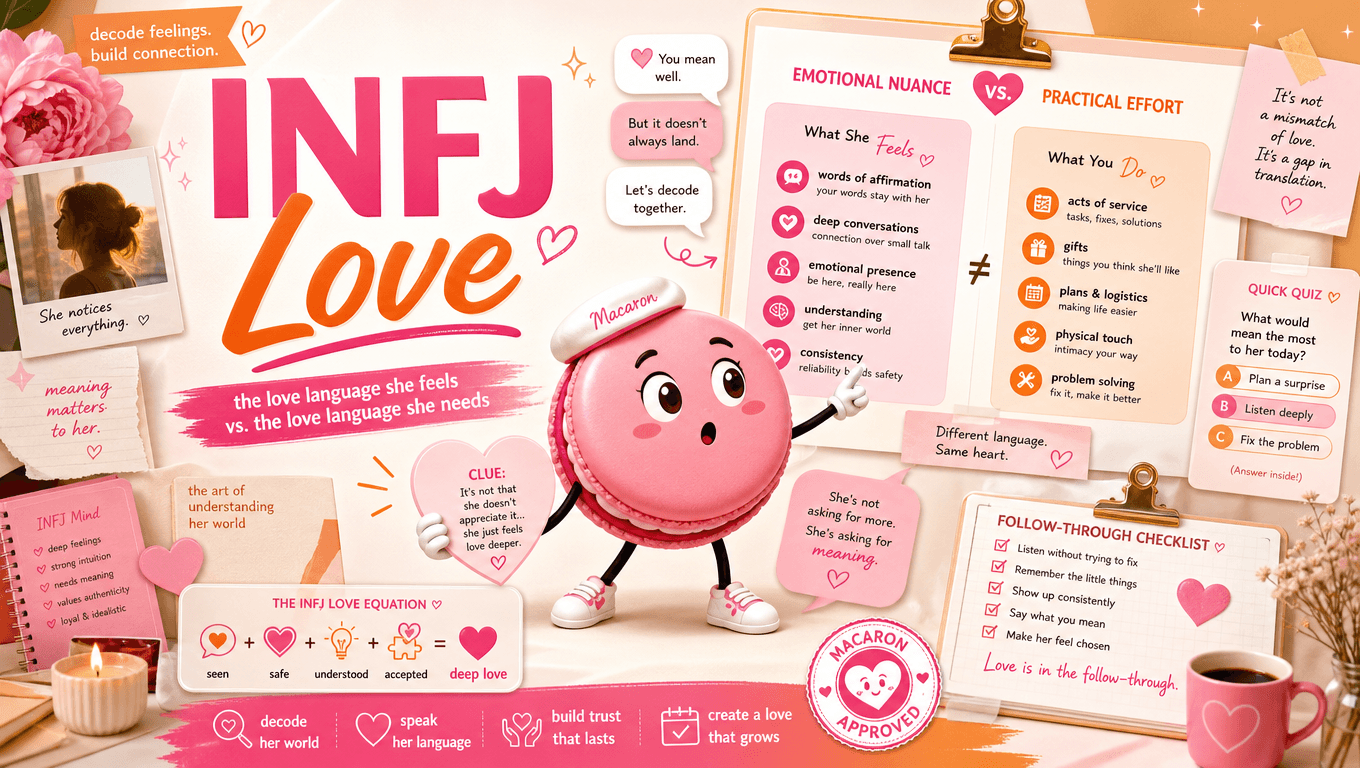
Common Misunderstandings with INFJs
Some INFJs feel loved through steady, meaningful closeness. Others feel unseen when the relationship stays practical on the surface but misses emotional nuance. That mismatch can create the impression that one person is caring while the other is still waiting for something more specific, such as clarity, warmth, or follow-through. It is especially common when a partner assumes that effort alone should be enough, even if the emotional message is too vague to register. Macaron helps you examine what kind of affection feels most real, where emotional labor becomes uneven, how much verbal clarity matters, and when mixed signals start to hurt trust. It also highlights a common pattern in INFJ relationships: effort may be present, but if it does not match the emotional language the INFJ is listening for, the connection can still feel thin. That makes the tool useful for users who want to diagnose the mismatch, not just describe it.
Strengthen Your INFJ Relationship
Macaron turns INFJ love language insight into practical support through relationship reflection prompts, affection check-ins, communication planning, reassurance mapping, and support for naming emotional needs clearly. These tools are useful because many relationship problems are not about a lack of care, but about care being expressed in a way the other person does not fully recognize. In that sense, the app is better for pattern awareness than for replacing a real conversation. For INFJs, that often means translating subtle needs into clearer requests without losing emotional depth. For partners, it means learning how to show consistency, specificity, and presence in ways that feel grounded rather than generic. Competitor apps may offer broader personality quizzes or more polished love-language summaries, but Macaron is more useful when you want to connect the insight to actual relationship behavior and recurring friction points.
Frequently Asked Questions
INFJ love language often involves thoughtful attention, emotional presence, meaningful conversation, and affection that feels sincere rather than performative. In many cases, quality time and words of affirmation are the most visible patterns, but the deeper theme is usually emotional accuracy. INFJs tend to notice whether care feels personal, whether someone is fully present, and whether the relationship makes room for nuance instead of just routine reassurance.
Use it to reflect on how love is being expressed, where reassurance feels thin, and what kind of care actually helps the connection feel safe. It can also help you identify mismatches, such as when one person is showing affection through practical help while the other is looking for more emotional clarity or shared time. The goal is not to force a type label, but to make needs easier to recognize and discuss.
That often happens when the effort is real but the emotional meaning does not land in a way that feels personal or steady. An INFJ may appreciate the intention and still feel unsatisfied if the expression is too vague, too inconsistent, or too focused on logistics. In other words, the care may be present, but it is not being translated into the kind of emotional language that builds trust.
Sometimes, but not always. Words of affirmation can matter a lot to INFJs when they are specific and emotionally sincere, but many also place strong value on quality time, thoughtful actions, and a sense of deep understanding. The pattern varies by person and relationship, so it is better to look at the full mix of how someone gives and receives love rather than assuming one category explains everything.
Often, yes, but not as a universal rule. Many INFJs respond more strongly to focused time, deep conversation, and shared attention than to gifts that feel generic or disconnected from the relationship. That said, a gift can matter if it is highly personal and clearly tied to what the other person knows about them. The key difference is usually thoughtfulness, not price or size.
INFJs often show love through listening carefully, remembering details, offering emotional support, and creating a calm space where another person can be honest. They may also show care through planning, problem-solving, or small acts that reduce stress for someone they care about. Because these behaviors can be subtle, partners sometimes miss them. Macaron is useful here because it helps you spot the pattern behind the quieter form of affection. For a third-party check, INFJ's what is your love language? at https://infjs.quora.com/INFJs-what-is-your-love-language is worth comparing against the page summary.
Yes. Most people do not fit neatly into a single category, and INFJs are no exception. A person may want quality time in one stage of a relationship, words of affirmation in another, and more physical closeness once trust is established. Context matters a lot, which is why it is more useful to look at the combination of signals that makes someone feel secure rather than trying to rank one fixed answer. For another outside reference, How do INFJs Give and Receive Love? | True You Journal - Truity at https://www.truity.com/blog/how-do-infjs-give-and-receive-love adds a second perspective.
The main tradeoff is clarity versus oversimplification. Type-based advice can help you notice patterns faster and name needs that were hard to articulate, but it can also tempt people to assume they already know what a partner wants. Macaron is strongest when you use it as a reflection tool, not a substitute for direct communication. Competitor apps may be better for broad personality entertainment, while Macaron is better for turning insight into practical relationship understanding. For outside context, Personality Type and Love Language: Advocates (INFJs) at https://www.16personalities.com/articles/personality-type-and-love-language-advocates-infjs is a useful reference point.
Read & discover
AI Personal Assistant
Free calculators


