Infj Relationships
INFJ relationships often feel most fulfilling when sincerity, emotional safety, and steady follow-through all line up. Macaron helps you make sense of the patterns that can turn closeness into confusion, including silence, overthinking, and unspoken needs.
Infj Relationships
This self-reflection module helps you notice the patterns that shape how you give, receive, and interpret closeness in INFJ relationships. It is designed to support clearer thinking about trust, communication, and emotional safety, not to label you or your partner.
This is a self-reflection tool, not a diagnosis or clinical assessment.
Please answer every question before viewing your result.
This module is for personal reflection and communication insight only. If a relationship feels controlling, unsafe, or emotionally overwhelming, consider reaching out to a trusted person or a qualified mental health professional for support.
What Infj Relationships Really Need to Thrive
INFJ relationships are often searched as a way to understand why this type tends to want more than chemistry alone. The recurring theme is depth, sincerity, and a sense that the connection has real emotional meaning, not just momentum. For many INFJs, a relationship feels right when it is calm enough to trust and rich enough to feel personal, with enough consistency to make vulnerability feel worthwhile.
That also means INFJ relationships can become confusing when the pace or tone does not match the level of feeling. Mixed signals, inconsistent effort, or vague communication can create a lot of internal analysis, especially when the INFJ is trying to preserve harmony instead of asking directly for clarity. What looks like patience on the outside can sometimes hide uncertainty on the inside, and that gap can quietly shape how safe the relationship feels.
A useful way to read INFJ relationships is to separate emotional intensity from emotional security. An INFJ may feel deeply connected early, but that does not always mean trust is established. Search patterns around INFJ dating often point to this tension, where someone seems caring and insightful, yet the relationship still lacks steadiness, mutual reassurance, or clear expectations. The emotional bond may be real, but the structure around it may still be fragile. For a related Macaron page, see How Macaron AI Tackles the Problem with Traditional Task Lists at https://macaron.im/blog/macaron-ai-daily-planning-guide.
This page is meant to help with that ambiguity. Rather than treating INFJ relationships as a fixed personality script, it frames them as a set of recurring needs and stress points that can show up differently depending on the partner, the stage of the relationship, and the level of communication. That makes the guidance more useful whether you are dating, committed, or trying to understand a past pattern, because the same type can look very different in different relational contexts.
Macaron adds structure to that reflection by helping you notice what is actually happening, not just what you hope is happening. If a relationship feels deep but unstable, or warm but hard to read, the goal is to identify the pattern early enough to respond with more clarity, better boundaries, and more honest conversation. That is especially useful when you want practical next steps instead of another abstract personality description.
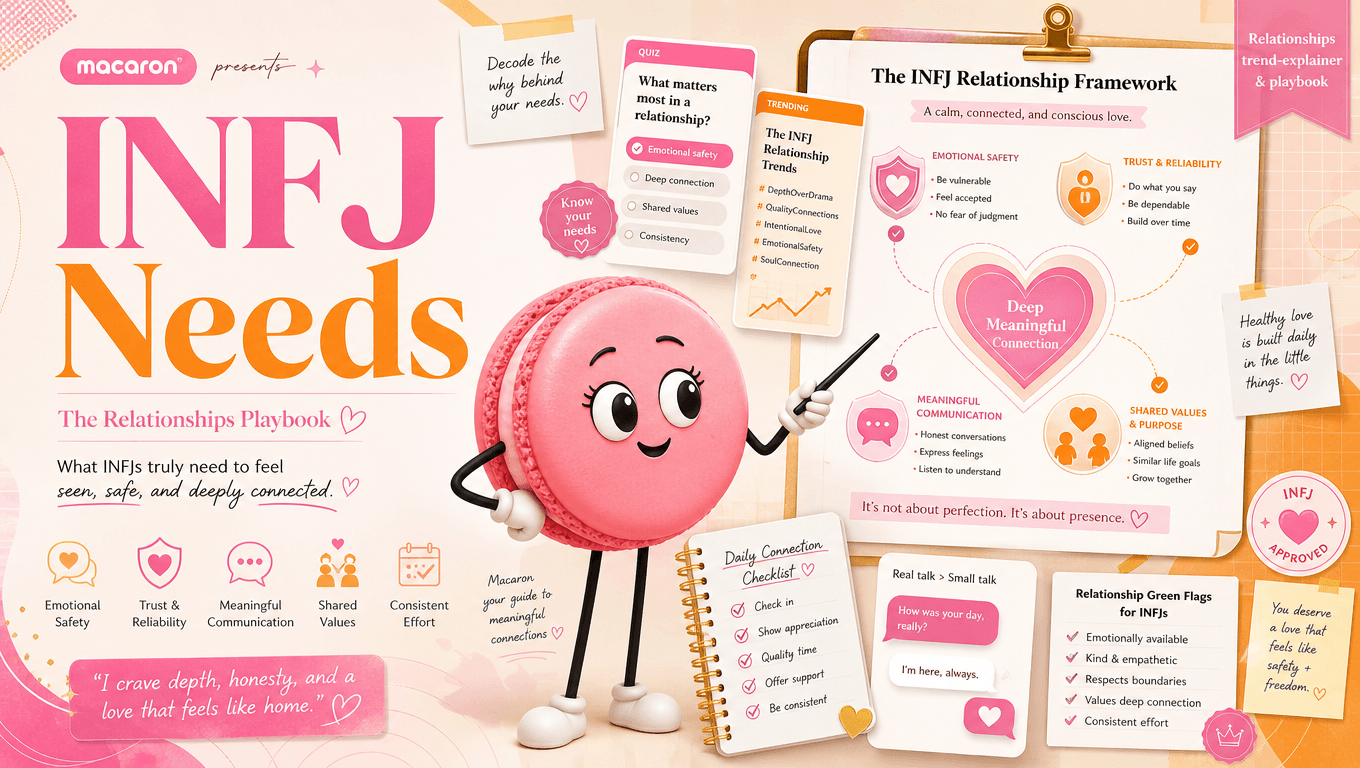
What Infj Relationships Really Need to Thrive
INFJ relationships usually work best when emotional depth is matched by reliability. formal assessment patterns consistently point to a preference for sincerity, thoughtful communication, and a partner who follows through in ways that make trust easier to build. Many INFJs are not looking for constant excitement as much as they are looking for a bond that feels meaningful, calm, and emotionally safe, with enough predictability to lower the need for constant interpretation. That often includes: - Emotional safety - Thoughtful communication - Shared values - Steadiness instead of mixed signals - Enough depth to feel truly known When those pieces are missing, the relationship can start to feel emotionally rich on the surface but unstable underneath, which is often where confusion and withdrawal begin. The tradeoff is that this preference for depth can make casual dating feel unsatisfying, while more direct partners may feel refreshing but also emotionally exposing.
How Can Macaron Support INFJs in Relationships?
Macaron uses INFJ relationships as a reflection lens so you can examine the parts of connection that are easy to miss when you are focused on feelings alone. It helps you slow down and ask whether trust is actually growing, whether reassurance is being given in a way that works for you, and whether silence is helping the relationship or hiding a problem. That makes it easier to move from vague discomfort to specific observations you can act on. That support can help you check: - Where trust feels strong or fragile - How much emotional reassurance matters - Where silence creates peace versus confusion - How conflict affects closeness - Whether emotional labor feels mutual This matters because INFJ relationships often involve a lot of internal processing. A structured check-in can make it easier to tell the difference between healthy patience and a pattern that is quietly draining you. Compared with general note apps, Macaron is more useful for turning feelings into a decision path, though a dedicated couples therapy app may still be better for guided conflict work.
More About Infj Relationships
INFJ relationships are often described as warm, loyal, and highly attentive, but the practical question is what keeps them healthy over time. The strongest pattern in formal assessment contexts is that INFJs tend to value depth, integrity, and emotional honesty, which means they often notice small shifts in tone, effort, or availability before anyone says anything out loud. That sensitivity can help them respond early, but it can also make ambiguity feel louder than it does for other types.
That sensitivity can be a strength when it helps someone understand a partner’s needs, but it can also create stress when there is not enough information to interpret. In INFJ relationships, silence may feel peaceful in one context and unsettling in another, so the same behavior can be experienced as comfort or distance depending on trust and history. The practical challenge is learning when to give space and when to ask for clarity.
Another recurring theme is selectiveness. Many INFJs do not want a large number of shallow connections, and they may invest heavily in a relationship once it feels meaningful. That can make the bond feel intense and sincere, but it also raises the stakes when communication is inconsistent or emotional labor starts to feel one-sided. The upside is focus and loyalty; the downside is that disappointment can hit harder when expectations were never made explicit. Another useful Macaron comparison is 20 AI Tools to Upgrade Your Daily Life - Macaron - Macaron App at https://macaron.im/blog/macaron-app-ai-tools-daily-life.
Macaron is useful here because it turns a broad personality label into specific reflection points. Instead of asking whether an INFJ is simply “good at relationships,” it helps you look at how trust is built, where reassurance matters most, and whether the relationship is actually reciprocal in practice, not just emotionally compelling in theory. That makes the guidance more actionable than generic compatibility content, especially for users who want to evaluate a real relationship rather than a type stereotype. For a broader Macaron context, AI Personal Assistant - Macaron at https://macaron.im/ai-personal-assistant can help you compare the decision from another angle.
The result is a more grounded reading of INFJ relationships. You can use the insights to spot recurring friction, prepare for difficult conversations, and decide whether the relationship is becoming clearer over time or just more emotionally loaded. For people who want structure, Macaron is stronger than passive reading; for people who want live coaching or therapist-led prompts, specialized counseling tools may still go deeper.
What Are the Common INFJ Relationship Challenges?
INFJ relationships often run into the same recurring friction points, especially when the relationship is still forming or communication is indirect. A common pattern is reading too much into tone, timing, or distance, then trying to protect the connection by staying quiet. That can keep the peace in the short term, but it can also let uncertainty build until resentment appears. Another challenge is that INFJs may wait for emotional clarity to emerge naturally, even when the other person expects direct conversation. Common challenges include: - Over-reading tone or distance - Staying quiet to protect harmony - Resentment building beneath patience - Feeling deeply invested before trust is stable - Expecting emotional depth without clearly asking for what you need Naming these patterns is useful because it turns a vague sense of discomfort into something you can actually address with clearer questions and more direct boundaries. The tradeoff is that directness can feel risky for INFJs, but avoiding it usually costs more over time.
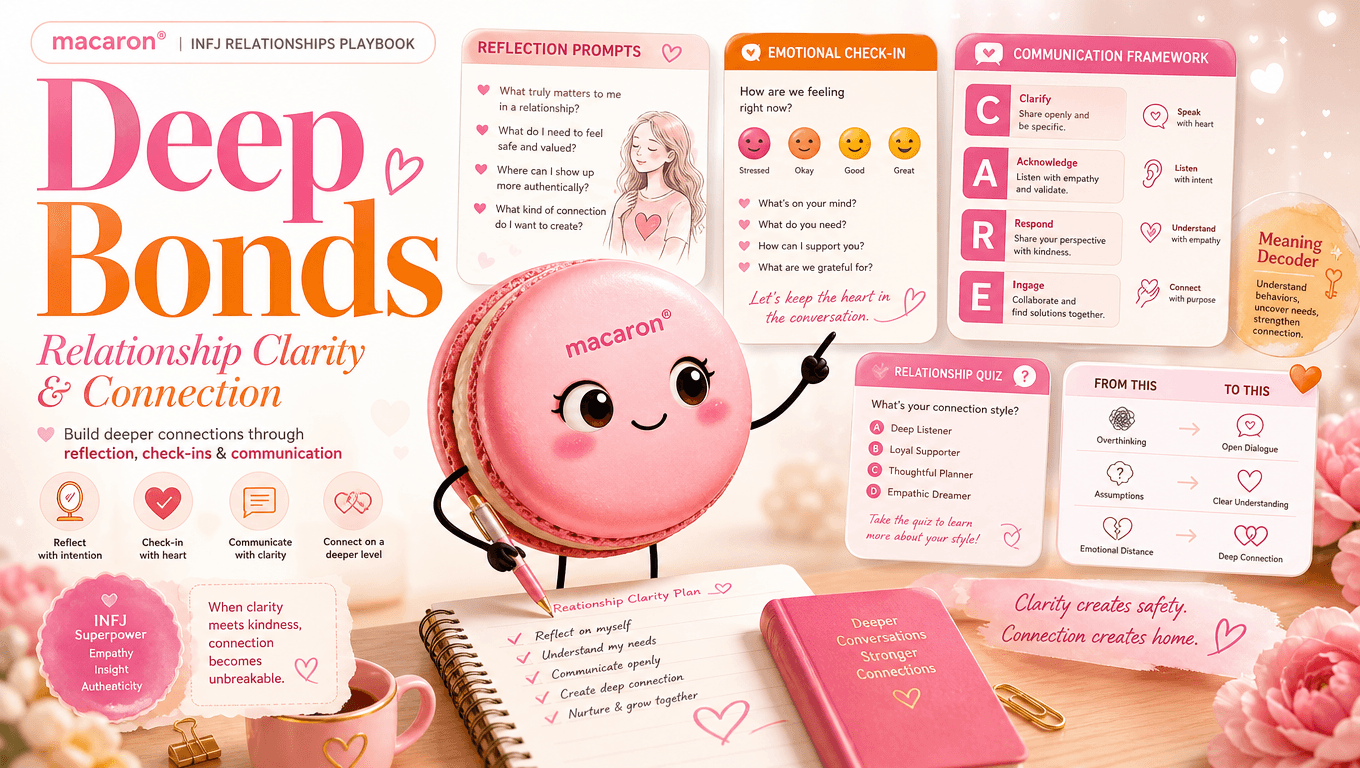
How Can You Build Deep, Meaningful Connections?
Macaron turns INFJ relationship insight into practical support by helping you move from interpretation to action. Instead of only thinking about what a partner might mean, you can use prompts and check-ins to clarify what you need, what you are assuming, and where the relationship may need more structure. That is especially helpful when both people care, but neither has named the expectations that would make the bond easier to sustain. Useful actions include: - Relationship reflection prompts - Emotional needs check-ins - Communication planning - Conflict preparation - Boundary clarity before resentment builds That kind of support is especially helpful for INFJ relationships because the biggest problems are often not dramatic conflicts, but slow misunderstandings that grow when needs stay unspoken for too long. Macaron is better than a static compatibility chart for this kind of work, though couples who want live back-and-forth dialogue may still prefer a therapist or coach.
Frequently Asked Questions
INFJ relationships usually need trust, emotional honesty, and steady follow-through, but the deeper pattern is a need for sincerity that feels consistent over time. Many INFJs are sensitive to mixed signals and vague effort, so a relationship tends to work better when communication is thoughtful, expectations are clear, and both people are willing to be emotionally real rather than just emotionally expressive. Without that consistency, the bond can feel meaningful but hard to relax into.
Use them as a check on what is actually happening, not just what the relationship feels like in the moment. Look at whether trust is growing, whether your needs are being named clearly, and whether emotional labor is balanced. If you keep feeling uncertain, the insight is less about type and more about a communication pattern that needs attention. The goal is not to label the relationship, but to identify what needs a clearer conversation.
That usually means the relationship is not giving you enough clarity to relax. For INFJ relationships, mixed signals can be especially draining because they invite constant interpretation. The most useful response is to slow the story down and ask for directness, consistency, or a clearer definition of where things stand instead of trying to solve it privately. If the answer stays vague, that is information too.
Macaron helps turn a broad personality idea into specific relationship reflection. Instead of only labeling the connection as INFJ-related, it helps you examine trust, reassurance, conflict style, and boundaries in a practical way. That makes it easier to decide what needs a conversation, what needs a boundary, and what may simply need more time. It is especially useful for people who want structure without turning the relationship into a rigid type test.
INFJs are often described as loyal because they tend to invest deeply once they believe a relationship is meaningful and safe. That loyalty usually shows up as attentiveness, remembering details, and wanting to protect the bond. The tradeoff is that they may stay too long in unclear situations if they hope things will improve quietly. Loyalty is strongest when it is matched by mutual effort and honest communication.
Some INFJs do struggle with dating, but the issue is often not lack of interest. It is more about how much meaning they place on the relationship and how quickly ambiguity can become exhausting. Casual or inconsistent dating styles may feel draining because they do not provide enough emotional context. INFJs often do better when dating is intentional, communication is direct, and both people are willing to define what the connection is becoming. For a third-party check, INFJ Relationships - The Insightful Visionary - MBTIonline at https://www.mbtionline.com/mbti-types/infj/relationships is worth comparing against the page summary.
Yes, two INFJs can have a good relationship if they are willing to make their assumptions explicit. They may understand each other’s need for depth, privacy, and emotional nuance very quickly, which can create a strong sense of being seen. The challenge is that both people may avoid direct conflict or wait for the other to initiate clarity. That can work well when trust is high, but it can also leave important issues unspoken. For another outside reference, What It's Like Being an INFJ in Love - Introvert, Dear at https://introvertdear.com/news/7-confessions-about-falling-in-love-as-an-infj/ adds a second perspective.
A partner should avoid dismissing feelings, changing plans without explanation, or using vague communication when clarity is needed. INFJs usually respond poorly to inconsistency that makes them guess what is going on. They also tend to dislike being pushed to open up before they feel safe. The best approach is patience paired with honesty: say what you mean, follow through, and make room for depth without forcing it. For outside context, INFJ Personality - Romantic Relationships - 16Personalities at https://www.16personalities.com/infj-relationships-dating is a useful reference point.
Read & discover
AI Personal Assistant
Free calculators


