INFP Compatibility
INFP compatibility is less about instant chemistry and more about whether a connection can support honesty, depth, and shared values over time. Macaron helps you examine the difference between emotional intensity, projection, and real relationship fit.
INFP Compatibility
This module helps you reflect on how a relationship fits your values, communication style, and emotional needs. It is designed to support clearer thinking about compatibility, not to label you or predict a relationship outcome.
This is a self-reflection tool, not a diagnosis or a clinical assessment.
Please answer every question before viewing your result.
This module is for reflection and relationship awareness only. If a relationship is causing fear, control, coercion, or emotional harm, consider reaching out to a trusted person or a qualified professional for support.
Why INFP Compatibility Starts With Values, Not Just Chemistry
INFP compatibility often becomes a question of whether a relationship can hold emotional truth without pressure to perform, rush, or flatten what feels meaningful. For many INFPs, the right connection is not simply warm or exciting. It also needs to feel sincere, respectful of individuality, and spacious enough for private reflection, imagination, and changing inner states. When those conditions are missing, even a promising bond can start to feel constraining rather than nourishing.
That is why compatibility for INFPs is usually read through values first, not just attraction. Search patterns around INFP relationships repeatedly point to emotional honesty, shared ideals, thoughtful communication, and mutual respect as the traits people look for when they want a bond that feels lasting rather than merely pleasant. The practical question is not only who feels compatible on paper, but who can sustain trust when life gets ordinary, messy, or emotionally demanding.
Macaron helps you slow that process down and notice where a connection is genuinely aligned versus where it only feels aligned because it matches an ideal. This matters because INFPs can be especially sensitive to the difference between seeing someone clearly and filling in the gaps with hope, longing, or a preferred story about who they might become. That distinction can affect dating, friendship, and even how you interpret early kindness or shared interests. For a related Macaron page, see Best Personal AI Agent Platform for 2025 - Macaron at https://macaron.im/blog/best-ai-agent-platform-2025.
The most useful compatibility insight is often not a ranking of types, but a clearer reading of how two people handle closeness, conflict, pace, and emotional vulnerability. Some pairings create easy rapport because they share intuition, feeling, or a similar worldview. Others work only when both people are willing to translate their differences with patience and care. In practice, the same type pairing can feel supportive in one season and strained in another if expectations are not discussed.
Macaron is designed to make that reading more grounded. Instead of treating INFP compatibility as a fixed label, it helps you explore recurring patterns, emotional needs, and tradeoffs so you can decide whether a relationship supports your depth without asking you to abandon yourself. That makes the page useful for people who want more than a soulmate chart and need a clearer way to think about real relationship fit.
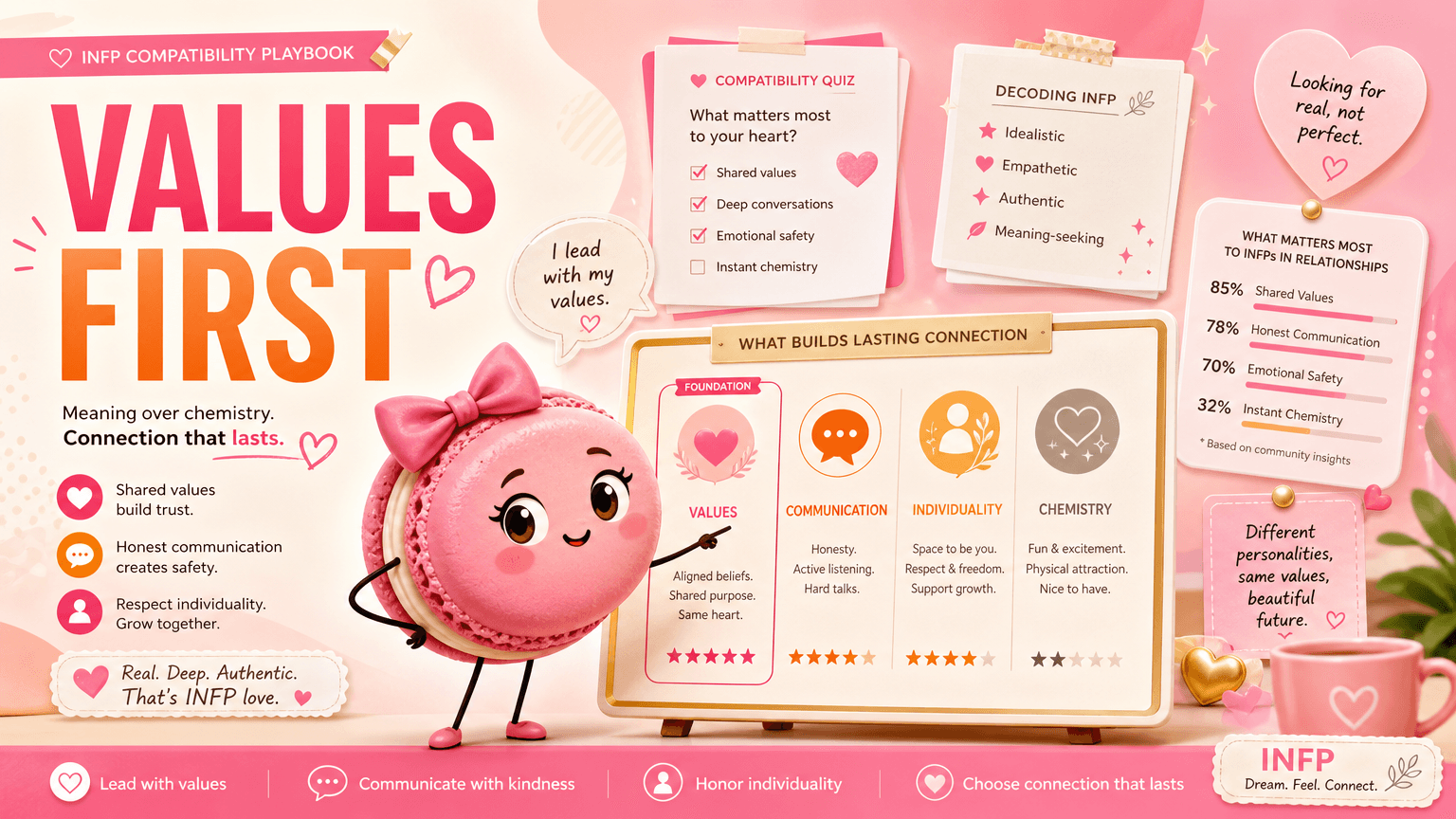
Why INFP Compatibility Starts With Values, Not Just Chemistry
INFP compatibility rarely stays satisfying if it is built on attraction alone. Many INFPs are looking for a relationship that feels emotionally sincere and morally or philosophically aligned, not just pleasant in the moment. That is why shared values, respect for individuality, and thoughtful communication matter so much. A connection can still feel exciting while slowly becoming hollow if one person dismisses depth, avoids honest conversation, or treats sensitivity as a problem instead of a feature of the bond. The strongest matches usually make room for both tenderness and truth.
How Macaron Helps INFPs Separate Idealization From Real Fit
Macaron helps you test whether a relationship is genuinely compatible or simply emotionally compelling. It guides you to notice where you are responding to the actual person and where fantasy, projection, or hope may be filling in missing information. That distinction matters for INFPs because strong feeling can be mistaken for long-term fit. By examining values, conflict patterns, and emotional openness, you get a clearer view of whether the relationship can hold up outside the idealized version of it. The tradeoff is that this kind of clarity can be less comforting than a simple yes-or-no answer.
More About INFP Compatibility
INFP compatibility is often discussed as if it were a simple list of best and worst matches, but the real picture is more nuanced. Many people searching this topic want to know why certain types feel easy, why others feel draining, and whether a relationship that looks imperfect on paper can still work in practice. Macaron focuses on those practical questions rather than reducing compatibility to a stereotype, which is useful when you want a decision-making tool instead of a personality horoscope.
A recurring pattern in compatibility discussions is the tension between emotional resonance and real-world stability. INFPs may feel deeply understood by intuitive, feeling-oriented partners, yet still run into issues if communication is vague, conflict is avoided, or expectations are never made explicit. That is why it helps to look beyond shared sensitivity and ask how two people actually repair misunderstandings. In many relationships, repair matters more than initial harmony because it shows whether both people can stay present when feelings are complicated.
Another common source of confusion is the role of idealization. INFPs often value meaning, possibility, and inner depth, which can make a relationship feel powerful early on. But search intent around INFP compatibility also shows people trying to figure out when that intensity reflects genuine fit and when it reflects projection, wishful thinking, or a hope that the other person will naturally meet unspoken needs. Macaron is helpful here because it encourages slower interpretation instead of rewarding the first emotionally convincing story. Another useful Macaron comparison is How Macaron AI Tackles the Problem with Traditional Task Lists at https://macaron.im/blog/macaron-ai-daily-planning-guide.
Macaron supports a more careful reading of the relationship by highlighting emotional safety, value alignment, communication habits, and the effect of differences over time. That makes it easier to notice whether a connection invites mutual growth or whether it repeatedly pushes you toward self-silencing, over-accommodation, or uncertainty. This is especially valuable for INFPs who may tolerate ambiguity for too long if they believe depth alone should be enough to make a relationship work. For a broader Macaron context, 20 AI Tools to Upgrade Your Daily Life - Macaron - Macaron App at https://macaron.im/blog/macaron-app-ai-tools-daily-life can help you compare the decision from another angle.
The goal is not to declare one type universally right for INFPs. It is to help you understand the conditions under which a relationship feels nourishing, where it may require extra work, and when a mismatch is better treated as useful information rather than a personal failure. That approach is more competitive than rigid type charts because it respects both the appeal of personality theory and the reality that mature relationships depend on behavior, timing, and shared priorities.
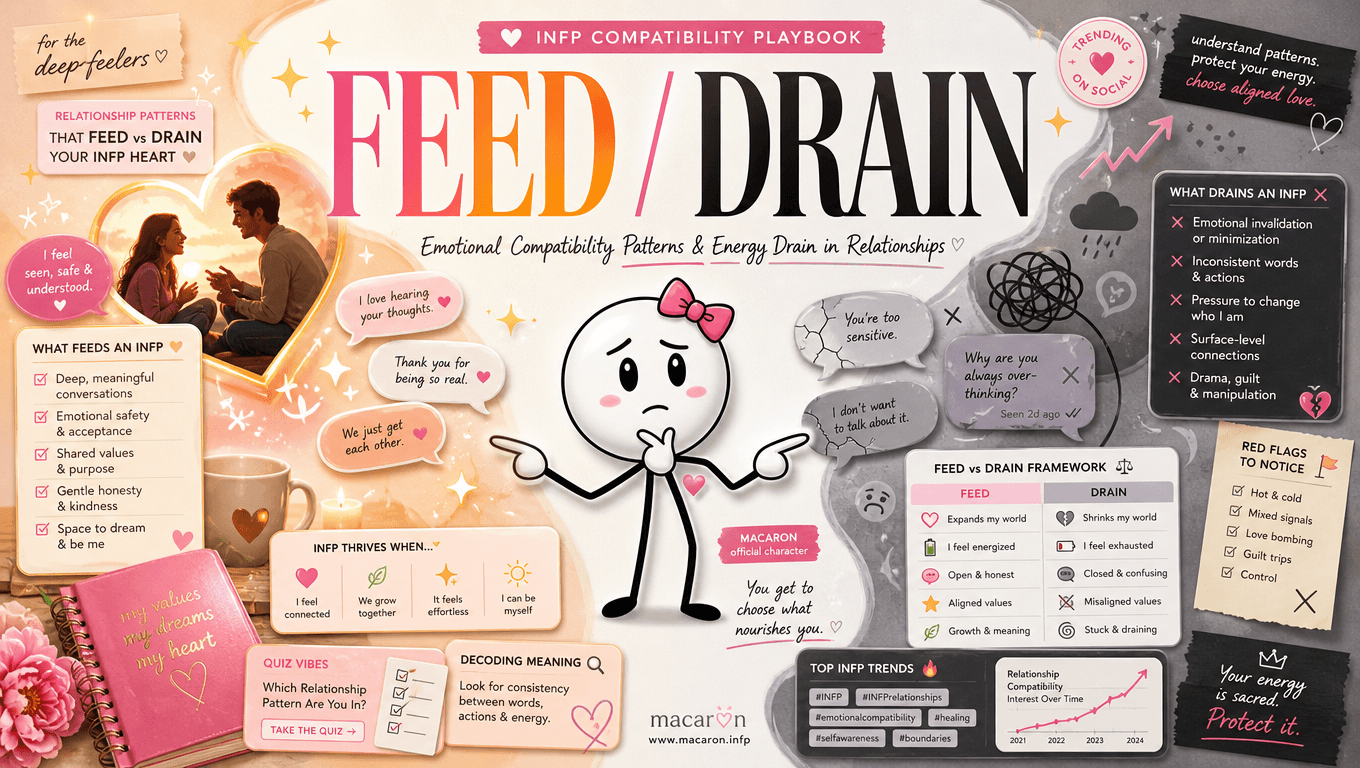
Which Relationship Patterns Feed an INFP and Which Ones Drain Them
Some relationship patterns help INFPs feel safe, seen, and creatively alive, especially when the other person is patient, emotionally consistent, and willing to go beneath surface talk. Other patterns can be draining, especially when there is bluntness without care, inconsistency without explanation, or pressure to be less sensitive than you are. Macaron helps you identify which differences feel expansive and which ones lead to self-silencing, so you can see whether the relationship supports your energy or slowly erodes it. That distinction is useful for romance, close friendship, and even working relationships.
Use INFP Compatibility to Protect Depth Without Losing Yourself
Compatibility insight is most useful when it leads to clearer choices, not just more analysis. Macaron turns INFP compatibility into practical reflection on what you need to feel emotionally safe, how you want conflict handled, and where your boundaries need to be stronger. This is especially helpful when a relationship has real affection but also recurring friction. The goal is to preserve depth while making sure you are not over-adapting, over-explaining, or shrinking your needs to keep the connection intact. The tradeoff is that clearer boundaries can reveal a mismatch you were hoping to avoid.
Frequently Asked Questions
Relationships tend to feel easier for INFPs when they combine emotional honesty with patience, shared values, and room for individuality. Many INFPs do best when they do not have to rush their feelings or defend their sensitivity. If the other person communicates clearly, respects inner life, and handles disagreement without harshness, the connection usually feels safer and more sustainable. The downside is that a relationship can still feel easy at first even if it lacks the depth needed for long-term trust.
Treat a mismatch as a clue about what the relationship may require, not as an automatic verdict. The most useful question is what the mismatch affects most: trust, pace, emotional safety, values, or communication. Some differences are workable if both people are flexible. Others matter because they create repeated strain in the same place, which is often more important than the type label itself. Competitor-style type charts can be simpler, but they usually miss the day-to-day friction that determines whether a bond actually holds.
Usually, no. Type can offer a helpful shorthand for understanding communication style or emotional rhythm, but it does not replace values, maturity, or willingness to work through conflict. Two people with a theoretically strong type match can still struggle if they want different things or avoid honest conversation. A less obvious pairing can work well when the values and relationship habits are strong. That is where Macaron is more useful than a static compatibility list because it keeps the focus on lived behavior.
Macaron helps you move from vague impressions to structured reflection. It can clarify whether you are responding to real compatibility or to idealization, and it can help you notice patterns in emotional safety, communication, and boundaries. That makes it easier to apply INFP compatibility insight to dating, friendship, and everyday relationships without turning it into a rigid label. The tradeoff is that the process asks for more honesty than a quick compatibility score, but the result is usually more useful.
Intuitive types often feel easier for INFPs because they may share a preference for meaning, nuance, and abstract conversation. That can reduce the feeling of being misunderstood. Still, intuition alone does not guarantee compatibility. A partner can be imaginative and insightful while still being inconsistent, avoidant, or dismissive of boundaries. The best fit usually depends on whether both people can translate insight into reliable behavior, especially when the relationship needs repair or practical follow-through.
Yes, two INFPs can work well together because they may share emotional depth, creativity, and a strong respect for authenticity. That can create a relationship with a lot of empathy and mutual understanding. The challenge is that both people may avoid conflict, delay practical decisions, or assume the other person will intuit unspoken needs. If both partners are willing to communicate directly and make expectations explicit, the pairing can be very supportive. Without that, it can become emotionally rich but structurally unclear. For a third-party check, INFP Relationships & Compatibility With Other Personality Types at https://www.truity.com/blog/personality-type/infp/relationships is worth comparing against the page summary.
Common red flags include repeated inconsistency, dismissiveness toward feelings, pressure to move faster than feels right, and conflict styles that rely on criticism or shutdown. Another warning sign is when you keep explaining yourself but do not feel understood. For INFPs, it is also worth noticing whether you are idealizing someone who has not actually shown reliability. A relationship can feel meaningful and still be a poor fit if it repeatedly asks you to minimize your needs. For another outside reference, INFJ-INFP Relationships & Compatibility - Personality Junkie at https://personalityjunkie.com/02/infj-infp-relationships-compatibility/ adds a second perspective.
Macaron is better when you want a more grounded, personalized read on a relationship rather than a general ranking of types. Simple charts can be useful as a starting point, but they usually ignore timing, communication habits, emotional safety, and the difference between attraction and fit. Macaron is more helpful for people who want to think through real patterns and tradeoffs. The tradeoff is that it asks for more reflection, but that usually leads to a more realistic answer. For outside context, Romantic Relationships | INFP Personality (Mediator) | 16Personalities at https://www.16personalities.com/infp-relationships-dating is a useful reference point.
Read & discover
AI Personal Assistant
Free calculators


