INFP Dating
INFP dating is best read as a way to notice how authenticity, emotional safety, pacing, and self-trust shape attraction and attachment. Macaron helps you reflect on the moments when depth feels real, when hope starts filling in gaps, and when a connection needs clearer evidence before you invest more.
INFP Dating
This module helps you notice how you approach INFP dating through the lens of authenticity, pacing, emotional safety, and clarity. It is designed to support reflection on real relationship patterns, not to judge your personality or predict compatibility.
This is a self-reflection tool, not a diagnosis or clinical assessment.
Please answer every question before viewing your result.
This module is for self-reflection only and cannot tell you who is compatible with you or whether a relationship is healthy. If dating situations are bringing up intense distress, fear, coercion, or thoughts of self-harm, consider reaching out to a trusted person or a qualified mental health professional right away.
What INFP Dating Can Help You Notice
INFP dating is most useful as a reflection lens, not a rulebook. Many descriptions of INFPs emphasize selectivity, values, and a slower path to trust, but those are tendencies, not guarantees. The more useful question is whether a specific connection feels emotionally safe, mutual, and grounded in observable behavior. Macaron helps you separate type language from the actual relationship in front of you.
A lot of people exploring this topic are trying to understand why dating can feel so intense early on. Shared values, emotional openness, or a sense of being understood can create a fast feeling of significance. That feeling may be real, but it can also blur the line between compatibility and hope. Macaron is built to help you slow down and check what is present before you invest more meaning than the situation has earned.
A recurring theme in INFP dating advice is the tension between wanting depth and feeling drained by interactions that seem mechanical, inconsistent, or emotionally thin. That preference for meaning can be a strength, but it can also make it easier to overlook practical questions like effort, follow-through, and communication style. Reflection is most useful when it keeps both your ideals and the other person’s behavior in view. For a related Macaron page, see AI Personal Assistant - Macaron at https://macaron.im/ai-personal-assistant.
This page is meant to support self-understanding around attraction, pacing, reassurance, and mixed signals. If you tend to read a lot into small gestures, or if inconsistency leaves you mentally preoccupied, the goal is not to criticize that sensitivity. The goal is to help you use it well so it supports discernment instead of keeping you attached to uncertainty or unfinished possibilities.
These patterns are descriptive, not predictive. Two people with the same type label can have very different dating experiences, and compatibility depends on timing, values, communication, and mutual effort more than personality shorthand alone. Macaron keeps the focus on practical reflection so you can make clearer choices without losing the authenticity that matters to you.
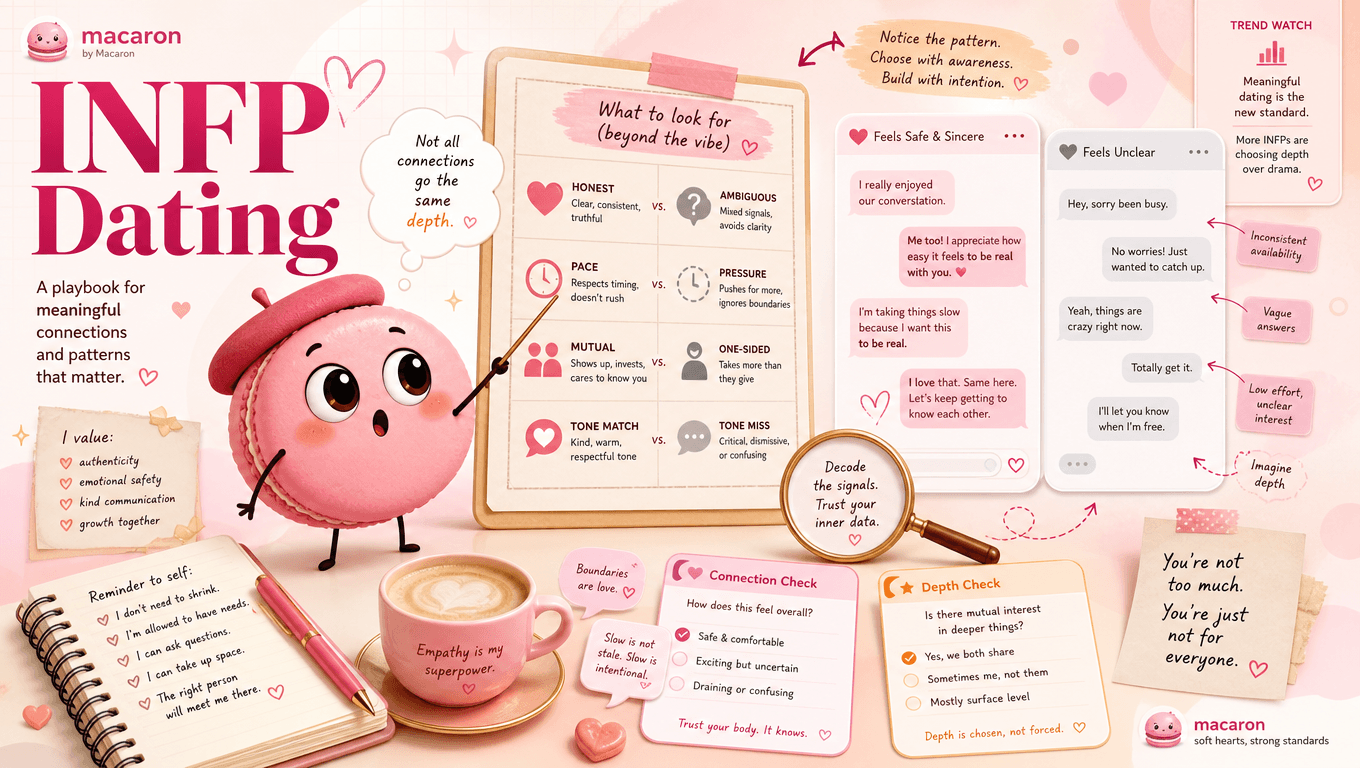
What INFP Dating Can Help You Notice
People who identify with INFP themes often value sincerity, emotional safety, thoughtful communication, room for individuality, and connection that feels meaningful rather than performative. In practice, that means paying attention to whether a conversation feels honest, whether the pace feels respectful, and whether the other person’s actions match the emotional tone they create. This lens also helps you notice when a relationship feels deep because it is genuinely mutual versus when it feels deep because you are filling in missing information with hope. The point is to notice patterns early enough to make clearer choices.
How Macaron Uses INFP Dating as a Reflection Lens
Macaron helps you reflect on patterns such as attaching to potential too quickly, reading emotional meaning into inconsistency, downplaying your own needs to keep the bond soft, feeling deeply affected by mixed signals, and needing more authenticity than the situation is offering. These are common pressure points in early dating, especially when someone seems emotionally interesting but not fully available. The reflection is not about blaming sensitivity. It is about helping you distinguish between a connection that is developing and one that is only emotionally compelling because it is unfinished.
More About INFP Dating
People who identify with INFP themes often look for sincerity, emotional safety, thoughtful communication, room for individuality, and a sense that the relationship is becoming meaningful for real reasons. In search behavior, this often shows up as questions about soulmates, compatibility, and whether a connection can feel deep without becoming rushed or performative. The useful insight is that depth is not just intensity. It also includes steadiness, honesty, and the ability to talk through uncertainty without losing the bond.
Macaron also helps you notice where idealization can enter the picture. A date may feel significant because of shared values, emotional openness, or the possibility of being deeply understood, but that does not automatically mean the relationship is workable. This section is meant to help you separate genuine resonance from projection, especially when a person is warm in theory but inconsistent in practice.
A common tension in INFP dating is the urge to protect the connection by softening your own needs. That can look like accepting vague communication, waiting longer than feels comfortable, or explaining away behavior that would matter to you in any other context. Reflection is useful here because it helps you ask whether you are being compassionate, or whether you are shrinking your standards to preserve hope. Another useful Macaron comparison is AI Story App - Macaron at https://macaron.im/ai-story-app.
Another pattern that comes up often is emotional overinvestment in mixed signals. When someone is inconsistent, an INFP-leaning dater may spend a lot of energy trying to interpret tone, pauses, and partial reassurance. Macaron helps you slow that loop down and ask a simpler question: is this person offering enough clarity, reciprocity, and follow-through to justify the emotional weight you are carrying? For a broader Macaron context, How to Use AI as a Personal Assistant: 30 Prompts That Actually Work at https://macaron.im/blog/ai-personal-assistant-prompts can help you compare the decision from another angle.
The practical goal is not to make dating colder. It is to make it more grounded. By turning INFP dating into a set of reflection prompts, communication checks, and boundary questions, Macaron helps you keep your sensitivity while reducing the chance that hope, ambiguity, or uneven effort will steer the relationship for you.
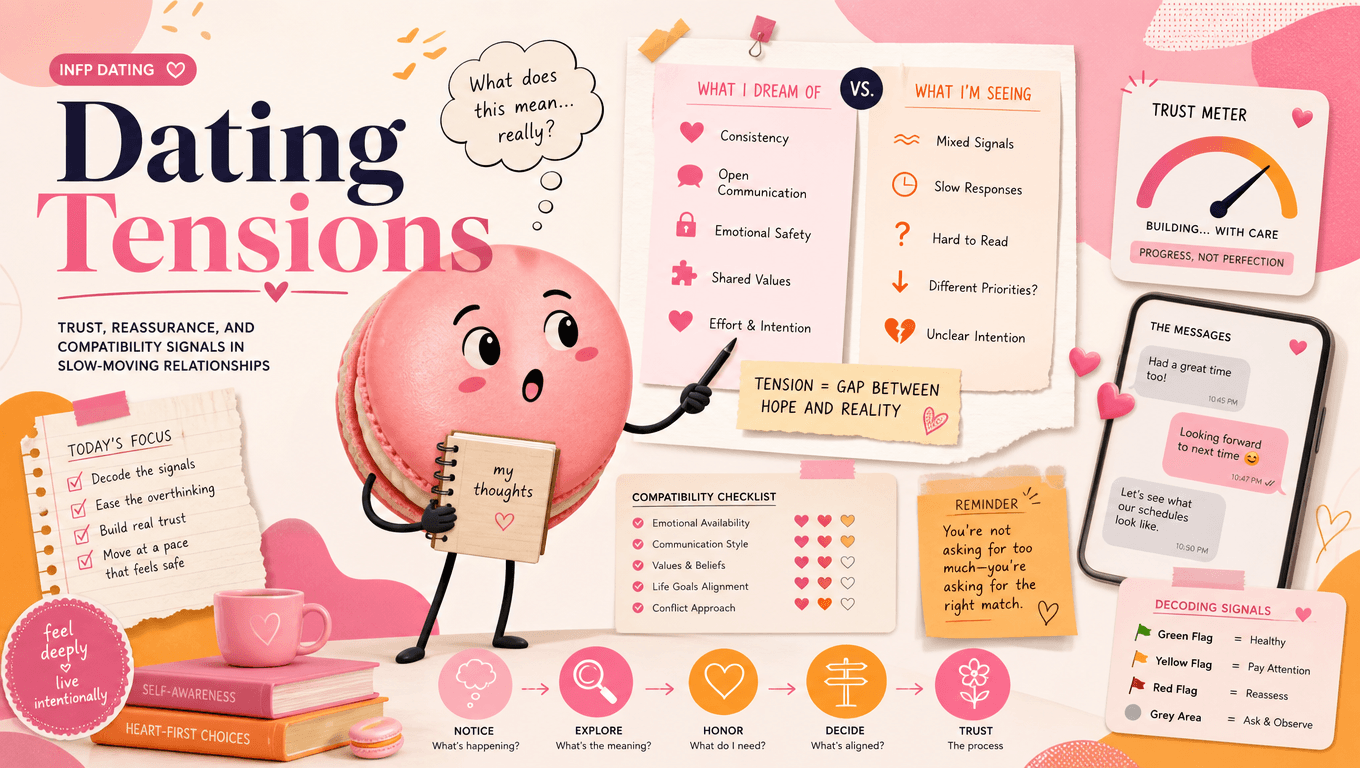
Common Dating Tensions
Macaron helps you examine what makes trust feel real, how much reassurance matters, when sensitivity is guiding you well, when hope is masking mismatch, and which signals point to genuine compatibility. This is especially useful when you are trying to decide whether a slow pace is healthy or whether it is simply a sign that the other person is not as invested as you are. The tension is often between wanting to stay open and needing enough evidence to feel secure. Clearer reflection can help you avoid confusing emotional intensity with relational stability.
Build a More Grounded Dating Life
Macaron turns INFP dating into practical support through dating reflection prompts, communication check-ins, clarity around emotional pacing, mixed-signal reviews, and support for stronger boundaries and self-trust. These tools are useful when you know you care deeply but are not sure whether the relationship is actually moving in a healthy direction. Instead of asking you to become less sensitive, the goal is to help you use that sensitivity with more structure. That can make it easier to ask direct questions, notice patterns sooner, and protect your energy without shutting down connection.
Frequently Asked Questions
INFP dating can help you reflect on pacing, sincerity, mixed signals, emotional safety, and whether a connection feels workable beyond idealization. It is especially useful when you are trying to tell the difference between a relationship that is genuinely developing and one that only feels meaningful because it is emotionally vivid. The reflection can also help you notice whether your needs are being met in practice, not just in intention.
That can happen when emotional resonance, shared values, or hope for depth creates a strong sense of significance early on. For many people, that feeling is not random. It often comes from noticing a rare sense of understanding or possibility. The challenge is that early meaning can be real without being enough to prove compatibility, so it helps to let time and behavior confirm what the feeling suggests.
Not always, but emotional meaning and authenticity often matter even in early stages. Some INFP-leaning daters are comfortable keeping things light if the interaction still feels honest, respectful, and low-pressure. Others find casual dating draining because it can feel vague or disconnected from their values. The key is not whether casual dating is inherently hard, but whether the format fits your emotional needs and communication style.
Macaron helps you notice where hope, inconsistency, or uneven effort is shaping the connection more than clarity or reciprocity. That matters because mixed signals can feel especially powerful when you are already invested in the possibility of depth. By slowing the pattern down, Macaron helps you ask whether the other person is actually showing up in a way that supports trust, or whether you are carrying the emotional meaning on your own.
The main tradeoff is that a strong preference for depth can make it easier to overlook practical signs of mismatch. Wanting a relationship to feel authentic is a real strength, but it can also lead to staying too long in situations that are emotionally interesting but not dependable. Macaron helps by keeping your standards visible while still respecting your need for sincerity and emotional resonance.
Macaron focuses on reflection rather than telling you to date a certain way or fit a personality stereotype. That makes it useful for people who want more nuance than broad compatibility charts or one-size-fits-all tips. The tradeoff is that it does not replace direct communication or real-world judgment. Apps that specialize in matching or messaging can still be better for logistics, while Macaron is better for clarifying what the connection means to you. For a third-party check, INFP Relationships, Love, & Compatibility - Personality Junkie at https://personalityjunkie.com/infp-relationships-dating-love-compatibility/ is worth comparing against the page summary.
If you notice idealization, the most useful step is to slow down and compare your interpretation with the other person’s actual behavior. Ask what you know, what you are assuming, and what would need to happen for trust to be earned. Macaron is helpful here because it turns that pause into a repeatable reflection process. It will not remove hope, but it can help you keep hope from doing the job of evidence. For another outside reference, The 5 Biggest Dating Struggles of an INFP Personality - Introvert, Dear at https://introvertdear.com/news/infp-dating-struggles/ adds a second perspective.
Yes, two people with INFP-leaning patterns can date successfully if they can communicate clearly, handle uncertainty, and keep expectations grounded. Shared sensitivity can create a lot of understanding, but it can also make it easier for both people to avoid direct conversations. The relationship works best when both partners can name needs, follow through, and avoid turning mutual idealism into a substitute for practical compatibility. For outside context, Romantic Relationships | INFP Personality (Mediator) | 16Personalities at https://www.16personalities.com/infp-relationships-dating is a useful reference point.
Read & discover
AI Personal Assistant
Free calculators


