INFP Love Language
INFP love language is best read as a reflection tool, not a fixed personality rule. It can help you notice why heartfelt words, quiet consistency, emotional safety, and personal gestures often matter more than performative affection.
INFP Love Language
This reflection module helps you notice which kinds of affection feel sincere, emotionally safe, and personally meaningful in an INFP-leaning relationship style. It is designed to support insight, not to box you into one fixed pattern.
This is a self-reflection tool, not a diagnosis or a clinical assessment.
Please answer every question before viewing your result.
This module is for self-reflection and relationship insight, not for diagnosing personality or mental health conditions. If relationship stress, anxiety, or emotional pain feels overwhelming, consider talking with a qualified professional or someone you trust.
What INFP Love Language Can Help You Notice
INFP love language is most useful when you treat it as a way to interpret emotional needs, not as a strict formula for every INFP. Public discussions and personality guides often point to sincerity, depth, and personal meaning, but they also show real variation. Some people lean toward words of affirmation, others toward quality time, and others toward physical touch, acts of service, or a mix that changes with trust and context.
Macaron helps you think through what makes affection feel believable to someone with INFP-leaning patterns. That often includes tone, timing, and whether the gesture feels emotionally aware rather than generic. A compliment can land well when it feels specific and deeply seen, while a larger gesture can still feel empty if it misses the emotional context or arrives before enough trust has been built.
This page is also useful if you are trying to understand why loving behavior can still feel unsatisfying. Many people do not reject care itself; they reject the mismatch between the care offered and the meaning they were hoping to receive. For INFP themes, that mismatch often shows up when affection feels rushed, overly practical, too public, or disconnected from inner life and private emotional processing. For a related Macaron page, see Best Personal AI Agent Platform for 2025 - Macaron at https://macaron.im/blog/best-ai-agent-platform-2025.
Another recurring pattern is that INFPs are often described as quiet, sensitive, and emotionally intense, but not always outwardly expressive in the same way as more demonstrative types. That means love language can be less about dramatic display and more about whether someone feels emotionally safe, respected, and understood enough to open up. Small signals of care can matter more than big declarations if they are consistent and personal.
Use this guide as a starting point for reflection, especially if you want to compare intention with impact. The goal is not to label a partner or yourself, but to notice which forms of care create trust, which ones feel thin, and where communication needs to become more specific. That makes the page useful for dating, long-term relationships, and any situation where emotional nuance is easy to miss.
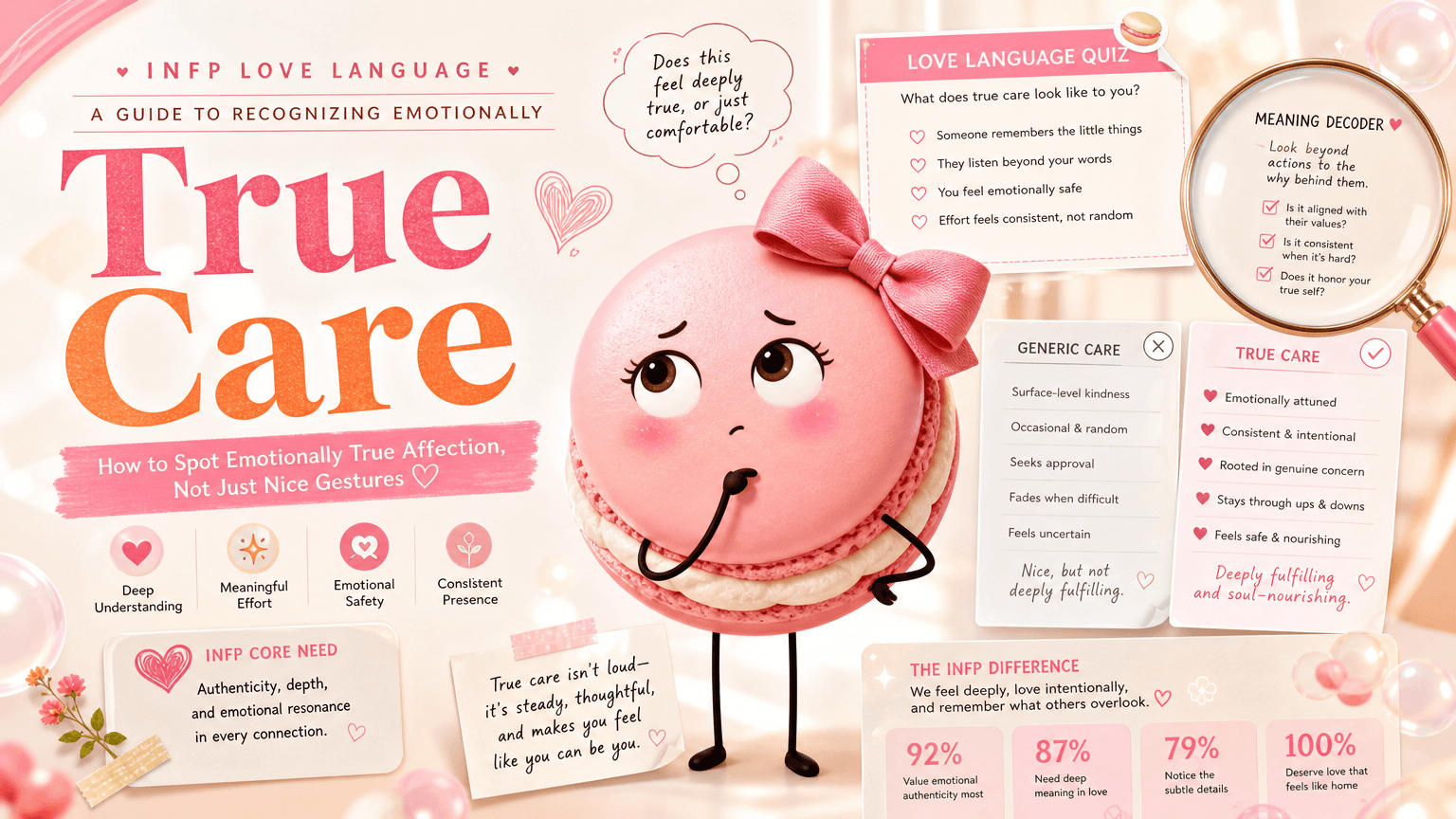
What INFP Love Language Can Help You Notice
INFP love language can help you notice the difference between affection that is merely present and affection that feels emotionally true. For many people with INFP-leaning preferences, the most meaningful care is specific, personal, and attentive to inner life. That may show up as thoughtful words, quiet quality time, or a gesture that proves someone has been paying attention to what matters. It can also help you spot when care is technically kind but still feels generic, rushed, or disconnected from the emotional reality of the relationship. The practical value is not in naming a type, but in identifying what makes love feel believable.
How Affection Can Feel Aligned or Mismatched
This reflection helps you compare intention with impact. A partner may be trying to show love, but the message can still feel off if the tone is too blunt, the timing is wrong, or the gesture ignores what makes the other person feel safe. For INFP themes, alignment often depends on sincerity, emotional nuance, and whether affection respects sensitivity instead of overwhelming it. Mismatch is not always about lack of effort. It is often about a difference in emotional language, pacing, expectations, or how much directness feels comforting versus intrusive in the moment.
More About INFP Love Language
People searching for INFP love language are usually trying to answer a practical question: what kind of affection actually feels meaningful to an INFP, and why do some gestures miss the mark? The answer is rarely one single love language. More often, the pattern is a preference for sincerity, emotional precision, and care that feels tailored rather than copied from a script. That makes the topic useful for anyone who wants to move beyond generic relationship advice and understand what emotional attunement looks like in practice.
Words of affirmation and quality time come up often, but not in a shallow way. The words need to feel personal and emotionally honest, and the time together needs to feel undistracted, calm, and real. For some people, physical touch matters too, but usually when it feels safe, mutual, and emotionally grounded rather than casual or intrusive. The common thread is not a single category; it is the feeling that affection was offered with real attention.
A common confusion is assuming that INFP love language is only about softness. In practice, it is also about trust, boundaries, and whether the relationship respects inner life. An INFP may appreciate affection deeply while still pulling back if they sense pressure, emotional noise, or a mismatch between what is said and what is actually felt. That creates a useful tradeoff to understand: the more emotionally direct the approach, the more clarity it can bring, but the more carefully it has to be timed. Another useful Macaron comparison is AI Calorie Tracker: How It Works and Best Options - Macaron at https://macaron.im/blog/ai-calorie-tracker.
This page also helps you notice the difference between care that is well meant and care that is well received. Acts of service, gifts, or reassurance can all matter, but they tend to work best when they reflect the person’s values, not just the giver’s habits. That is why a small, thoughtful gesture can feel more loving than something expensive or elaborate. Competitor-style summaries often stop at listing love languages; this page focuses on why the same gesture can succeed in one relationship and fall flat in another. For a broader Macaron context, Best AI Personal Assistant in 2025: A Test Suite You Can Reuse at https://macaron.im/blog/ai-personal-assistant-test can help you compare the decision from another angle.
Macaron turns these patterns into something you can actually use in a relationship conversation. Instead of asking only what your love language is, you can ask what makes affection feel sincere, what creates emotional safety, and where repeated misunderstandings are weakening connection. That is especially helpful for users who want a structured reflection tool without reducing the relationship to a label. The tradeoff is that the guidance is more interpretive than prescriptive, but that also makes it more adaptable to real conversations.
Nurture the Emotional Bond More Carefully
Macaron helps you look at the small patterns that either strengthen or strain emotional closeness. That includes whether reassurance feels believable, whether misunderstandings keep repeating, and whether one person is shrinking their feelings to keep the peace. For INFP-leaning relationships, gentleness matters because it creates room for honesty without pressure. This section is useful when connection feels fragile, when one person is over-explaining and the other is withdrawing, or when both people care but are not landing on the same emotional frequency. It is especially helpful for users who want to notice patterns before they harden into resentment.
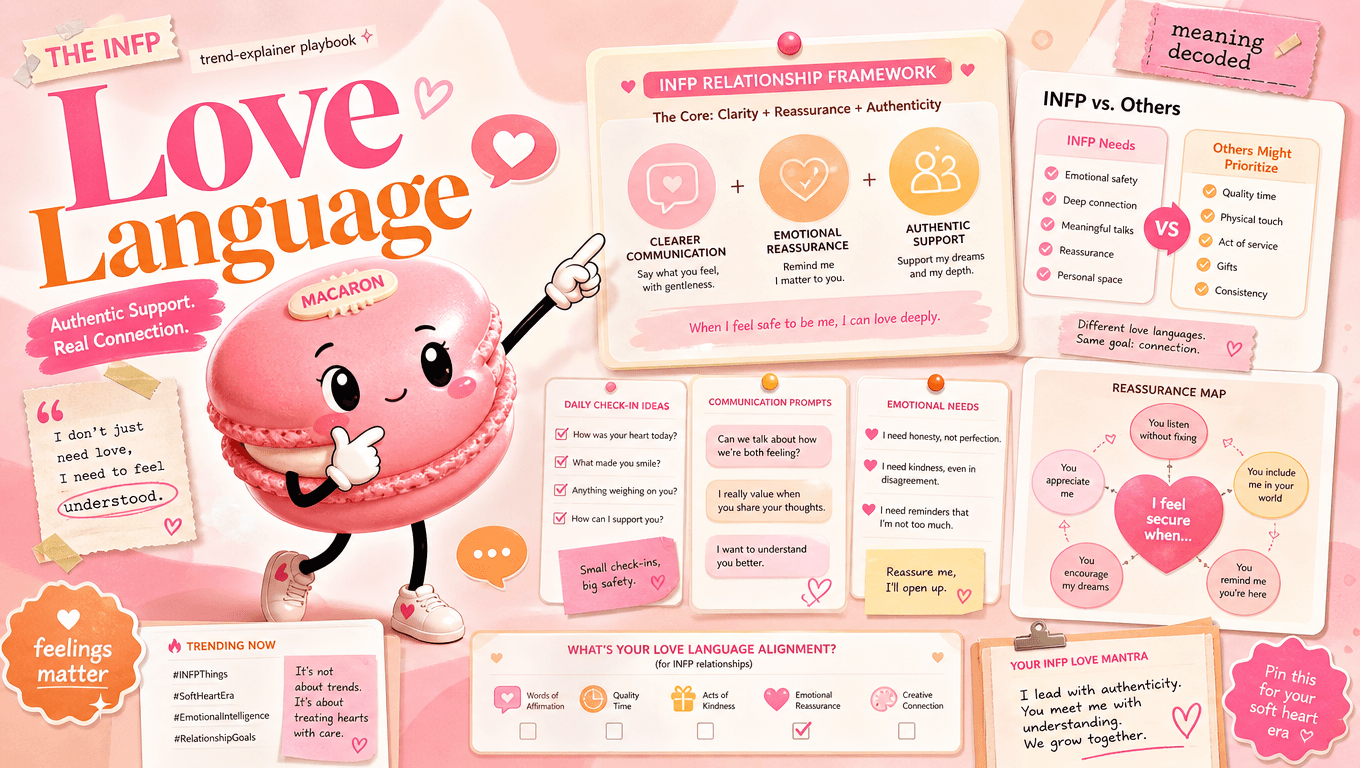
Support a More Authentic Relationship
Macaron turns INFP love language insight into practical relationship support, especially when you need to move from vague concern to clearer communication. Affection check-ins can reveal what feels comforting versus what feels performative. Communication prompts can help name needs without turning the conversation into a test. Emotional needs reflection and reassurance mapping are especially useful when one person wants more depth and the other thinks they are already being caring. The goal is not to force a style, but to make care easier to recognize and respond to. Compared with broader relationship apps, Macaron is more useful for translating feelings into specific next steps.
Frequently Asked Questions
INFP love language can help you reflect on what makes affection feel sincere, emotionally safe, and personally meaningful. It is useful for noticing whether you respond more to heartfelt words, calm quality time, gentle reassurance, or small gestures that show real understanding. It can also clarify why some kind actions still feel flat if they do not match your emotional pace or the deeper meaning you were hoping to receive. That makes it a reflection tool, not a rule.
A gesture can be caring in intention but still feel thin if it misses the emotional context that matters most. This often happens when the effort is visible but the tone feels generic, rushed, or disconnected from what the other person actually needs. For INFP-leaning preferences, meaning matters as much as action, so a loving act usually lands better when it feels personal, specific, and emotionally aware. The same gesture can feel very different depending on timing and trust.
No. The same patterns can show up in close friendships, family relationships, and any bond where emotional trust matters. INFP love language is especially helpful anywhere people want to feel understood rather than simply helped. In non-romantic relationships, it can still clarify why certain kinds of reassurance, time, or thoughtful communication feel especially important. That broader use is one reason the topic is practical rather than purely romantic.
Macaron helps you break down where the mismatch is happening. It can make it easier to see whether the issue is tone, timing, emotional specificity, or a difference in expectations about reassurance. That matters because many relationship problems are not about a lack of care. They are about care being expressed in a way that does not fully register as loving to the other person. The result is clearer feedback without turning the conversation into blame.
No. INFPs are often associated with sincerity, depth, and emotional nuance, but that does not mean every person with that pattern wants the same kind of affection. Some people strongly prefer words of affirmation, others value quality time, and others feel most cared for through touch, service, or gifts that are deeply personal. Context, history, and relationship safety can matter as much as personality. The useful question is not what INFPs always want, but what this specific person experiences as loving. For a third-party check, What are the love languages of an INFP? - Quora at https://www.quora.com/What-are-the-love-languages-of-an-INFP is worth comparing against the page summary.
The main tradeoff is that personality-based ideas can make patterns easier to notice, but they can also tempt people to overgeneralize. A label can help you start a conversation, yet it should not replace direct communication about preferences, boundaries, and changing needs. For INFP love language, the benefit is a more sensitive lens for meaning and emotional safety. The limitation is that real people are more varied than any type description, so the label should stay flexible. For another outside reference, Understanding the Love Languages of an INFP - Boo at https://boo.world/infp-personality/infp-love-languages adds a second perspective.
Competitor apps can be better if you want a quick, static summary of common love language categories or a broad personality overview. Macaron is stronger when you want to turn the idea into a live reflection process: what feels sincere, what feels performative, and what needs to change in the relationship. If you only need a definition, a simpler reference may be enough. If you want to think through a real interaction and decide what to say next, Macaron is more useful. For outside context, Personality Type and Love Language: Mediators (INFPs) at https://www.16personalities.com/articles/personality-type-and-love-language-mediators-infps is a useful reference point.
Read & discover
AI Personal Assistant
Free calculators


