INTJ Compatibility
INTJ compatibility is easier to read when you look beyond type labels and focus on how two people handle clarity, independence, emotional expression, and conflict. Macaron helps you turn those patterns into practical relationship insight instead of vague personality advice.
INTJ Compatibility
This module helps you reflect on how INTJ compatibility shows up in real relationships, including communication, independence, trust, and emotional pacing. It is designed to highlight patterns that may support or strain connection, not to rank people or predict outcomes.
This is a self-reflection tool, not a diagnosis or a scientific assessment of relationship success.
Please answer every question before viewing your result.
This reflection tool is meant to support self-understanding, not to label you or your relationships. If a relationship feels unsafe, controlling, or emotionally harmful, prioritize support from trusted people or a qualified professional.
Why INTJ Compatibility Depends on Respect, Clarity, and Long-Term Logic
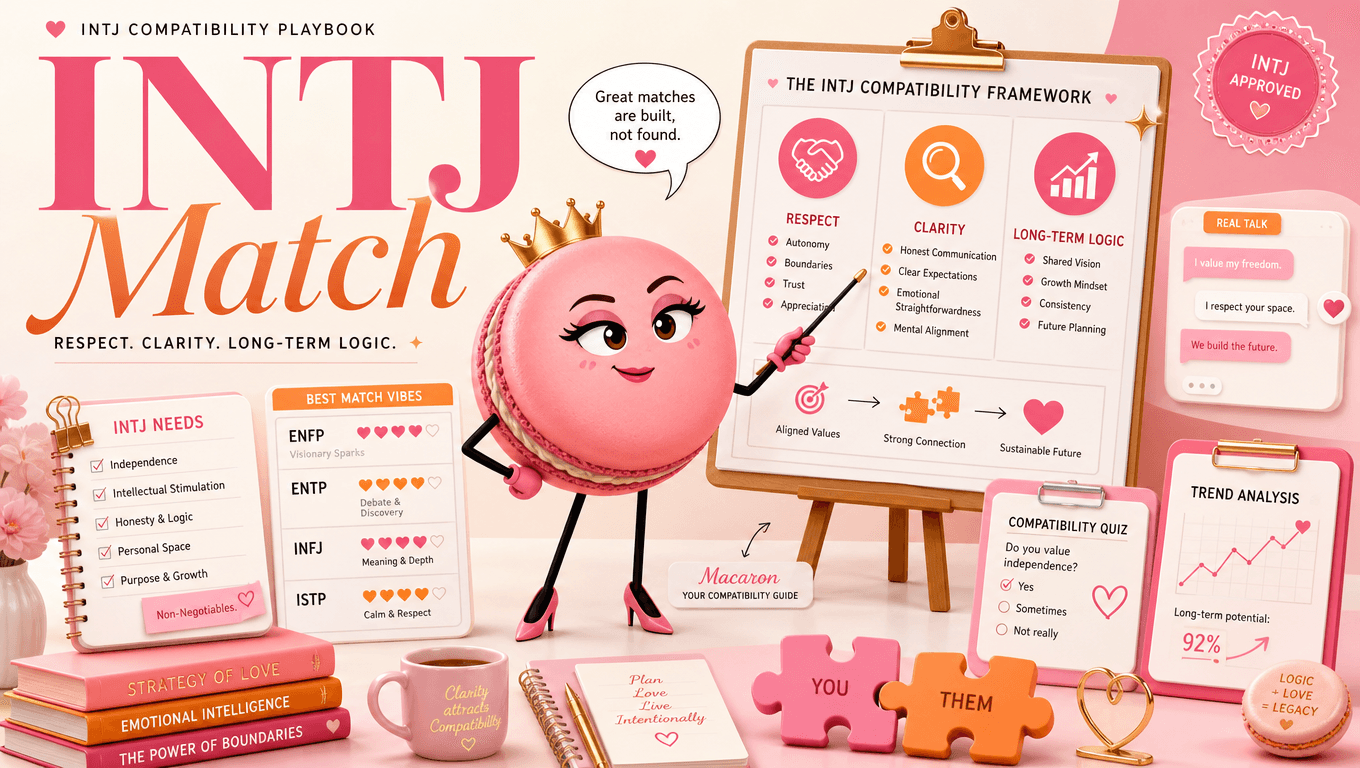
INTJ compatibility is usually less about finding a perfect type match and more about whether the other person can work with direct communication, strong boundaries, and a preference for substance over performance. Many people want a simple soulmate answer, but the real question is often whether the relationship can handle honesty, pace, and independence without turning every difference into tension. That makes compatibility a practical test of behavior, not just attraction.
Macaron helps you read INTJ compatibility in a more grounded way by looking at trust, emotional expression, and how each person responds when plans change or feelings get complicated. That matters because INTJs are often described as selective, strategic, and future-focused, which means compatibility depends on whether the relationship supports long-term thinking rather than short-term chemistry alone. The useful question is not just who feels exciting, but who feels sustainable.
A useful INTJ compatibility check also includes the less obvious friction points. For example, a partner may be intellectually engaging but still create strain if they communicate indirectly, need constant reassurance, or expect emotional availability in a style that feels overwhelming. On the other hand, a relationship can feel stable and energizing when both people respect autonomy and can talk through problems without pressure or guesswork. The difference is often in pacing, not just values. For a related Macaron page, see AI Personal Assistant - Macaron at https://macaron.im/ai-personal-assistant.
This page is designed for people who want more than a tier list. common user discussions around INTJ compatibility often compare types, but those comparisons can oversimplify what actually makes a relationship work. Macaron focuses on the recurring patterns that shape real compatibility, including how conflict is handled, how quickly trust builds, and whether both people can stay connected without losing their independence. That gives you a clearer read on what is happening now, not just what a type chart predicts.
If you are trying to understand a romantic partner, a friend, or a coworker, INTJ compatibility becomes most useful when it helps you name the pattern clearly. That can mean noticing where communication is efficient but emotionally thin, where differences are productive versus draining, and where the relationship needs a reset rather than a verdict. The goal is not to force a match, but to understand whether the connection has enough clarity and respect to grow.
Why INTJ Compatibility Depends on Respect, Clarity, and Long-Term Logic
INTJ compatibility usually improves when both people value clear expectations, direct language, and enough independence to think and act without constant checking in. INTJs are often drawn to relationships that feel purposeful, not performative, so compatibility tends to be stronger when the other person can handle candor, keep commitments, and think beyond immediate mood. The challenge is that strong logic alone is not enough. If one person needs ambiguity, frequent reassurance, or emotionally indirect communication, the relationship can feel tiring even when the attraction is real. Compatibility is strongest when respect and long-term alignment are visible in everyday behavior, not just in shared ideas.
How Macaron Helps INTJs Read Emotional Friction Before It Turns Into Distance
Macaron helps INTJs notice the early signs of emotional friction that often show up as silence, over-analysis, or a growing sense of mismatch. Instead of waiting for a conflict to become obvious, it helps you examine whether communication is actually clear, whether emotional needs are being acknowledged, and whether independence is still creating connection rather than quiet separation. This is especially useful in relationships where one person wants logic and the other wants reassurance, because the same conversation can feel efficient to one side and dismissive to the other. The goal is not to label the relationship as good or bad, but to understand what pattern is repeating and what it is costing you.
More About INTJ Compatibility
INTJ compatibility is often discussed as if it were a fixed ranking, but the more practical view is that it depends on how two people manage structure, honesty, and emotional pacing. Some pairings feel easy because both people value competence and clarity, while others work only when each person is willing to adapt their style without feeling controlled. That makes compatibility less about a perfect label and more about whether the relationship can stay functional under real pressure.
Searches for INTJ compatibility often reveal a second layer of confusion: people want to know whether a relationship is naturally strong, merely workable, or likely to require ongoing effort. Macaron helps separate those possibilities by examining the habits that create stability, such as consistency, follow-through, and mutual respect for space. This is useful because a relationship can look promising on paper and still fail if the day-to-day rhythm is mismatched.
The biggest compatibility issues are not always dramatic. In many INTJ relationships, the strain comes from vague expectations, mismatched communication styles, or one person interpreting quietness as distance and the other interpreting emotion as pressure. Those patterns can be subtle at first, which is why a more detailed read is often more useful than a generic type summary. Macaron is designed to surface those patterns early, before they harden into assumptions. Another useful Macaron comparison is Macaron App - Download for iOS & Android at https://macaron.im/macaron-app.
INTJ compatibility also changes depending on context. Romantic relationships may need more emotional reassurance, friendships may rely more on shared interests and low-drama trust, and work relationships usually depend on clarity, competence, and predictable communication. A good compatibility read should account for those differences instead of treating every relationship the same. That context matters because the same trait can be a strength in one setting and a source of friction in another. For a broader Macaron context, AI Story App - Macaron at https://macaron.im/ai-story-app can help you compare the decision from another angle.
Macaron turns INTJ compatibility into something you can actually use by helping you identify what is working, what is merely tolerable, and what needs a direct conversation. That makes the page useful not just for curiosity, but for deciding whether to adjust expectations, set boundaries, or invest more seriously in the relationship. The tradeoff is that this approach is more nuanced than a simple compatibility score, but it is also more useful when the relationship is real.
Which Relationship Dynamics Work With INTJ Independence and Which Ones Create Drag
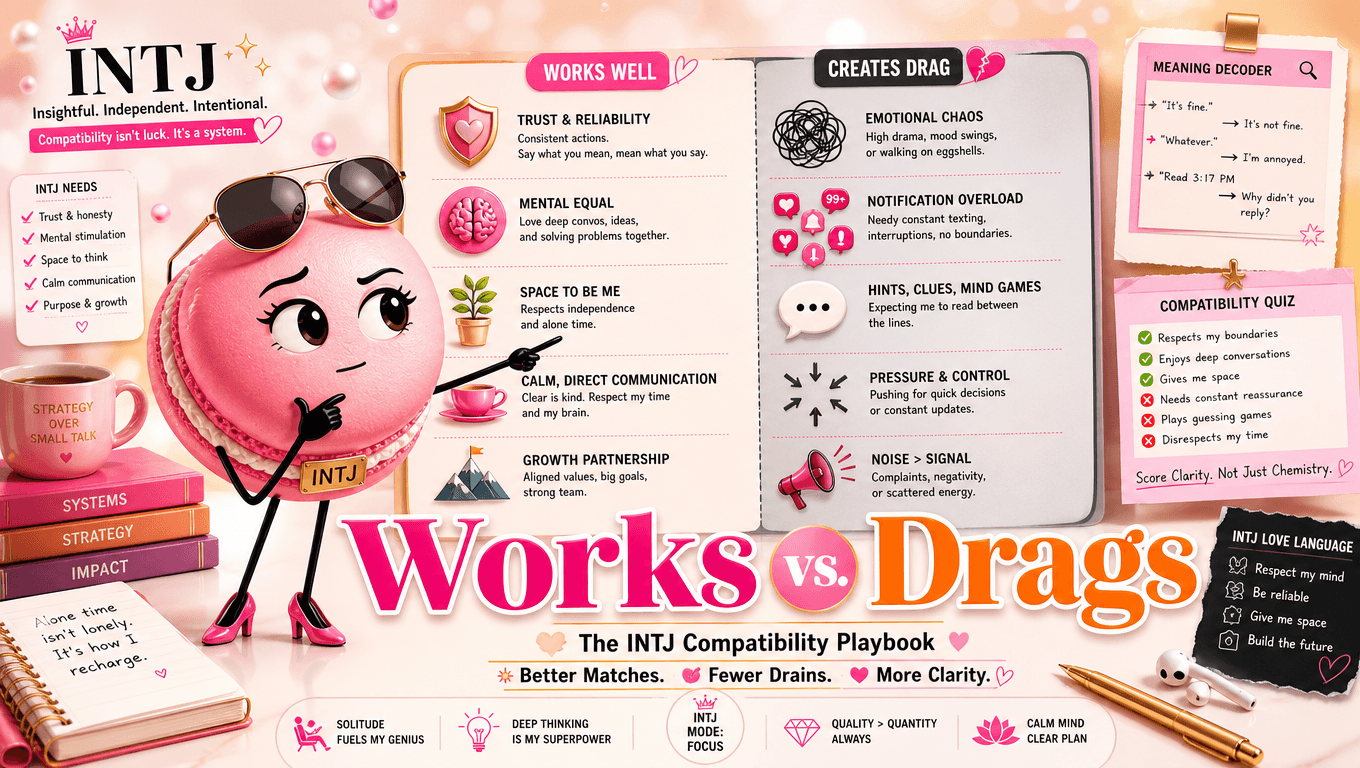
Some relationships work well with INTJ independence because they leave room for solitude, deep thinking, and self-direction while still maintaining warmth and reliability. Others create drag when they rely on unpredictability, indirect hints, emotional tests, or constant pressure to respond in the moment. For INTJs, the difference often comes down to whether the relationship feels calm and intentional or mentally noisy and hard to trust. Macaron helps you sort through that by looking at what makes trust feel solid, which differences are actually workable, and where the relationship may be asking for growth that is realistic versus exhausting. That makes the dynamic easier to interpret in practical terms.
Build INTJ Relationships That Feel Direct, Stable, and Deep
Macaron turns INTJ compatibility into a set of practical next steps instead of a vague personality verdict. That includes reflection prompts that help you name what you need, communication resets that reduce confusion, conflict planning that prepares you for hard conversations, boundary clarity that protects energy, and long-term fit check-ins that keep the relationship honest over time. These tools are useful because INTJ relationships often improve when expectations are explicit and revisited, not assumed. Whether the relationship is romantic, platonic, or professional, the aim is to create a structure where depth does not come at the expense of stability. Competitor type guides may offer broader pairing theories, but Macaron is better when you want to act on a specific relationship.
Frequently Asked Questions
INTJ compatibility is shaped most by communication style, trust, emotional pacing, respect for independence, and whether both people want the relationship to move in a clear long-term direction. A strong match usually feels calm, direct, and consistent, while weaker matches often involve mixed signals, pressure to react quickly, or repeated misunderstandings about emotional needs. It also helps when both people can disagree without turning the conversation into a power struggle or a withdrawal pattern.
In a work relationship, INTJ compatibility is less about chemistry and more about whether collaboration feels efficient, respectful, and predictable. Use the insights to check how expectations are set, whether feedback is direct enough to be useful, and whether conflict is handled in a way that solves problems instead of creating confusion. This can help you decide when to clarify roles, when to ask for more structure, and when a communication reset would improve the working dynamic.
Emotionally intense relationships can feel draining for INTJs when intensity replaces clarity. If feelings are expressed in a way that is frequent, urgent, or hard to interpret, INTJs may spend a lot of energy trying to analyze what is happening instead of simply connecting. The strain usually grows when there is no shared method for handling reassurance, conflict, or uncertainty, so the relationship starts to feel like constant emotional problem-solving rather than mutual support.
Macaron is more useful than a static type summary because it helps you apply INTJ compatibility to a real situation instead of a general stereotype. Rather than telling you who should or should not work, it encourages you to look at the actual patterns in communication, trust, pacing, and conflict. That makes it easier to understand whether a relationship needs more patience, clearer boundaries, or a different expectation altogether.
INTJs often find it easiest to connect with people who are direct, self-contained, and comfortable with thoughtful conversation. Types that bring intellectual stimulation and respect for autonomy can feel especially natural, but the real advantage is not the label itself. It is the ability to communicate clearly, avoid unnecessary drama, and stay consistent over time. A type match can still fail if the person is unreliable or emotionally mismatched.
Yes, two INTJs can have a very strong relationship when they share goals, respect each other’s independence, and communicate without turning every disagreement into a strategic contest. The upside is usually strong mutual understanding, efficient problem-solving, and a shared preference for depth over small talk. The tradeoff is that both people may under-express feelings or assume the other already understands them, so the relationship still needs deliberate emotional check-ins. For a third-party check, INTJ Relationships, Love, & Compatibility | Personality Junkie at https://personalityjunkie.com/intj-relationships-dating-love-compatibility/ is worth comparing against the page summary.
The biggest challenge in INTJ friendships is often not conflict, but drift. INTJs may value friendships that are low-maintenance and meaningful, yet that same preference can lead to long gaps, unspoken expectations, or a sense that the friendship is fine until it suddenly feels distant. Macaron is helpful here because it can surface whether the friendship is simply quiet, or whether both people are slowly disengaging without naming it. For another outside reference, Romantic Relationships | INTJ Personality (Architect) - 16Personalities at https://www.16personalities.com/intj-relationships-dating adds a second perspective.
Type charts can be a useful starting point, but they are not enough to judge INTJ compatibility on their own. They usually describe broad tendencies, not the actual habits that make a relationship succeed or fail. Real compatibility depends on how two people handle trust, repair conflict, manage space, and respond to emotional needs. That is why a more detailed read is better when you are deciding whether to invest, adjust expectations, or have a direct conversation. For outside context, INTJ Relationships & Compatibility With Other Personality Types at https://www.truity.com/blog/personality-type/intj/relationships is a useful reference point.
Read & discover
AI Personal Assistant
Free calculators


