INTJ In Love
INTJ in love often looks calm and self-contained at first, but the attachment underneath can be serious, loyal, and highly intentional. This guide explains how INTJs tend to show care, where relationships get complicated, and what helps love feel secure without forcing emotional performance.
INTJ In Love
This short self-reflection helps you notice how INTJ-style affection may show up in real relationships, especially through trust, consistency, and emotional pacing. It is designed to support clearer communication and self-understanding, not to label you or your partner.
This is a reflective tool for personal insight only, not a diagnosis or a clinical assessment.
Please answer every question before viewing your result.
This module is for self-reflection and relationship insight only. If your relationship involves fear, control, threats, or emotional harm, consider reaching out to a trusted person or a qualified professional for support.
How INTJs Experience and Express Love
INTJ in love is often less about dramatic displays and more about deliberate investment. Once an INTJ decides a relationship matters, they may become steady, attentive, and unusually committed, even if they still seem reserved on the surface. That contrast is one reason people search this term: the feelings can be strong, but the expression is often subtle and easy to misread. For many INTJs, love is not a mood they perform; it is a decision they reinforce through consistency, attention, and follow-through.
A common pattern is that INTJs show affection through actions before words. They may solve problems, remember details, make plans, or offer practical support instead of relying on frequent verbal reassurance. In relationship expert and community discussions, this often comes up as acts of service, direct honesty, and long-term thinking rather than sentimental language. That can be reassuring for partners who value reliability, but it can also leave room for confusion if someone expects warmth to be expressed in obvious, immediate ways.
At the same time, INTJ in love can involve hesitation. Many INTJs want enough trust, competence, and emotional clarity before they fully open up, which can make early dating feel slow or hard to read. If a partner expects constant outward warmth, the INTJ may seem distant even while caring deeply and thinking seriously about the future. The tradeoff is that this caution can protect the relationship from impulsive attachment, but it can also delay reassurance when a partner needs it most. For a related Macaron page, see Best Free AI Calorie Trackers You Can Start Today - Macaron at https://macaron.im/blog/free-ai-calorie-tracker.
This page is designed to clarify that gap between feeling and expression. It focuses on how INTJs tend to experience love internally, why emotional conflict can feel especially draining, and how independence, vulnerability, and consistency all shape whether the relationship feels safe or strained. It also helps distinguish between healthy reserve and avoidant behavior, since those can look similar from the outside but have very different effects on trust and closeness.
If you are trying to understand your own INTJ love style or make sense of an INTJ partner, the useful question is usually not whether they care, but how they communicate care. Looking at trust, boundaries, reassurance, and shared goals often reveals more than looking for obvious romance alone. Macaron is useful here because it turns vague relationship patterns into concrete reflection prompts, while still leaving room for the fact that some partners need more overt affection than an INTJ naturally gives.
How INTJs Experience and Express Love
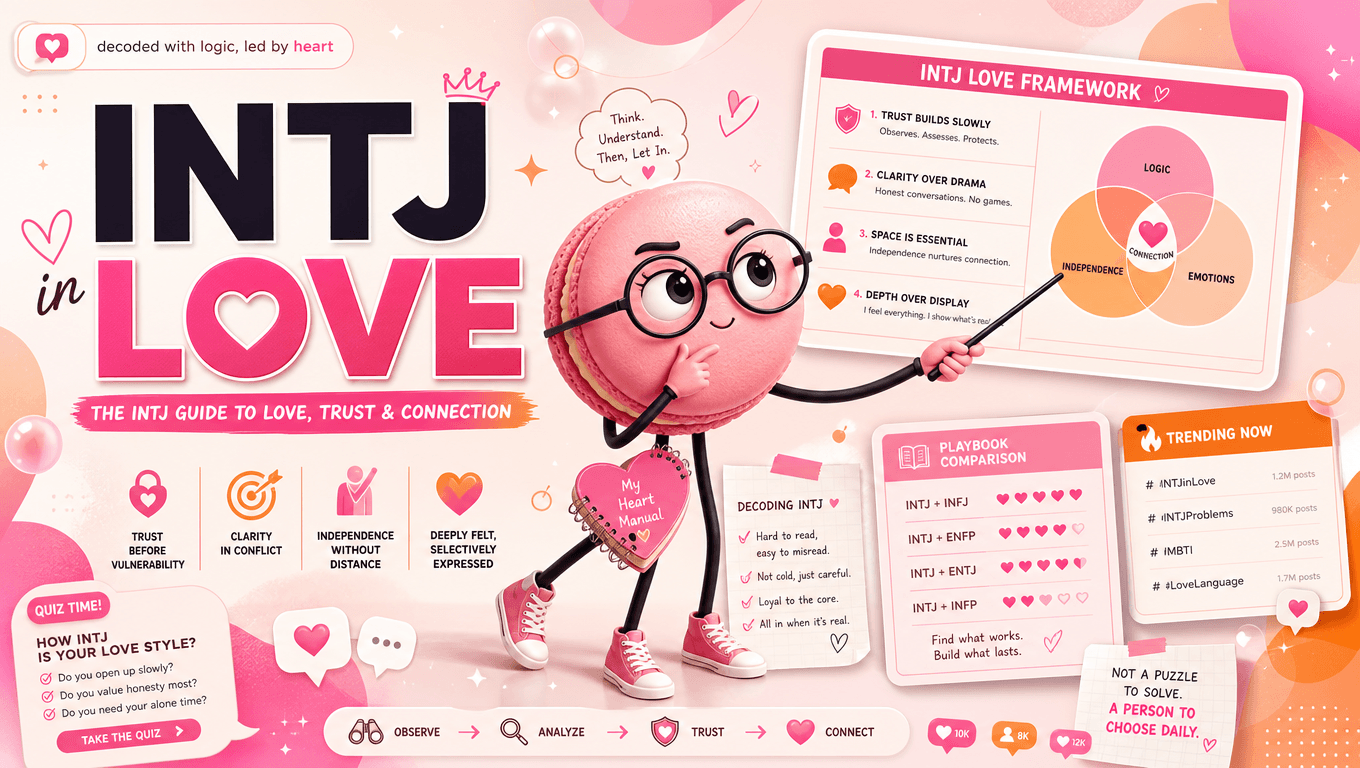
INTJ in love is rarely casual once the bond feels real. Many INTJs move carefully at first, then invest with unusual depth and consistency, which can surprise partners who only notice the reserved exterior. Their affection often shows up through practical support, thoughtful planning, remembering what matters, and making life easier in small but meaningful ways. They may not say everything out loud, but they often communicate commitment through reliability, follow-through, and a willingness to stay engaged when the relationship has real long-term potential. This style tends to work best with partners who notice actions as evidence of care, not just words.
Why Love Can Feel Complicated for INTJs
Macaron uses INTJ in love as a reflection lens for patterns such as holding back until trust feels solid, struggling to translate feeling into visible warmth, wanting clarity during emotional conflict, needing independence without creating distance, and feeling deeply while expressing selectively. These patterns are common because INTJs often prefer certainty, privacy, and emotional control before they fully open up. The challenge is that what feels careful and respectful from the inside can look distant or hard to read from the outside, especially if a partner expects quick reassurance or frequent verbal affection. That mismatch is where many misunderstandings begin.
More About INTJ In Love
INTJ in love is usually easiest to understand when you look at behavior over performance. Many INTJs are not trying to be mysterious on purpose, but they often prefer sincerity, usefulness, and consistency over highly expressive affection. That means love may show up as follow-through, thoughtful planning, or a willingness to help in concrete ways, especially when the relationship feels worth protecting. For partners who value reliability, this can feel deeply grounding; for partners who need visible emotional warmth, it may feel understated.
A second pattern is that emotional closeness often develops slowly and selectively. INTJs may share ideas, future plans, and personal opinions before they share softer feelings, because intellectual trust can feel safer than immediate vulnerability. This can create confusion if a partner reads caution as disinterest, when it may actually be a sign that the INTJ is taking the bond seriously. The upside is that once trust is earned, the connection can become unusually stable; the downside is that early uncertainty can last longer than some partners expect.
Conflict is another place where INTJ in love becomes more complicated. When emotions rise quickly, some INTJs default to analysis, problem-solving, or withdrawal rather than immediate comfort. That does not always mean they do not care. It often means they want clarity, space to think, and a way to resolve the issue without feeling overwhelmed or cornered. Competitor relationship guides often stop at this observation, but the more useful question is what happens next: whether the INTJ returns with a solution, or whether silence becomes a pattern that leaves the partner carrying the emotional load alone. Another useful Macaron comparison is Macaron App Download (iOS & Android): Official, Safe, and Fast Install at https://macaron.im/blog/macaron-app-download.
What INTJs need to feel loved is often more specific than generic reassurance. They tend to respond well to honesty, competence, respect for independence, and partners who can state needs directly without games or pressure. They may also value admiration for their effort and capability, since feeling understood can matter as much as feeling desired. The tradeoff is that a partner who is very expressive but inconsistent may not feel safe to them, while a partner who is calm and direct may build trust quickly even without much romance theater. For a broader Macaron context, How to Write Better Prompts for Macaron AI at https://macaron.im/blog/macaron-ai-prompt-engineering-guide can help you compare the decision from another angle.
Macaron turns these patterns into practical reflection tools, so the idea of INTJ in love becomes easier to apply in real relationships. Instead of asking for a perfect personality match, the goal is to notice what builds trust, what creates distance, and which habits make the connection feel steadier over time. That makes the guidance useful for both self-understanding and partner communication. It is especially helpful for users who want to compare intention with behavior, since many relationship problems come from assuming the other person already understands what was meant.
What INTJs Need to Feel Loved
Some INTJs feel closest in relationships that combine honesty, competence, and emotional steadiness. Others shut down when the connection feels unpredictable, intrusive, or emotionally chaotic, especially if they sense pressure to react before they have processed what they feel. Macaron helps you reflect on what makes trust feel earned, how reassurance actually lands, when independence feels healthy, where directness helps or hardens the bond, and which relationship habits make love feel more secure. The point is to identify the conditions that let affection feel safe enough to deepen, while also noticing where a partner may need more warmth than you naturally give.

Build a More Honest Love Life
Macaron turns INTJ in love insight into practical support through relationship reflection prompts, communication check-ins, conflict planning, boundary clarity, and support for naming needs earlier. That matters because many INTJs do not struggle with commitment as much as they struggle with timing and expression. They may know what they want only after they have already gone quiet or pulled back. These tools help turn private reflection into clearer conversations, so the relationship does not depend on guesswork or delayed emotional disclosure. Compared with broader dating apps, Macaron is more useful for self-audit and pattern recognition, though a therapist or couples counselor may still be better for entrenched conflict.
Frequently Asked Questions
INTJ in love often looks steady, loyal, selective, and deeply invested once trust has been built. The affection may be quieter than people expect, but it is often shown through consistency, problem-solving, and a serious interest in the relationship’s future. Rather than constant emotional display, many INTJs communicate care by being dependable, remembering details, and showing up when it matters.
Use them to reflect on trust, emotional expression, independence, and whether important needs are being stated clearly. If you are dating an INTJ, look at how they show care in practice, not just whether they say the right words. If you are the INTJ, notice where you may be assuming your partner can read your intentions without explanation, especially during stress or conflict.
That can happen when feelings are strong but hard to express quickly, especially during conflict or emotional uncertainty. Many INTJs need time to process before they speak, and they may protect themselves by becoming analytical or quiet. From the outside, that can look like detachment, but internally it may be caution, overwhelm, or an attempt to avoid saying something inaccurate.
Often it includes both, but loyalty, consistency, and long-term intent may show up more clearly than overt sentimentality. Many INTJs are romantic in a practical sense: they want a relationship that is meaningful, stable, and worth building over time. The romance may appear in planning, problem-solving, and deep commitment rather than in frequent dramatic gestures.
An INTJ may say it directly, but many show it first through actions that make life easier or more secure. That can include planning ahead, solving problems, protecting your time, or remembering what matters to you. For some INTJs, saying the words is meaningful precisely because they do not use them casually. The key is to look for consistency between the words and the behavior.
Usually not quickly, because many INTJs want enough evidence of trust, compatibility, and emotional stability before they commit deeply. They may be interested early, but they often observe carefully before attaching. That slower pace can be frustrating if you want immediate openness, yet it can also reduce impulsive choices. The tradeoff is that once they decide, they may be far more deliberate and difficult to shake. For a third-party check, The Quiet Ways INTJs Say “I Love You” | True You Journal - Truity at https://www.truity.com/blog/quiet-ways-intjs-say-i-love-you is worth comparing against the page summary.
Repeated inconsistency, emotional games, pressure to perform feelings on demand, and vague communication can all be draining for an INTJ. They often do better when expectations are explicit and conflict is handled directly. They may also struggle if their independence is treated as rejection. At the same time, a partner should not have to guess at affection forever, so the healthiest relationships balance space with visible care. For another outside reference, INTJ's: What does 'love' mean to you? And how do you know when ... at https://intjcafe.quora.com/INTJs-What-does-love-mean-to-you-And-how-do-you-know-when-you-love-someone adds a second perspective.
Often yes, because many INTJs value autonomy and appreciate partners who have their own goals, routines, and emotional self-management. That does not mean they want distance or low intimacy. It means they usually do better when closeness is chosen, not forced. Independent partners can make room for that balance, but the relationship still needs warmth, responsiveness, and enough reassurance to keep the bond emotionally alive. For outside context, Romantic Relationships | INTJ Personality (Architect) - 16Personalities at https://www.16personalities.com/intj-relationships-dating is a useful reference point.
Read & discover
AI Personal Assistant
Free calculators


