INTJ Love Language
INTJ love language is often expressed through consistency, problem solving, and quiet follow-through rather than constant verbal display. Macaron helps you read those patterns more clearly so affection, trust, and emotional needs are easier to understand on both sides.
INTJ Love Language
This short reflection helps you notice how INTJ love language may show up in your relationships, both in how you give care and how you feel cared for. It focuses on everyday patterns like consistency, problem solving, time, and emotional clarity rather than on labels or fixed rules.
This is a self-reflection tool, not a diagnosis or a clinical assessment.
Please answer every question before viewing your result.
This reflection is for personal insight and relationship communication, not for diagnosing personality or mental health conditions. If a relationship feels unsafe, controlling, or emotionally overwhelming, consider reaching out to a trusted person or a qualified professional for support.
How INTJs Prefer to Give and Receive Love
INTJ love language is often misunderstood because it does not always look warm in the ways people expect. Instead of frequent reassurance or dramatic gestures, many INTJs show care through reliability, planning, and actions that make life easier over time. That can make their affection feel subtle, but not shallow. In practice, the signal is often steadiness: remembering details, following through, and making decisions that reduce friction for the people they care about.
Searchers usually want to know what INTJs actually respond to in relationships, not just a list of the five love languages. The real question is how an INTJ signals commitment, what makes them feel safe enough to open up, and why their style can seem reserved even when they are deeply invested. That makes this topic less about stereotypes and more about reading behavior in context, especially when one partner expects visible emotion and the other prefers quiet consistency.
A useful way to read INTJ love language is as a preference for sincerity over performance. Practical support, thoughtful conversation, and follow-through often matter because they feel believable. For many INTJs, affection becomes meaningful when it is specific, consistent, and tied to trust rather than emotional pressure. They are often more responsive to a partner who notices what actually helps than to gestures that look romantic but do not fit the relationship. For a related Macaron page, see Best AI Personal Assistant in 2025: A Test Suite You Can Reuse at https://macaron.im/blog/ai-personal-assistant-test.
This page also helps clarify a common confusion: an INTJ may not be expressive in a conventional way, yet still care intensely. Some prefer quality time because focused attention feels rare and valuable. Others lean toward acts of service, direct honesty, or physical affection once trust is established. The pattern is often selective, not absent. That selectivity can be a strength in long-term relationships, but it can also create misunderstandings if a partner assumes quiet means detached.
If you are dating an INTJ or are an INTJ trying to explain your own style, the goal is not to force one label onto every relationship. It is to notice which forms of care feel real, which ones feel awkward, and where mismatched expectations are creating distance that could be reduced with clearer communication. Macaron is useful here because it helps translate vague relationship tension into concrete patterns you can actually discuss.
How INTJs Prefer to Give and Receive Love
INTJ love language usually centers on meaning, not volume. Many INTJs prefer affection that feels deliberate, competent, and consistent, which is why practical support and thoughtful planning often stand out. They may show love by anticipating needs, keeping promises, or making decisions that reduce stress for the people they care about. Receiving love can work the same way. A partner who is reliable, direct, and attentive to details may feel more loving than someone who is highly expressive but inconsistent. For many INTJs, trust is what makes affection believable, and without that trust, even kind gestures can feel hard to fully accept. The tradeoff is that this style can miss spontaneous warmth, so partners who value verbal reassurance may need explicit check-ins.
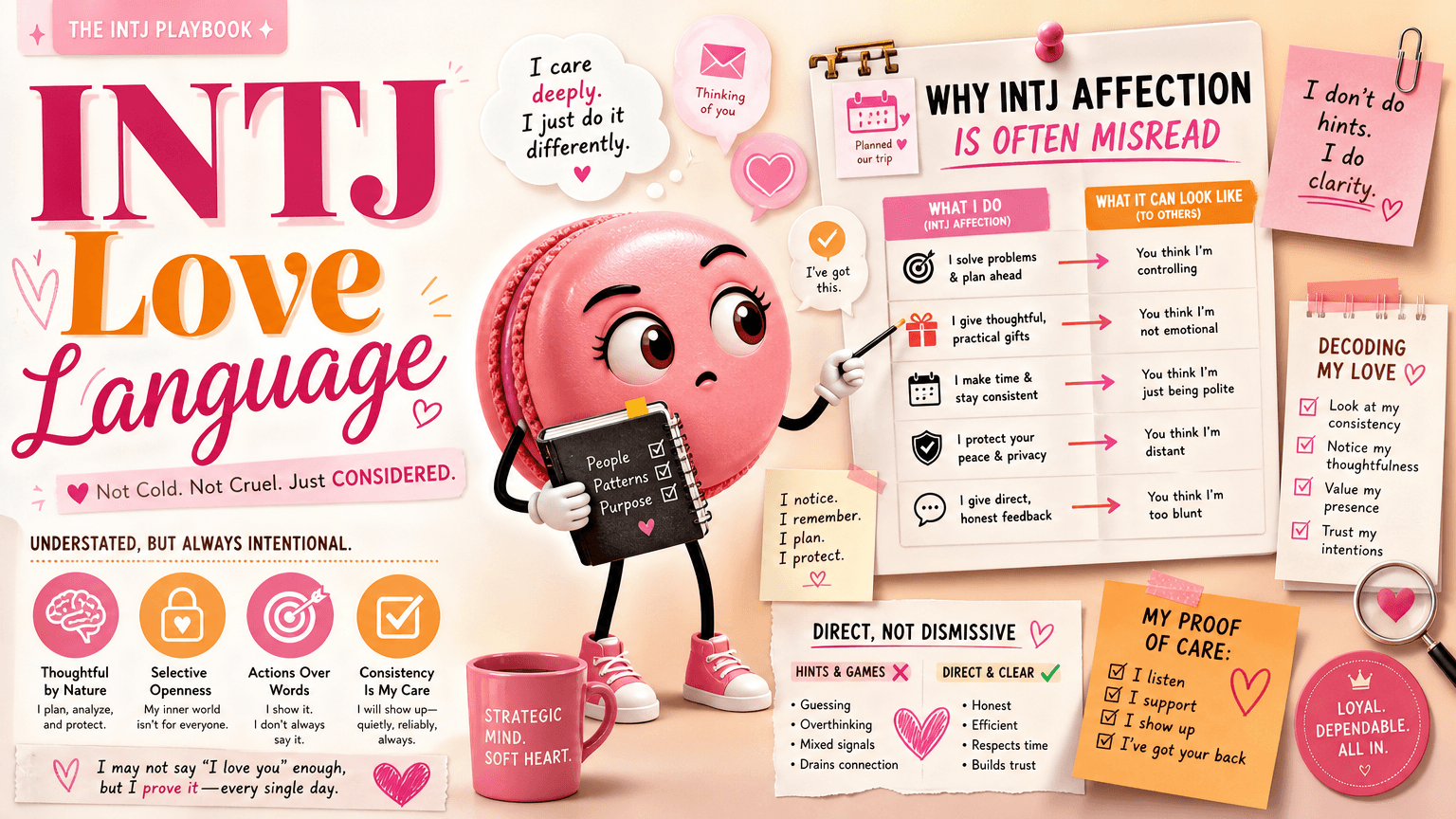
Why INTJ Affection Can Be Misread
INTJ affection is often misread because it can be understated, selective, and highly context dependent. An INTJ may care deeply while still appearing reserved, especially early in a relationship or when they are unsure whether emotional openness will be respected. They may also prefer directness over hints, which means they can miss subtler bids for reassurance from a partner. At the same time, partners may overlook the ways an INTJ is already showing care through consistency or problem solving. This section helps separate low display from low investment, which is a common source of confusion in INTJ relationships. It also explains why some people experience INTJs as emotionally private rather than emotionally unavailable.
More About INTJ Love Language
INTJ love language often reflects a preference for depth over display. Many INTJs are more comfortable showing care through planning, problem solving, and dependable support than through frequent emotional declarations. That does not mean they are unemotional. It usually means they want affection to feel grounded, intentional, and worth trusting. In relationships, this can look like helping a partner think through decisions, creating stability, or quietly taking responsibility for things that matter.
When people search this topic, they are often trying to map the five love languages onto INTJ behavior. The pattern that comes up most often is quality time, followed by acts of service, with words of affirmation, physical touch, and gifts varying by person and relationship context. The important detail is that preference can change depending on trust, maturity, and the kind of bond involved. That flexibility is useful, but it also means there is no single INTJ formula that fits everyone.
Another recurring theme is that INTJs may give love in ways that are easy to overlook. They might solve a problem before it becomes a crisis, remember a practical detail, or invest energy in long-term planning for the relationship. Those actions can be deeply affectionate, but partners sometimes miss them because they do not look like overt romance. In some relationships, that quiet support is exactly what makes the bond feel secure; in others, it can leave a partner wanting more visible warmth. Another useful Macaron comparison is AI Personal Assistant - Macaron at https://macaron.im/ai-personal-assistant.
The harder part is interpretation. An INTJ may want closeness without constant emotional processing, and that can be confusing for partners who read silence as distance. On the other hand, some INTJs do want more verbal reassurance than they admit, especially when they feel uncertain or vulnerable. Understanding the difference between private and indifferent is often the key. It also helps to distinguish between a temporary need for space and a stable preference for lower-intensity communication. For a broader Macaron context, AI Story App - Macaron at https://macaron.im/ai-story-app can help you compare the decision from another angle.
Macaron helps turn this into something usable by highlighting where affection is being expressed, where it is being missed, and what kind of communication would make it easier to recognize. That makes the page more than a personality label. It becomes a practical lens for noticing trust, pacing, and the small signals that shape connection over time. Compared with generic type summaries, the value here is in making relationship patterns easier to act on, not just easier to name.
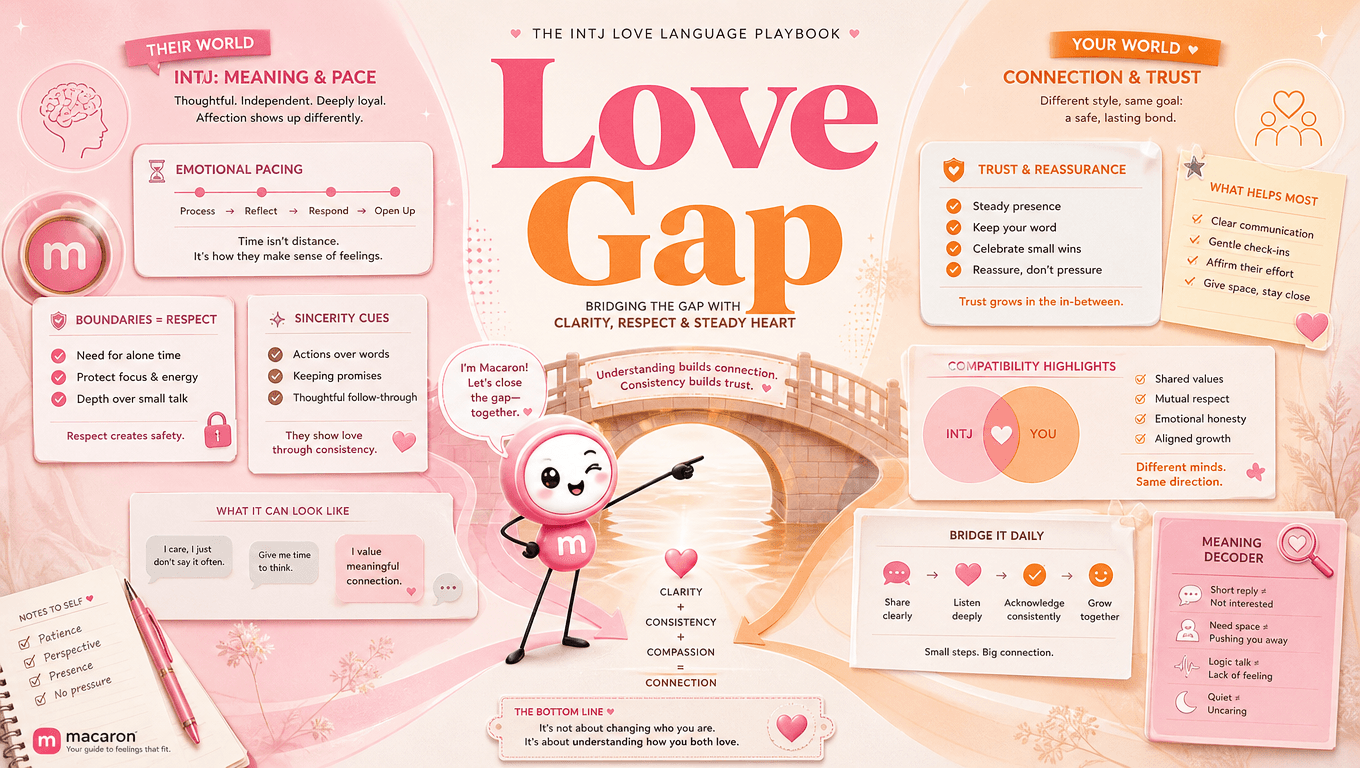
Bridging the Gap with a Partner
Bridging the gap with an INTJ usually means making affection easier to recognize and easier to trust. Some INTJs feel most loved when a partner is steady, competent, and respectful of boundaries. Others need more verbal reassurance, but only when it feels sincere and not forced. The challenge is often not a lack of feeling, but a mismatch in timing, tone, or expression. Macaron helps you look at where the relationship gets stuck, whether the issue is emotional pacing, unclear expectations, or different definitions of what counts as care. That clarity can reduce frustration on both sides and make it easier to ask for the kind of support that actually lands.
Deepen Connection with an INTJ
Macaron turns INTJ love language insight into practical relationship support by making the pattern visible instead of leaving it abstract. Affection check-ins can help identify which gestures feel meaningful and which ones feel performative. Communication planning can make difficult conversations less reactive and more specific. Reflection prompts help both partners notice what they assume love should look like, while reassurance mapping can reveal where one person is giving care in a way the other does not naturally register. For INTJs especially, this kind of support can make expression feel less awkward and more intentional. The tradeoff is that structured reflection works best for people willing to slow down and analyze the relationship rather than rely on instinct alone.
Frequently Asked Questions
INTJ love language usually looks quieter than people expect. Common signs include thoughtful problem solving, practical help, loyalty over time, and attention to future planning. Many INTJs also value quality time because focused attention feels meaningful, not just present. Depending on the person, words of affirmation or physical touch may matter too, but they often need to feel sincere and well timed. The main pattern is that affection is more likely to be shown through usefulness, consistency, and trust than through constant verbal display.
Use it as a way to compare how love is being expressed with how it is being received. If an INTJ partner is showing care through actions but the other person is looking for more verbal reassurance, both people may feel unseen even though effort is present. This insight can help you ask better questions about what feels believable, what feels supportive, and where expectations are mismatched. It is most useful when it leads to clearer communication rather than a fixed label about personality.
INTJs can seem reserved because they often prefer to build trust before becoming emotionally open. They may also be selective about when and how they express feelings, especially if they think emotional displays should be meaningful rather than frequent. That reserve is not always distance. In many cases, it reflects caution, privacy, or a preference for showing care through actions first. Partners who expect immediate verbal warmth may miss the depth of feeling that is already there in quieter forms.
Acts of service is often a strong fit for INTJs, but it is not the whole story. Many INTJs also place a high value on quality time, especially when it involves focused attention or thoughtful conversation. Some care a great deal about words of affirmation once trust is established, and others appreciate physical touch in a private, intentional way. The better question is not whether INTJs have one universal love language, but which forms of affection feel most credible and emotionally safe to them.
Often, yes, but not always. Quality time tends to work well for many INTJs because it signals focus, presence, and shared attention without requiring constant emotional performance. Words of affirmation can still matter, especially when they are specific, honest, and tied to real behavior. The difference is that vague praise may feel empty, while thoughtful recognition of effort can feel meaningful. If you are dating an INTJ, the best approach is to notice whether they respond more to undistracted time, clear appreciation, or a combination of both.
INTJs often show love by investing in the relationship in practical, future-oriented ways. They may help solve problems, remember important details, make plans, or take responsibility for things that reduce stress for their partner. They are also likely to be consistent once they commit, even if they are not highly expressive every day. That said, some INTJs do become more verbally affectionate over time. The key is that their care usually becomes visible through reliability and intention before it becomes obvious through emotional display. For a third-party check, What are the INTJ love language? How does an INTJ express love? at https://www.quora.com/What-are-the-INTJ-love-language-How-does-an-INTJ-express-love is worth comparing against the page summary.
The biggest mistake is assuming that quiet affection means low affection. INTJs may not use the most obvious romantic signals, but they often communicate care through consistency, competence, and follow-through. Another common mistake is expecting them to respond well to pressure, hints, or emotional tests. INTJs usually do better with direct, specific communication. If you want to understand their affection, look at what they repeatedly do, not just what they say in the moment. For another outside reference, INTJs, what are your love languages? | Personality Cafe at https://www.personalitycafe.com/threads/intjs-what-are-your-love-languages.43545/ adds a second perspective.
Apps that focus on broad personality education or general relationship advice may be better if you want a quick overview without much setup. Macaron is stronger when you want to turn a personality pattern into something practical, like noticing where affection is being missed or what kind of communication would help. The tradeoff is that more structured insight can take a little more reflection. If you want simple entertainment or a lightweight quiz, other apps may feel easier. If you want a clearer relationship lens, Macaron is more useful. For outside context, Personality Type and Love Language: Architects (INTJs) at https://www.16personalities.com/articles/personality-type-and-love-language-architects-intjs is a useful reference point.
Read & discover
AI Personal Assistant
Free calculators


