INTP Compatibility
INTP compatibility is most useful as a way to examine communication style, independence, emotional pacing, and whether a connection is only mentally stimulating or actually sustainable. Macaron helps you think through the patterns that make closeness feel easy, strained, or quietly draining.
INTP Compatibility
This module helps you notice how an INTP-style connection feels in real life, beyond first impressions or shared interests. It focuses on pacing, communication, autonomy, and whether the relationship leaves room for both curiosity and steadiness.
This is a self-reflection tool, not a diagnosis or a scientific measure of relationship success.
Please answer every question before viewing your result.
This module is for reflection only and cannot determine whether a relationship will succeed or whether a person fits a personality type. If a connection feels controlling, frightening, or emotionally unsafe, prioritize support from trusted people or a qualified professional.
What INTP Compatibility Can Help You Notice
INTP compatibility is best treated as a practical lens rather than a verdict about who will or will not work. Many people search for type pairings, but the more useful question is whether a connection supports curiosity, autonomy, and honest exchange without forcing either person to perform on a timeline that feels unnatural. That distinction matters because a relationship can look promising on paper and still feel strained in everyday life.
People who relate to INTP patterns often want room to think, time to process, and conversations that feel substantive instead of scripted. When those needs are respected, the connection can feel calm, intelligent, and unusually easy to inhabit. When they are not, rushed expectations, vague communication, or constant emotional urgency can make even a promising bond feel tiring, confusing, or oddly restrictive.
Macaron helps you separate shared interests from shared relationship habits. Two people can enjoy the same topics and still differ on pacing, reassurance, follow-through, and how much closeness feels comfortable from day to day. Those differences are often what determine whether a relationship becomes dependable. Compatibility is usually decided in ordinary moments, not in the first spark or the most interesting conversation. For a related Macaron page, see AI Personal Assistant - Macaron at https://macaron.im/ai-personal-assistant.
This page is designed to help you read INTP compatibility in context. That includes the tradeoff between independence and responsiveness, the role of conflict style, and whether both people can say what they need instead of expecting the other person to infer it. Macaron is useful here because it keeps the focus on patterns you can actually observe, not just labels that sound neat.
Use these insights as reflection prompts for dating, friendship, or long-term partnership. They can help you identify recurring patterns such as delayed clarity, avoidant distance, mismatched emotional tempo, or strong intellectual chemistry that has not yet translated into reliable trust. The goal is not to rank people, but to understand what kind of connection is being built and what it still needs.
What INTP Compatibility Can Help You Notice
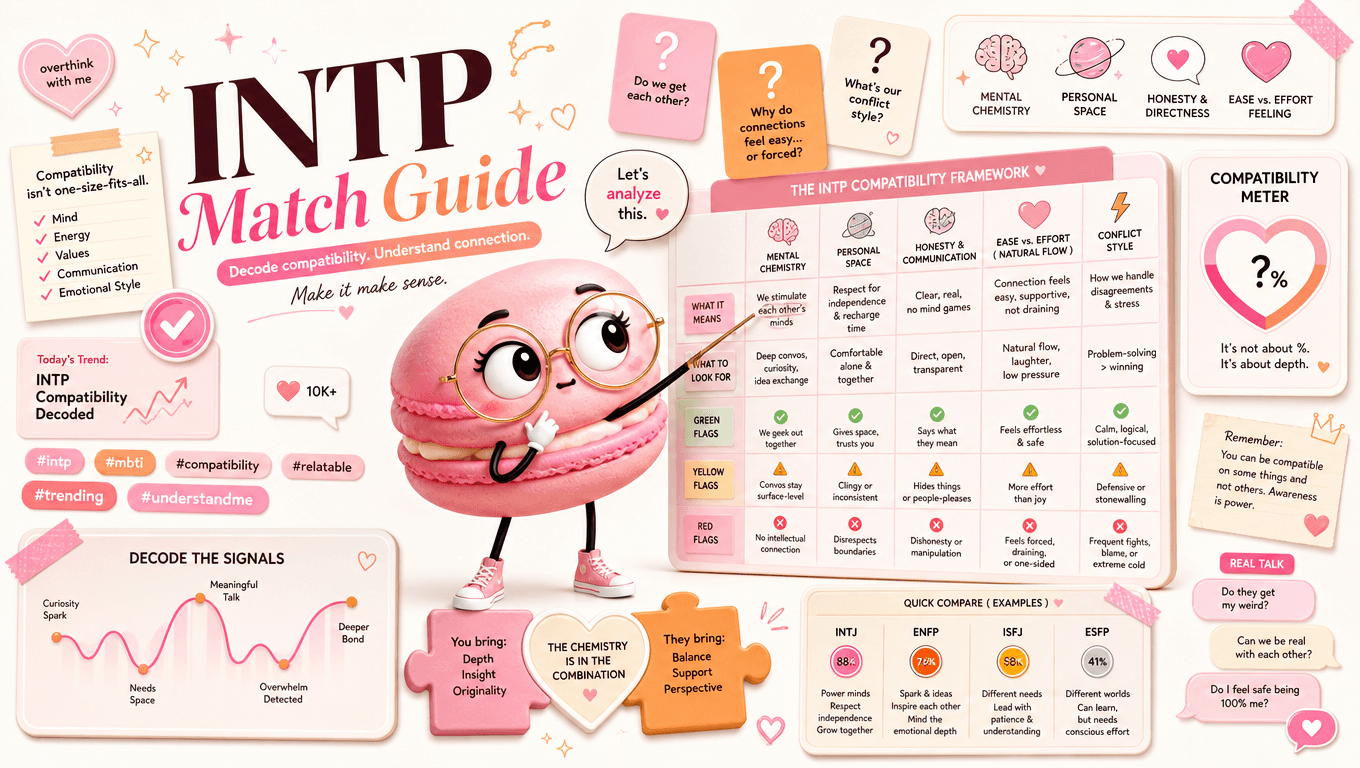
People who identify with INTP themes often look for relationships that feel mentally alive without becoming emotionally crowded. They may value curiosity, honesty, and enough personal space to think clearly, but those preferences are sometimes mistaken for detachment when they are really about comfort, processing style, and a low tolerance for unnecessary pressure. Macaron helps you notice whether closeness feels easy or forced, whether emotional expression is direct or hard to read, and whether conflict tends to be avoided, overexplained, or turned into debate. It also helps you spot where clarity is missing, since ambiguity often creates more strain than disagreement itself. That makes it useful for dating, friendship, and long-term partnership alike.
How Macaron Uses INTP Compatibility as a Reflection Lens
Macaron uses INTP compatibility to examine the mechanics of a connection rather than labeling it good or bad. That means looking at what helps you relax, what makes you pull back, and whether the relationship gives both people enough room to think without drifting into vagueness. It can also highlight where directness builds trust and where it creates tension, which is especially useful when one person wants more emotional certainty than the other naturally offers. The point is to identify repeat patterns, not to force a type-based conclusion that ignores the actual relationship. That tradeoff matters because type language can clarify behavior, but it cannot replace lived compatibility.
More About INTP Compatibility
INTP compatibility often becomes clearer when you separate attraction from sustainability. A relationship may feel exciting because the conversation is sharp, original, or full of shared analysis, but that does not automatically mean the day-to-day rhythm works. Macaron helps you look at the parts that usually decide whether a connection settles into ease or keeps creating friction, including pacing, repair, and whether both people feel understood when the novelty wears off.
A common pattern in INTP compatibility discussions is the importance of autonomy. Many INTP-leaning people do best when they can think independently, keep some privacy, and avoid feeling monitored or rushed. The challenge is that too much distance can also be read as disinterest, so compatibility often depends on whether both people can distinguish space from withdrawal. Macaron is useful because it helps you tell the difference between healthy breathing room and a pattern that is quietly eroding trust.
Emotional pacing is another major factor. Some pairings feel strong because both people are thoughtful and honest, while others struggle because one person wants immediate reassurance and the other needs time to process. Macaron helps you examine whether emotional expression is becoming clearer over time or whether the same misunderstandings keep repeating. That matters because a relationship can be intellectually fluent and still feel emotionally out of sync if timing, reassurance, and responsiveness are mismatched. Another useful Macaron comparison is AI Story App - Macaron at https://macaron.im/ai-story-app.
Compatibility also depends on how conflict is handled. INTP-style connections can break down when disagreements become sharp, overly abstract, or left unresolved for too long. The useful question is not whether conflict exists, but whether both people can return to the issue, clarify assumptions, and make follow-through visible enough to rebuild trust. Macaron adds value here by turning vague tension into a pattern you can inspect, which is often more helpful than trying to decide whether the relationship is simply “good” or “bad.” For a broader Macaron context, How to Use AI as a Personal Assistant: 30 Prompts That Actually Work at https://macaron.im/blog/ai-personal-assistant-prompts can help you compare the decision from another angle.
If you are trying to understand INTP compatibility in a more grounded way, Macaron gives you a structure for noticing patterns that matter in real relationships: who initiates repair, how much directness feels respectful, whether curiosity stays alive under stress, and whether the connection still feels workable when novelty fades. That approach is especially useful for people who want a thoughtful relationship without losing independence, because it keeps both the emotional and practical sides of fit in view.
Which Dynamics Support Connection and Which Create Friction
Some INTP connections work well because both people can be independent without becoming disconnected. Others start to strain when one person expects faster reassurance, more visible emotion, or constant agreement about what the relationship means. Macaron helps you sort out which differences are workable and which ones keep producing the same stress. That includes noticing whether follow-through is reliable, whether distance is a healthy reset or a sign of avoidance, and whether the relationship feels easier after honest clarification. The point is to identify the dynamics that support trust over time, not just the ones that create strong initial chemistry. This is where Macaron is especially practical for users who want fewer assumptions and more concrete signals.
Make Intellectual Connections Last
Macaron turns INTP compatibility into something you can actually use by focusing on the habits that keep a relationship stable after the first spark. That includes reflection prompts that help you notice what you need to feel understood, communication check-ins that reduce guesswork, and boundary clarity around pace and availability. It can also support conflict resets when a conversation has become too abstract, too delayed, or too emotionally loaded to resolve cleanly. For INTP-leaning people, lasting connection often depends on whether insight is matched by follow-through, so the practical question becomes how to keep the relationship both thoughtful and dependable. That tradeoff is where Macaron is stronger than generic type charts, which usually stop at labels.
Who INTPs Often Connect With Best
Search interest around INTP compatibility often centers on specific pairings such as INTJ, INFJ, ENTJ, ENTP, and sometimes INFP or ENFJ. The recurring theme is not a perfect match, but a preference for people who can handle ideas, respect autonomy, and communicate with enough honesty to avoid unnecessary confusion. Some pairings are described as strong for chemistry, while others are seen as better for growth or balance. Macaron keeps that nuance intact by helping you ask what kind of fit you actually want, since an easy intellectual rhythm is not always the same thing as a relationship that can support long-term emotional reliability. That makes it useful for users comparing attraction, stability, and shared pace.
Where INTP Compatibility Gets Misread
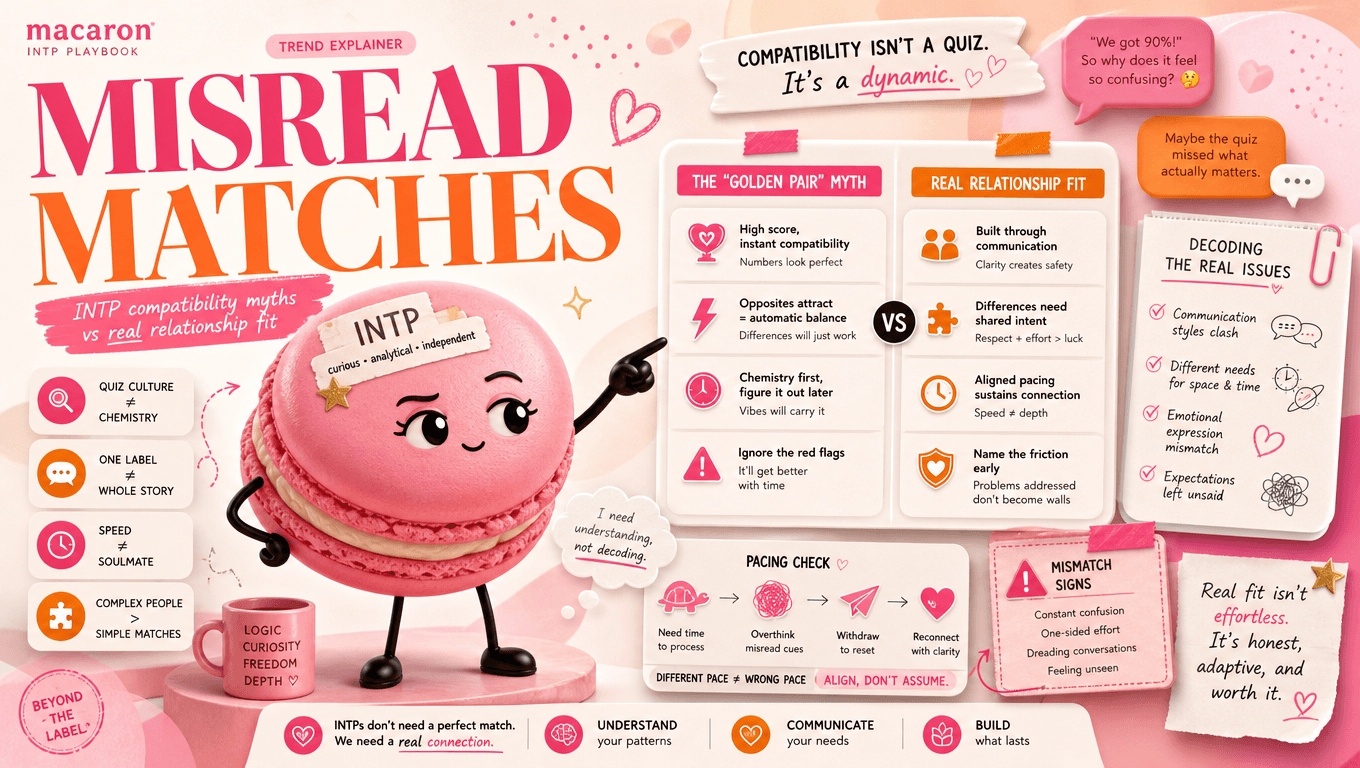
A lot of INTP compatibility advice gets oversimplified into rankings, golden pairs, or worst matches, but those labels can hide the real issue. What often matters more is whether the other person can tolerate ambiguity, respond clearly, and avoid turning every difference into pressure. INTPs are sometimes described as avoidant, but that label can miss the point if the real problem is poor pacing or repeated misunderstanding. Macaron helps you read the situation more carefully by separating temporary distance from deeper mismatch, and by showing where a relationship may need clearer communication rather than a new personality theory. That is a useful tradeoff: less certainty up front, but more accuracy about what is actually happening.
Use the Insights Without Overfitting the Type
INTP compatibility is most useful when it helps you notice patterns, not when it becomes a shortcut for deciding everything in advance. Two people with the same type can still have very different needs, habits, and conflict styles, and a strong relationship can exist even when the type pairing is not the one people usually recommend. Macaron keeps the focus on what is actually happening between two people: how they repair, how they clarify, how they handle space, and whether the connection feels sustainable once novelty fades. That makes the guidance more practical for dating, friendship, and long-term partnership. It also leaves room for cases where other apps may be better at broad type education, while Macaron is better at turning the idea into personal reflection.
Frequently Asked Questions
Strong INTP compatibility usually comes from a mix of intellectual stimulation, honest communication, and respect for personal space. Many INTP-leaning people also do better when the other person is patient with processing time and does not treat quietness as automatic disinterest. Beyond shared ideas, the relationship tends to work better when expectations are clear, conflict can be revisited calmly, and emotional reassurance is given in a way that feels direct rather than performative. In practice, the best fit is often the one that makes both curiosity and trust easier to sustain.
Use them as a way to check recurring patterns, not as a fixed label for the relationship. INTP compatibility can help you ask whether the connection feels mentally engaging, whether both people can handle independence without drifting apart, and whether emotional pacing is creating comfort or confusion. It is especially useful when you keep wondering why a relationship feels promising in conversation but harder in everyday life. The goal is to notice what repeats, what gets clarified, and what still feels unresolved after honest discussion.
Strong mental chemistry can fade in usefulness when the relationship does not support reassurance, timing, or follow-through. Two people may enjoy the same ideas and still struggle if one wants more emotional visibility, faster responses, or clearer commitment than the other naturally gives. Over time, that gap can make the connection feel exciting but unstable. In other words, conversation can be excellent while the relationship still feels tiring, because compatibility depends on how the bond functions outside the most stimulating moments.
Macaron helps by making repeating patterns easier to see before they turn into bigger misunderstandings. If clarity tends to arrive late, the issue may be delayed communication, vague expectations, or a habit of assuming the other person will infer what was meant. Macaron can help you identify where the delay starts, what kinds of conversations keep getting postponed, and which signals are being missed. That gives you a better chance to respond earlier, ask more precise questions, and reduce the cycle of confusion.
INTPs often find it easier to connect with people who respect independent thinking and do not demand constant social or emotional output, which can make some introverts feel like a natural fit. That said, an extrovert can also work well if they are patient, direct, and comfortable with slower processing. The better question is not introvert versus extrovert, but whether the other person can handle space without turning it into distance and can communicate clearly enough to prevent misunderstandings from piling up.
An INTP-INTP relationship can be deeply comfortable because both people may value logic, privacy, and open-ended conversation. The tradeoff is that two similar people can also delay decisions, avoid emotional follow-up, or assume the other person already understands what is unsaid. That can make the relationship feel calm but under-structured. It works best when both partners are willing to make expectations explicit and follow through consistently. Some people prefer other pairings because they add balance, structure, or emotional momentum. For a third-party check, INTP Compatibility Chart: Best Match (Relationships, Love) | Boo at https://boo.world/intp-personality/intp-compatibility-chart is worth comparing against the page summary.
The biggest warning signs are repeated misunderstanding, pressure to respond before you are ready, and a pattern where one person keeps needing more certainty than the other can realistically give. Another sign is when conversations stay interesting but nothing becomes clearer over time. If the relationship keeps relying on hope, interpretation, or indirect hints instead of direct repair, compatibility may be weaker than it first appeared. Macaron is helpful here because it highlights patterns that are easy to excuse when the connection is intellectually engaging. For another outside reference, What is the perfect match for an INTP? - Life According to INTPs at https://lifeaccordingtointps.quora.com/What-is-the-perfect-match-for-an-INTP adds a second perspective.
Yes. INTP compatibility can be very useful in friendship because many of the same factors still matter: pacing, honesty, autonomy, and whether conversation feels energizing rather than draining. In friendships, the pressure may be lower, but misunderstandings about availability, responsiveness, or emotional expectations can still create distance. Macaron can help you see whether a friendship works because both people enjoy similar rhythms or whether it only works in short bursts. That makes it easier to keep the connection healthy without overcommitting to a dynamic that does not fit. For outside context, INTP Relationships & Compatibility With Other Personality Types at https://www.truity.com/blog/personality-type/intp/relationships is a useful reference point.
Read & discover
AI Personal Assistant
Free calculators


