INTP Dating
INTP dating is best read as a lens for understanding curiosity, independence, directness, and emotional pacing, especially when strong mental chemistry does not automatically translate into easy relationship fit. Macaron helps you sort out what feels promising, what feels unclear, and where communication patterns may need more care.
INTP Dating
This self-reflection module helps you notice how curiosity, independence, pacing, and communication shape your dating experiences. It is designed to support clearer choices, not to decide whether a relationship is right or wrong for you.
This is a self-reflection tool, not a diagnosis or a clinical assessment.
Please answer every question before viewing your result.
This module is for self-reflection only and cannot tell you what type of partner you should choose or whether a relationship is healthy. If dating brings up distress, fear, or patterns that feel overwhelming, consider talking with a trusted person or a qualified mental health professional.
What INTP Dating Can Help You Notice
INTP dating is most useful when you treat it as a way to notice patterns, not as a formula for how a relationship should work. Searchers usually want to know whether INTPs are hard to date, what they value, and why a connection can feel intellectually strong but emotionally uncertain. That makes this topic less about labels and more about reading how interest, timing, and communication actually show up in real interactions.
A common theme in INTP dating advice is the tension between independence and closeness. People drawn to this style often want room to think, low-pressure conversation, and enough space to stay themselves, while still wanting a relationship that feels meaningful rather than casual or repetitive. The practical question is whether both people can respect that need for autonomy without mistaking it for disinterest or emotional distance.
Another recurring pattern is that INTPs are often described as direct, honest, and skeptical of games, but not always quick to signal feelings in obvious ways. That can create confusion for partners who expect more frequent reassurance, more visible pursuit, or faster emotional labeling. In practice, the mismatch is often about style rather than intent: one person is waiting for explicit confirmation while the other assumes thoughtful conversation already says enough. For a related Macaron page, see Best Free AI Calorie Trackers You Can Start Today - Macaron at https://macaron.im/blog/free-ai-calorie-tracker.
Macaron uses INTP dating as a reflection tool for those moments when the connection is real but the rhythm is off. It helps you look at pacing, follow-through, clarity, and whether the relationship feels energizing because it is compatible or only because it is mentally stimulating. That distinction matters when a date feels promising on paper but still leaves you unsure what happens next.
The goal is not to predict who an INTP should date. It is to help you read the relationship more carefully, especially when you are trying to tell the difference between interesting chemistry, healthy mutual respect, and a pattern that may stay unclear without more direct communication. That makes the page useful for people who want a grounded read on compatibility, not a rigid personality script.
What Does INTP Dating Usually Mean?
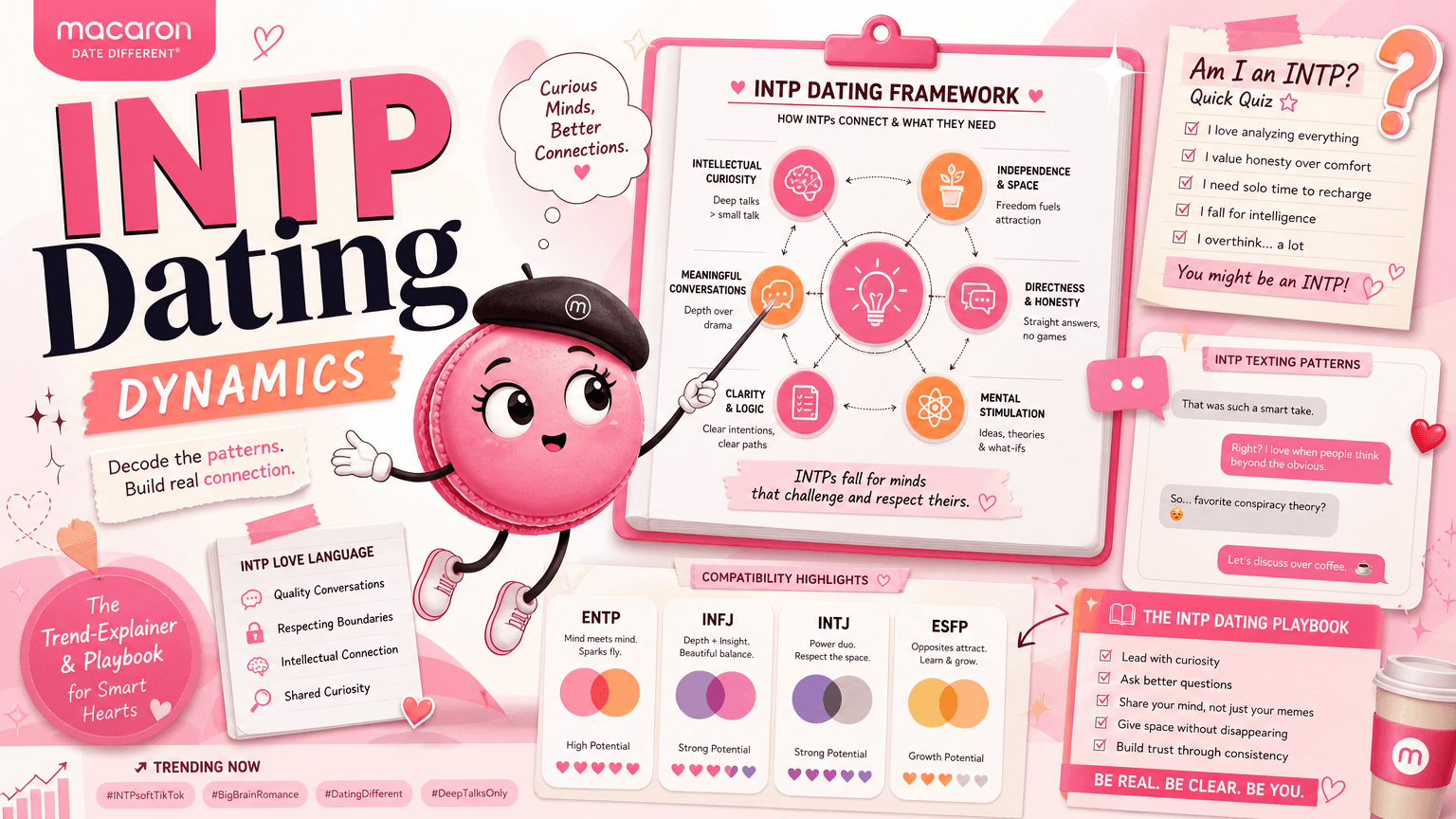
INTP dating usually refers to the relationship patterns people associate with the INTP personality type: intellectual curiosity, independence, directness, and a preference for honest conversation over social performance. The useful question is not whether an INTP follows a fixed script. It is whether the relationship gives both people enough space, clarity, and mental stimulation to feel natural after the first few dates. In practice, that means noticing whether the connection stays easy to talk through, whether expectations are explicit, and whether the pace supports trust instead of forcing it.
How Macaron Uses INTP Dating as a Reflection Lens
Macaron helps you reflect on the practical questions that come up when a relationship feels promising but hard to read. That includes whether the connection is emotionally workable, how much space feels healthy, what kind of directness builds trust, and whether the pace feels supportive or draining. It also helps you separate interesting differences from exhausting ones. In other words, the lens is not about deciding if someone is an ideal type, but about noticing whether the relationship has enough clarity, steadiness, and mutual understanding to keep going. That is especially useful when you are unsure whether to lean in, ask for more clarity, or step back.
More About INTP Dating
People who identify with INTP themes often care less about performative dating and more about whether the conversation feels intelligent, honest, and worth continuing. They may be drawn to partners who can discuss ideas, tolerate pauses, and avoid pressure to define everything too quickly. That preference can make early dating feel refreshingly direct, but it can also make vague interest or social games feel draining fast.
Macaron helps you test the difference between curiosity and compatibility. A date can feel exciting because the other person is clever, unusual, or easy to talk to, but the real question is whether the connection also supports trust, consistency, and a pace both people can actually sustain. That matters because novelty can create momentum even when the relationship does not yet have enough structure to last.
Many INTP dating questions come from ambiguity rather than conflict. People often wonder why someone seems warm in conversation but inconsistent in follow-up, why emotional signals feel subtle, or why a relationship stalls when practical clarity is needed. Those are pattern questions, not personality flaws. The more useful response is to look at what is being communicated through actions, timing, and willingness to have a direct conversation. Another useful Macaron comparison is Best Personal AI Agent Platform for 2025 - Macaron at https://macaron.im/blog/best-ai-agent-platform-2025.
This page also reflects a common search intent around compatibility. People want to know who tends to pair well with INTPs, but the more useful reading is usually about what kind of communication style, emotional steadiness, and tolerance for independence make the relationship easier to maintain over time. Some partners are better at giving space without creating distance, while others need more reassurance than the dynamic naturally provides. For a broader Macaron context, Eat This Much Review: Meal Planner and Alternatives - Macaron AI at https://macaron.im/blog/eat-this-much-review can help you compare the decision from another angle.
Macaron turns those observations into practical support by helping you review dates, notice recurring friction, and decide whether a connection needs more direct conversation or a cleaner boundary. That makes the topic less about type labels and more about how two people actually relate in real life. The tradeoff is that this kind of reflection is slower than a quick compatibility quiz, but it is usually more useful when the situation is genuinely unclear.
Is Dating an INTP Hard?
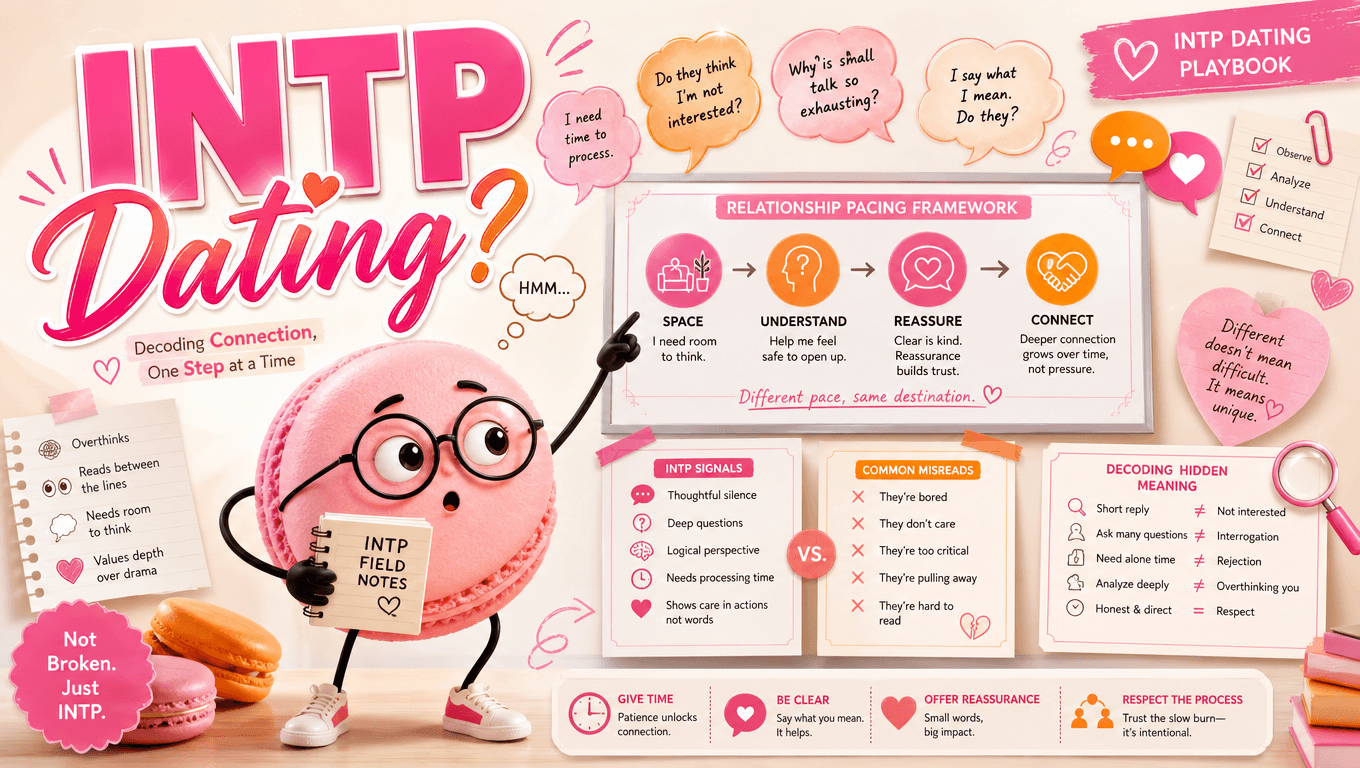
Dating an INTP can feel easy at first and confusing later if the relationship depends on hints, pressure, or fast emotional labeling. The challenge is usually not lack of interest. It is the mismatch between someone who wants room to think and someone who wants more visible reassurance. Macaron helps you examine those early tensions before they harden into distrust. The goal is to notice whether the issue is simple pacing, mismatched expectations, or a deeper pattern of avoiding the conversations that would make the connection easier to understand. That is more actionable than assuming the relationship is either doomed or effortless.
Who Is Romantically Compatible With INTPs?
Compatibility with INTPs usually depends less on a perfect type match and more on whether the other person can handle independence, directness, and thoughtful conversation. Partners who are steady, curious, and comfortable with space often make the relationship easier to sustain. Macaron turns INTP dating into something more practical than personality commentary. It gives you a way to review what happened after a date, what felt clear, what felt ambiguous, and whether the interaction supports a real relationship rather than just a compelling idea of one. That can help you spot when chemistry is real but the day-to-day fit is still weak.
Frequently Asked Questions
INTP dating can help you think through pace, communication, independence, clarity, and whether the connection still feels workable after the initial excitement. It is especially useful when you are trying to understand why a date feels mentally engaging but still hard to read emotionally. The point is not to label someone, but to notice whether the relationship has enough mutual understanding, follow-through, and room for both people to stay themselves. That makes it easier to decide whether to continue, clarify, or step back.
That usually happens when the intellectual side of the connection is strong, but the relationship has not yet developed enough reassurance, directness, or shared pacing. Someone may enjoy the conversation, but still be unsure about interest, timing, or emotional availability. In INTP dating, that gap often shows up when both people are thinking a lot but not saying enough. The result is chemistry without enough relational clarity to make the next step feel obvious. Macaron is useful here because it helps you separate a good conversation from a workable relationship pattern.
It can be hard if you expect constant verbal reassurance or quick emotional certainty. INTPs often prefer honest conversation, room to think, and a slower pace that lets trust build naturally. That does not make them difficult by default. It means the relationship works best when both people are clear about expectations and willing to communicate directly instead of relying on hints. If you value explicit feedback and frequent check-ins, the tradeoff is that you may need to ask for them more directly than you would with other styles.
In dating, INTP usually points to a style that values curiosity, independence, directness, and thoughtful conversation. It is less about a fixed romantic script and more about the patterns people often notice in how someone approaches interest, pacing, and emotional expression. The most useful reading is practical: does the relationship feel clear, steady, and mutually engaging? If the answer is yes, the type label matters less than the actual behavior. If the answer is no, the label should not be used to excuse confusion.
Romantic compatibility with INTPs often comes from shared curiosity, emotional steadiness, and comfort with independence. People who communicate clearly and do not pressure the relationship to move faster than it naturally wants to often fit well. The exact type matters less than whether both people can respect space, stay honest, and keep the connection mentally alive. Some partners are better at this than others, but even a strong match can struggle if one person wants more reassurance than the other naturally gives.
INTPs often look for a partner who can think deeply, communicate honestly, and avoid unnecessary drama. They may value someone who is interesting to talk to, comfortable with silence, and willing to let the relationship develop without constant pressure. Emotional steadiness matters too, but usually in a practical way: can this person be clear, consistent, and respectful of space? The strongest connections often feel like a mix of friendship, curiosity, and trust rather than constant intensity.
An INTP around a crush may seem thoughtful, observant, and a little hard to read. They might ask unusual questions, remember small details, or spend time analyzing the interaction before making a move. Some are direct once they feel sure; others hesitate because they do not want to misread the situation or create awkwardness. That can make interest easy to miss if you are waiting for obvious flirting. Macaron can help you look at the pattern over time instead of trying to decode one moment. For a third-party check, 7 Secrets About Dating an INTP Personality | Introvert, Dear at https://introvertdear.com/news/intp-dating-secrets/ is worth comparing against the page summary.
Yes. The same patterns often show up in friendship, work relationships, and other close connections where independence, honesty, and communication style matter. If someone prefers space, directness, and thoughtful conversation, those preferences can shape how they respond in many kinds of relationships, not just romantic ones. Looking at the pattern outside dating can sometimes make it easier to understand what feels natural, what feels draining, and what kind of communication helps most. That broader view can make dating decisions clearer too. For another outside reference, As an INTP person, is it difficult for you to find a life partner? at https://lifeaccordingtointps.quora.com/As-an-INTP-person-is-it-difficult-for-you-to-find-a-life-partner adds a second perspective.
Macaron helps you slow down and identify where the breakdown is happening. Sometimes the issue is timing, sometimes it is unclear expectations, and sometimes one person is assuming the other will infer interest without saying it directly. By reviewing the pattern instead of the moment, you can see whether the connection needs a clearer conversation, a different pace, or a more honest boundary. That makes it easier to respond before uncertainty turns into frustration. Competitor guides may explain the type well, but Macaron is more useful when you need to decide what to do next. For outside context, Romantic Relationships | INTP Personality (Logician) - 16Personalities at https://www.16personalities.com/intp-relationships-dating is a useful reference point.
Read & discover
AI Personal Assistant
Free calculators


