Introvert Test
An introvert test is most useful when it helps you understand what energizes you, what drains you, and how you prefer to recover after social demands. Macaron uses guided reflection to make those patterns easier to notice, while making clear that this is not a diagnostic or clinical assessment.
Introvert Test
This self-reflection module explores how you manage social energy, stimulation, and recovery in everyday life. It is designed to help you notice patterns, not to place you into a fixed label.
This is a self-reflection tool, not a clinical or diagnostic assessment. Your answers may shift with stress, context, culture, and life stage.
Please answer every question before viewing your result.
This module is for self-reflection only and cannot determine whether you are introverted, extroverted, or anything else with medical certainty. If social stress, isolation, or exhaustion is causing distress or affecting daily life, consider talking with a qualified professional or someone you trust.
Start with Your Energy Pattern
An introvert test is most helpful when it does more than sort people into a fixed category. Many people who search for this term are trying to understand why certain social situations feel energizing while others feel exhausting, and whether their preferences are about solitude, depth, pace, or overstimulation. A useful result should connect those patterns to everyday life instead of stopping at a label.
Macaron frames the introvert test as a guided reflection on energy and social style. That matters because introversion is often misunderstood as simply being quiet, shy, or antisocial, when the more practical question is how a person restores energy and how much stimulation they can comfortably handle. The goal is to help you notice patterns in conversation, work, and recovery time with more clarity.
This kind of introvert test is best read as a self-understanding tool, not a standardized personality inventory. It can help you think through how you respond to group settings, one-to-one conversations, written communication, and busy environments, but it should not be treated as a diagnosis or a definitive psychological label. The value is in the reflection it prompts, especially when your behavior changes across contexts. For a related Macaron page, see Best AI Personal Assistant in 2025: A Test Suite You Can Reuse at https://macaron.im/blog/ai-personal-assistant-test.
Searchers often want to know whether they are an introvert, an extrovert, or somewhere in between. That ambiguity is part of the point, because many people show mixed patterns depending on stress, familiarity, role expectations, or the amount of recovery time they have. A thoughtful introvert test should leave room for that spectrum rather than forcing a simplistic yes or no answer.
Used well, an introvert test can become a practical starting point for better decisions. It can help you plan social time more intentionally, recognize when you need quiet to reset, and understand why certain environments support focus while others create friction. The most useful outcome is not a label alone, but a clearer picture of how to protect your energy and work with your natural preferences.
Start with Your Energy Pattern
An introvert test works best when it starts with energy, because energy is usually the clearest clue behind introversion-related preferences. Instead of asking only whether you like people, it helps to notice what kinds of interactions leave you refreshed, what kinds leave you depleted, and how long you need to recover. Macaron prompts reflection on common patterns such as smaller groups versus large gatherings, quiet settings versus busy ones, and whether you think more clearly after time alone. Those details make the result more useful than a simple personality label.
How Macaron Structures This Reflection
Macaron organizes the introvert test around the situations that most often reveal social style in real life. That includes how you feel before and after plans, whether you prefer one-to-one conversation over group discussion, how you respond to noise or fast-paced environments, and whether meetings leave you energized or mentally drained. This structure helps separate introversion from related traits like shyness or social anxiety, since someone can be socially confident and still need quiet recovery time after stimulation-heavy settings.
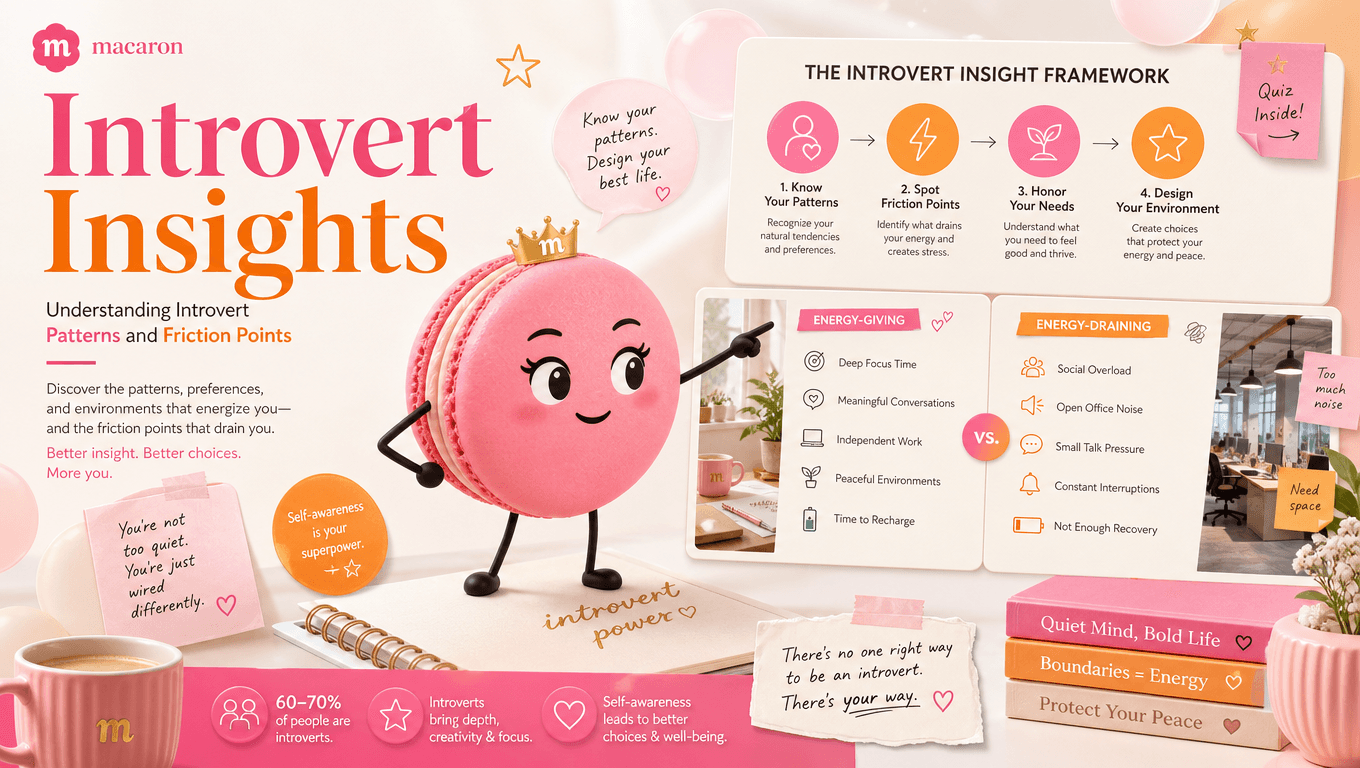
What Your Result Can Help You Understand
Your result can help you recognize patterns that are often easy to overlook, such as deep focus, careful listening, preference for meaningful conversation, and comfort with independent work. It can also clarify where friction tends to appear, like back-to-back social commitments, open offices, or environments that demand constant responsiveness. The point is not to rank traits as better or worse, but to show how your natural style affects attention, communication, and recovery so you can make more informed choices.
More About Introvert Test
An introvert test is most useful when it examines several related patterns together instead of relying on one trait. Energy level, stimulation tolerance, communication preference, and recovery needs often interact, which is why a person may enjoy people deeply but still need substantial quiet time afterward. Looking at those pieces together gives a more realistic picture than asking whether someone is simply outgoing or reserved.
The strongest introvert test experiences also acknowledge the middle ground. Many people do not fit neatly into a pure introvert or pure extrovert category, and their answers can shift depending on whether they are tired, comfortable, under pressure, or in a role that requires constant interaction. That flexibility helps explain why one quiz result may feel accurate in some areas and incomplete in others.
Macaron structures the reflection around the situations people actually wonder about, such as how they feel before and after plans, whether they recover faster alone or with company, and how they respond to noise, pace, and group energy. Those details matter because introversion is often easier to recognize in context than in theory, especially for people who function well socially but still feel depleted afterward. Another useful Macaron comparison is Calorie Tracker — Monitor every bite to shape your health | Macaron at https://macaron.im/playbook/calorie-tracker-68957e011bbc6bcd9f80555e.
A useful introvert test should also point toward strengths, not just limitations. Many introverts notice details quickly, listen carefully, and prefer meaningful conversation over constant surface-level interaction. Those traits can support focused work, thoughtful relationships, and steady independent problem-solving, but they may also come with tradeoffs such as needing more recovery time or feeling strained in high-stimulation settings. For a broader Macaron context, How to Use AI as a Personal Assistant: 30 Prompts That Actually Work at https://macaron.im/blog/ai-personal-assistant-prompts can help you compare the decision from another angle.
The practical value of the result is in what you do next. If the test helps you see recurring patterns, you can use that insight to plan meetings more carefully, set boundaries around draining environments, choose communication styles that fit you, and build routines that support recovery. That makes the test less about identity performance and more about usable self-knowledge.
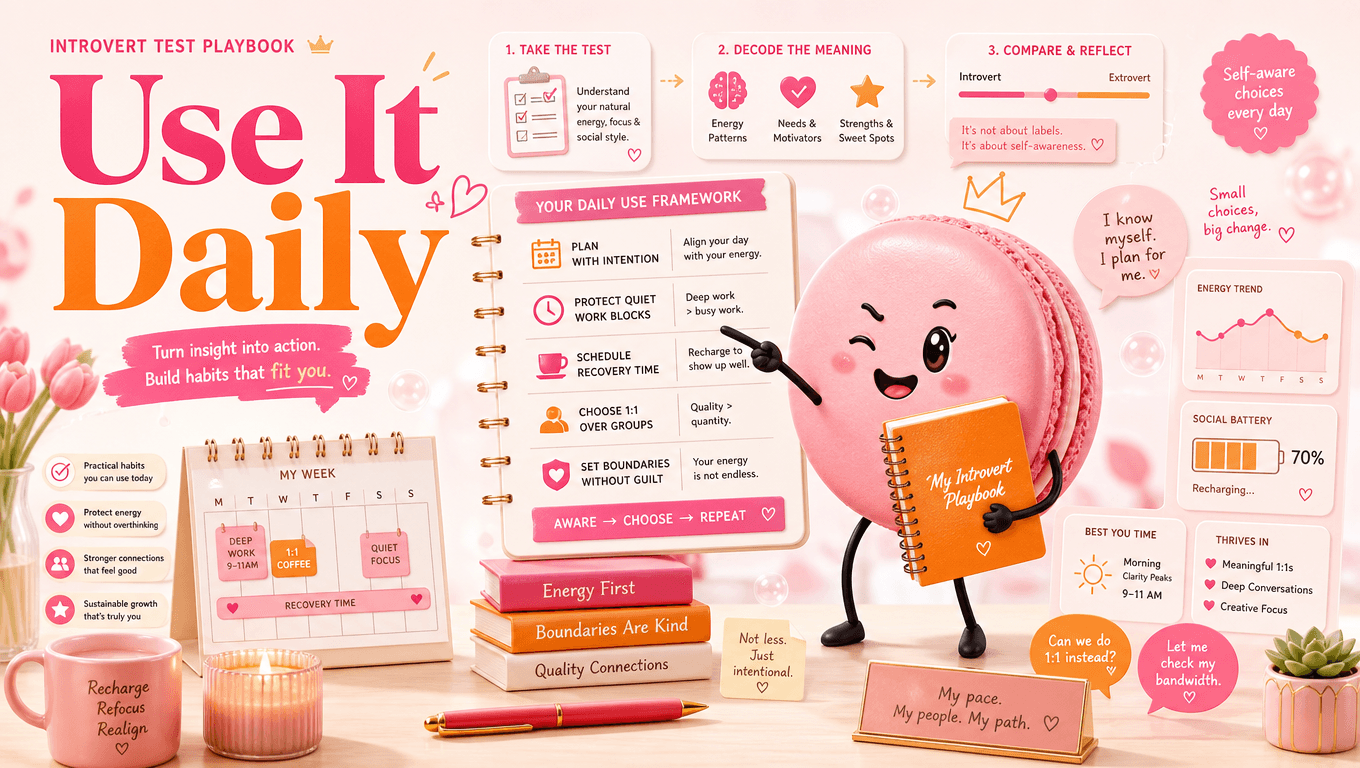
Use the Result in Everyday Life
Macaron turns the introvert test into practical guidance by connecting insight to routine decisions. If you know you drain quickly in crowded settings, you can plan recovery time after events, choose quieter work blocks, or set expectations around how much socializing feels sustainable. If you prefer direct one-to-one communication, you can use that knowledge to shape conversations, boundaries, and collaboration styles. The result becomes most valuable when it helps you adjust habits, not just describe them.
Your Responses and Privacy
Because personality reflection can reveal sensitive information about habits, stress, and social comfort, privacy matters. Macaron is provided by **MINDAI PTE. LTD.**, and users can review the official [Privacy Policy](https://macaron.im/privacy-policy) for details on handling personal data. If you have questions about privacy or data use, you can also contact `contact@macaron.im`. This section is important for anyone using an introvert test as a self-reflection tool, especially when the answers feel personal.
Frequently Asked Questions
This introvert test focuses on the patterns that usually matter most in real life: where you get your energy, how much stimulation you tolerate, whether you prefer one-to-one or group interaction, how quickly you need to recover, and how you tend to communicate. It is designed to help you interpret those habits in context, not to reduce you to a single personality label.
Use the result as a starting point for one practical change. For example, if you notice that busy environments drain you quickly, you might schedule quiet time after social events, reduce back-to-back meetings, or choose a calmer place to work. The most useful next step is usually small and specific, because the goal is to support your energy pattern rather than overhaul your personality.
Yes, because an introvert test can highlight the conditions where you focus best and the situations that create unnecessary fatigue. That can be useful when deciding how to handle meetings, group projects, open workspaces, presentations, or study routines. It will not make decisions for you, but it can help you understand which environments are more likely to support concentration, recovery, and steady performance.
A personality label gives you a name for a pattern, but a structured introvert test helps you see how that pattern shows up in daily life. It can reveal whether your preferences are about stimulation, recovery time, conversation style, or the amount of social input you can comfortably handle. That makes the result more actionable, because it points to habits and environments rather than just a category.
No. Introversion is about how you tend to manage stimulation and restore energy, while shyness is more about discomfort or hesitation in social situations. A person can be outgoing, confident, and socially skilled while still needing quiet time to recover after a lot of interaction. Separating those ideas makes the result more accurate and helps you avoid reading the test as a judgment about confidence or friendliness.
Yes. People often answer differently when they are tired, overwhelmed, in a new environment, or carrying more social responsibility than usual. That does not mean the test is wrong; it means your social style is being filtered through context. A good introvert test should account for that flexibility and help you notice what is stable versus what changes when your circumstances change. For a third-party check, Am I an Introvert? - 16Personalities at https://www.16personalities.com/articles/am-i-an-introvert is worth comparing against the page summary.
Common strengths include careful listening, preference for depth over noise, strong focus, and comfort with independent work. Many introverts also notice details quickly and think through responses before speaking, which can help in writing, analysis, and one-to-one conversations. Those strengths can be valuable, but they often come with the tradeoff of needing more recovery time after high-stimulation settings or long social stretches. For another outside reference, Quiet Quiz - Susan Cain at https://susancain.net/quiet-quiz/ adds a second perspective.
Macaron is designed to be more practical than a quick label quiz because it focuses on energy, recovery, and real situations rather than only asking whether you seem quiet or outgoing. That makes it useful for people who want to apply the result to work, school, and daily routines. Some competitor quizzes may offer broader personality frameworks or more established scoring models, so they can be better if you want a formalized personality profile instead of a reflection-first experience. For outside context, Introversion / Extroversion Test / Quiz - Psychology Today at https://www.psychologytoday.com/us/tests/personality/extroversion-introversion-test is a useful reference point.
Read & discover
AI Personal Assistant
Free calculators


