ISFJ Compatibility
ISFJ compatibility is easiest to understand through trust, consistency, and whether care is shown in practical, reliable ways. Macaron helps you look past surface labels to spot mutual support, quiet strain, and the habits that shape lasting connection.
ISFJ Compatibility
This self-reflection module helps you notice what kind of relationship dynamics tend to feel steady, appreciated, and sustainable for an ISFJ. It focuses on everyday patterns like follow-through, reciprocity, communication, and practical care rather than on type labels alone.
This is a self-reflection tool, not a diagnosis or a scientific compatibility test.
Please answer every question before viewing your result.
This module is for reflection only and cannot determine whether a relationship is healthy, unhealthy, or clinically significant. If a relationship involves fear, control, coercion, or emotional harm, consider reaching out to a trusted person or qualified professional for support.
ISFJ Relationship Strengths and Needs
ISFJ compatibility is usually less about instant chemistry and more about whether a relationship feels dependable, considerate, and emotionally safe over time. Many people searching this term want more than a type chart. They want to know what actually makes an ISFJ feel valued, what kind of partner tends to fit their pace, and where a relationship may look fine externally while feeling uneven underneath. That makes practical behavior more important than labels alone.
Macaron approaches ISFJ compatibility as a pattern check, not a fixed verdict. It helps you reflect on trust, reciprocity, communication style, and whether support is expressed in ways that match the ISFJ preference for practical care and follow-through. That makes the page useful for dating, long-term partnership, friendship, and family dynamics where reliability matters. The tradeoff is that no type tool can replace direct conversation, but it can help you ask better questions.
A recurring theme in type-based relationship guidance is that ISFJs often do well with partners who are thoughtful, consistent, and willing to show appreciation clearly. Types often discussed as compatible include ESFJ, ISTJ, and INFP, while more friction-prone pairings are often described around ENTP and ESTP because of differences in pace, communication, and lifestyle. These are tendencies, not rules, and healthy behavior matters more than type labels alone. In practice, maturity and respect can make many pairings workable. For a related Macaron page, see Playbook — AI Hacks for Daily Life, Family, Growth & Hobbies at https://macaron.im/playbook.
The more useful question is not simply who matches an ISFJ, but what kind of relationship structure helps them stay open without overextending. ISFJs may quietly absorb more responsibility than they should, especially when they value harmony and do not want to create tension. Compatibility becomes clearer when you look at whether both people contribute, reassure, and repair conflict in a steady way. If one person always adapts, the relationship can feel peaceful while still being imbalanced.
This guide is designed to help you read those signals with more nuance. Instead of treating compatibility as a personality score, Macaron helps you notice patterns that build closeness or create slow resentment, so you can make better decisions about what feels sustainable, mutual, and emotionally secure. It is especially useful for people who want a grounded read on whether a bond is genuinely supportive or simply familiar. That distinction matters most when commitment and care are both on the line.

ISFJ Relationship Strengths and Needs
ISFJ compatibility tends to be strongest in relationships that feel calm, dependable, and considerate in everyday life. ISFJs often value partners who show care through actions, keep commitments, and notice what needs to be done without turning support into a performance. Common needs include consistency, practical help, emotional steadiness, and follow-through. These strengths make ISFJs highly supportive partners, but they can also make them sensitive to mixed signals, broken promises, or relationships where one person gives much more than the other. They usually thrive when care is visible, routine, and reciprocated.
Where ISFJs Feel Valued and Where Quiet Strain Starts Building
Macaron uses ISFJ compatibility to help you spot the difference between a relationship that feels good in theory and one that actually feels nourishing day to day. ISFJs often feel valued when appreciation is specific, care is mutual, and responsibility is shared without reminders. Quiet strain can build when they keep adjusting, helping, or forgiving while their own needs remain unspoken. This section helps you examine where reassurance is missing, where resentment is starting to form, and whether the relationship is balanced enough to stay healthy over time. It also highlights the cost of being the reliable one too often.
More About ISFJ Compatibility
ISFJ compatibility often shows up in the small things that repeat every day. A partner who remembers details, follows through, and offers help without being asked can feel deeply reassuring to an ISFJ, because it signals care in a concrete way. On the other hand, vague promises, inconsistent contact, or a habit of leaving emotional labor to one person can quickly erode trust, even if the relationship looks stable from the outside. The pattern matters more than the occasional grand gesture.
Macaron helps you interpret compatibility as lived behavior rather than abstract type theory. That matters because many ISFJs are not looking for constant excitement. They are usually looking for steadiness, respect, and a sense that effort is shared. The tool is useful when you want to compare what is said with what is actually done, especially in relationships where one person is more expressive and the other is more practical. That comparison can reveal whether the bond is balanced or merely polite.
Compatibility also depends on how appreciation is communicated. Some partners assume care is obvious, but ISFJs often feel most secure when gratitude is explicit and consistent. If recognition is missing, they may continue giving while privately feeling unseen. Macaron helps surface that gap so you can tell the difference between a genuinely supportive bond and a relationship that relies on the ISFJ to keep things running. That is a useful distinction for both romance and close family ties. Another useful Macaron comparison is AI Calorie Tracker - Macaron at https://macaron.im/ai-calorie-tracker.
Another important pattern is the difference between healthy loyalty and over-functioning. ISFJs can be dependable to a fault, which sometimes means they take on too much, smooth over conflict too quickly, or stay in a lopsided dynamic because they value commitment. Compatibility is stronger when both people can name needs early, share responsibility, and make room for honest disagreement without treating it as disloyalty. The healthiest version of loyalty includes boundaries, not self-erasure. For a broader Macaron context, AI Story App - Macaron at https://macaron.im/ai-story-app can help you compare the decision from another angle.
This page is built to support that kind of reading. It gives you a practical way to think about who tends to fit ISFJ values, where misunderstandings usually start, and what changes when care becomes mutual instead of one-sided. The goal is not to rank people, but to help you understand the relationship conditions that let an ISFJ relax, trust, and stay engaged. Macaron is strongest when you want a structured lens, while more established personality platforms may still offer broader type-by-type reference material.
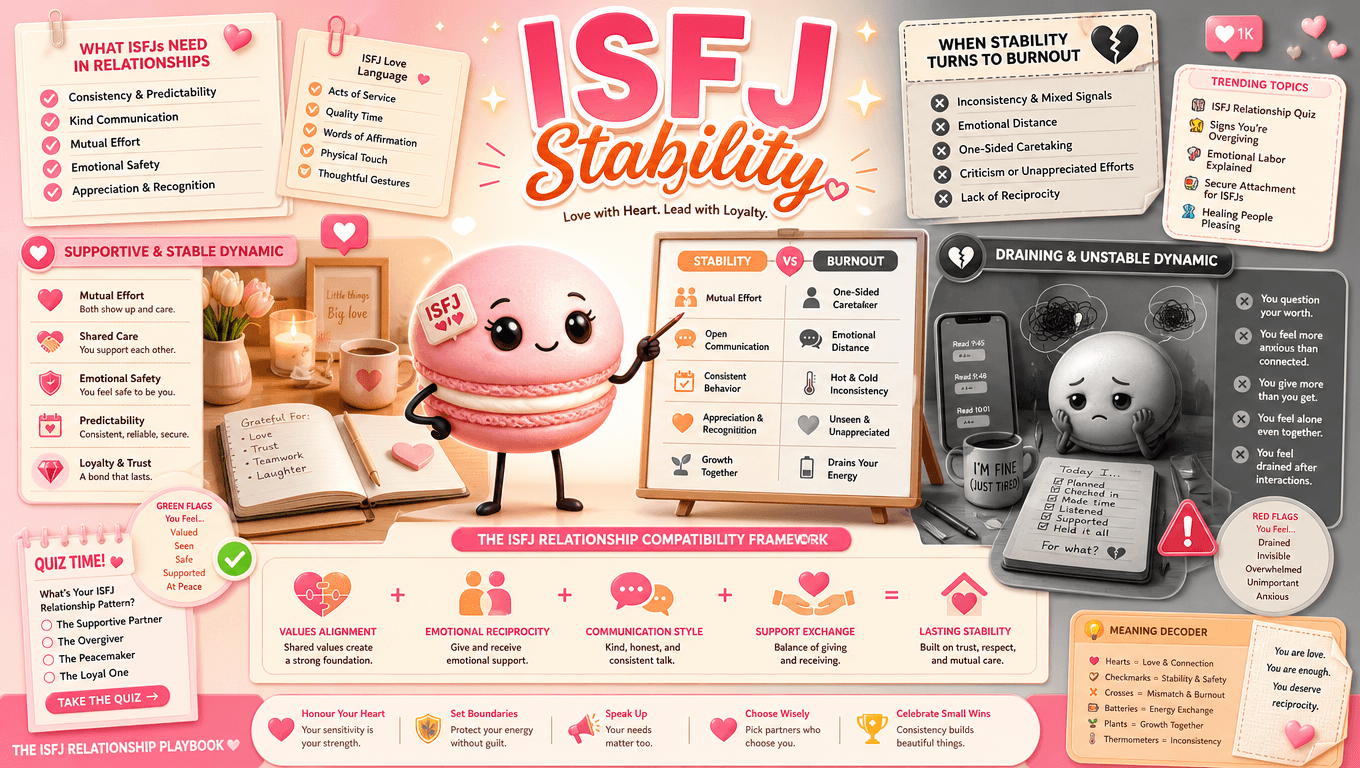
Which Relationship Dynamics Support ISFJ Stability and Which Ones Wear It Down
Some dynamics help ISFJs settle in because they combine warmth, predictability, and mutual effort. Others wear them down through inconsistency, emotional distance, or a pattern where the ISFJ becomes the default caretaker. Macaron helps you look at how support is exchanged, whether recognition is frequent enough, and whether loyalty is being met with equal investment. It also helps identify recurring patterns, such as staying too long in one-sided roles or mistaking endurance for compatibility. That makes the insight more practical than a simple best-match list, especially when the relationship feels calm but not truly reciprocal.
Build Loyal and Supportive Partnerships
Macaron turns ISFJ compatibility into something actionable by helping you reflect on the habits that keep relationships steady. That includes prompts for checking reciprocity, planning clearer communication, resetting after conflict, and defining boundaries around care and responsibility. The goal is to help you build a relationship where support is visible on both sides, not assumed by one person alone. For ISFJs, that often means learning how to ask for reassurance earlier, name needs before resentment grows, and protect the energy that makes them such reliable partners. It is especially helpful when you want structure without losing warmth.
Frequently Asked Questions
ISFJ compatibility is shaped most by consistency, loyalty, clear communication, and whether care feels mutual in practice. ISFJs usually respond well to partners who follow through, notice details, and show appreciation in concrete ways. Compatibility is not only about shared values, though. It also depends on whether both people handle responsibility fairly, repair conflict respectfully, and create enough emotional safety for the ISFJ to relax instead of over-monitoring the relationship.
This often happens when an ISFJ is used to being dependable and finds it easier to keep helping than to ask for more. They may notice imbalance early but delay speaking up because they do not want to create tension or seem demanding. Over time, that can turn into quiet resentment, especially if the other person assumes the relationship is fine. Compatibility improves when needs are named directly and responsibility is shared before the imbalance becomes a habit.
Yes. ISFJ compatibility is useful beyond romance because many of the same patterns show up in family and friendship relationships. It can help you understand where care is being reciprocated, where one person is carrying the emotional or practical load, and why certain interactions feel supportive while others feel draining. This is especially helpful in close family systems where duty, reliability, and unspoken expectations can shape the relationship as much as affection does.
Macaron helps you look for early signs of imbalance, such as repeated follow-through from one side, vague appreciation, or a pattern where your effort is assumed rather than acknowledged. It also helps you notice emotional labor, like always initiating repair, remembering details, or smoothing over conflict. By making those patterns easier to name, you can address them before they harden into resentment or become part of the relationship’s default structure.
ISFJs are often paired with ESFJ, ISTJ, and INFP in type discussions because those combinations can offer warmth, steadiness, or complementary values. Some people also report good chemistry with types like ISFP, ESFP, INTJ, or even ESTJ depending on maturity and communication style. These are not guarantees, though. A healthy relationship depends more on reliability, emotional awareness, and mutual effort than on any single compatibility chart.
Not necessarily. More direct or fast-paced types can create friction if they move too quickly, communicate too bluntly, or overlook the ISFJ need for reassurance and predictability. But those differences can also be useful when both people are flexible. The tradeoff is that the relationship may require more explicit communication and more intentional repair after conflict. Competitor-style type guides often simplify this into a best-match list, while Macaron emphasizes how the dynamic actually behaves. For a third-party check, Romantic Relationships | ISFJ Personality (Defender) | 16Personalities at https://www.16personalities.com/isfj-relationships-dating is worth comparing against the page summary.
Yes, but the core themes are similar. In friendship, ISFJs often value reliability, thoughtful check-ins, and people who remember what matters to them. In romance, those same qualities matter, but expectations around emotional intimacy, shared responsibility, and long-term planning become more important. A friendship can tolerate more inconsistency than a partnership usually can. Macaron helps you compare those contexts so you can see whether the connection is supportive, merely pleasant, or quietly draining. For another outside reference, ISFJs and Their Compatibility with Every Myers-Briggs® Personality ... at https://www.psychologyjunkie.com/isfjs-and-their-romantic-compatibility-with-every-personality-type/ adds a second perspective.
The biggest mistake is assuming that because an ISFJ is patient, helpful, and low-conflict, they do not need much in return. That assumption can leave them carrying the emotional and practical load while their own needs stay invisible. Another common mistake is confusing quietness with agreement. ISFJs may avoid confrontation until the imbalance becomes hard to ignore. Compatibility improves when appreciation is explicit, needs are discussed early, and care is treated as a two-way responsibility. For outside context, ISFJ Relationships & Compatibility With Other Personality Types at https://www.truity.com/blog/personality-type/isfj/relationships is a useful reference point.
Read & discover
AI Personal Assistant
Free calculators


