ISFP Compatibility
ISFP compatibility is often less about finding a perfect type match and more about recognizing the conditions that make closeness feel natural, calm, and sincere. Macaron helps you read those patterns with more clarity so you can understand what supports trust and what quietly creates pressure.
ISFP Compatibility
This short reflection helps you notice what kind of connection feels steady, respectful, and emotionally safe for you. It is designed to highlight relationship patterns around pace, affection, space, and communication, not to judge whether a relationship is right or wrong.
This is a self-reflection tool, not a diagnosis or a scientific compatibility test.
Please answer every question before viewing your result.
This module is for reflection and conversation starters only. If relationship stress is causing ongoing distress, fear, or harm, consider reaching out to a trusted person or a qualified mental health professional.
ISFP in Love: Gentle, Creative, and Deep
ISFP compatibility is usually felt first as a tone rather than a theory. A relationship can seem promising on paper, but if it feels rushed, overly analytical, or emotionally performative, many ISFPs will pull back before they can fully settle in. What tends to matter most is whether the connection leaves room for sincerity, privacy, and a pace that does not force emotional disclosure before trust is ready.
In personality guides, ISFP compatibility is often discussed through likely matches such as ESFP, ISTP, INFP, ESFJ, and ENFJ. Those pairings can be useful as a starting point, but they are not a guarantee of ease. The more practical question is which kinds of people make it easier for an ISFP to stay open, affectionate, and grounded over time, especially when life becomes stressful or expectations start to rise.
Many ISFPs are described as warm, loyal, patient, and attentive to the needs of the people they care about. That can make them easy to misread, because they may show commitment through actions, shared experiences, and quiet consistency rather than constant verbal processing. Compatibility improves when both people can recognize those signals and avoid assuming that less talk means less care or less investment. For a related Macaron page, see AI Personal Assistant - Macaron at https://macaron.im/ai-personal-assistant.
This page is designed to help you interpret ISFP compatibility in a more usable way. Instead of reducing relationships to a single best match, it looks at emotional safety, independence, conflict style, and the rhythm of closeness. Those details matter because a relationship that feels supportive to one ISFP may still feel draining to another if the pace, expectations, or communication style are off.
Macaron helps you turn that ambiguity into something more concrete. By reflecting on what feels comforting, what feels crowded, and where connection starts to lose ease, you can better understand whether a relationship is naturally aligned or simply demanding more adaptation than it should. That makes the page useful for dating, long-term partnerships, and friendships that need a clearer read on what is working.
ISFP in Love: Gentle, Creative, and Deep
ISFP compatibility often grows through warmth, shared ease, and a sense that affection can unfold naturally. Many ISFPs are drawn to relationships where kindness is visible in small actions, where creativity or shared interests create easy connection, and where emotional honesty does not have to be forced. They may enjoy partners who notice details, respect personal space, and understand that intimacy can deepen slowly without losing depth. The relationship usually works best when it feels emotionally real, not overly managed, and when both people can enjoy closeness without turning it into pressure. A tradeoff is that this slower pace can frustrate partners who want frequent verbal reassurance or quick definition.
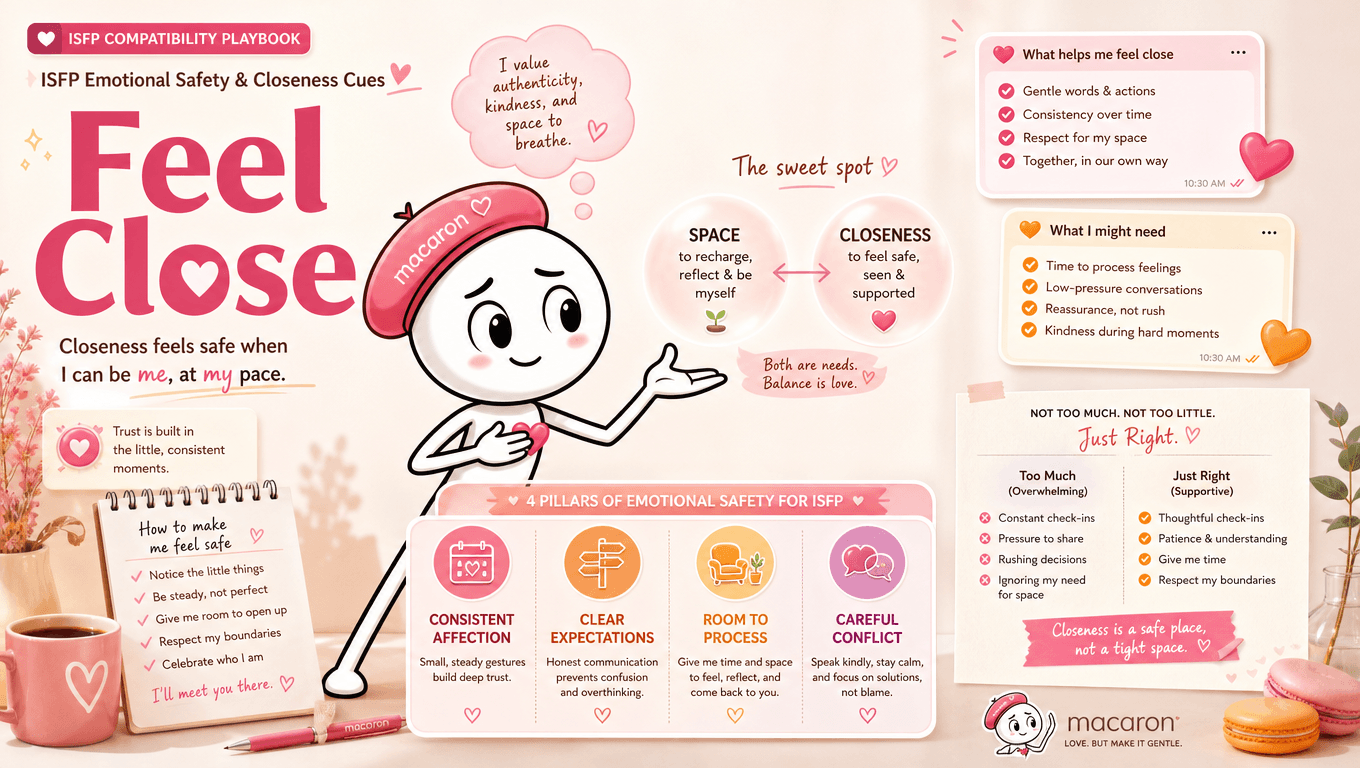
What Helps an ISFP Feel Close Instead of Cornered
Macaron uses ISFP compatibility to help you identify the conditions that make trust easier to build. That includes noticing whether reassurance feels grounding or repetitive, whether conflict is handled with care or intensity, and whether your partner gives you enough room to process before expecting an answer. Many ISFPs feel safest when affection is consistent, expectations are clear, and emotional conversations do not arrive as ambushes. This section helps you separate genuine closeness from the kind of pressure that can make an ISFP go quiet, even when they still care deeply. It is especially useful for people who want to avoid mistaking temporary withdrawal for lack of interest.
More About ISFP Compatibility
ISFP compatibility is often strongest when the relationship feels lived-in rather than managed. Many ISFPs respond well to affection that is steady, specific, and unforced, especially when it does not come with pressure to explain every feeling immediately. The goal is not constant intensity, but a sense that closeness can deepen without becoming controlling or noisy. That said, a very loose or ambiguous relationship can also leave an ISFP unsure whether they are truly valued.
Compatibility discussions around ISFPs repeatedly point to shared values, emotional warmth, room for individuality, and a partner who can respect a slower opening process. That is why type-match lists can be helpful as a starting point, but they are not the whole story. Two people with a theoretically strong pairing can still struggle if one person wants frequent processing while the other needs more space, or if one partner reads silence as rejection.
Macaron helps you notice the difference between healthy quiet and avoidant distance, or between reassuring attention and emotional crowding. That distinction matters because ISFPs often prefer directness that is kind and low-pressure, not bluntness that feels exposing. Understanding that boundary can make it easier to interpret mixed signals without overreacting or withdrawing too quickly. It also gives you a clearer way to decide when to wait, when to ask, and when to step back. Another useful Macaron comparison is AI Calorie Tracker: How It Works and Best Options - Macaron at https://macaron.im/blog/ai-calorie-tracker.
The page also reflects a common pattern in compatibility discussions: people often ask who ISFPs are most compatible with, but the more useful question is what kind of relationship rhythm works best. Some bonds thrive on shared hobbies, creativity, nature, and easy companionship. Others become stressful when one person expects constant verbal reassurance, rapid conflict resolution, or a level of emotional performance that does not fit the ISFP style. Competitor-style type charts can be faster for ranking, but they are usually less helpful for real-world decisions. For a broader Macaron context, How Macaron AI Tackles the Problem with Traditional Task Lists at https://macaron.im/blog/macaron-ai-daily-planning-guide can help you compare the decision from another angle.
Macaron turns that insight into practical reflection tools, so compatibility becomes something you can actually use. Whether you are evaluating a romantic partner, a friendship, or a relationship that has started to feel off-balance, the focus stays on patterns you can observe and discuss, not on labels alone. That makes it easier to spot where a relationship is genuinely supportive and where it may need a different pace, clearer boundaries, or more mutual patience.
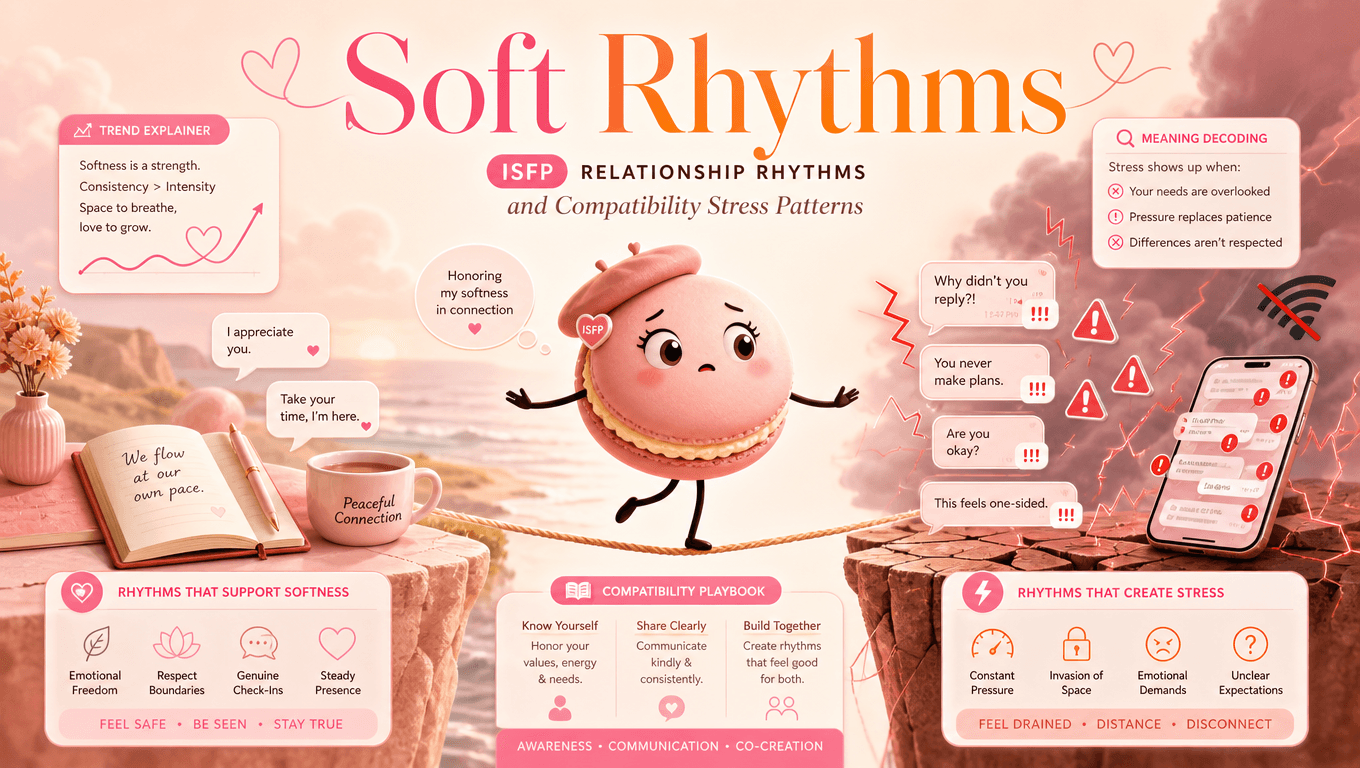
Which Relationship Rhythms Support ISFP Softness and Which Ones Create Stress
Some relationship rhythms fit ISFP compatibility better than others. A steady, patient pace can help an ISFP feel relaxed enough to open up, while constant urgency, repeated confrontation, or frequent demands for explanation can quickly create strain. Macaron helps you look at how direct communication lands, whether silence feels restorative or distancing, and which recurring patterns keep making the bond feel heavier than it should. This is especially useful when a relationship seems loving in some moments but overwhelming in others, because the issue may be rhythm rather than lack of care. The tradeoff is that slower pacing can leave unresolved issues hanging longer than some partners prefer.
Nurture Harmony and Authenticity
Macaron turns ISFP compatibility into practical support by helping you work with real relationship situations instead of abstract type labels. That includes reflection prompts that clarify what you need, check-ins that make affection and boundaries easier to discuss, and communication resets that reduce the chance of shutdown or misunderstanding. It also helps you prepare for conflict in a way that respects emotional sensitivity, so you can address tension without making the relationship feel unsafe. This is especially helpful for people who want to stay authentic without becoming overly self-protective. More structured relationship apps may still be better if you want rigid scripts or highly prescriptive advice.
Frequently Asked Questions
The biggest factors in ISFP compatibility are usually emotional safety, a respectful pace, and a partner who understands that affection may be shown through actions as much as words. Many ISFPs also do best when independence is not treated as distance and when conflict is handled gently rather than aggressively. In practice, compatibility is less about a perfect personality label and more about whether the relationship feels sincere, steady, and easy to trust.
A relationship can feel demanding for an ISFP when it moves too quickly, asks for constant verbal processing, or turns every disagreement into a high-pressure conversation. ISFPs often need time to sort out what they feel before they can explain it clearly, so repeated pushing can make them shut down. The issue is not always conflict itself, but the pace and tone of the conflict.
Yes. ISFP compatibility is not only useful for romance, because friendship can also drift when emotional expectations, communication style, or closeness levels stop matching. An ISFP may quietly step back if a friendship becomes too intense, too demanding, or too inconsistent. Looking at compatibility can help you see whether the distance is about reduced interest, mismatched rhythms, or simply a need for more space.
Macaron helps you notice the moments that lead to shutdown, such as feeling rushed, misunderstood, or pressured to respond before you are ready. It gives you a way to reflect on your emotional pace, identify what makes communication feel safer, and prepare for conversations before distance turns into disconnection. That can make it easier to speak honestly without feeling cornered.
No. Those types are often mentioned because they can align well with ISFP values, pace, or communication style, but compatibility is never guaranteed by type alone. A strong relationship still depends on maturity, timing, conflict habits, and whether both people can respect each other’s needs. Some less-discussed pairings can work very well too if the relationship has trust, patience, and enough room for individuality.
The biggest tradeoff is that the same qualities that make ISFPs warm and easy to be around can also make them hard to read when they feel overwhelmed. They may need space, time, and low-pressure communication, which can be comforting to some partners and frustrating to others. If the relationship lacks clarity, the other person may feel uncertain even when the ISFP still cares deeply. That is why pacing and explicit reassurance matter. For a third-party check, ISFP Compatibility Chart: Best Match (Relationships, Love) - Boo at https://boo.world/isfp-personality/isfp-compatibility-chart is worth comparing against the page summary.
Look for patterns rather than one-off moments. An ISFP who needs space may still return, stay consistent in small ways, and respond well when the pressure eases. If interest is fading, the distance usually becomes broader and more persistent, with less follow-through and less effort to reconnect. Macaron can help you track those patterns so you do not confuse temporary withdrawal with a deeper mismatch. For another outside reference, ISFP Personality - Romantic Relationships - 16Personalities at https://www.16personalities.com/isfp-relationships-dating adds a second perspective.
Apps that focus only on MBTI charts or relationship scoring can be faster if you want a simple ranking or a quick comparison between types. Macaron is more useful when you want to think through the actual relationship dynamics behind the label, especially pace, boundaries, and emotional safety. The tradeoff is that Macaron asks for more reflection, while chart-based tools may feel more immediate for users who want a short answer. For outside context, ISFP Relationships & Compatibility With Other Personality Types at https://www.truity.com/blog/personality-type/isfp/relationships is a useful reference point.
Read & discover
AI Personal Assistant
Free calculators


