ISTP Compatibility
ISTP compatibility is easiest to understand through real relationship patterns, not just type labels. Macaron helps you see where independence, direct communication, and emotional pace create ease or friction.
ISTP Compatibility
This short reflection helps you notice what tends to make connection feel easy, steady, or draining in ISTP compatibility. It focuses on everyday relationship patterns like autonomy, honesty, pace, and emotional pressure rather than on type labels alone.
This is a self-reflection tool, not a diagnosis or a scientific compatibility test.
Please answer every question before viewing your result.
This module is for reflection only and cannot determine whether a relationship is healthy, unhealthy, or clinically significant. If a relationship involves fear, coercion, manipulation, or ongoing distress, consider reaching out to a trusted person or a qualified professional for support.
ISTP Relationship Style: Practical and Independent
ISTP compatibility is usually less about dramatic chemistry and more about whether two people can build trust without crowding each other. Many ISTPs are drawn to relationships that feel straightforward, useful, and emotionally unforced, so the real question is often whether the connection can stay steady without becoming demanding. A good fit tends to feel calm, respectful, and flexible enough to let both people keep their own rhythm.
A useful way to read ISTP compatibility is to look at the balance between freedom and reliability. Many ISTPs are comfortable with closeness when it feels honest, low-pressure, and grounded in real behavior, but they may pull back if a relationship requires constant reassurance, vague expectations, or repeated emotional processing on someone else’s schedule. The more a relationship respects autonomy, the easier it is for trust to grow naturally.
That is why compatibility for ISTPs can look different in dating, long-term partnership, and friendship. A person may be fun, exciting, or even deeply attractive at first, yet still become draining if the connection depends on frequent verbal affirmation or rapid disclosure. By contrast, a quieter match can work well if it offers mutual respect, clear boundaries, and enough patience to solve problems in practical ways instead of turning every issue into a high-stakes conversation. For a related Macaron page, see 20 AI Tools to Upgrade Your Daily Life - Macaron - Macaron App at https://macaron.im/blog/macaron-app-ai-tools-daily-life.
Macaron organizes ISTP compatibility around the patterns people actually notice in daily life, such as how conflict starts, how repair happens, and whether both people can stay connected without forcing the same communication style. That matters because type labels alone do not tell you whether a specific relationship feels supportive, tense, or simply mismatched in pace. Macaron’s approach is more useful when you want to understand the relationship in front of you, not just a general theory about the type.
If you are trying to understand whether a connection is a good fit, the key question is often not whether the other person is a perfect type match, but whether the relationship supports the ISTP need for autonomy while still creating enough steadiness to feel safe. That tension shows up repeatedly in compatibility discussions, and it is where the most useful reflection begins. The tradeoff is that this style can miss subtle emotional needs if you only focus on logic and independence.
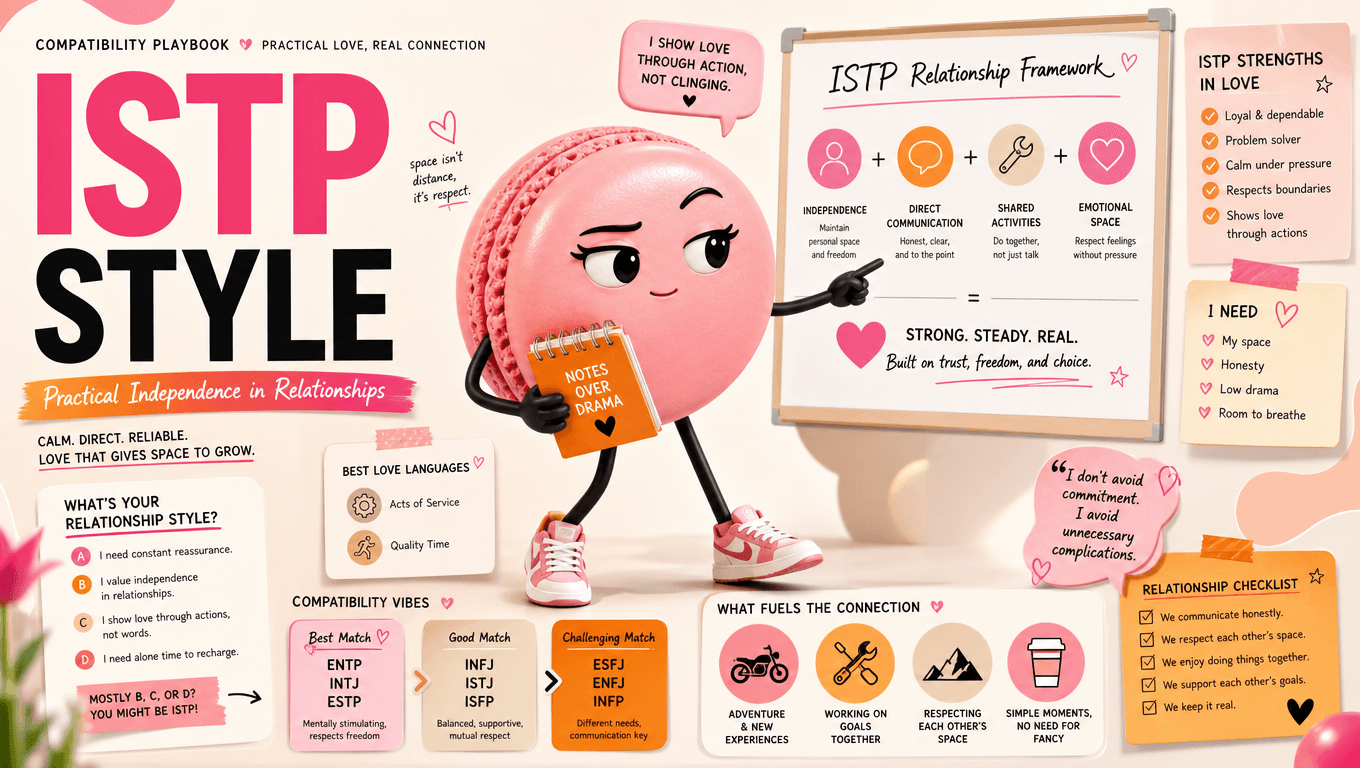
ISTP Relationship Style: Practical and Independent
ISTP compatibility is usually shaped by how well a relationship handles independence without turning distant. Many ISTPs prefer direct communication, practical follow-through, and enough personal space to think before responding, especially when emotions are running high. They often do best when the relationship feels calm rather than performative, and when affection is shown through reliability, problem-solving, or shared activity instead of constant emotional display. The main tradeoff is that too much pressure can make even a promising connection feel restrictive, especially if expectations are unclear, emotionally urgent, or built around frequent reassurance.
How Macaron’s ISTP Compatibility Insights Support Reflection
Macaron uses ISTP compatibility as a way to examine the patterns that matter most in real life, not just in theory. You can look at how much space feels healthy, whether directness builds trust or creates tension, and how each person reacts when conflict appears or when plans change unexpectedly. It also helps you notice whether emotional expression feels manageable or overwhelming, which is often a key difference in ISTP relationships. The result is a more grounded way to reflect on compatibility, especially when a connection feels good in some areas but strained in others.
More About ISTP Compatibility
ISTP compatibility is often discussed in terms of which types are most complementary, but the more practical question is what each person brings to the relationship. Many compatibility guides point toward partners who can match an ISTP's calm, direct style or balance it with structure, warmth, or spontaneity. The real issue is whether the pairing reduces friction around pace, expectations, decision-making, and how much emotional explanation is required to keep things stable.
Search patterns also show a lot of uncertainty around whether ISTPs are hard to date, who they are attracted to, and which types feel incompatible. That confusion makes sense because ISTPs can seem easygoing on the surface while still being selective about emotional pressure. A relationship may look fine on paper yet feel off if one person wants constant verbal affirmation and the other prefers action, space, and straightforward problem-solving. The mismatch is often about timing and style, not lack of care.
Macaron helps you move from abstract type talk to concrete relationship reading. Instead of asking only whether a pairing is labeled good or bad, you can examine how the two people handle conflict, how much independence each person needs, and whether closeness feels energizing or restrictive. Those details matter more than a generic compatibility ranking when you are trying to understand a real relationship, especially one that works in some settings but breaks down under pressure. Another useful Macaron comparison is AI Personal Assistant - Macaron at https://macaron.im/ai-personal-assistant.
This page is also useful for people comparing romantic, friendship, and long-term partnership dynamics. ISTP compatibility can look different depending on whether the connection needs daily logistics, emotional intimacy, shared hobbies, or simply mutual respect. A match that works well for adventure and conversation may still need extra care around commitment, consistency, or emotional expression. That is where Macaron’s practical framing helps: it shows where a pairing is naturally easy and where it needs deliberate adjustment. For a broader Macaron context, AI Personal Assistant: What to Look For in 2026 - Macaron at https://macaron.im/blog/ai-personal-assistant-what-to-look-for-2026 can help you compare the decision from another angle.
The goal is not to force a perfect answer from a personality type label. It is to help you recognize recurring patterns, such as when a connection feels natural because it is direct and low-drama, or when it becomes tiring because the pace is too intense or the expectations are too vague. That kind of reading is what makes compatibility insight genuinely useful. Competitor type charts can be helpful for quick orientation, but Macaron is better when you want to evaluate a specific relationship with more nuance.
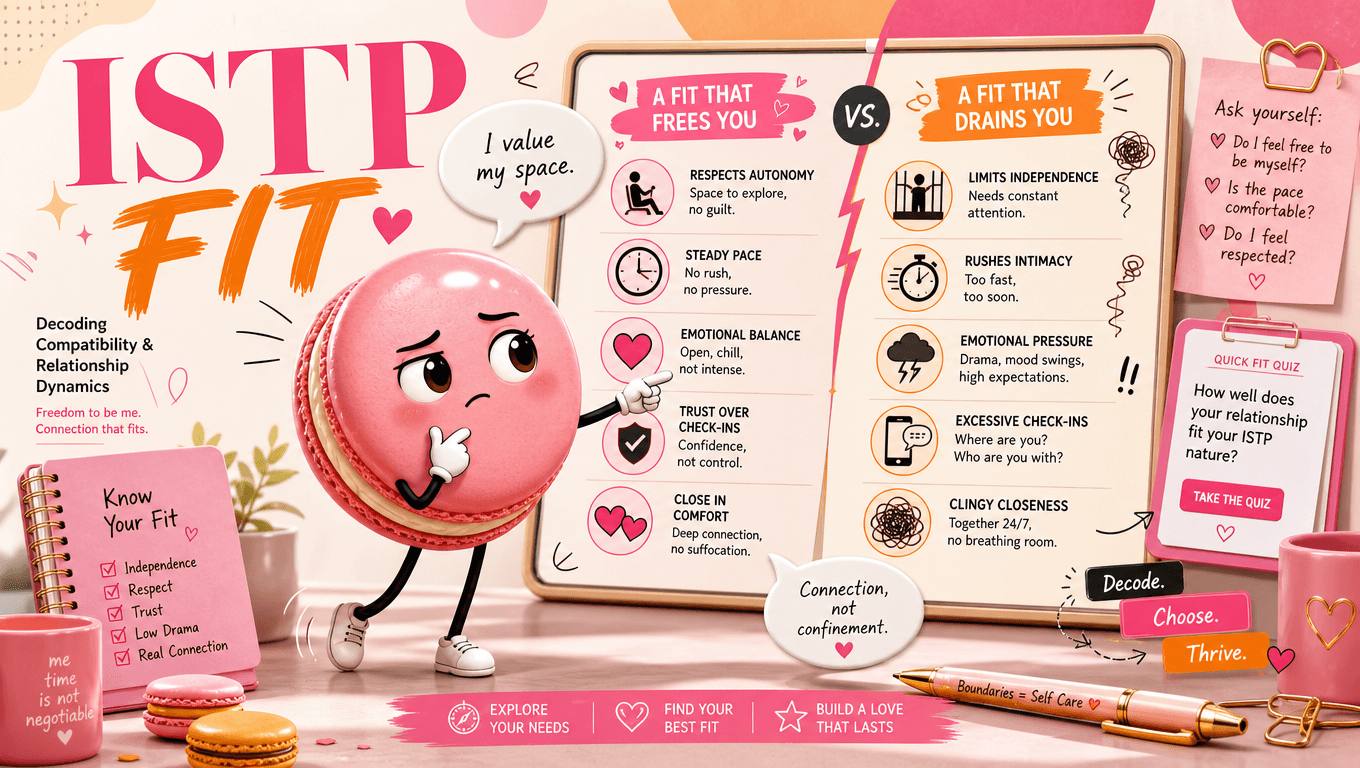
Which Relationship Dynamics Fit ISTP Independence and Which Ones Feel Confining
Some relationships work well for ISTPs because they allow autonomy, clear expectations, and a steady pace. Others become difficult when one person expects immediate emotional processing, frequent check-ins, or a level of closeness that leaves little room to reset. Macaron helps you sort through those differences by looking at what makes closeness feel comfortable, where pressure starts to shut you down, and which differences are actually workable. This is especially useful when a relationship is not obviously bad, but still feels tiring, overmanaged, or mismatched in everyday interaction. The tradeoff is that it asks you to notice patterns instead of relying on a simple compatibility label.
Balance Freedom and Connection
Macaron turns ISTP compatibility into practical support by focusing on the parts of a relationship that usually need adjustment over time. That includes reflection prompts for noticing recurring patterns, communication check-ins for reducing misunderstandings, and conflict resets for when a conversation becomes too charged or too vague. It also highlights boundary clarity, which matters because ISTPs often need connection that does not come at the cost of autonomy. This is especially helpful for people who want a relationship to feel steady without becoming controlling, while still leaving room for emotional honesty and repair.
Frequently Asked Questions
ISTP compatibility tends to feel strongest when the relationship is direct, low-pressure, and built on mutual respect. ISTPs often respond well to partners who are honest, self-sufficient, and comfortable with practical forms of care. Strong compatibility usually also means there is enough space for independence, but not so much distance that the connection feels undefined or emotionally unavailable. The best fit often feels calm, useful, and easy to maintain without constant negotiation.
Use them as a way to check the day-to-day fit, not as a final verdict. Pay attention to how you and the other person handle pace, conflict, and expectations around closeness. If the relationship feels easier when communication is direct and harder when emotions are rushed, that is useful information. Compatibility insight works best when it helps you name patterns you already sense, then decide what needs adjustment and what is simply a mismatch.
That does not automatically mean the relationship is wrong, but it may mean the pace or style of connection is not a good fit. ISTPs often need time, clarity, and room to process before responding. If intensity keeps creating shutdown, distance, or frustration, the issue may be less about care and more about mismatched expectations, communication style, or emotional timing. In some cases, slower pacing and clearer boundaries help; in others, the mismatch is structural.
A type chart can tell you which pairings are often discussed together, but it cannot show how a specific relationship is actually functioning. Macaron helps you think through the details that matter most for ISTP compatibility, such as boundaries, conflict patterns, and whether closeness feels supportive or confining. That makes the insight more practical for real decisions, not just curiosity. It is especially useful when the relationship is mixed, not obviously good or bad.
Yes. Friendship may work well with less emotional intensity, fewer expectations, and more room for shared activity or occasional check-ins. Romance usually adds more pressure around consistency, vulnerability, and long-term planning, which can expose differences that are easy to ignore in friendship. An ISTP pairing that feels easy as friends may need more structure, patience, and communication skill once commitment enters the picture. That is why context matters as much as type.
ISTPs often get along well with people who are calm, direct, and comfortable with independence. In practice, that can include partners or friends who value honesty, practical problem-solving, and low-drama communication. Some pairings work because they share a similar pace, while others work because one person adds structure or warmth without becoming controlling. The better question is not just which type is listed as compatible, but whether the actual relationship feels respectful and sustainable. For a third-party check, Romantic Relationships | ISTP Personality (Virtuoso) - 16Personalities at https://www.16personalities.com/istp-relationships-dating is worth comparing against the page summary.
Common friction points include pressure for constant reassurance, unclear expectations, emotional conversations that move too fast, and partners who interpret independence as disinterest. ISTPs may also struggle when a relationship becomes overly managed or when conflict is handled through hints instead of directness. On the other side, ISTPs can sometimes seem detached if they do not explain their internal process. The issue is usually not lack of care, but a mismatch in communication and pacing. For another outside reference, ISTP Compatibility Chart: Best Match (Relationships, Love) - Boo at https://boo.world/istp-personality/istp-compatibility-chart adds a second perspective.
Yes, but it usually works best when both people respect the difference instead of trying to erase it. A more expressive partner may bring warmth, clarity, and emotional momentum, while the ISTP brings steadiness and practical grounding. The challenge is making sure expression does not become pressure and independence does not become avoidance. If both people can agree on timing, boundaries, and repair, the contrast can be useful rather than exhausting. For outside context, ISTP Relationships & Compatibility With Other Personality Types at https://www.truity.com/blog/personality-type/istp/relationships is a useful reference point.
Read & discover
AI Personal Assistant
Free calculators


