Loneliness Quiz
A loneliness quiz can help you pause and notice whether disconnection is affecting your mood, routines, or sense of belonging. Macaron turns that check-in into guided reflection, while making clear it is not a clinical diagnosis or formal screening tool.
Loneliness Quiz
This self-reflection helps you notice whether disconnection is showing up in your mood, routines, or sense of belonging. It is designed to support insight and next steps, not to label you or make a diagnosis.
This is a self-reflection tool, not a clinical assessment or diagnosis.
Please answer every question before viewing your result.
If loneliness is making it hard to function, affecting sleep or appetite, or bringing up hopelessness, please reach out to a trusted person or a mental health professional. If you feel at risk of harming yourself or need immediate support, contact local emergency services or a crisis line right away.
What This Reflection Can Help You Notice
A loneliness quiz is most useful when you want a quick, low-pressure way to check whether feeling disconnected is starting to shape your mood, energy, or daily habits. People often search for this kind of quiz when they are unsure whether they are simply spending time alone or experiencing a deeper sense of isolation. Macaron treats that uncertainty as a starting point for reflection, not a problem to be scored or judged.
Macaron uses the loneliness quiz as a guided reflection, not a label. The goal is to help you notice what feels missing in your social world, whether that is emotional closeness, reliable support, or a stronger sense of belonging in ordinary routines. That makes the experience more useful for self-understanding than a blunt result that only tells you whether you are “lonely” or not.
Searchers often want to know what a loneliness quiz actually measures. In practice, these quizzes usually ask about feeling left out, having no one to talk to, or feeling disconnected even when other people are around. That means the best versions are less about a single symptom and more about the quality of your relationships, your access to support, and how often you feel understood. For a related Macaron page, see How Macaron AI Tackles the Problem with Traditional Task Lists at https://macaron.im/blog/macaron-ai-daily-planning-guide.
This page is designed to clarify that distinction. Loneliness can show up as surface-level relationships, a sense of invisibility, or the feeling that contact exists without real understanding. A good check-in should help you name the pattern without turning it into self-judgment, especially because many people feel embarrassed about loneliness even when it is a common and understandable experience.
Because loneliness can overlap with stress, low mood, social anxiety, grief, or major life changes, the result is best read as a starting point rather than a conclusion. It can help you decide whether you need a small connection step, a more intentional support plan, or outside help if the feeling is persistent, intense, or starting to affect daily functioning.
What This Reflection Can Help You Notice
Macaron helps you notice the kinds of loneliness that people often describe in everyday language, such as feeling left out, having no one to talk to, or sensing that relationships are present but not emotionally satisfying. It can also surface subtler patterns, like wanting closeness but hesitating to reach out, feeling invisible in groups, or feeling emptier after social contact than before it. Those details matter because loneliness is often about the quality of connection, not just the amount of time spent with other people.
How Macaron Structures This Reflection
Macaron organizes the reflection around the main ways loneliness tends to show up: how connected you feel right now, whether the feeling is more emotional or more social, whether support is available when you need it, and how much the pattern is affecting your daily life. That structure helps separate temporary solitude from ongoing isolation and from a deeper belonging problem. It also makes the result easier to interpret, which is useful if you want a practical next step instead of a vague score.
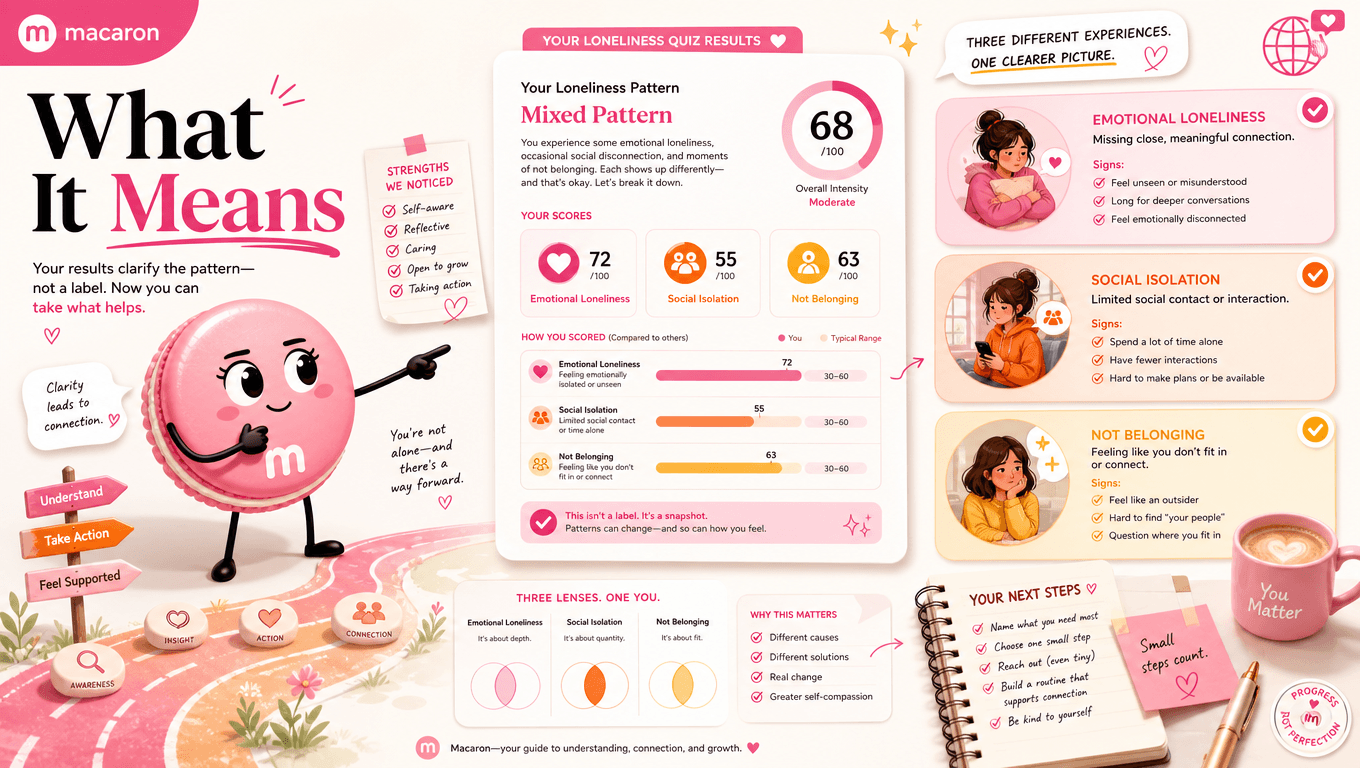
What Your Result Can Clarify
Your result is meant to give you a clearer read on the pattern, not a label to carry around. It can help you identify whether the strongest issue is emotional loneliness, social isolation, or a broader sense of not belonging, and it can show whether the feeling is mild, recurring, or affecting your routines and mood. It may also point you toward the first practical move, such as reaching out, reflecting on what kind of connection is missing, or getting outside support if the loneliness feels persistent.
More About Loneliness Quiz
Macaron helps you reflect on the parts of loneliness that are easy to miss in day-to-day life. That includes feeling alone in a crowd, wanting closeness but not knowing how to ask for it, or noticing that conversations happen without much emotional depth. It can also help you distinguish loneliness from simply preferring solitude, which matters because being alone is not always the same as feeling disconnected or unsupported.
The quiz is structured to separate different kinds of disconnection, since loneliness is not always the same as being physically isolated. Some people have regular contact but still feel unseen, while others have too little contact and feel cut off from support altogether. Macaron’s approach is useful for people who want to understand the shape of the problem, not just whether they should be worried about it.
Your result is meant to clarify the pattern, not rank how serious you are. That matters because many loneliness quizzes online use score-based language that can feel blunt or overly clinical, while a reflective check-in is often more helpful for understanding what is actually missing. The tradeoff is that a reflection tool is less standardized than a formal screening, so it is better for insight and next steps than for comparison or diagnosis. Another useful Macaron comparison is AI Calorie Tracker: How It Works and Best Options - Macaron at https://macaron.im/blog/ai-calorie-tracker.
Macaron then turns the result into practical next steps. That can include a small outreach idea, a prompt to think about where connection feels weakest, or a reminder to build routines that make it easier to stay in touch with people who matter to you. This is especially helpful for users who know they want more connection but feel stuck on where to begin or what kind of connection would actually help. For a broader Macaron context, How to Use AI as a Personal Assistant: 30 Prompts That Actually Work at https://macaron.im/blog/ai-personal-assistant-prompts can help you compare the decision from another angle.
If the result suggests the loneliness feels heavy, persistent, or tied to distress, the page also points you toward support rather than leaving you with a score alone. That makes the experience more useful in real life, especially for people whose loneliness is connected to grief, depression, anxiety, or major life transitions. For users who want a quick self-check, Macaron is practical; for users who need a formal assessment, a clinician or standardized tool may still be better.
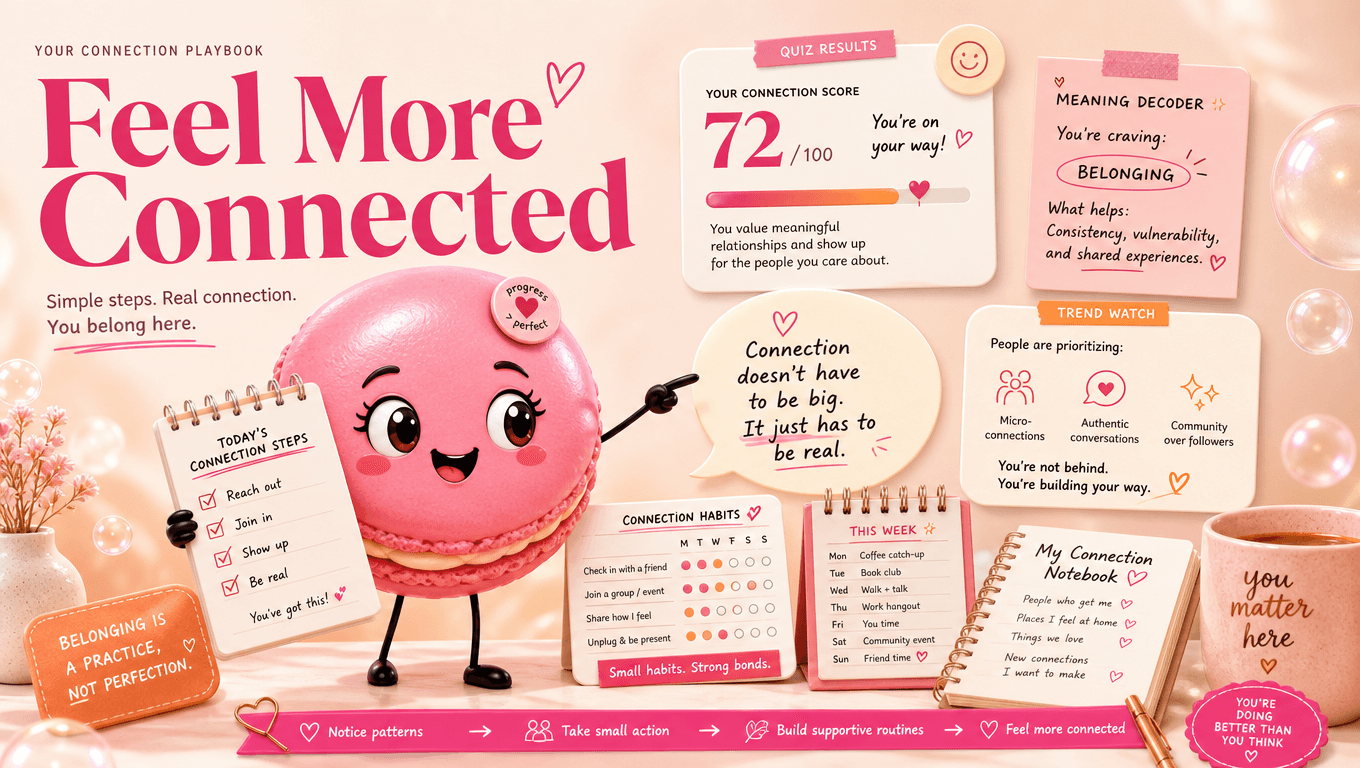
Practical Ways to Feel More Connected
Macaron uses the quiz result to suggest next steps that feel manageable rather than overwhelming. That may include a low-pressure message to someone you trust, a brief check-in with your own habits and routines, or a prompt to notice which settings leave you feeling most included or most alone. It can also help you think about belonging in a broader sense, including whether you need more regular contact, more emotionally honest conversation, or professional support to break a longer pattern of disconnection. The advantage is that the guidance is tied to the pattern you described, not a generic self-help list.
If You Need Immediate Support
This quiz is only a reflection tool, so it should not be used as a substitute for urgent help. If loneliness feels unbearable, if you do not feel safe, or if the feeling is connected to thoughts of self-harm, contact crisis support right away. In the United States, you can call or text 988. In the United Kingdom and Ireland, call 116 123. If you are elsewhere, use a trusted international directory such as findahelpline.com to locate local support quickly. If you are unsure whether your situation is urgent, it is safer to reach out.
Your Responses and Privacy
Loneliness and belonging can be sensitive topics, so it is reasonable to think about how your responses are handled. Macaron is provided by MINDAI PTE. LTD., and the official Privacy Policy explains how data is managed. If you have questions about privacy or want to understand how reflection data is treated, you can review the policy directly or contact contact@macaron.im for the privacy team. That transparency matters for users who want a private check-in, especially when the topic feels personal or emotionally loaded.
Frequently Asked Questions
This loneliness quiz focuses on the lived experience of disconnection, including emotional loneliness, social isolation, belonging, and whether the feeling is affecting your day-to-day life. It is meant to help you notice patterns like feeling left out, having no one to talk to, or being around people without feeling understood. The emphasis is on context and impact, not on giving you a clinical label.
Start with the part of the result that feels most true right now, then choose one small next step that matches the pattern. For some people that means reaching out to one person, for others it means reflecting on where the loneliness shows up most, and for others it means building a more regular connection routine. If the result feels heavy or persistent, consider talking with a licensed professional.
Loneliness should be taken more seriously when it does not ease over time, starts affecting sleep, motivation, or daily functioning, or begins to feel overwhelming or unsafe. It is also important to seek help if loneliness is tied to hopelessness, panic, or thoughts of self-harm. In those cases, a quiz is not enough, and crisis support or a mental health professional is the right next step.
This page offers an AI-guided reflection, which is useful for a quick check-in and for understanding the shape of your experience. A formal loneliness screening is usually standardized, scored in a more clinical way, and designed for professional use. Macaron is not presenting this as a diagnostic tool, so the result should be read as insight and guidance rather than a medical conclusion.
Being alone is a physical state; loneliness is the feeling that your connection needs are not being met. Some people enjoy solitude and feel restored by it, while others feel isolated even in a busy room. This quiz is designed to help you tell the difference by looking at emotional closeness, support, and belonging, not just how much time you spend with other people.
It can help you notice emotional loneliness, which is about missing closeness or understanding, and social loneliness, which is about lacking a broader network or regular contact. It may also surface a more general sense of not belonging, where you have people around you but still feel unseen or disconnected. That distinction matters because each pattern usually calls for a different next step. For a third-party check, Loneliness Test - IDRlabs at https://www.idrlabs.com/loneliness/test.php?srsltid=AfmBOoqv167rYwX2p8dHbHtMoDdIJkEO5Rbabw5vl-ErSVwZ4vHRMsew is worth comparing against the page summary.
Yes. Many people feel lonely even when they have friends, family, or coworkers around them. In those cases, the issue is often not the number of relationships but the depth, reliability, or emotional safety of those connections. Macaron is useful here because it helps you look at whether you need more honest conversation, more consistent support, or a different kind of community. For another outside reference, The Loneliness Quiz - Oprah.com at https://www.oprah.com/omagazine/the-loneliness-quiz_1 adds a second perspective.
It can be. Some people use loneliness reflections as a periodic check-in to notice whether their sense of connection is improving, staying flat, or getting worse over time. That can be useful after a move, breakup, job change, or other life transition. The tradeoff is that a self-check is not a substitute for professional assessment if the feeling is intense, persistent, or tied to distress. For outside context, Loneliness Test / Quiz | Psychology Today at https://www.psychologytoday.com/us/tests/relationships/loneliness-test is a useful reference point.
Read & discover
AI Personal Assistant
Free calculators


