Loneliness Test
A loneliness test can be useful when the problem is not simply being alone, but feeling unseen, left out, or emotionally disconnected from the people around you. Macaron uses this as a guided reflection, not a clinical diagnosis, to help you understand what kind of loneliness may be present and what support might help next.
Loneliness Test
This reflection helps you notice whether your loneliness feels more like missing company, missing closeness, missing belonging, or carrying a mix of all three. It is designed to support clearer self-understanding and small next steps, not to label you.
This is a self-reflection tool, not a diagnosis or clinical assessment.
Please answer every question before viewing your result.
This reflection is meant for self-understanding, not diagnosis or emergency decision-making. If loneliness is making it hard to function, leading to hopelessness, or connecting with thoughts of self-harm, please reach out to a trusted person, a mental health professional, or local emergency support right away.
What This Reflection Can Help You Notice
A loneliness test is most useful when the feeling is less about being physically alone and more about a persistent sense of disconnection. People often look for this kind of check when they feel like an outsider in a group, have no one they can speak to honestly, or notice that their relationships are active but not emotionally close. Macaron treats that experience as something worth understanding in context, not something to reduce to a single label.
Macaron frames the loneliness test as a reflection tool that helps you separate social loneliness, emotional loneliness, and a broader sense of not belonging. That distinction matters because the next step is often different depending on what is missing. You may need more contact, more trust, more intimacy, or a stronger sense of being included. A clearer category makes the result more actionable and less vague.
This page is intentionally not presented as a formal diagnosis or a rigid score. Many loneliness quizzes borrow formal assessment language such as subjective loneliness, social isolation, or UCLA-style measures, but they are not all designed for the same purpose. Macaron keeps the experience conversational so you can think clearly without feeling judged, compared, or pushed into a number that may not reflect your full situation. For a related Macaron page, see How Macaron AI Tackles the Problem with Traditional Task Lists at https://macaron.im/blog/macaron-ai-daily-planning-guide.
The goal is to help you notice patterns that are easy to miss in daily life. Loneliness can show up as low energy, avoiding plans, feeling drained after social contact, or sensing that conversations stay on the surface. It can also appear when you are surrounded by people but still feel unseen. Those details are often more useful than a broad label because they point toward what kind of support would actually help.
If you are trying to interpret a loneliness test result, the most useful reading is usually practical rather than absolute. A result can help you decide whether the feeling is occasional or persistent, what type of connection feels absent, and whether a small outreach step, a routine change, or outside support is the most realistic next move. Macaron is designed to make that next step easier to identify without overcomplicating the process.
What This Reflection Can Help You Notice
Macaron helps you reflect on forms of loneliness such as social loneliness, emotional loneliness, deeper disconnection, loss of belonging, and a reduced sense of being understood. These categories matter because loneliness is not always one thing. Some people have enough social contact but still feel emotionally unseen, while others feel cut off from community or unsure where they fit. The reflection is designed to help you notice which pattern feels closest to your experience so the result is more specific, more grounded, and more useful for deciding what to do next.
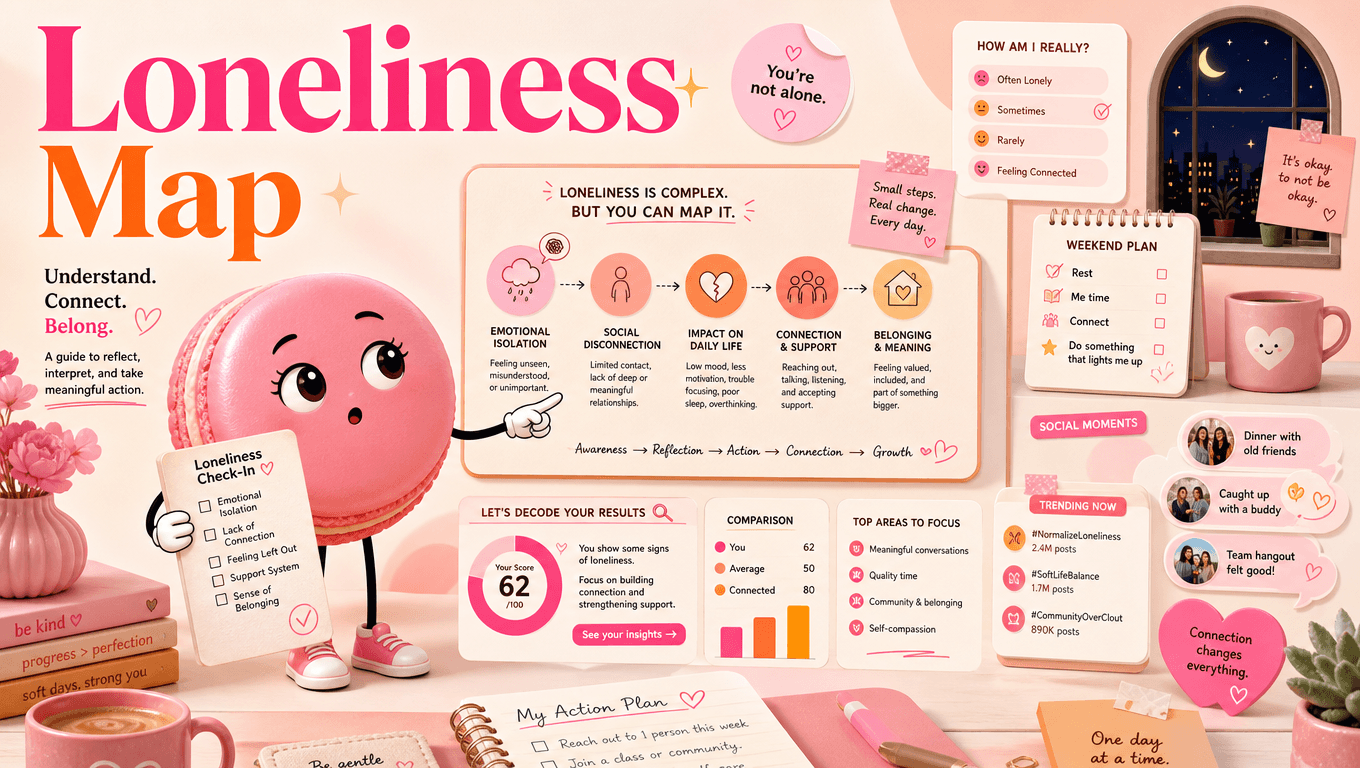
How Macaron Structures This Reflection
Macaron structures this reflection around current sense of connection, emotional isolation, social disconnection, belonging and support, and daily impact. That layout helps you move from a vague feeling to a clearer picture of what is happening in real life. For example, you may notice that loneliness shows up most at night, after social events, during weekends, or in routines that used to feel easier. Looking at both emotional and practical context makes the result easier to interpret and easier to act on.
What Your Result Can Clarify
Your result is there to support reflection, not self-judgment. It can help you notice whether the feeling is occasional or persistent, what type of connection feels most missing, how loneliness is affecting mood, energy, or routines, and what next step might bring more steadiness. That kind of clarity is useful because loneliness often becomes harder to read once it starts affecting sleep, motivation, or willingness to reach out. A result can help you separate a passing low point from a pattern that deserves attention.
More About Loneliness Test
Macaron helps you notice the difference between being alone and feeling lonely. That distinction matters because many people are not looking for a general mood quiz; they want help understanding why solitude feels heavy, why social contact still feels empty, or why belonging seems harder than it should. A good loneliness reflection should make those differences visible instead of treating every quiet period as the same experience.
The reflection is organized around the parts of loneliness people most often describe in plain language: feeling left out, lacking companionship, missing closeness, or sensing that relationships are too surface-level. This makes the result easier to interpret because it connects the idea of loneliness to everyday experiences instead of abstract terminology. It also helps you compare what you feel now with what has changed in your routines, relationships, or environment.
The structure also leaves room for context, not just symptoms. Loneliness can be tied to a recent move, a breakup, remote work, caregiving, grief, neurodivergence, social anxiety, or a long-running pattern of not feeling understood. A useful loneliness test should account for those differences instead of assuming one cause or one solution. That makes the reflection more realistic and more respectful of how varied loneliness can be. Another useful Macaron comparison is AI Personal Assistant - Macaron at https://macaron.im/ai-personal-assistant.
Macaron then turns the reflection into action by suggesting low-pressure ways to respond. That may include checking in with one person, rebuilding a routine that creates more contact, or noticing which relationships feel safe enough for deeper conversation. The point is not to force socializing or pretend connection is easy. It is to make the next step feel manageable, especially when loneliness has made everything feel heavier than usual. For a broader Macaron context, Eat This Much Review: Meal Planner and Alternatives - Macaron AI at https://macaron.im/blog/eat-this-much-review can help you compare the decision from another angle.
The page also keeps boundaries clear. If loneliness is becoming overwhelming, persistent, or tied to thoughts of self-harm, a self-check is not enough on its own. In that situation, the most helpful next step is professional or crisis support, because the right response is care, not just more reflection. Macaron is useful for insight and planning, but it should not replace urgent help when safety is a concern.
Build More Meaningful Connection
Macaron helps turn the loneliness test into next steps through reflection prompts, connection check-ins, low-pressure outreach ideas, habits that support belonging, and clearer paths toward outside support. This is especially helpful when the hardest part is not knowing where to start. A small message, a recurring plan, or a more intentional conversation can be more realistic than trying to fix everything at once. The aim is to make connection feel possible without turning it into a performance, and without assuming you need a large social circle to feel better.
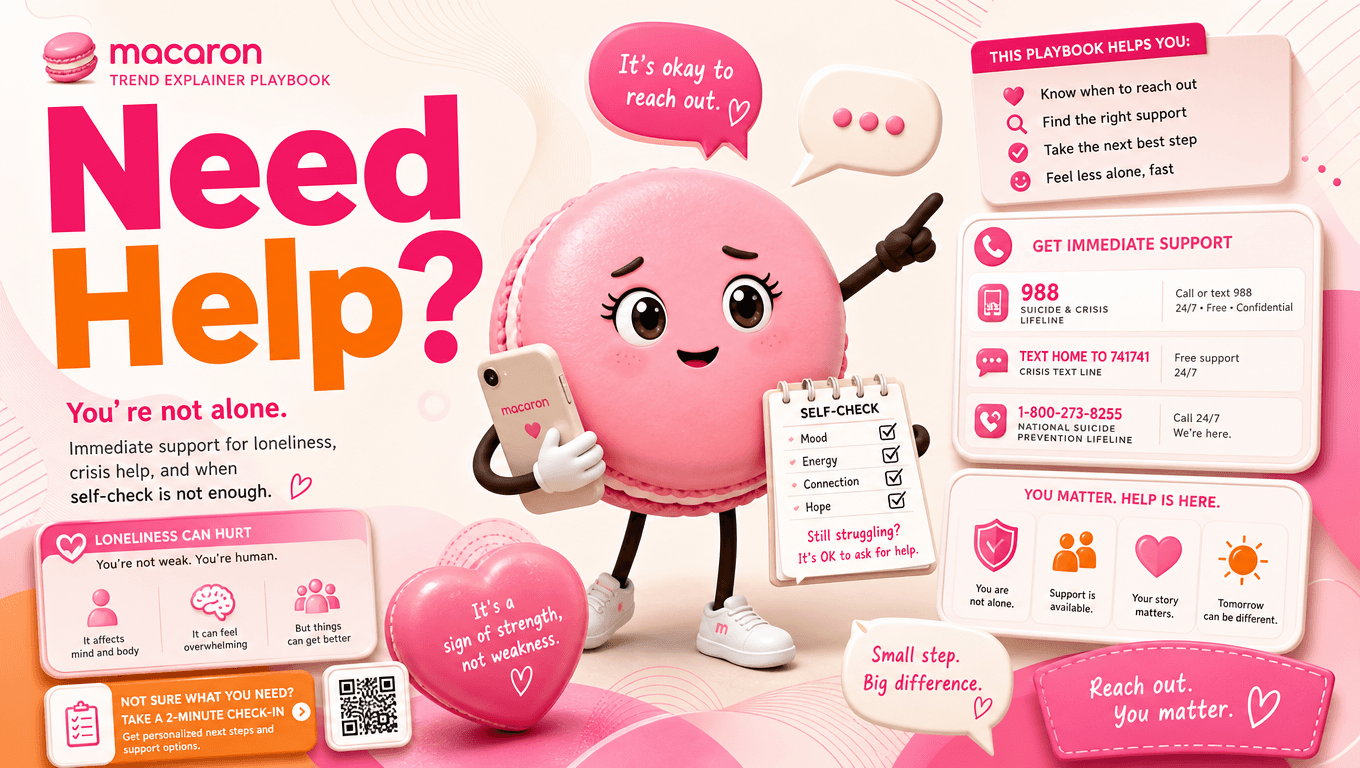
If You Need Immediate Support
This self-check is not a substitute for professional help. If loneliness feels overwhelming, if you feel unsafe, or if you are thinking about harming yourself, please contact crisis support right away. Loneliness can sometimes sit alongside depression, anxiety, grief, trauma, or other distress that needs more than self-reflection. If you are in the United States, call or text 988. In the United Kingdom and Ireland, call 116 123. For other locations, use findahelpline.com to find local support.
Your Responses and Privacy
Emotional reflection data can be sensitive, especially when it touches on isolation, belonging, or distress. Macaron is provided by MINDAI PTE. LTD., and the official Privacy Policy explains how responses are handled. If you are cautious about sharing personal feelings online, it is reasonable to review the policy before starting. Privacy contact is available at contact@macaron.im for questions related to data handling or account concerns. That transparency matters when a tool asks about personal emotional experience.
Frequently Asked Questions
This loneliness test focuses on social disconnection, emotional isolation, belonging, and the way loneliness may be affecting everyday life. It is meant to help you notice whether the feeling is mostly about not having enough contact, not feeling close to the people you do have, or not feeling understood in your current relationships. That distinction can make the result more practical and easier to act on.
Start with the strongest pattern in the result and ask what it suggests in real life. If the issue is lack of contact, a small outreach step may help. If the issue is emotional distance, a deeper conversation may matter more. If the feeling has been building for a while, use the result as a prompt to rebuild routine support, adjust habits that increase isolation, or consider outside help.
Loneliness should be taken more seriously if it feels persistent, is affecting sleep, mood, energy, or daily routines, or starts to feel overwhelming or unsafe. It is also worth paying attention if loneliness is tied to depression, grief, anxiety, or thoughts of self-harm. In those cases, reaching out to a licensed professional or crisis support is the safest next step, especially if the feeling is getting harder to manage alone.
This page offers AI-guided reflection for personal insight, not a standardized clinical measure. Formal loneliness assessments usually use fixed scoring methods and are designed for formal assessment or screening contexts. Macaron is meant to help you think through what the feeling means in context, which type of loneliness may be present, and what kind of support or connection might help next. That makes it more conversational, but less clinically definitive.
No. Solitude and loneliness are not the same thing. Some people enjoy being alone and feel restored by it, while others feel lonely even in busy social settings. What matters is whether your alone time feels chosen and comfortable, or whether it feels like disconnection, exclusion, or emotional emptiness. Macaron is designed to help you tell the difference so you can respond to the real issue rather than the surface situation.
People often talk about social loneliness, emotional loneliness, and belonging-related loneliness. Social loneliness is usually about not having enough contact or companionship. Emotional loneliness is about missing closeness, trust, or someone to confide in. Belonging-related loneliness can feel like being around people but not feeling included or understood. A useful reflection helps you notice which of these feels closest, because each one points to a different kind of support. For a third-party check, The Loneliness Quiz - Oprah.com at https://www.oprah.com/omagazine/the-loneliness-quiz_1 is worth comparing against the page summary.
UCLA-style loneliness scales are widely known because they measure subjective loneliness and social isolation in a structured way. Many online quizzes borrow that language because it is familiar and easy to compare. Macaron does not try to turn the experience into a rigid score first. Instead, it uses the idea of structured reflection to help you understand what the feeling means in your own life before deciding whether a formal assessment would be useful. For another outside reference, Loneliness Test - IDRlabs at https://www.idrlabs.com/loneliness/test.php?srsltid=AfmBOorgc7I5jSXIoyDOhQJl6bp7i8bAwBym6OODLjLqwl08VVL4f6vH adds a second perspective.
Yes. Loneliness can be connected to a move, breakup, caregiving, grief, remote work, changes in routine, or a long period of not feeling understood. It can also show up for neurodivergent people when social expectations, communication styles, or sensory demands make connection harder to sustain. Macaron leaves room for those contexts because the same feeling can come from very different situations, and the best next step depends on the cause. For outside context, Loneliness Test / Quiz | Psychology Today at https://www.psychologytoday.com/us/tests/relationships/loneliness-test is a useful reference point.
Read & discover
AI Personal Assistant
Free calculators


