Relationship Anxiety Test
A relationship anxiety test can help when closeness starts to feel uncertain, triggering overthinking, reassurance-seeking, or fear that something is wrong even without clear evidence. Macaron uses this reflection to help you examine attachment triggers, communication patterns, and the moments that make trust feel fragile, while making clear that it is not a clinical diagnosis.
Relationship Anxiety Test
This self-reflection module helps you notice how relationship anxiety shows up in your thoughts, body, and communication patterns. It is designed to clarify patterns around reassurance-seeking, uncertainty, and attachment triggers so you can respond with more awareness.
This is a self-reflection tool, not a diagnosis or medical assessment.
Please answer every question before viewing your result.
This reflection is for personal insight only and cannot tell you whether you have a mental health condition. If relationship worry is causing panic, sleep loss, controlling behavior, or thoughts of self-harm, please reach out to a licensed professional or local crisis support right away.
What Relationship Anxiety Can Feel Like
A relationship anxiety test is most useful when the problem is not just general worry, but the way worry attaches itself to a partner, a text message, a pause in conversation, or a change in tone. People searching for this term are often trying to tell the difference between normal relationship stress and a pattern that keeps pulling them into doubt, checking, and second-guessing. That distinction matters because the same event can feel ordinary to one person and deeply destabilizing to another.
Macaron treats the relationship anxiety test as a guided reflection, not a medical label. It helps you look at common patterns that show up in anxious relationships, such as needing repeated reassurance, reading too much into small shifts, or feeling unable to settle even when nothing obvious is wrong. The value is in making the pattern easier to see, especially if your reactions feel confusing, inconsistent, or hard to explain to a partner.
common user discussions around this topic often mention attachment style, ROCD, and examples like worrying about a partner leaving, overthinking messages, or staying awake at night replaying interactions. That reflects a real ambiguity in the term: some people want a quick self-check, while others are trying to understand whether their anxiety is rooted in attachment fears, communication problems, or a broader anxiety condition. A useful test should help separate those possibilities instead of collapsing them into one label. For a related Macaron page, see How Macaron AI Tackles the Problem with Traditional Task Lists at https://macaron.im/blog/macaron-ai-daily-planning-guide.
This relationship anxiety test is designed to help you notice the shape of the pattern, not to force a diagnosis. The goal is to identify what tends to trigger the strongest reaction, how quickly your interpretation changes, and whether the anxiety is affecting sleep, communication, or your ability to feel secure in the relationship. That kind of clarity is often more actionable than a simple score because it points to the specific moments where the loop starts.
If you are using the test because closeness feels harder to trust than it should, the most helpful outcome is often not a score but a clearer next step. That might mean reflecting on triggers, naming reassurance loops, or deciding whether the situation calls for a conversation, a boundary, or professional support. Macaron is strongest when you want structured self-reflection; it is less useful if you want a formal assessment or a therapist-led interpretation.
What Relationship Anxiety Can Feel Like
A relationship anxiety test is useful because relationship stress does not always show up as obvious conflict. It can look like replaying a short conversation for hours, worrying that a delayed reply means something has changed, or feeling briefly reassured and then unsettled again. Macaron helps you notice patterns such as repeated overthinking after small interactions, a strong need for reassurance, fear of losing closeness, quick assumptions about distance, and the sense that you cannot fully relax even when the relationship seems stable. That makes it easier to distinguish a passing concern from a recurring loop that keeps pulling your attention back.
How Macaron Structures This Reflection
Macaron structures this reflection around the parts of relationship anxiety that people most often struggle to name clearly. That includes reassurance needs, fear of distance or abandonment, attachment-related triggers, emotional reactivity, and the way anxiety affects communication or daily functioning. The point is not to label every concern as anxiety, but to help you see whether the same pattern keeps repeating across different situations, especially when uncertainty or silence makes your mind fill in the blanks. Compared with generic quizzes, this approach is more useful for people who want to understand why certain moments feel disproportionately intense.
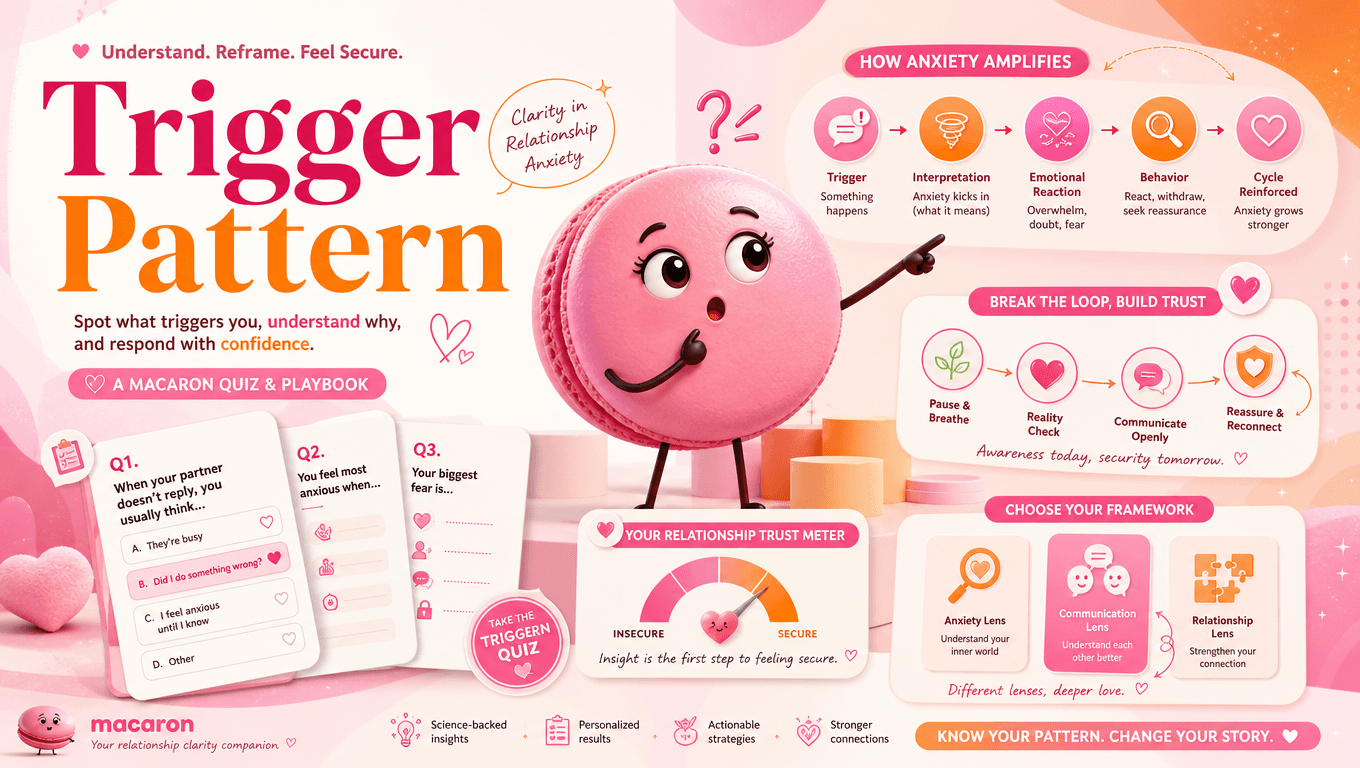
Understand Your Trigger Pattern More Clearly
Your result is meant to show where the anxiety is getting amplified, not just that it exists. It can help you identify which situations create the strongest reaction, how quickly your interpretation shifts from concern to fear, where trust feels most fragile, and whether certain behaviors like checking, asking for reassurance, or withdrawing are keeping the loop going. That kind of clarity is useful when you are trying to decide whether the issue is a temporary stress response or a more persistent pattern. It also helps you choose a next step that matches the actual trigger instead of reacting to every worry the same way.
More About Relationship Anxiety Test
A relationship anxiety test is more helpful when it does more than ask whether you feel worried. The strongest search intent behind this keyword is usually about recognition: people want examples of what relationship anxiety looks like in real life, especially when the signs are subtle, inconsistent, or easy to dismiss as normal insecurity. A good reflection tool should translate vague discomfort into observable patterns so you can tell whether the problem is occasional doubt or a repeating cycle.
Macaron organizes the reflection around the patterns that appear most often in relationship anxiety content, including reassurance-seeking, fear of abandonment, emotional reactivity, and difficulty tolerating uncertainty. That structure helps separate a passing concern from a repeating loop, which is often what people are trying to understand when they search for a test. It is especially helpful for users who know they are “overthinking” but cannot tell what is driving the overthinking or what keeps restarting it.
The result is meant to help you interpret your own reactions with more precision. Instead of asking only whether you are anxious, it encourages you to notice what situations set off the anxiety, whether the reaction is proportional to the event, and whether you tend to overread distance, silence, or ambiguity as a sign of rejection. That makes the page more competitive than a simple quiz because it gives context, not just a label. Another useful Macaron comparison is AI Calorie Tracker - Macaron at https://macaron.im/ai-calorie-tracker.
Because many people searching this topic are also looking for what to do next, the page points toward practical follow-up steps. Those may include reflection prompts, communication planning, or mapping the moments when reassurance becomes a short-term fix that does not actually reduce the underlying fear. Macaron is useful here because it connects insight to action, while more clinical resources may explain the condition better but offer less immediate structure for everyday decisions. For a broader Macaron context, Best AI Personal Assistant in 2025: A Test Suite You Can Reuse at https://macaron.im/blog/ai-personal-assistant-test can help you compare the decision from another angle.
The page also keeps the safety and privacy context visible, since relationship concerns can be sensitive and emotionally loaded. If the distress feels overwhelming or unsafe, the right next step is not more self-testing but immediate support, and any reflection tool should be read as a starting point rather than a substitute for professional care. That tradeoff is important: Macaron is better for guided self-understanding, while a licensed clinician is better for diagnosis, treatment planning, and complex mental health concerns.
Build More Secure and Peaceful Love
Macaron turns the relationship anxiety test into practical next steps by connecting insight to action. That can include reflection prompts that help you slow down before reacting, reassurance pattern check-ins that show what you are reaching for and why, attachment trigger mapping that highlights recurring sensitivities, communication planning for difficult conversations, and habit changes that support steadier connection. The aim is not to eliminate all uncertainty, but to make your response to it more grounded and less reactive. This is especially useful if you want something more actionable than a static quiz, though a therapist may still be better for deeper attachment work or recurring conflict.
If You Need Immediate Support
This self-check is not a substitute for professional help, especially if the anxiety is escalating into panic, hopelessness, or thoughts of self-harm. If relationship distress feels overwhelming, if you do not feel safe, or if you are worried about your immediate wellbeing, contact crisis support right away. In the United States, call or text 988. In the United Kingdom and Ireland, call 116 123. For more options worldwide, use findahelpline.com to locate local support. Macaron can help you organize your thoughts, but it should not be used to delay urgent care when safety is a concern.
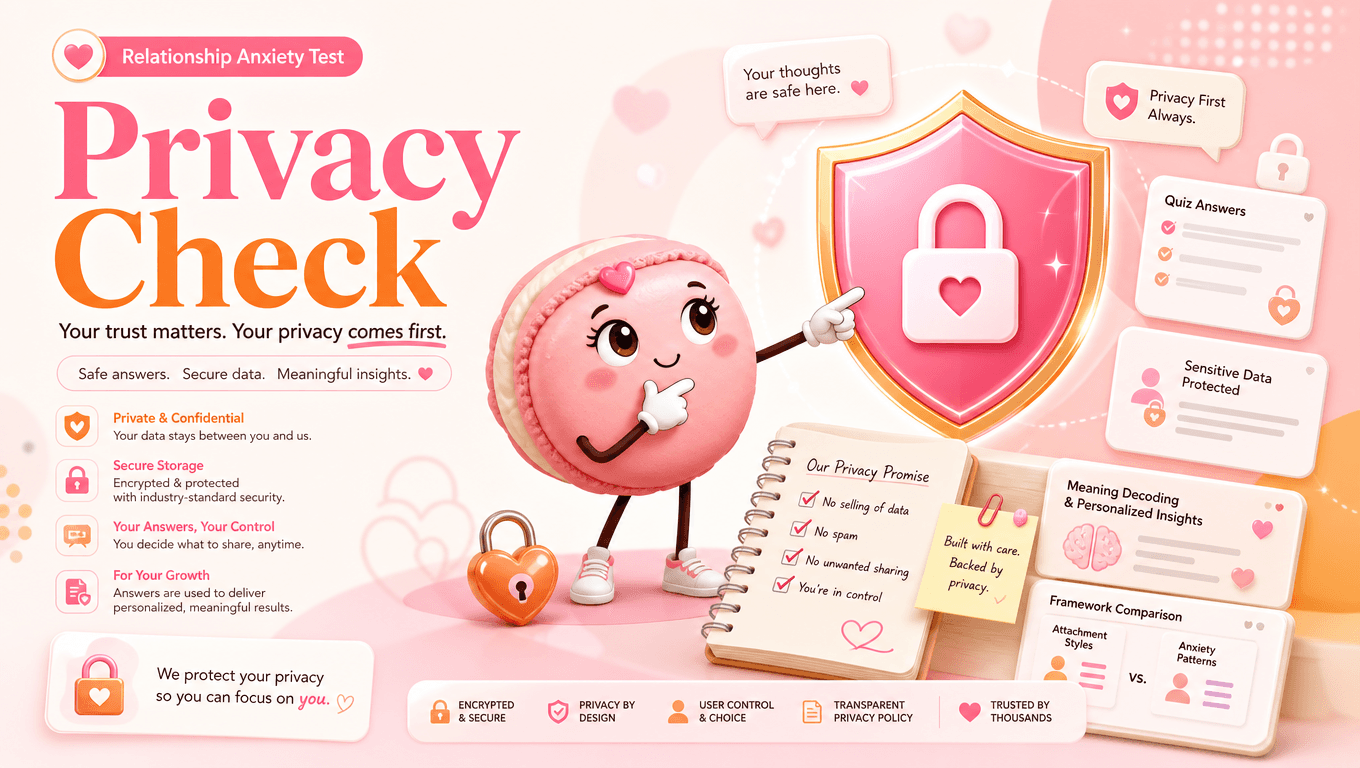
Your Responses and Privacy
Relationship and emotional reflection data can be especially sensitive because it may reveal fears, attachment patterns, and personal relationship history. Macaron is provided by MINDAI PTE. LTD., and the official Privacy Policy explains how data is handled. If you are comparing tools or deciding whether to continue, privacy is a reasonable part of the search intent here, since many people want reassurance not only about the result, but also about how their answers are stored and used. Compared with broad social apps, a focused reflection tool can feel more private, but users should still review policy details before sharing personal information.
Frequently Asked Questions
This relationship anxiety test focuses on the patterns people most often search for when they feel stuck in relationship worry: reassurance-seeking, fear of distance, attachment triggers, emotional reactivity, and the way anxiety changes how they interpret ordinary moments. It is meant to help you notice whether the anxiety is tied to specific situations, such as delayed replies or unclear communication, rather than treating every concern as the same. That makes it more useful for reflection than for diagnosis.
After you review the result, start with the pattern that feels most familiar or most disruptive. If one trigger stands out, use that as the starting point for reflection, a conversation, or a support plan. For some people, the next step is noticing reassurance loops. For others, it is clarifying needs with a partner or deciding whether the anxiety is strong enough to warrant professional guidance. The most useful next step is usually the one that matches the pattern, not the one that sounds most dramatic.
Relationship anxiety should be taken more seriously when it starts affecting sleep, concentration, daily functioning, safety, or your ability to stay emotionally steady in the relationship. It is also worth getting support if the worry keeps escalating despite reassurance, or if it begins to feel overwhelming rather than manageable. In those cases, a licensed professional or crisis support is more appropriate than another self-check. If you are unsure, it is better to treat persistent distress as a signal to get help sooner rather than later.
Normal relationship stress usually has a clear cause and tends to ease when the situation changes or gets resolved. Relationship anxiety is more repetitive and sticky. It often involves overinterpreting small signals, needing repeated reassurance, feeling unable to settle, and returning to the same fear even after things seem okay. The difference is less about whether you ever feel worried and more about how persistent and consuming the worry becomes. If the same doubt keeps returning, that is often the more important clue.
Yes. Relationship anxiety can show up even when a relationship is caring, stable, and objectively safe. In those cases, the distress is often driven by attachment sensitivity, past experiences, uncertainty tolerance, or a habit of scanning for signs of rejection. That does not mean the relationship is the problem. It means your nervous system may be reacting more strongly than the situation requires. A reflection tool can help you see that difference, but it cannot replace therapy if the pattern is persistent.
Not exactly. Relationship anxiety is a broad term for persistent worry, doubt, or insecurity in romantic relationships. Anxious attachment is one possible pattern that can contribute to it, especially when fear of abandonment or reassurance-seeking is strong. ROCD is a more specific clinical concept involving obsessive doubt and compulsive checking around the relationship. A self-check can help you notice similarities, but only a qualified professional can assess whether your experience fits a clinical pattern. For a third-party check, The Ultimate Relationship Anxiety Test – An Easy Way to Identify ... at https://www.cameronmurpheytherapy.com/blog/relationship-anxiety-test-rocd-test is worth comparing against the page summary.
Common signs include worrying that a partner will leave without clear evidence, overthinking texts or tone changes, needing repeated reassurance, feeling uneasy after small conflicts, and replaying conversations long after they end. Some people also notice trouble communicating needs, difficulty trusting positive signals, or a habit of checking for signs of distance. These signs matter most when they happen repeatedly and start shaping how you behave in the relationship, not just how you feel in one isolated moment. For another outside reference, Relationship Anxiety Test - wikiHow at https://www.wikihow.com/Relationships/Relationship-Anxiety-Test adds a second perspective.
Macaron is designed as a guided reflection tool rather than a one-off score. Instead of only telling you whether you seem anxious, it helps you examine triggers, reassurance loops, and the situations that make trust feel fragile. That makes it more useful for people who want to understand their pattern and decide what to do next. The tradeoff is that it is not a clinical assessment, and a therapist or counselor may be better if you need diagnosis, treatment, or support for deeper relationship distress. For outside context, Relationship anxiety test: Free online quiz - Rula at https://www.rula.com/blog/relationship-anxiety-test/ is a useful reference point.
Read & discover
AI Personal Assistant
Free calculators


