Self Compassion Quiz
A self compassion quiz is a quick way to reflect on how you respond to mistakes, stress, and emotional pain, especially when you want a clearer read on self-talk and recovery. Macaron uses guided reflection to help you notice patterns without treating the result as a clinical diagnosis or formal psychological score.
Self Compassion Quiz
This self compassion quiz is a gentle reflection on how you tend to respond to mistakes, stress, and painful moments. It can help you notice whether your inner voice is mostly supportive, mixed, or overly harsh, without turning that pattern into a diagnosis.
This is a self-reflection tool, not a clinical assessment or medical diagnosis.
Please answer every question before viewing your result.
This quiz is for reflection only and cannot tell you whether you have a mental health condition. If your self-talk feels overwhelming, you feel unsafe, or you are dealing with thoughts of self-harm, seek immediate support from local emergency services or a crisis line in your area.
What This Reflection Can Help You Notice
A self compassion quiz is most useful when you want a fast, low-pressure check-in on how you treat yourself during stress, disappointment, or moments when you feel you have fallen short. People often search for this term because they are not looking for a diagnosis, but for a clearer sense of whether their inner response is supportive, harsh, or somewhere in between. Macaron keeps that use case in view by focusing on reflection, not labeling.
Macaron frames the self compassion quiz as a guided reflection rather than a standardized test. That matters because many searchers expect something like the Self-Compassion Scale or a validated screening, while others simply want a practical way to think through self-kindness, self-judgment, and emotional recovery in everyday life. The page bridges both intents by using familiar language while staying clear about what the tool is and is not.
The quiz can help you notice recurring patterns that are easy to miss in the moment, such as replaying mistakes, speaking to yourself more critically than you would to a friend, or feeling isolated when things go wrong. It can also surface the opposite pattern, where kindness is present but hard to access under pressure. That distinction is useful because many people are not consistently harsh or consistently gentle; they shift depending on the situation. For a related Macaron page, see How Macaron AI Tackles the Problem with Traditional Task Lists at https://macaron.im/blog/macaron-ai-daily-planning-guide.
Because self-compassion is often discussed in terms of self-kindness, common humanity, and mindfulness, results can be easier to interpret when you think about the context around them. For example, someone may be compassionate in calm situations but become much more self-critical after conflict, work pressure, or a personal setback. Macaron’s approach is better suited to that real-world variability than a one-note score that ignores context.
This page is designed to help you read your result as a starting point, not a verdict. If the quiz points toward low self-compassion, that usually means there is room to build gentler habits, not that something is wrong with you. If it points toward stronger self-compassion, it can still be useful to see where your support for yourself breaks down under stress. That makes the result more actionable than a simple label.
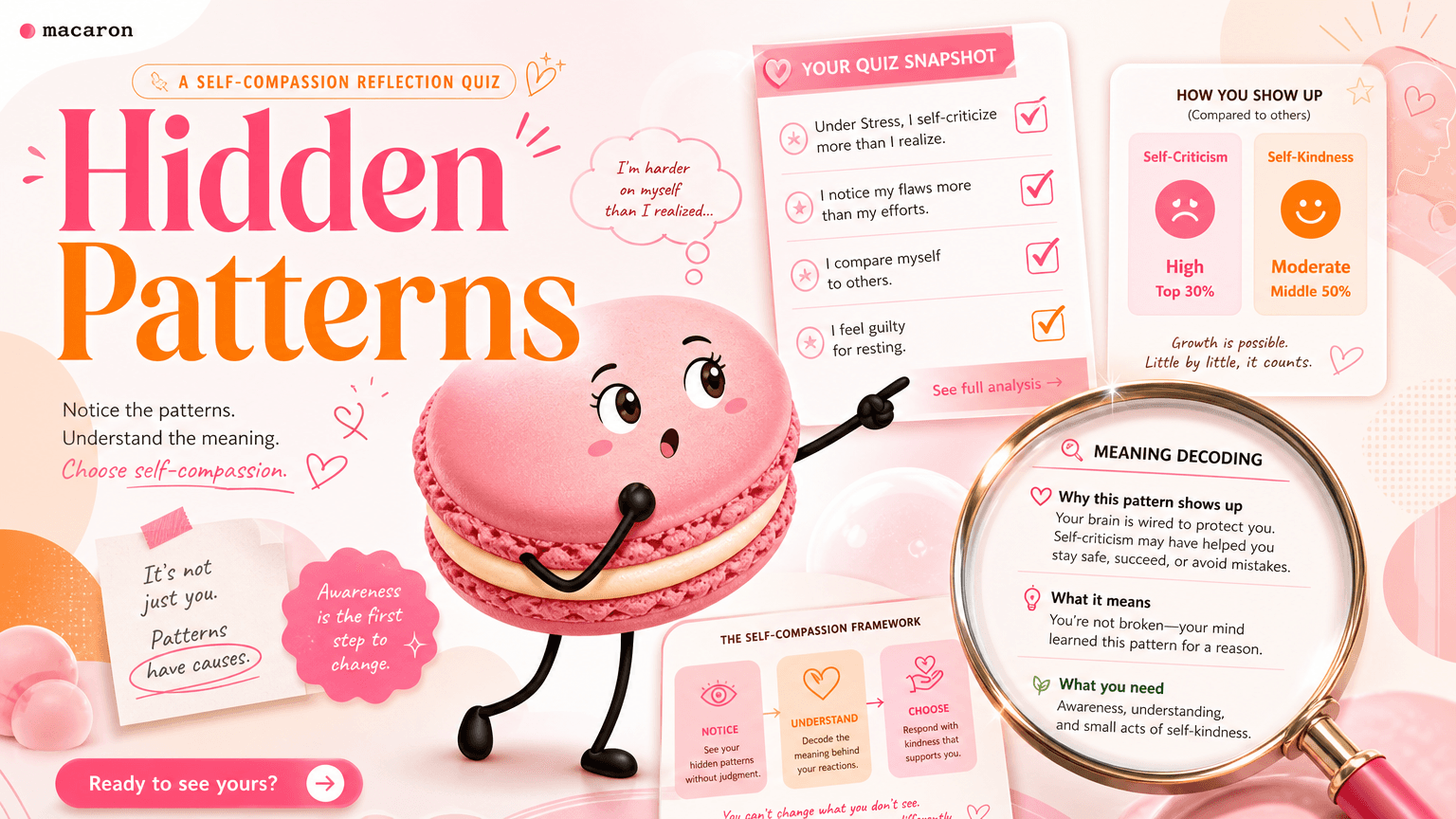
What This Reflection Can Help You Notice
Macaron helps you notice the patterns that usually sit underneath a self compassion quiz result, especially the ones that show up when life gets uncomfortable. That can include harsh inner commentary after a mistake, replaying disappointment for longer than you want to, or feeling like kindness toward yourself is easier to offer other people than to accept personally. It can also reveal subtler patterns, such as being supportive in one area of life but unusually self-critical in another, which is common when stress, shame, or perfectionism are involved. The value is in identifying where your response changes, not just whether it is generally positive or negative.
How Macaron Structures This Reflection
Macaron structures the reflection around the practical parts of self-compassion that people usually search for when they want to understand the term more clearly. Rather than focusing only on a general feeling, it looks at self-talk, how you respond to setbacks, whether emotional care comes naturally, and how well you stay humane with yourself under pressure. That structure helps separate temporary frustration from a deeper pattern, which is useful when someone is trying to understand whether they are simply having a rough week or consistently defaulting to self-judgment. It also makes the result easier to translate into a next step.
What Your Result Can Clarify
The result is meant to clarify where your inner response is already supportive and where it tends to tighten into shame or self-blame. For many people, the most useful insight is not a single score but the contrast between situations: maybe you recover quickly from small mistakes but struggle after public embarrassment, or maybe you can be kind to yourself in hindsight but not in the moment. That kind of detail makes the result more actionable because it points to the exact conditions where self-compassion is easiest to lose. Macaron is designed to make those conditions easier to see.
More About Self Compassion Quiz
Macaron helps you look at the parts of self-compassion that usually show up in real life, not just in theory. That includes how you talk to yourself after a mistake, whether you can recover without spiraling, and whether your response to pain is to care for yourself or to push harder and criticize more. The point is to make the pattern visible in ordinary moments, where self-talk often matters most.
The reflection also helps clarify common confusion around the term itself. Some people assume self-compassion means lowering standards or avoiding accountability, but formal assessment language and practical use point to something more specific: being honest about difficulty while responding with steadiness instead of punishment. Macaron keeps that distinction visible so the result can be interpreted as support for responsible self-care, not as permission to ignore problems.
Another useful angle is how the quiz handles emotional context. A person may sound self-compassionate in general, yet still become harsh, ashamed, or withdrawn when they are tired, embarrassed, or under pressure. That is why the result is more helpful when you think about patterns across situations rather than one isolated mood. Macaron is especially useful for people who notice that their inner voice changes sharply under stress. Another useful Macaron comparison is AI Calorie Tracker - Macaron at https://macaron.im/ai-calorie-tracker.
Macaron turns the quiz into a practical check-in by connecting reflection to action. Instead of stopping at a score or label, it encourages small next steps such as noticing self-critical phrases, pausing before reacting to setbacks, or choosing one kinder response that feels realistic rather than forced. That makes the page more useful for daily life than a static result, especially for users who want something they can actually try after the quiz. For a broader Macaron context, How to Use AI as a Personal Assistant: 30 Prompts That Actually Work at https://macaron.im/blog/ai-personal-assistant-prompts can help you compare the decision from another angle.
The page also keeps the safety and privacy context visible. If your distress feels intense or unsafe, a quiz is not enough and professional or crisis support matters more. And because emotional reflection can be sensitive, it is worth understanding how your responses are handled before treating the exercise as a private journal or clinical assessment. Macaron is helpful for guided reflection, but it is not a substitute for care when the situation is serious.
Simple Ways to Practice Self-Compassion
Macaron helps turn the self compassion quiz into something you can use after the page closes. The goal is not a dramatic mindset overhaul, but a few repeatable habits that make self-kindness more available when stress hits. That might mean catching a familiar self-critical phrase, replacing it with a more balanced one, checking what emotional support you actually need, or building a calmer recovery routine after setbacks. Small practices matter here because self-compassion usually grows through repetition, not through one perfect insight. The tradeoff is that this approach is practical rather than deeply therapeutic, so it works best as a daily check-in.
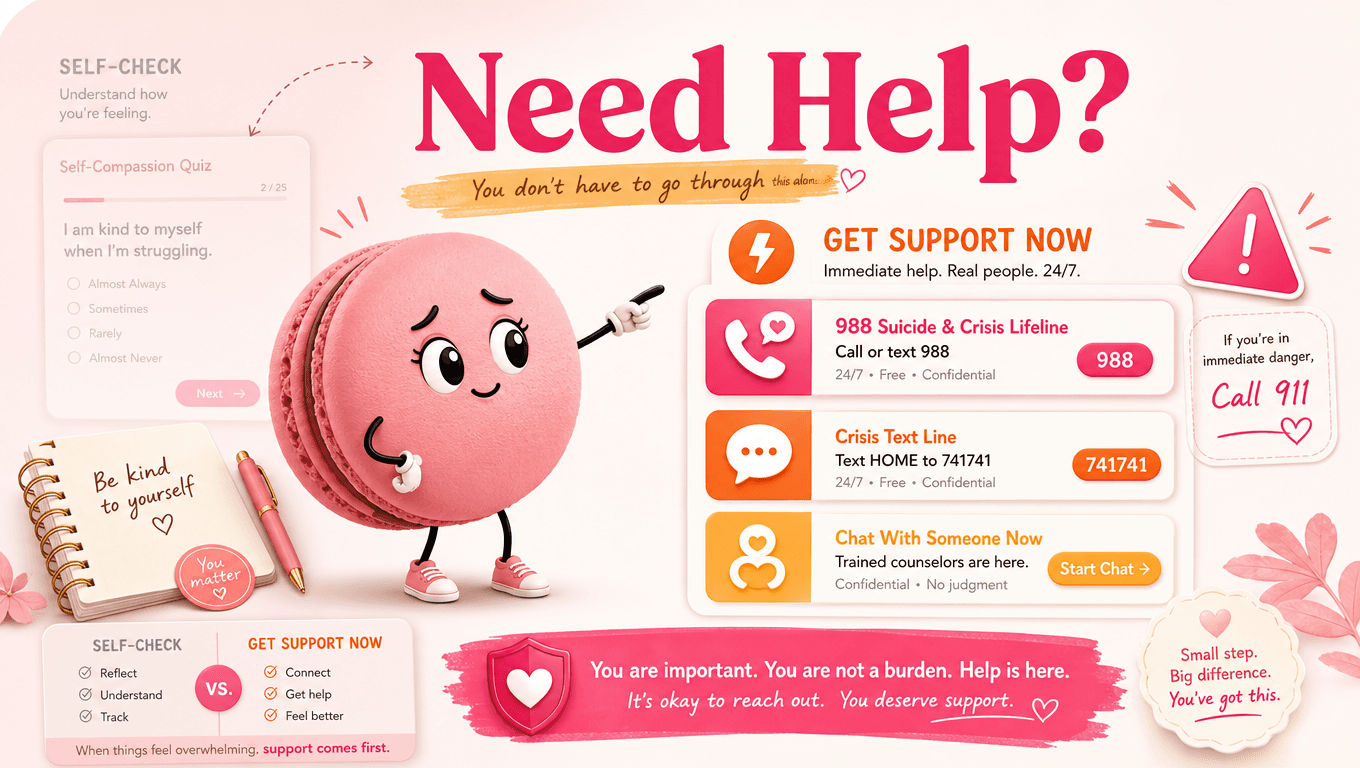
If You Need Immediate Support
This self-check can be helpful for reflection, but it should not be used when you need urgent mental health support. If your distress feels overwhelming, if you feel unsafe, or if thoughts of self-harm are present, the right next step is immediate crisis help rather than more self-assessment. In those moments, a quiz cannot provide the care, risk assessment, or support planning that a trained professional or crisis line can offer, so the page keeps those resources visible for a reason. Macaron is best for insight and habit-building, not for emergency response.
Your Responses and Privacy
Because a self compassion quiz can involve sensitive emotional reflection, it is reasonable to think carefully about privacy before answering. Macaron is provided by MINDAI PTE. LTD., and the privacy policy explains how the service handles user information. If you are using the quiz to explore shame, self-judgment, or stress patterns, it is worth reviewing the policy and contact details so you understand what happens to your responses and where to ask questions if you want more clarity. That transparency matters more here than in a casual quiz because the topic is personal.
Frequently Asked Questions
This self compassion quiz focuses on the parts of self-compassion people most often want to understand: self-talk, emotional care, shame, recovery after mistakes, and how you respond when stress builds. In practice, that means it is looking for whether your default reaction is supportive, critical, avoidant, or mixed depending on the situation. It is meant to give you a clearer picture of your pattern, not to label you as good or bad at self-compassion.
After you get your result, look for the pattern that shows up most clearly rather than focusing only on the overall impression. If the result points to self-criticism, choose one small response you could use the next time you make a mistake, such as pausing before reacting or writing a kinder sentence to yourself. If the result suggests stronger self-compassion, think about where that strength breaks down under pressure so you can protect it in harder moments.
Self-criticism should be taken more seriously when it starts to feel relentless, overwhelming, or tied to unsafe thoughts rather than ordinary frustration. If shame, self-judgment, or emotional distress is making it hard to function, or if you are thinking about harming yourself, a quiz is not enough and you should contact a licensed professional or crisis support right away. The key question is not whether you are being hard on yourself sometimes, but whether the pattern is becoming harmful.
This page is designed as guided reflection, so it helps you think through how you treat yourself without presenting itself as a clinical instrument. Formal self-compassion screenings are usually standardized measures, often based on validated scales such as the Self-Compassion Scale, and they are used for more structured assessment. Macaron’s version is better understood as a quick, practical check-in that can help you notice patterns and decide what to do next.
In plain language, self-compassion means responding to your own difficulty with the same steadiness you might offer a friend. It usually includes being kind instead of cruel, remembering that struggle is part of being human, and staying aware of what is happening without getting lost in it. It does not mean pretending everything is fine. It means acknowledging pain without adding extra punishment on top of it.
No. Self-compassion is not the same as lowering standards or avoiding responsibility. A person can care about doing well and still speak to themselves in a fair, steady way after mistakes. The difference is that self-compassion tries to correct behavior without turning the correction into shame. That said, some people do find it harder to maintain ambition when they stop using self-criticism as fuel, so the adjustment can feel unfamiliar at first. For a third-party check, How Self-Compassionate Are You? - The New York Times at https://www.nytimes.com/interactive/2019/02/14/well/mind/14compassion-quiz.html is worth comparing against the page summary.
That is very common. Many people are kind to themselves in low-stress moments but become much harsher when they are embarrassed, tired, or under pressure. A useful result is one that shows where your self-compassion drops, because that tells you what conditions need support. Macaron is designed to make those shifts easier to notice, which can be more helpful than a single overall impression that hides the context. For another outside reference, Self-Compassion Quiz - Greater Good Science Center at https://greatergood.berkeley.edu/quizzes/take_quiz/self_compassion adds a second perspective.
Start small and specific. Notice one phrase you use when you make a mistake, then try replacing it with a more balanced version. You can also pause before reacting, name what you need, or write down how you would speak to a friend in the same situation. These steps are modest on purpose. Self-compassion usually becomes more reliable through repeated practice, not through trying to force a perfect mindset. For outside context, Self-Compassion Test at https://self-compassion.org/self-compassion-test/ is a useful reference point.
Read & discover
AI Personal Assistant
Free calculators


