Self Compassion Test
A self compassion test is useful when you want a clearer view of how you respond to stress, mistakes, and disappointment, especially if your inner voice turns harsh under pressure. Macaron uses guided reflection to help you notice patterns in self-kindness, common humanity, and recovery without treating the result as a clinical diagnosis.
Self Compassion Test
This self compassion test is a guided reflection on how you tend to respond to mistakes, stress, and self-doubt. It can help you notice whether your inner voice leans toward care, criticism, distance, or emotional overwhelm.
This is a self-reflection tool, not a diagnosis or clinical assessment.
Please answer every question before viewing your result.
This page is for self-reflection only and cannot tell you whether you have a mental health condition. If your self-talk feels relentlessly cruel, or if you are dealing with hopelessness, self-harm thoughts, or a crisis, please reach out to a qualified professional or local emergency support right away.
What This Reflection Can Help You Notice
A self compassion test is often useful when you can be patient and encouraging with other people, yet become sharply critical of yourself the moment something goes wrong. The point is not to produce a flattering score. It is to notice what happens in the exact moments that tend to trigger shame, frustration, or emotional shutdown, such as a mistake at work, a conflict, a missed goal, or a day when you feel worn down.
Macaron treats the self compassion test as guided reflection rather than a rigid label, which matters because many people have only a vague sense of what self-compassion includes. The most common framework looks at self-kindness, common humanity, and mindfulness, but those terms can feel abstract. This page translates them into everyday situations so you can recognize how they show up in your own reactions, habits, and inner dialogue.
A careful self compassion test can also clear up a common misunderstanding: being kinder to yourself is not the same as excusing everything or lowering your standards. In practice, self-compassion often means staying accountable without turning every setback into proof of failure. That distinction is important for people whose default response is overcorrection, rumination, or withdrawing from others after disappointment. For a related Macaron page, see AI Personal Assistant - Macaron at https://macaron.im/ai-personal-assistant.
Macaron is designed to surface patterns that are easy to miss when you are living through them. You may notice that shame arrives quickly, that recovery takes longer than you expected, or that your inner voice becomes more severe when you are already tired, stressed, or embarrassed. Those patterns are often more useful than a single number because they show how you actually treat yourself under pressure.
Because this is a reflective tool rather than a formal psychological assessment, it works best as a starting point for self-understanding. If you want a standardized measure, you can compare your experience with established self-compassion scales. If you want practical insight into how you respond to setbacks, Macaron is meant to help you begin that process in a way that is careful, concrete, and easy to act on.
What This Reflection Can Help You Notice
Macaron helps you notice the patterns that usually sit underneath a self compassion test result, not just the headline score. That includes whether your inner voice becomes harsh after mistakes, whether you feel isolated when things go wrong, and whether you can recover without turning every setback into proof that something is wrong with you. It also helps you see the tension between healthy accountability and self-punishment, which is where many people get stuck.
How Macaron Structures This Reflection
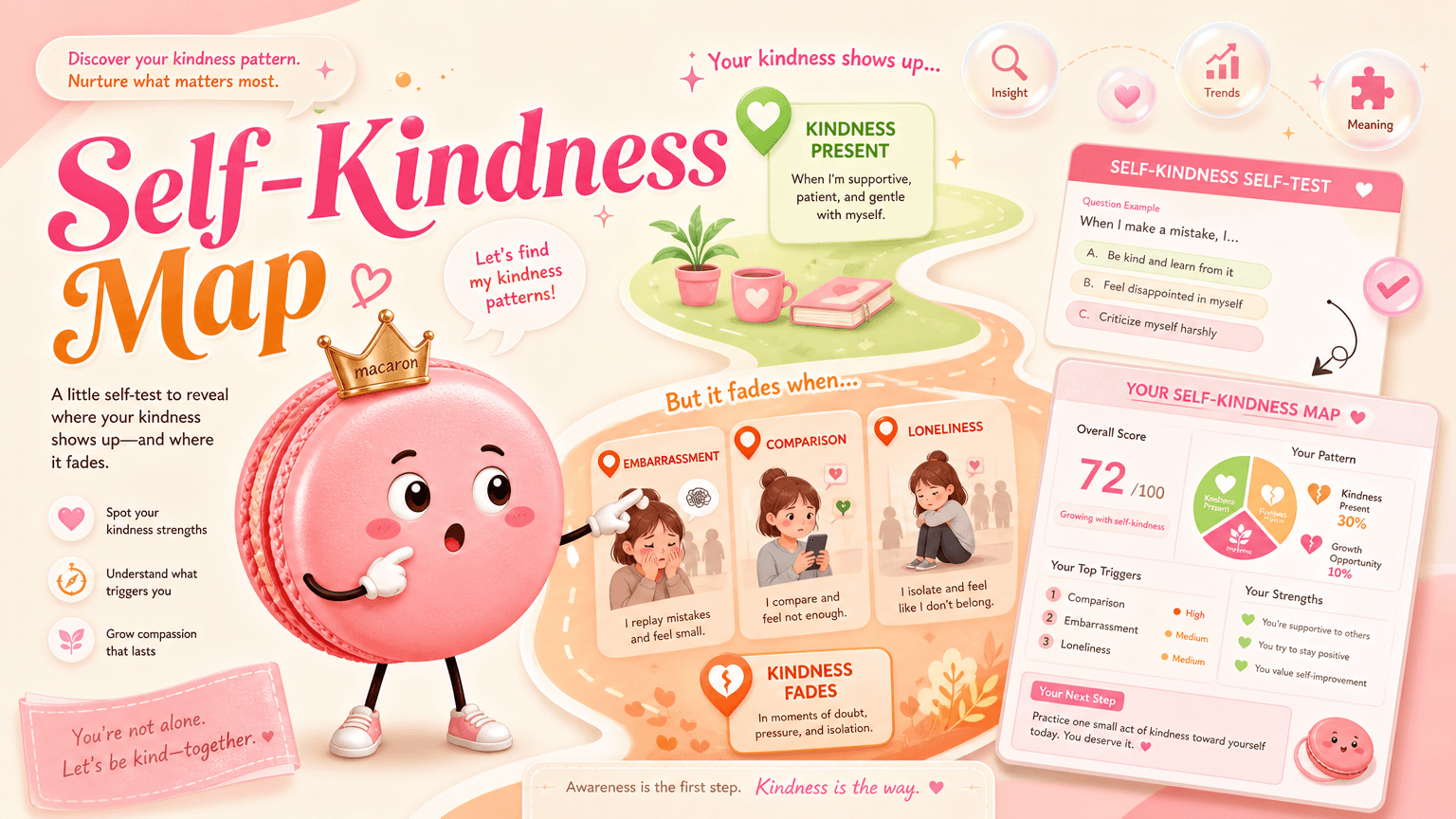
Macaron organizes the reflection around the situations where self-compassion is most likely to break down: stress, failure, disappointment, and emotional pain. Instead of asking only whether you are kind to yourself in theory, it looks at how you talk to yourself in the moment, whether you can stay grounded after a mistake, and whether your response helps you recover or keeps you stuck in shame and overthinking.
What Your Result Can Clarify
The result can help you identify where self-kindness is already present and where it disappears quickly. It may show that your hardest moments are not the ones with the biggest consequences, but the ones that trigger embarrassment, comparison, or a sense of being alone. That kind of clarity is useful because it points to the exact situations where a gentler response would make the biggest difference.
More About Self Compassion Test
Macaron helps you reflect on patterns such as harsh self-talk, impatience with your own mistakes, and the feeling that you should be able to handle everything alone. These are common reasons people look for a self compassion test, especially when they notice that stress brings out criticism instead of care. The value here is not in judging yourself for having those reactions, but in seeing when they appear and what tends to trigger them.
The reflection also separates parts of self-compassion that are often mixed together. You can be highly responsible and still be very self-critical. You can care deeply about improvement and still struggle to speak to yourself in a steady, humane way after disappointment. That distinction matters because it helps you avoid the false choice between being disciplined and being kind.
Self-compassion is more practical than a vague personality trait because it shows up in specific moments: how you interpret setbacks, whether you stay grounded instead of spiraling, and whether you can offer yourself the patience you would naturally extend to a friend. Macaron uses that structure to make the result easier to understand and more useful for daily life, rather than leaving you with a label that does not tell you what to do next. Another useful Macaron comparison is How Macaron AI Tackles the Problem with Traditional Task Lists at https://macaron.im/blog/macaron-ai-daily-planning-guide.
Your result can clarify where self-kindness is easiest, where shame tends to take over, and what kind of support is missing in your inner routine. Some people discover they are gentler with small private mistakes than with public ones. Others notice that recovery becomes hardest when they feel isolated, compared, or watched. Those differences matter because they point to the situations where your self-talk needs the most support. For a broader Macaron context, AI Calorie Tracker - Macaron at https://macaron.im/ai-calorie-tracker can help you compare the decision from another angle.
Macaron then turns the reflection into next steps that are small enough to use in real life, such as prompts for inner dialogue, reset habits after a hard moment, and routines that make it easier to respond with steadier care. The tradeoff is that this kind of tool is more useful for insight and habit-building than for formal scoring. If you want a validated scale, a validated assessment may be better; if you want something practical, Macaron is built for that.
Daily Practices to Treat Yourself Kindly
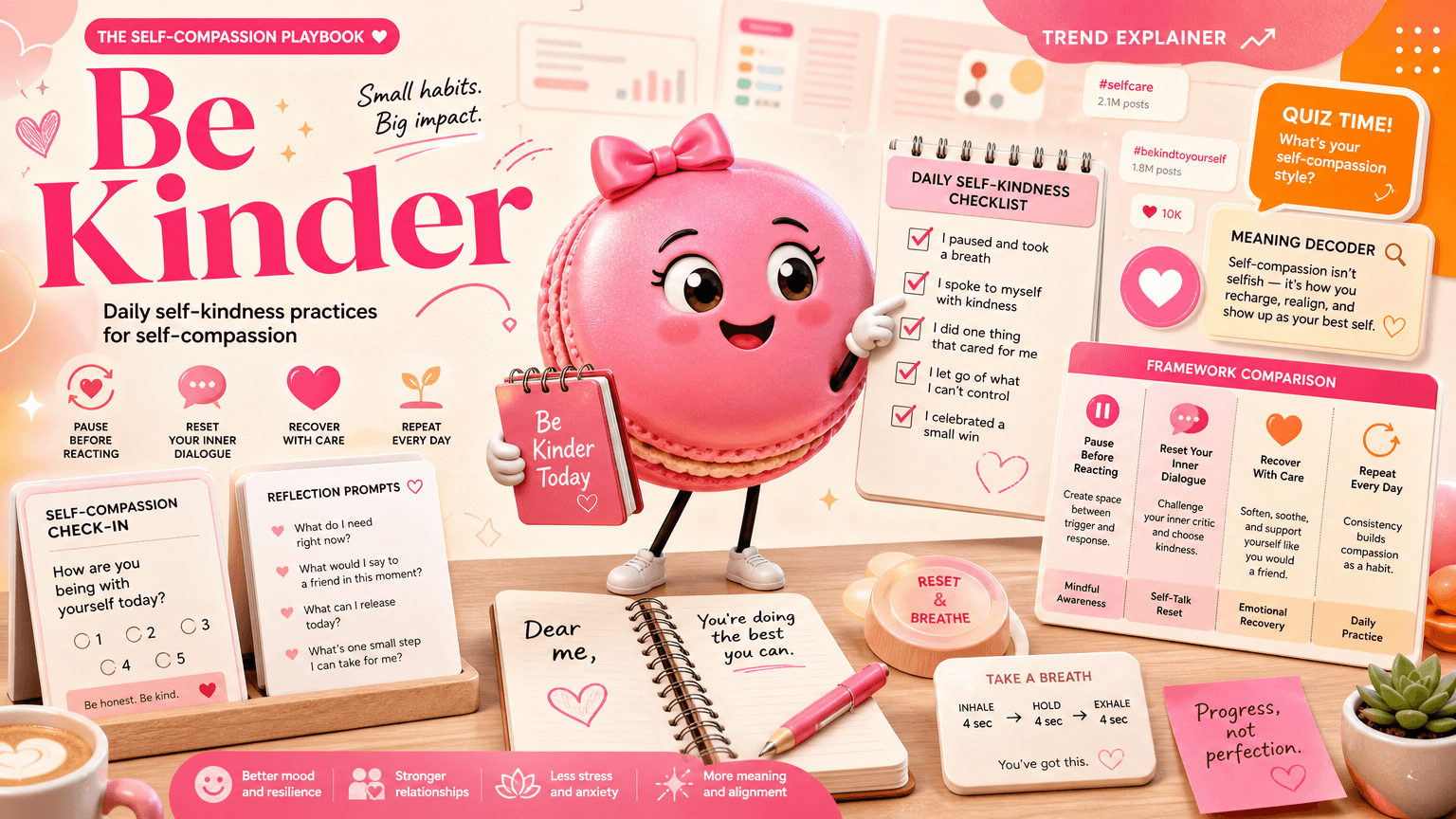
Macaron helps turn the self compassion test into something you can actually use day to day. The reflection prompts can help you pause before reacting, notice when your inner dialogue becomes punitive, and choose a reset that is realistic rather than idealized. Over time, these small check-ins can make it easier to recover after mistakes, reduce spiraling, and build a steadier habit of emotional care. The tradeoff is that it takes repetition, not a one-time result, to change a deeply ingrained inner voice.
If You Need Immediate Support
This self-check is meant for reflection, not crisis care. If your distress feels overwhelming, if you do not feel safe, or if thoughts of self-harm are present, the right next step is immediate support from a crisis line, emergency service, or a trusted professional. A self compassion test can help you notice patterns, but it should never be used to delay help when the situation feels urgent. In that situation, speed and human support matter more than any app-based insight.
Your Responses and Privacy
Because self-reflection can involve sensitive emotional information, it is reasonable to ask how your responses are handled. Macaron is provided by MINDAI PTE. LTD., and the privacy policy explains how data is managed and what choices you have. If you are cautious about sharing personal feelings online, reviewing that policy first can help you decide whether the tool feels appropriate for you. Compared with some competitor quizzes, this is a more practical privacy checkpoint, though a dedicated clinical platform may still offer more detailed data controls.
Frequently Asked Questions
This self compassion test focuses on the parts of self-compassion that show up in real life: self-talk, recovery after mistakes, emotional care, resilience, and the way you respond when you are hurting. It is especially useful for noticing whether you become more understanding with yourself under stress or whether shame and self-judgment take over quickly. The goal is to make your patterns easier to see, not to reduce you to a single label.
After you review the result, start with the pattern that feels most active in your daily life, not necessarily the lowest score. One small change, such as pausing before self-criticism or writing a kinder response to a mistake, is often more useful than trying to change everything at once. The goal is to make self-compassion more usable in ordinary moments, where stress and habit usually shape the response.
Seek outside support if harsh self-judgment, shame, or emotional distress feels overwhelming, persistent, or unsafe. A self compassion test can help you notice what is happening, but it cannot replace care from a licensed professional, especially if you are struggling to function, feeling trapped in distress, or having thoughts of harming yourself. If safety is a concern, immediate human support should come first.
This page is designed as guided reflection, not as a standardized psychological measure. Formal self-compassion assessments are usually built around validated scales and scoring methods, while this experience is meant to help you interpret your habits, notice patterns, and think through what your result may mean in everyday life. It is useful for insight, but not for diagnosis. If you need a validated score, a validated scale may be a better fit.
The most common framework describes self-compassion through self-kindness, common humanity, and mindfulness. Self-kindness means responding to pain with care instead of harshness. Common humanity means remembering that struggle is part of being human, not proof that you are uniquely flawed. Mindfulness means noticing difficult feelings without exaggerating or suppressing them. Together, these ideas help explain why self-compassion is different from self-pity or avoidance.
Yes. Responsibility and self-compassion are not opposites. You can acknowledge a mistake, repair what needs repairing, and still avoid turning the mistake into a global judgment about your worth. In fact, many people find that they handle accountability better when they are not drowning in shame. The difference is between learning from an event and using it as evidence that something is wrong with you. For a third-party check, Self-Compassion Test - IDRlabs at https://www.idrlabs.com/self-compassion/test.php?srsltid=AfmBOooysucxT_S4Chy55ztD0bCCP0eoY3X1qx4F4PaJRUqYAhpLcqnC is worth comparing against the page summary.
A low result usually means your inner response to stress may be more self-critical, isolated, or overidentified with mistakes than you would like. That does not mean anything is broken or fixed forever. It simply points to where your habits may need support. Start with one situation that reliably triggers harsh self-talk and practice a more balanced response there. Competitor quizzes may give more formal scoring context, but Macaron is designed to help you turn the result into a practical next step. For another outside reference, How Self-Compassionate Are You? - The New York Times at https://www.nytimes.com/interactive/2019/02/14/well/mind/14compassion-quiz.html adds a second perspective.
Some competitor quizzes are stronger if you want a more formal format, a validated scale, or a more detailed score breakdown. Macaron is different because it focuses on guided reflection and practical follow-through, so the result is easier to use in daily life. The tradeoff is that it is less like a formal assessment and more like a structured self-check. If you want interpretation and next steps, Macaron is useful; if you want a strict scale, another tool may fit better. For outside context, Self-Compassion Test at https://self-compassion.org/self-compassion-test/ is a useful reference point.
Read & discover
AI Personal Assistant
Free calculators


