Self Esteem Quiz
A self esteem quiz can help you notice how self-worth shows up in your decisions, reactions to mistakes, and inner dialogue. Macaron turns that reflection into a guided experience, while making clear it is for insight, not diagnosis.
Self Esteem Quiz
This self esteem quiz is a guided reflection on how you talk to yourself, respond to feedback, and make decisions when confidence feels shaky. It is designed to help you notice patterns in self-worth, not to label you or measure you clinically.
This is a self-reflection tool, not a diagnosis or a clinical screening.
Please answer every question before viewing your result.
This reflection is for personal insight only and cannot tell you whether you have a mental health condition. If low self-worth is affecting your safety, relationships, or daily functioning, or if you feel overwhelmed, reach out to a qualified professional or local crisis support right away.
What This Reflection Can Help You Notice
A self esteem quiz is most useful when you want to understand how self-worth operates in real life, not just how confident you feel on a good day. People often search for this kind of quiz because they are trying to make sense of harsh self-talk, second-guessing, or the way praise and criticism affect them. The value is in spotting patterns, especially when confidence looks different in relationships, work, or private moments. Macaron frames that reflection around everyday behavior so the result feels grounded in lived experience rather than abstract labels.
Macaron uses the self esteem quiz as an AI-guided reflection tool, which means the focus is on interpretation rather than scoring for its own sake. Instead of treating self-esteem as a single number, the experience helps you notice where you rely on outside approval, where you trust yourself, and where doubt tends to take over. That makes the result easier to use as a starting point for self-understanding. It is especially helpful for people who suspect their confidence is uneven and want a clearer picture of what is driving that unevenness.
Many self-esteem quizzes online are very short or framed as simple high versus low tests, but that can miss the nuance people are actually looking for. Someone may feel capable at work yet still feel ashamed after criticism, or seem confident socially while struggling to accept praise. A more useful self esteem quiz should help separate those patterns so the result feels specific rather than vague. Macaron leans into that nuance, which is useful if you want insight into where self-worth is stable and where it becomes fragile. For a related Macaron page, see Macaron Novel App Download at https://macaron.im/playbook/macaron-novel-app.
This page is designed to clarify what the quiz can and cannot do. It is not a standardized psychological scale, not a clinical screening, and not a substitute for professional evaluation. That distinction matters because self-esteem is often tied to mood, stress, relationships, and life context, so a reflection tool should be read as insight into tendencies, not a final verdict about your mental health. Macaron is intentionally positioned as a practical self-check, which is useful for awareness but less useful than a clinical tool if you need formal assessment.
If you are using a self esteem quiz because something feels off, the most helpful outcome is usually not a label but a clearer next step. You may realize that self-doubt shows up most when you make mistakes, or that validation from others has become a major factor in how you judge yourself. That kind of clarity can make it easier to choose one practical area to work on first. The tradeoff is that a reflection tool can point you toward patterns, but it cannot resolve the deeper causes on its own.
What This Reflection Can Help You Notice
Macaron helps you look for the self-worth patterns that often sit underneath everyday behavior, such as criticizing yourself after small mistakes, assuming other people know better, or feeling uneasy when you are not being reassured. These patterns matter because self-esteem is usually visible in reactions, not just in how someone answers a direct question about confidence. The reflection is meant to surface recurring habits that may be easy to overlook when they feel normal. That makes it useful for people who want to understand why certain situations trigger self-doubt more than others.
How Macaron Structures This Reflection
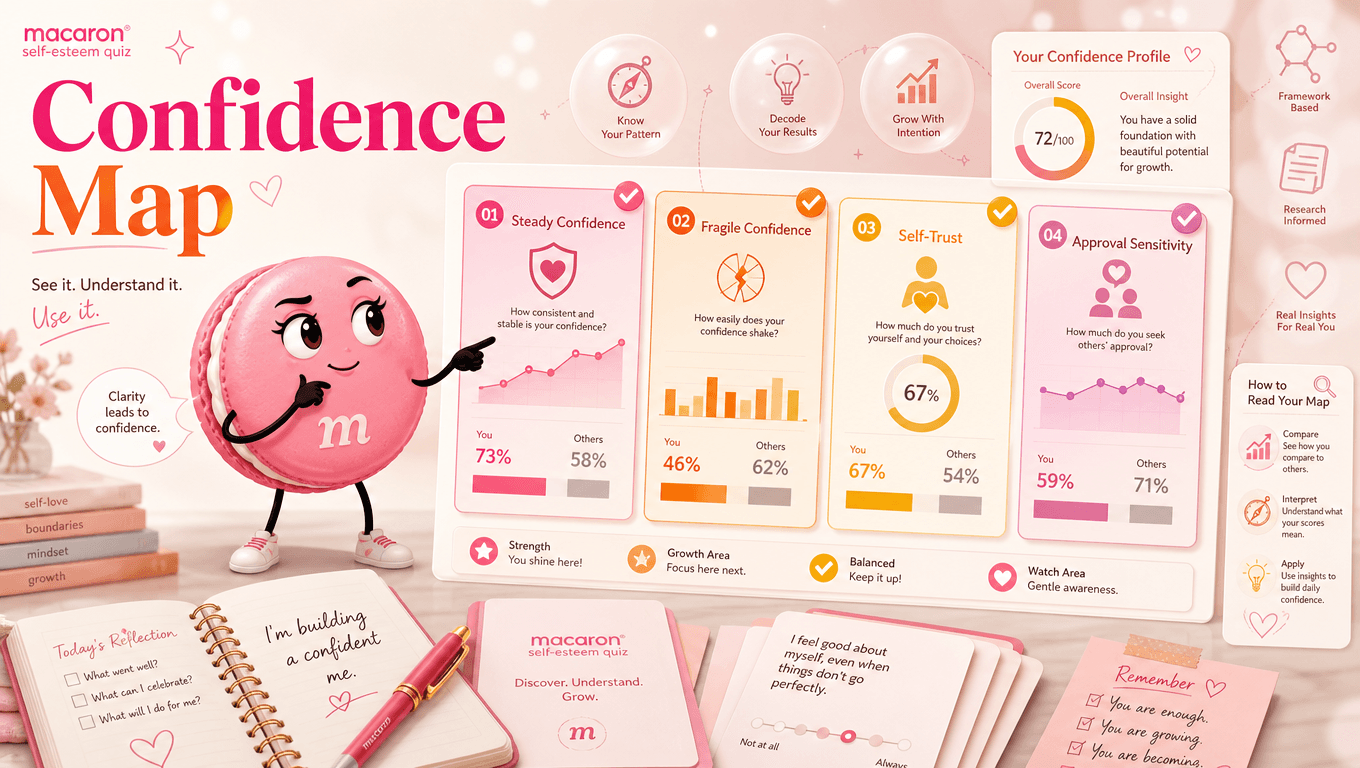
Macaron organizes the self esteem quiz around a few practical areas that commonly shape self-worth: the way you talk to yourself, how much you trust your own decisions, how you respond to setbacks, how strongly you depend on validation, and whether your sense of value feels stable or easily shaken. This structure helps keep the result focused on real-life patterns instead of abstract personality language. It is a stronger fit for users who want a usable self-check rather than a generic score that does not explain what to do next.
What Your Result Can Clarify
The result is designed to help you identify where your confidence is relatively steady and where it becomes fragile. That might mean noticing that you feel capable in familiar settings but doubt yourself when you are evaluated, or that approval from others affects your choices more than you expected. It can also help you decide which issue deserves attention first, especially if several patterns show up at once. Competitor quizzes often stop at a broad label, while Macaron is more useful when you want to separate confidence, self-trust, and approval-seeking into distinct themes.
More About Self Esteem Quiz
Macaron helps you reflect on patterns such as the tone of your inner voice, how quickly you dismiss your own strengths, and whether criticism lingers longer than it should. These are common reasons people look for a self esteem quiz in the first place, because low self-worth often shows up as a habit of minimizing yourself rather than as one obvious feeling. The goal is to make those habits easier to recognize in context. That can be more useful than a simple score if you are trying to understand what actually drives your reactions.
The reflection also looks at dependence on approval, which is one of the most common themes in self-esteem searches and self-help content. If compliments feel necessary to feel okay, or if other people’s reactions strongly shape your mood, that can point to a fragile sense of self-worth. Macaron helps you notice that pattern without assuming it means the same thing for everyone. This is a practical advantage over one-size-fits-all quizzes, though a more structured clinical tool may still be better if you need formal measurement.
Another useful angle is decision confidence. Some people know what they think but still hesitate because they fear being wrong, disappointing others, or making a choice that cannot be undone. A self esteem quiz can surface that hesitation as a pattern rather than a personality flaw, which makes it easier to see whether the issue is self-trust, perfectionism, or fear of judgment. That distinction matters because the right next step depends on the source of the hesitation, not just the fact that hesitation exists. Another useful Macaron comparison is Best Meal Planning Apps in 2026 - Macaron at https://macaron.im/blog/best-meal-planning-apps.
The result is meant to clarify where self-doubt appears fastest and what kind of support may be most relevant. For some people, the main issue is negative self-talk after mistakes. For others, it is trouble receiving praise, setting boundaries, or feeling steady without reassurance. That kind of distinction matters because the next step should match the pattern, not just the label. Macaron is strongest when you want a practical map of your self-worth habits, while competitor apps may be better if you want a standardized score or a more clinically familiar format. For a broader Macaron context, Macaron App Download (iOS & Android): Official, Safe, and Fast Install at https://macaron.im/blog/macaron-app-download can help you compare the decision from another angle.
Macaron then turns the reflection into something more actionable by pairing insight with prompts and habits that fit the issue you noticed. That may include checking the language you use with yourself, noticing when you seek reassurance, or practicing a more stable response to setbacks. The point is not to force confidence, but to build a more realistic and durable sense of self-worth over time. The tradeoff is that this kind of guided reflection asks more of the user than a quick result, but it usually gives more context in return.
Build Stronger Self-Worth Step by Step
Macaron turns the self esteem quiz into a practical starting point by connecting insight to small, repeatable actions. That can include reflection prompts that challenge automatic self-criticism, self-talk resets that interrupt harsh internal language, validation check-ins that reduce overreliance on reassurance, and confidence-building habits that support steadier choices. The emphasis is on gradual change, since self-worth usually improves through repeated practice rather than one breakthrough. This is useful if you want something more actionable than a score, though a therapist or structured workbook may be better for deeper or long-running self-esteem issues.
If You Need Immediate Support
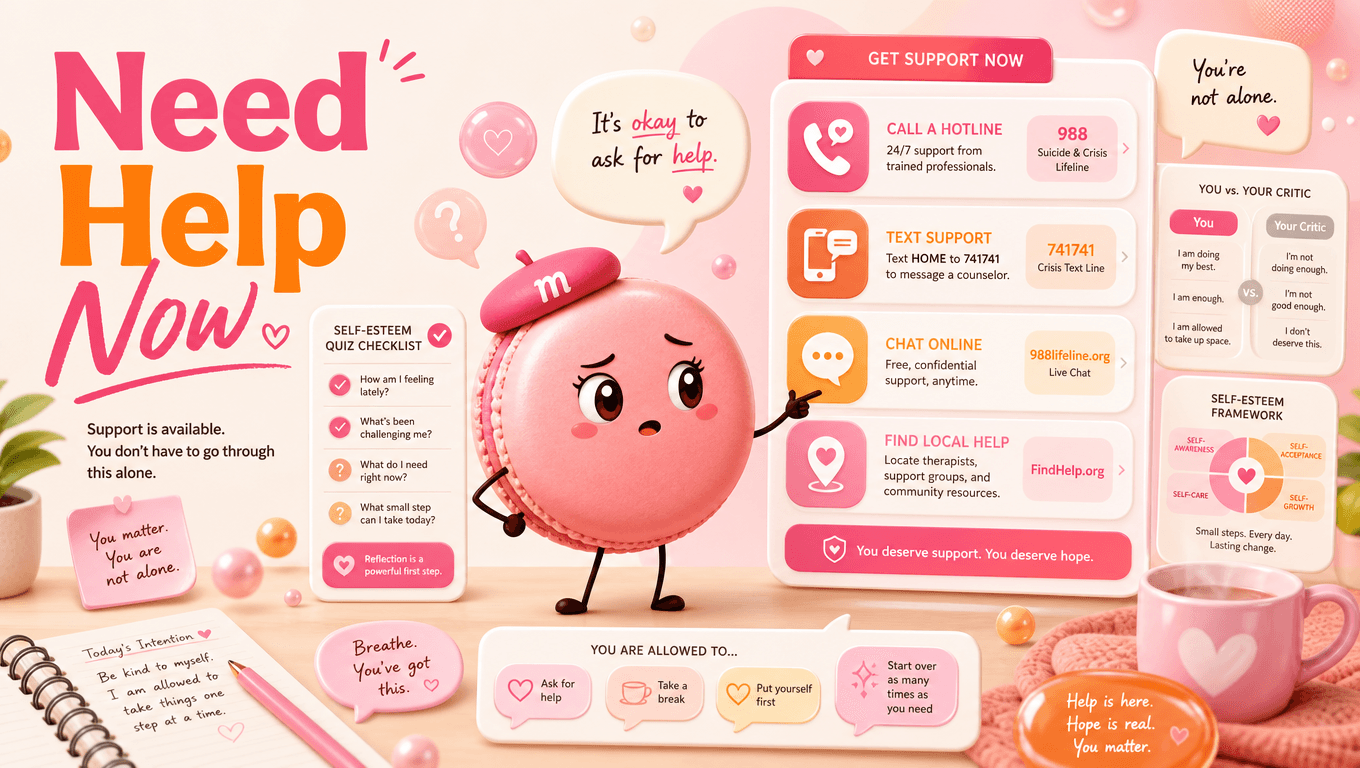
This self-check is meant for reflection, not crisis care. If your distress feels overwhelming, if you do not feel safe, or if thoughts of self-harm are present, seek immediate help from a crisis line or emergency service rather than relying on a quiz result. In the United States, call or text 988. In the United Kingdom and Ireland, call 116 123. If you are elsewhere, use a local crisis resource or findahelpline.com to locate support quickly. A quiz can help with awareness, but it is not a substitute for urgent human support.
Your Responses and Privacy
Self-esteem reflection can involve sensitive information about shame, insecurity, and emotional habits, so privacy matters. Macaron is provided by MINDAI PTE. LTD., and the official Privacy Policy explains how data is handled. If you have questions about your responses or how your information is processed, you can also contact contact@macaron.im for privacy-related support. That transparency is important for users who want to reflect honestly without wondering how their answers are stored or used.
Frequently Asked Questions
This self esteem quiz is designed to surface patterns that often shape self-worth in daily life, including harsh self-talk, overreliance on approval, hesitation in decision-making, discomfort with mistakes, and difficulty accepting praise. It can also help you notice whether your confidence feels stable in some situations but fragile in others. That distinction is useful because self-esteem is often uneven rather than simply high or low. Macaron focuses on those differences so the result is more specific and easier to act on.
Start with the pattern that feels most familiar or most disruptive, then choose one small action that matches it. If self-talk is the issue, try noticing the phrases you use after mistakes. If validation is the issue, practice pausing before asking for reassurance. If decision confidence is low, make one low-stakes choice without checking with others. The goal is to convert insight into a repeatable habit. Macaron is most useful when you treat the result as a starting point, not a final answer.
Outside support is a good idea when low self-worth starts affecting daily functioning, relationships, school or work performance, or your ability to cope with stress. It is especially important to reach out if shame, hopelessness, or self-criticism is becoming intense, or if you feel unsafe. A quiz can help you notice patterns, but it cannot replace a licensed professional when the impact is serious. If the issue feels persistent or is tied to anxiety, depression, or trauma, professional help may be more effective than self-guided reflection alone.
This page offers guided reflection rather than a clinical assessment. Formal screenings are usually standardized, scored against a defined method, and used in professional settings. Macaron’s self esteem quiz is meant to help you think through your own patterns, especially around self-talk, validation, and confidence, so you can better understand what may need attention. The tradeoff is that it is less formal than a clinical instrument, but it is easier to use as a practical self-check.
Yes. Many people feel capable in one context and unsure in another, such as being confident at work but highly sensitive to criticism in relationships, or appearing socially confident while doubting their own decisions. That is one reason a simple high-versus-low label can be misleading. Macaron is designed to help you notice those differences instead of flattening them into a single score. That makes the reflection more useful if your self-worth changes depending on the situation.
The reflection is generally most useful for adults who want to understand how self-worth affects choices, relationships, and self-talk. Teens may still find the ideas helpful, but the interpretation should be age-appropriate and ideally supported by a trusted adult or professional if the concerns are serious. Competitor quizzes sometimes target teens specifically, while Macaron is better suited to users who want a more flexible, guided reflection on everyday self-worth patterns. For a third-party check, Self-Esteem Test: Free Report - Attachment Project at https://www.attachmentproject.com/self-esteem-test/ is worth comparing against the page summary.
That pattern can be a sign that your sense of worth is being shaped heavily by outside feedback. It does not automatically mean something is wrong, but it can become tiring if your mood rises and falls based on how others respond. A useful next step is to notice when you ask for reassurance and what feeling comes before it. Macaron helps you identify that cycle so you can practice tolerating uncertainty without immediately seeking confirmation. For another outside reference, How's Your Self-Esteem? (Quiz) (for Teens) | Nemours KidsHealth at https://kidshealth.org/en/teens/self-esteem-quiz.html adds a second perspective.
Yes, there are many free self-esteem tests online, and some are very quick to complete. Macaron differs by focusing less on a generic score and more on the specific patterns behind self-worth, such as self-talk, validation needs, and decision confidence. That can make the result more actionable. The tradeoff is that a quick quiz elsewhere may feel simpler if you only want a fast number, while Macaron is better if you want a more guided reflection. For outside context, Self-Esteem Test / Quiz - Psychology Today at https://www.psychologytoday.com/us/tests/personality/self-esteem-test is a useful reference point.
Read & discover
AI Personal Assistant
Free calculators


