Self Worth Assessment
A self worth assessment can be helpful when your sense of value changes with praise, mistakes, or comparison, and that pattern starts affecting choices, boundaries, or self-talk. Macaron looks beyond a simple confidence score to explore self-trust, validation needs, and the beliefs that shape how much respect you feel you deserve.
Self Worth Assessment
This self worth assessment helps you notice how your sense of value shifts in everyday situations like feedback, mistakes, comparison, and asking for support. It focuses on patterns of self-trust and validation needs so you can reflect on what may be strengthening or weakening your confidence.
This is a self-reflection tool, not a diagnosis or clinical test.
Please answer every question before viewing your result.
This self-reflection module is for personal insight only and is not a medical or psychological diagnosis. If your answers bring up overwhelming distress, hopelessness, or thoughts of harming yourself, seek immediate support from a trusted person, local emergency services, or a crisis line in your area.
Why Self-Worth Needs More Than a Surface-Level Check
A self worth assessment is useful when confidence feels conditional, rising after approval and dropping after criticism, setbacks, or comparison. in common user language, people often use the term to mean more than a quick self-esteem quiz, because they want to understand the deeper pattern behind how they evaluate themselves day to day. That distinction matters when the issue is not just mood, but a repeated way of measuring personal value against outcomes, reactions, or other people.
Macaron approaches self-worth as a layered experience rather than a single score. It looks at inner security, dependence on outside validation, reactions to mistakes, and the quiet assumptions that influence whether you speak up, set limits, or accept care without feeling undeserving. This makes the assessment more useful for people who want to understand why their self-view shifts in specific situations, not just whether they feel good or bad in the moment.
This matters because self-worth often shows up indirectly. It can affect how you respond to feedback, whether you overexplain, how hard you are on yourself after small errors, or whether praise feels believable. A more specific self worth assessment can make those patterns easier to notice without reducing them to a vague label. That kind of clarity is especially helpful when the same pattern keeps appearing across work, relationships, and private self-talk. For a related Macaron page, see AI Personal Assistant - Macaron at https://macaron.im/ai-personal-assistant.
The goal is not to decide whether you are “confident enough.” It is to help you see where your sense of value feels stable, where it becomes fragile, and what situations tend to trigger self-doubt. That kind of clarity can be more useful than a broad result that does not explain why the pattern happens. It also gives you a better starting point for deciding whether the next step is reflection, boundary-setting, or outside support.
This self worth assessment is designed for reflection and personal insight. It is not a diagnosis, treatment, or replacement for professional evaluation, but it can be a practical starting point if you want to understand your self-talk, validation habits, and the beliefs that shape your everyday choices. Compared with generic quiz-style tools, Macaron is more focused on helping you connect the result to real situations and practical next steps.
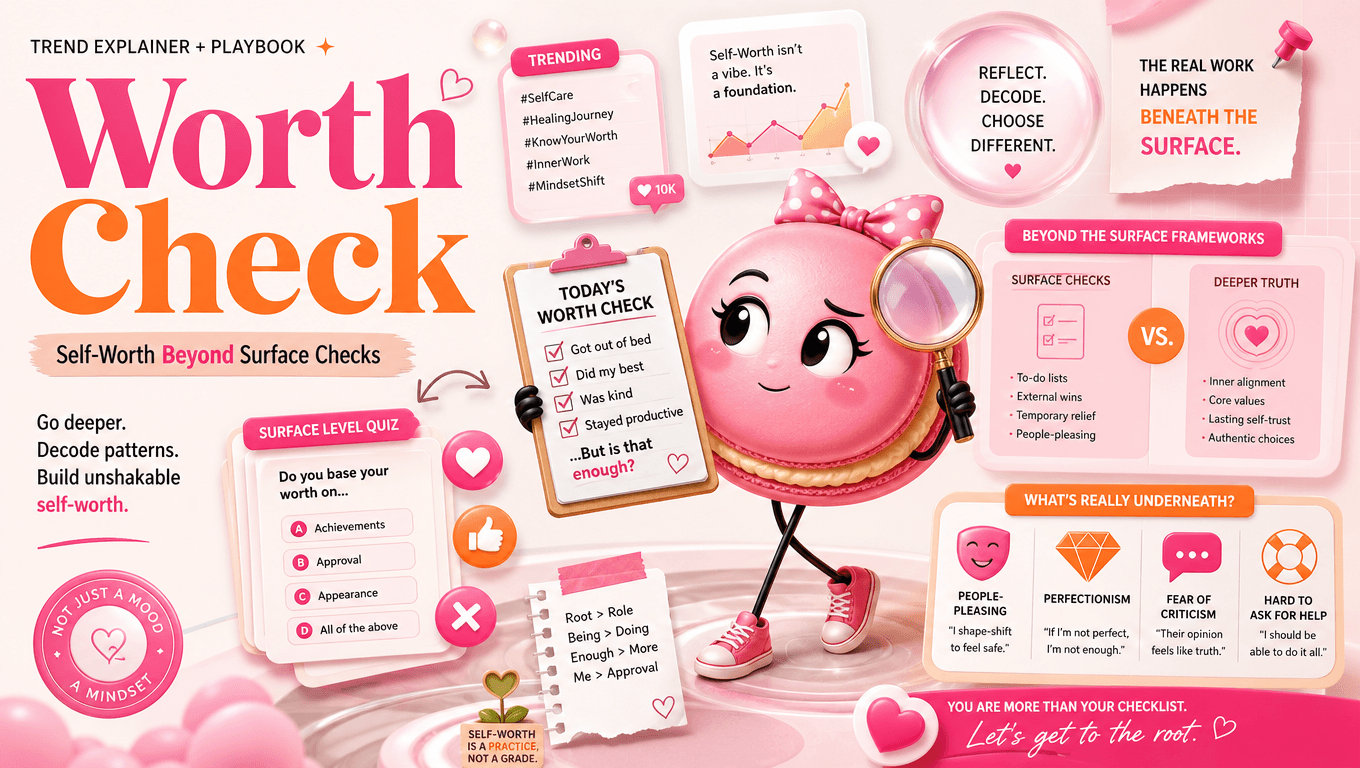
Why Self-Worth Needs More Than a Surface-Level Check
A self worth assessment is useful because self-worth often sits underneath problems that look unrelated at first, such as people-pleasing, perfectionism, fear of criticism, or difficulty asking for help. Searchers often come to this term because they want more than a confidence label. They want to understand why approval matters so much, why mistakes feel so heavy, or why praise does not always feel real. Macaron helps you examine those patterns in context so the result points to the beliefs and habits shaping them, not just the feeling itself. That makes it more actionable than a generic self-esteem score, though it is still less formal than a clinician-administered measure.
What This Self Worth Assessment Looks At
The self worth assessment is organized around the parts of self-evaluation that tend to drive everyday behavior. That includes inner self-trust, how you react to failure or imperfection, how much reassurance you need from other people, and whether your sense of value changes depending on performance or feedback. It also pays attention to emotional steadiness, since self-worth can feel secure in one setting and fragile in another. After the result, Macaron adds guided reflection so you can connect the pattern to real-life situations instead of treating it like an abstract personality label. The tradeoff is that this is more reflective than a standardized formal instrument, but it is often easier to use for personal insight.
Understanding Which Areas Need Attention
Your result is meant to help you identify where self-worth is most vulnerable, not to rank you as better or worse. In practice, that can mean noticing whether criticism, comparison, rejection, or mistakes are the fastest ways to shake your confidence. It can also help you see whether you rely on approval to feel settled, or whether certain beliefs about deserving respect keep showing up in your choices. The point is to narrow the focus so you can work on the most relevant pattern first, which is often more helpful than trying to fix everything at once. That focus can be especially useful if you already know the problem is recurring but have not been able to name the trigger.
More About Self Worth Assessment
A self worth assessment is most useful when it goes beyond general confidence language and looks at the patterns underneath it. People searching for this topic often want to know whether their struggle is about low self-esteem, shame, approval-seeking, or a deeper belief that they must earn respect before they deserve it. Macaron is built to surface those distinctions so the result is easier to interpret and more relevant to daily life.
Macaron organizes the reflection around the areas that commonly matter in self-worth work: self-trust, response to failure, sensitivity to criticism, need for reassurance, and the ability to accept praise or support without dismissing it. Those details help the result feel more concrete and easier to act on. They also make it easier to compare what happens in different settings, since self-worth can look stable in one context and shaky in another.
The result is meant to show where your self-worth feels steady and where it gets interrupted. That can help you notice recurring triggers, such as comparison, perfectionism, or feeling exposed after a mistake, and it can also point to the kinds of support that are most relevant right now. For some users, the useful insight is not that they feel “low” overall, but that one or two situations reliably pull them into self-doubt. Another useful Macaron comparison is How Macaron AI Tackles the Problem with Traditional Task Lists at https://macaron.im/blog/macaron-ai-daily-planning-guide.
Instead of stopping at a score, Macaron adds guided reflection and practical next steps. That may include noticing the beliefs behind your reactions, trying gentler self-talk, or identifying one boundary that would reduce the pressure to keep proving your value in every situation. This is where Macaron differs from many quick quiz tools: it is designed to help you do something with the result, not just read it and move on. For a broader Macaron context, AI Calorie Tracker: How It Works and Best Options - Macaron at https://macaron.im/blog/ai-calorie-tracker can help you compare the decision from another angle.
If the assessment brings up distress, it is important to treat that as a signal to slow down rather than push through. The tool is meant for insight, not pressure, and it should sit alongside professional support when someone is dealing with overwhelming insecurity, unsafe thoughts, or emotional crisis. More structured clinical tools may be better for diagnosis or formal screening, while Macaron is better suited to personal reflection and pattern recognition.
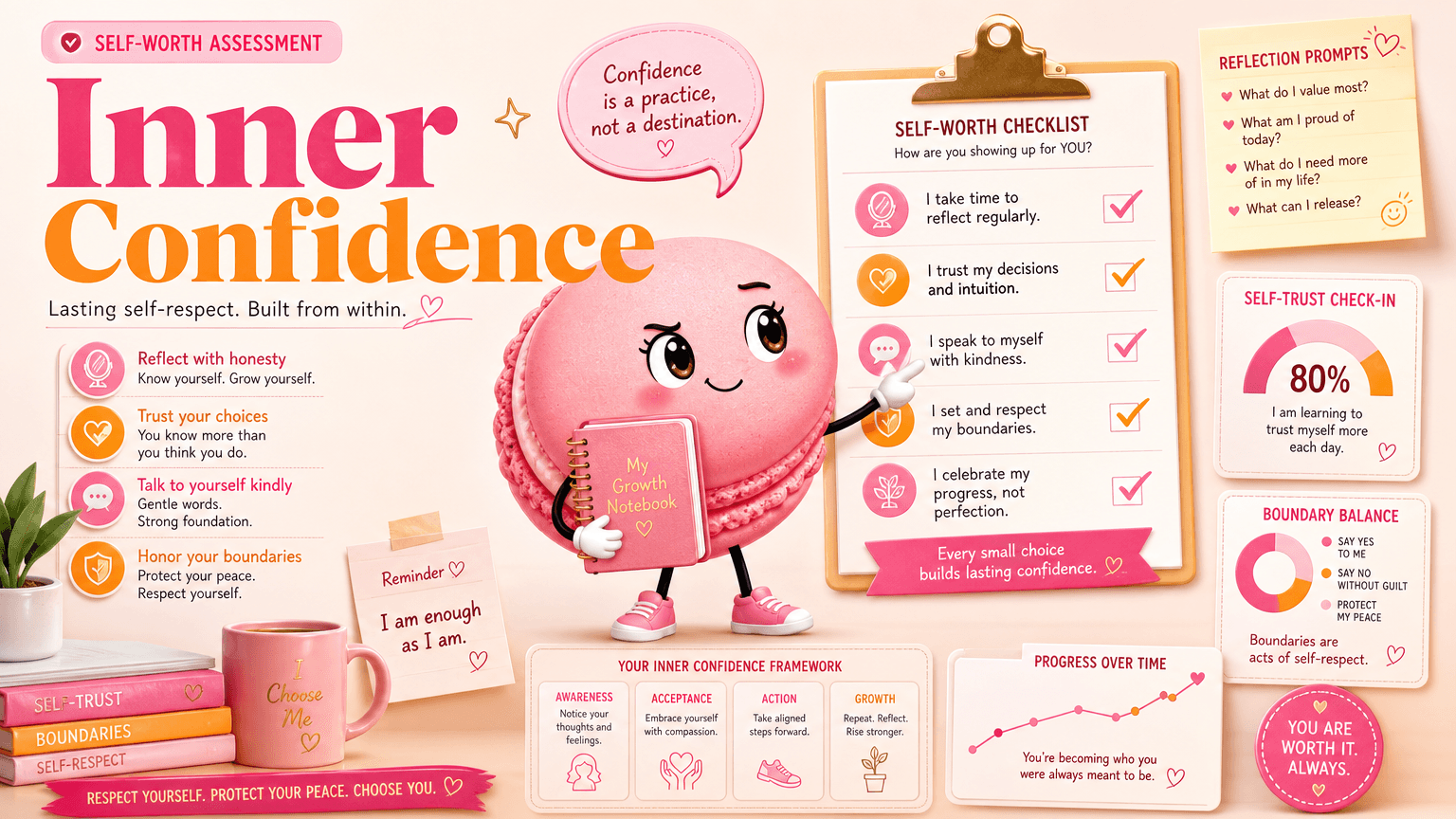
Build Lasting Inner Confidence
Macaron turns the self worth assessment into something you can use after the result, not just read once and forget. The follow-up is designed to support steadier self-respect through reflection prompts, self-trust check-ins, gentler self-talk habits, and boundary awareness. That matters because lasting confidence usually comes from repeated practice, not from a single insight. If your self-worth tends to depend on performance or approval, these next steps can help you test a different pattern in small, realistic ways and notice what changes when you stop treating every setback as proof of your value. Compared with a simple score, this gives you a clearer path from insight to action.
If You Need Immediate Support
This self-check is not a substitute for professional help, especially if the reflection brings up intense distress, hopelessness, or thoughts of self-harm. A self worth assessment can surface painful feelings, but it should not be used as a stand-in for crisis care or mental health treatment. If you feel unsafe or overwhelmed, contact crisis support right away. In the United States, call or text 988. In the United Kingdom and Ireland, call 116 123 for Samaritans. For other locations, use findahelpline.com to locate local support, and contact emergency services if there is immediate danger. If you are already working with a therapist, bringing the result to that conversation can be more useful than trying to process everything alone.
Your Responses and Privacy
Emotional reflection data can be sensitive because it may reveal insecurities, self-doubt, or personal experiences tied to self-worth. Macaron is provided by MINDAI PTE. LTD., and its Privacy Policy explains how information is collected, used, disclosed, protected, and retained. If you are using a self worth assessment to think through personal patterns, it is worth reviewing how your responses are handled, whether they can be deleted, and how to make privacy requests. For questions about privacy, you can contact `contact@macaron.im`. That transparency matters because people often share more honestly when they know what happens to their answers.
Frequently Asked Questions
This self worth assessment focuses on the patterns that shape how you evaluate yourself, including self-trust, validation needs, reaction to mistakes, emotional steadiness, and beliefs about whether you deserve respect or support. It is designed to look beneath a simple confidence rating so you can see what tends to strengthen or weaken your sense of value in everyday life. That makes it more useful for reflection than a one-line label.
Start with the pattern that feels most familiar or most disruptive, then connect it to a real situation from your life. From there, choose one small next step, such as noticing your self-talk, reducing reassurance-seeking, or setting one clearer boundary. The result is most useful when it leads to a practical reflection, not when it is treated as a final label. If needed, write down the trigger, your reaction, and one alternative response.
Pause and slow down if the reflection feels heavy. A self worth assessment can bring up shame, fear, or painful memories, especially if self-criticism is already intense. If you feel overwhelmed, unsafe, or unable to calm yourself, reach out to a licensed mental health professional or crisis support right away. The assessment should never replace urgent care when you need it, and it is okay to stop before finishing if it feels like too much.
A self worth assessment usually goes deeper than a basic self-esteem quiz. Instead of only asking how confident you feel, it looks at the beliefs and habits underneath that feeling, such as whether approval changes your mood, whether mistakes feel like proof of failure, or whether praise is hard to accept. That makes it better suited to understanding recurring patterns rather than a momentary mood. It is closer to a reflection tool than a quick score.
They overlap, but they are not identical. Self-worth is the deeper sense that you have value as a person. Self-esteem is how you evaluate yourself, often based on qualities or performance. Self-confidence is more specific to believing you can do something well. A self worth assessment is useful because it helps separate those layers, which can matter when you seem capable on the outside but still feel undeserving or easily shaken inside.
It can help you notice patterns like people-pleasing, perfectionism, overexplaining, fear of criticism, difficulty accepting praise, or needing reassurance to feel settled. It may also show whether your self-view changes depending on who is watching, how well you performed, or whether you made a mistake. Those patterns are often more useful than a general score because they point to the situations where self-worth becomes fragile and where support may help most. For a third-party check, Self-Esteem Test: Free Report - Attachment Project at https://www.attachmentproject.com/self-esteem-test/ is worth comparing against the page summary.
Formal scales like the Rosenberg Self-Esteem Scale are widely used in formal measurement and can be helpful for standardized measurement. Macaron is different because it is built for personal reflection, guided interpretation, and practical follow-up rather than formal scoring. That means it may be more useful for understanding your day-to-day patterns, but less suitable if you need a validated clinical or academic instrument. The tradeoff is depth of reflection versus formal standardization. For another outside reference, [PDF] Rosenberg Self-Esteem Scale (RSE) at https://www.apa.org/obesity-guideline/rosenberg-self-esteem.pdf adds a second perspective.
Yes. That pattern is common, and it is one reason a self worth assessment can be more helpful than a broad confidence question. Many people feel capable in one setting but become highly self-critical in another, such as after feedback, during conflict, or when comparing themselves to others. Macaron is designed to help you notice those context shifts so you can work on the specific trigger instead of assuming the problem is constant. For outside context, Self-Esteem Test / Quiz - Psychology Today at https://www.psychologytoday.com/us/tests/personality/self-esteem-test is a useful reference point.
Read & discover
AI Personal Assistant
Free calculators


