Self Worth Test
A self worth test can help you notice whether your sense of value feels steady, approval-dependent, or easily shaken by mistakes and comparison. Macaron turns that reflection into a guided check-in, while making clear it is not a clinical assessment or diagnosis.
Self Worth Test
This self worth test is a guided reflection on how you relate to your value, especially in moments of feedback, comparison, and mistakes. It is designed to help you notice patterns in self-trust, validation needs, and emotional steadiness so you can choose a next step that fits you.
This is a self-reflection tool, not a diagnosis or clinical assessment.
Please answer every question before viewing your result.
This reflection is not a medical or psychological diagnosis. If these questions bring up overwhelming distress, hopelessness, or thoughts of self-harm, please reach out to a trusted person, local emergency services, or a crisis line right away.
What This Reflection Can Help You Notice
A self worth test is useful when you want to understand the quieter patterns behind confidence, such as whether you trust your own judgment, accept care without hesitation, or feel your value depends on performance and approval. People often search this term when they are not looking for a diagnosis, but for a clearer mirror on how they relate to themselves day to day. That makes the best version of this test practical, specific, and easy to apply to real situations.
Macaron frames the self worth test as guided reflection rather than a formal psychological scale. That matters because many searches for self-worth overlap with self-esteem, self-acceptance, and confidence, even though those ideas are not identical. This page is designed to help you interpret the term in a practical way, so the result feels relevant to lived experience instead of abstract theory. The tradeoff is that you get more personal insight, but not a clinical score.
The reflection focuses on patterns that commonly show up in everyday life, such as second-guessing decisions, downplaying compliments, overreacting to criticism, or feeling uneasy when you are not being reassured. These are often the places where self-worth becomes visible first, especially when stress, relationships, or setbacks make inner doubts louder. If you recognize yourself in those moments, the test can help you name what is happening more clearly. For a related Macaron page, see Macaron Novel App Download at https://macaron.im/playbook/macaron-novel-app.
Rather than treating self-worth as a fixed label, the test helps you notice where it feels stable and where it becomes fragile. That can be helpful if you are trying to separate a temporary rough patch from a longer-running habit of seeking external validation, harsh self-talk, or feeling undeserving of respect and care. Macaron is especially useful for people who want a reflection that connects feelings to behavior, not just a vague self-rating.
Because this is a reflective tool, the goal is awareness, not scoring yourself into a good or bad category. A useful self worth test should leave you with a more specific understanding of what needs attention, whether that is self-trust, boundaries, emotional steadiness, or the way you talk to yourself after mistakes. If you want a quick check-in that leads to a concrete next step, this format is often more helpful than a generic quiz.
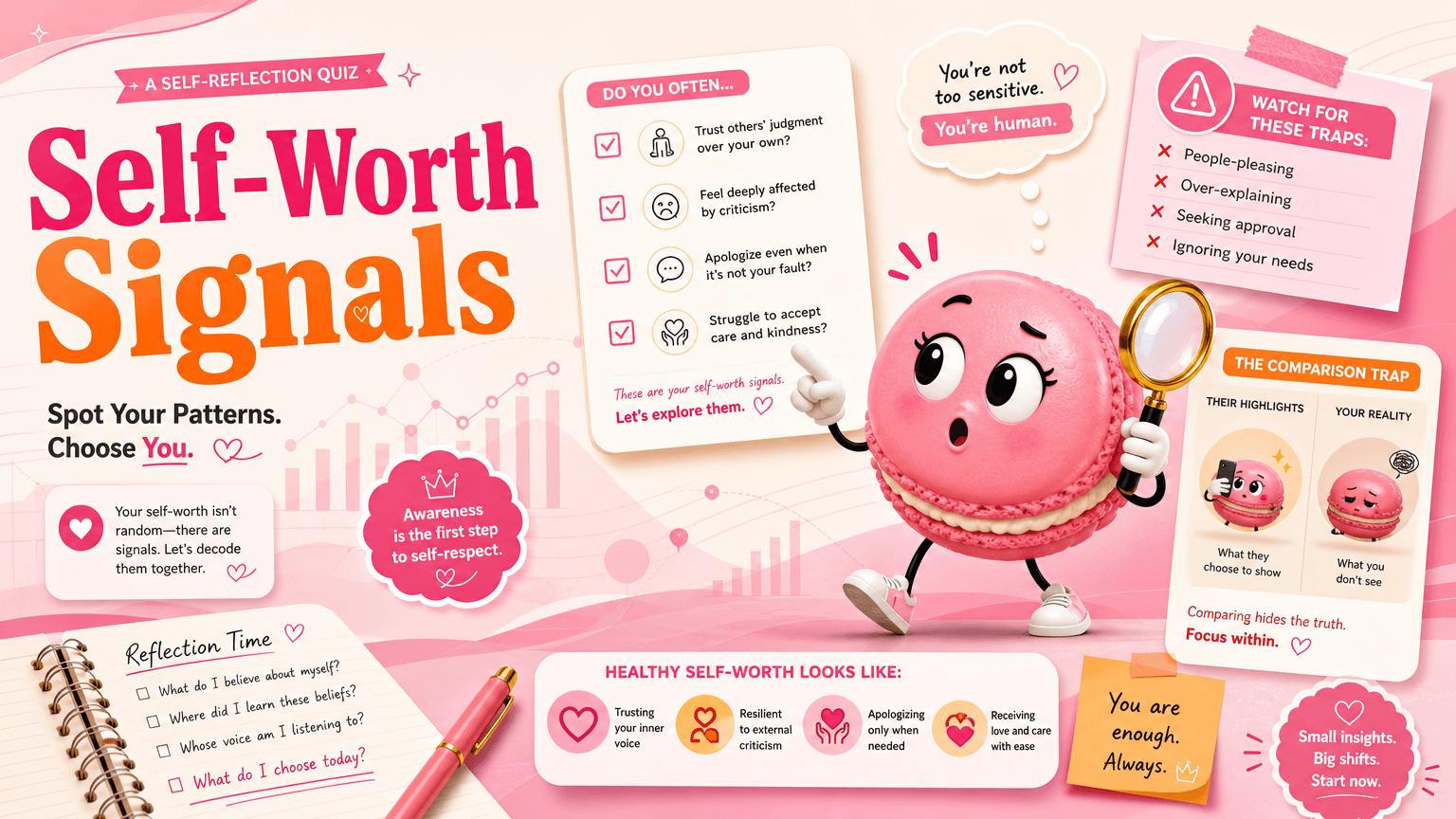
What This Reflection Can Help You Notice
Macaron helps you notice the patterns that usually reveal self-worth in real life, not just in theory. That includes whether you trust your own judgment, how strongly you rely on outside reassurance, how you respond when you make a mistake, and whether criticism sends you into self-doubt. It can also highlight subtler signs, such as shrinking your needs, apologizing too quickly, or feeling uncomfortable receiving care and respect without earning it first. Compared with many short quizzes, Macaron is better at connecting those signals into a usable picture of how you relate to yourself.
How Macaron Structures This Reflection
Macaron organizes the reflection around five practical areas: self-trust, validation needs, response to mistakes, emotional steadiness, and beliefs about personal value. This structure helps you tell the difference between a temporary confidence dip and a more repeated pattern, such as people-pleasing, fear of failure, or feeling that your worth rises and falls with performance. The goal is to make the result easier to interpret and more useful afterward. That said, a structured reflection still depends on honest answers, so it works best when you are willing to look at uncomfortable patterns without rushing to judge them.
What Your Result Can Clarify
Your result is designed to show where your self-worth feels most secure and where it becomes fragile under pressure. It can help you see whether insecurity appears mainly around criticism, relationships, achievement, or comparison, and whether outside approval is shaping your choices more than you realized. Instead of giving a vague label, the result points to the pattern that may deserve attention first, so your next step feels more specific and manageable. That makes it easier to move from insight to action without trying to fix everything at once.
More About Self Worth Test
Macaron helps you reflect on patterns that often sit underneath self-worth, including how quickly you defer to other people’s opinions, whether you can make choices without overexplaining, and how you react when you do not get the response you hoped for. These details matter because self-worth is often easier to spot in behavior than in broad statements about confidence. The advantage of this approach is that it captures everyday habits; the limitation is that it is still a reflection, not a diagnostic measure.
Macaron structures this reflection around self-trust, validation needs, response to mistakes, emotional steadiness, and beliefs about personal value. That structure helps separate similar but different experiences, such as feeling capable at work while still feeling unworthy in relationships, or seeming confident on the outside while privately doubting your own value. People who benefit most are often those who want to understand why they can perform well yet still feel unsettled inside.
Your result is meant to clarify patterns, not rank your worth. Many self-worth quizzes online use short, direct statements like whether you feel worthy of love and respect, whether you can accept compliments, or whether you make choices to please others. Macaron uses that same practical lens, but turns the outcome into a more thoughtful read on what is driving the pattern. That makes it more useful for follow-up reflection, though less like a fast scorecard than some competitor apps. Another useful Macaron comparison is AI Story App - Macaron at https://macaron.im/ai-story-app.
Macaron helps turn the self worth test into action through reflection prompts, self-trust check-ins, gentler self-talk habits, and boundary-focused next steps. That is especially useful if your pattern is not low confidence in general, but a repeated tendency to abandon your own needs, minimize your feelings, or recover slowly after criticism. The tradeoff is that you may need to spend a little more time with the result, but the payoff is a clearer next step. For a broader Macaron context, AI Calorie Tracker: How It Works and Best Options - Macaron at https://macaron.im/blog/ai-calorie-tracker can help you compare the decision from another angle.
If the reflection brings up distress, the right next step may be support rather than more analysis. This page is not a substitute for professional care, and if your answers point to overwhelming shame, hopelessness, or feeling unsafe, it is important to contact crisis support or a licensed professional instead of trying to process everything alone. In that situation, a simple quiz is not enough; immediate human support is more appropriate.
Build More Grounded Self-Worth
Macaron helps turn the self worth test into something practical by pairing reflection with action. That may include prompts that help you challenge harsh assumptions, check-ins that strengthen self-trust, and small habit shifts that make boundaries and self-respect easier to practice. The point is not to force positivity, but to help you respond differently when self-doubt shows up, especially in moments where you usually look outward for reassurance. This is most helpful for users who want a next step, not just a label.
If You Need Immediate Support
If the reflection leaves you feeling overwhelmed, unsafe, or pulled into thoughts of self-harm, do not treat the test as the next step. Reach out for immediate support from a crisis line, trusted person, or licensed professional. In the United States and Canada, call or text 988. In the United Kingdom and Ireland, call 116 123. If you are elsewhere, use a local emergency number or the international directory at findahelpline.com. A self-worth check-in should never delay urgent help.

Your Responses and Privacy
Emotional reflection data is sensitive, especially when it involves self-worth, shame, reassurance needs, or personal boundaries. Macaron is provided by **MINDAI PTE. LTD.**, and you can review how data is handled in the official [Privacy Policy](https://macaron.im/privacy-policy). Treat your responses as personal context, avoid sharing details you are not ready to disclose, and use the result as a private starting point for reflection. For privacy questions or concerns, contact `contact@macaron.im`.
Frequently Asked Questions
This self worth test looks at the everyday signals that often reveal self-worth, including self-trust, need for approval, reactions to mistakes, emotional steadiness, and beliefs about whether you deserve care and respect. It is especially helpful if you are trying to understand patterns like people-pleasing, harsh self-talk, or feeling shaken by criticism. The aim is to show how self-worth may be showing up in your habits, not to assign a clinical label.
Start with the pattern that feels most familiar or most disruptive, then choose one small action that matches it. For example, if approval-seeking stands out, you might practice making one decision without checking with others. If self-criticism is the issue, you might work on a gentler response after mistakes. The result is most useful when it leads to one concrete change rather than a broad promise to be more confident.
Pause before trying to analyze the result further. If the reflection brings up shame, panic, hopelessness, or any sense that you are not safe, shift to support and grounding instead of more self-assessment. Reach out to a trusted person, a licensed mental health professional, or crisis support right away if needed. A self worth test should never replace immediate care when distress feels intense.
This page is a guided reflection tool, not a standardized psychological measure. Formal assessments usually follow a validated scoring method and are used in clinical or formal settings, while this self worth test is meant to help you notice patterns in a more personal, conversational way. It can be a useful starting point for insight, but it should not be treated as a diagnosis or a substitute for professional evaluation.
People often use the terms interchangeably, but they are not exactly the same. Self-worth usually refers to your deeper sense of being valuable as a person, while self-esteem often includes how you evaluate yourself in relation to abilities, appearance, or performance. A person can feel competent in some areas and still struggle with worth. Macaron’s reflection is useful because it helps you notice both the deeper belief and the day-to-day behaviors around it.
Most self-worth quizzes are designed to be quick, often taking only a few minutes. Macaron’s version is still meant to be accessible, but it gives you more context than a simple score by connecting your answers to patterns like validation-seeking, self-trust, and reactions to mistakes. If you want a fast check-in, that is helpful; if you want a more useful takeaway, it is worth spending a little extra time with the reflection. For a third-party check, Free Rosenberg Self-Esteem Scale (RSES) - Mission Connection at https://missionconnectionhealthcare.com/blog/quiz/self-esteem-test/ is worth comparing against the page summary.
Common signs include needing frequent reassurance, downplaying compliments, feeling crushed by criticism, apologizing excessively, avoiding decisions, or believing you have to earn care and respect. Some people also notice that they compare themselves constantly or feel like their value changes with performance. These signs do not prove anything on their own, but they can point to patterns worth exploring. A reflection tool is useful when it helps you notice which signs show up most often. For another outside reference, Self-Esteem Test: Free Report - Attachment Project at https://www.attachmentproject.com/self-esteem-test/ adds a second perspective.
Yes. Many people look confident outwardly while privately struggling with self-doubt, perfectionism, or a strong need for approval. That mismatch is one reason a self worth test can be useful: it helps you compare how you appear to others with how you actually feel when you are alone, criticized, or uncertain. Macaron is especially helpful for this kind of pattern because it focuses on behavior, not just a surface-level confidence label. For outside context, Self-Esteem Test / Quiz - Psychology Today at https://www.psychologytoday.com/us/tests/personality/self-esteem-test is a useful reference point.
Read & discover
AI Personal Assistant
Free calculators


