Simple Life App
Simple Life has evolved from a basic fasting timer to a broader wellness platform with AI coaching, nutrition analysis, and habit tracking. That wider scope helps users who want structure, but the subscription model, limited trial access, and mixed cancellation feedback make value harder to judge than with simpler fasting apps.
What the Simple Life App Includes
Simple Life started as a fasting timer, but the current product is closer to a guided weight-loss and wellness coach. The app now centers on AI support, nutrition feedback, and behavior change rather than just time-restricted eating. That shift makes it more useful for people who want daily direction, but it also means the experience is more opinionated and less lightweight than a basic tracker.
The app’s main appeal is that it tries to make health habits feel manageable. Avo, the AI coach, gives prompts and meal guidance, while Blinky and other visual elements make logging feel less clinical. Users who struggle with consistency may appreciate that tone. Users who want precise nutrition data or a more professional interface may find the presentation too playful for serious tracking.
Simple’s current design leans heavily on habit formation. Streaks, progress scores, and reminders are meant to keep users engaged long enough to build routines around fasting, food choices, sleep, and movement. That can be helpful for beginners who need structure. The tradeoff is that the app asks for regular interaction, so it may feel busy for people who only want to check fasting windows or log meals quickly. For a related Macaron page, see When Nano Banana Meets Macaron: Next‑Level AI Image Editing ... at https://macaron.im/blog/macaron-ai-essential-personal-assistant-features.
The platform now combines several wellness functions in one place: fasting schedules, nutrition scoring, meal planning, workout suggestions, and sleep-related tracking. This all-in-one approach is convenient if you want one app to cover multiple goals. It is less ideal if you prefer specialized tools with deeper analytics, more export options, or fewer prompts competing for attention on the home screen.
Simple Life sits in a crowded category where many apps promise personalized coaching. Its difference is the combination of AI guidance and a structured behavior-change framework. That works best for users who want a coach-like experience and do not mind paying for it. Competitors can still be better if you want a free-form toolkit, more transparent pricing, or a less guided workflow.
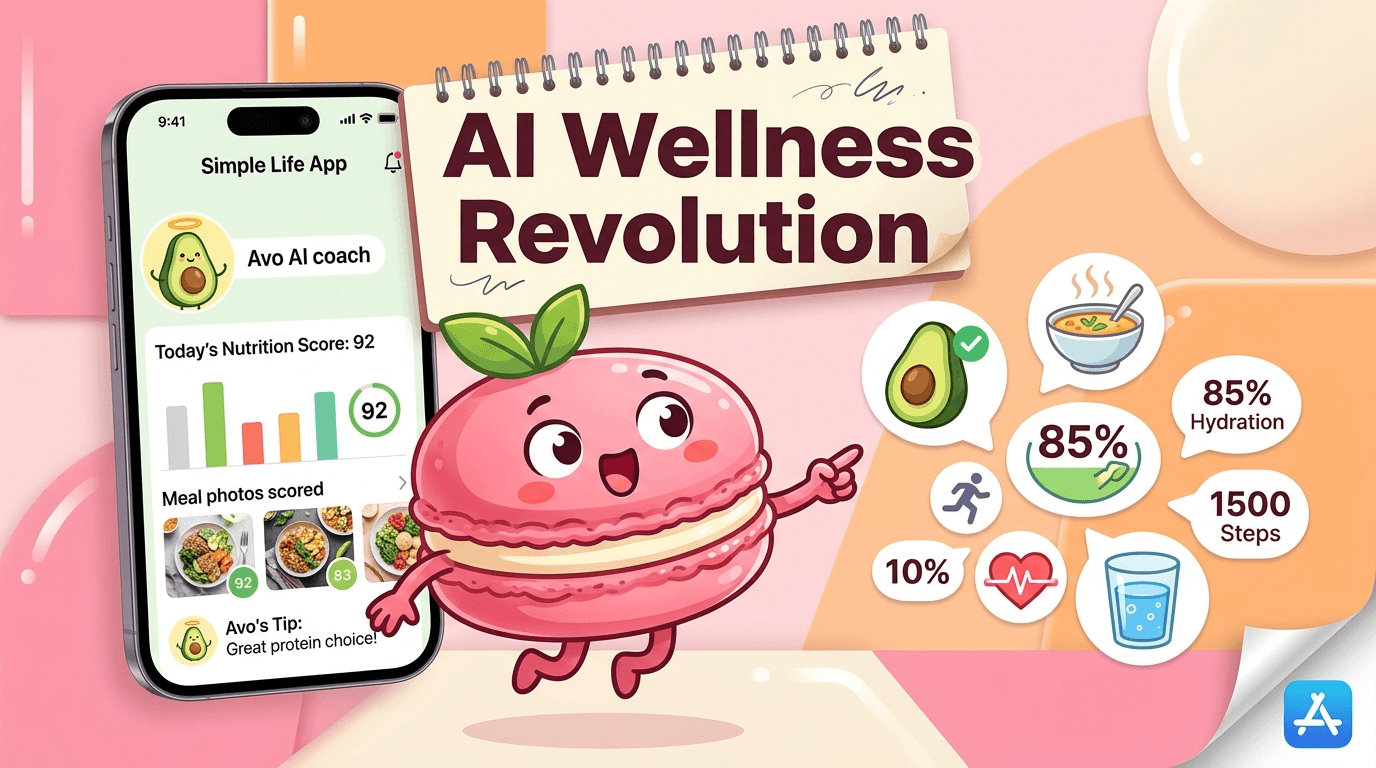
What the Simple Life App Includes
Simple Life now presents itself as an AI-powered wellness system rather than a single-purpose fasting app. Core features include Avo, the AI coach, nutrition scoring across many health metrics, meal feedback, and habit tools such as streaks and reminders. The app also supports food photo analysis through Avo Vision, which can speed up logging for common meals. The downside is that the broader feature set increases daily interaction and can feel more demanding than a minimalist fasting timer.
Simple Life's Fasting, Sleep, and Wellness Tracking
The fasting tools are still central, with customizable windows and progress graphs that help users see patterns over time. Simple also connects fasting habits to sleep and recovery, which is useful for people trying to understand how late meals or inconsistent schedules affect energy. Nutrition scoring adds another layer by labeling meals and trends in a simple way. That simplicity helps beginners, but advanced users may want more detailed nutrient breakdowns, better trend exports, or fewer gamified elements.
More About Simple Life App
Avo is the feature most likely to shape a user’s first impression of Simple. It offers coaching, meal feedback, and motivational nudges that make the app feel more interactive than a standard tracker. When it works well, it reduces decision fatigue. When it misses context, the responses can feel generic or repetitive. That makes Simple better for users who want encouragement and less ideal for people who expect highly specific nutrition guidance.
Food logging is one of Simple’s strongest practical features because it combines barcode scanning, photo analysis, and quick entry options. That flexibility helps users capture meals with less friction than manual calorie counting. The tradeoff is that photo-based interpretation is not always reliable for mixed dishes, restaurant meals, or recipes with hidden ingredients. Users who need exact macro tracking may still prefer a dedicated nutrition app with more granular controls.
Simple uses behavioral design heavily. Streaks, scores, reminders, and progress visuals are meant to reinforce consistency and make the app feel rewarding. This can help people who respond well to structure and visible progress. It can also feel distracting if you want a calm dashboard or straightforward data review. Compared with more clinical apps, Simple is less about raw analytics and more about keeping users engaged long enough to change habits. Another useful Macaron comparison is AI Personal Assistant - Macaron AI at https://macaron.im/ai-personal-assistant.
Pricing is one of the biggest decision points. Simple is free to download, but the features that make it compelling are generally behind a subscription. That creates a clear value question: if you want coaching and structure, the app may justify the cost; if you mainly want fasting timers or food logging, the paywall can feel steep. Some users also report confusion around trials, renewals, and regional pricing differences. For a broader Macaron context, Best Personal AI Agent Platform for 2025 - Macaron at https://macaron.im/blog/best-ai-agent-platform-2025 can help you compare the decision from another angle.
Macaron is a useful comparison because it takes a more flexible approach. Instead of pushing users through a fixed wellness program, it works as an AI toolkit that can generate meal plans, analyze food photos, and adapt to different schedules or diets. That makes it better for self-directed users and people with unusual routines. Simple is still stronger if you want a guided program, but Macaron is often easier to tailor without subscription pressure.

Simple Life Pricing
Simple uses a freemium model, but the free version is limited enough that many users will need a subscription to get meaningful value. Pricing is commonly reported in the $20-30 monthly range, with annual plans offering a lower effective monthly cost. The bigger issue is not just price, but access: users often cannot fully test premium tools before paying, which makes the purchase decision harder. Regional pricing differences and renewal complaints add another layer of friction for international users.
The AI-Powered Alternative
Macaron is positioned differently because it behaves more like an AI assistant toolkit than a structured weight-loss program. Users can ask for custom meal plans, analyze meals from photos, or adapt suggestions to specific diets without being pushed into a fixed routine. That flexibility is valuable for people with dietary restrictions, irregular work hours, or a preference for self-guided planning. The tradeoff is that Macaron gives less built-in structure than Simple, so users who want coaching may need to create more of their own system.
Frequently Asked Questions
Simple Life began as a fasting tracker, but it now functions more like a broader weight-loss and wellness coach. The fasting timer is still part of the app, yet it sits alongside AI nutrition guidance, sleep-related tracking, and habit-building tools. That makes it a better fit for users who want a guided routine. If you only want a simple fasting timer, the current version may feel more complex than necessary.
Simple Life is free to download, but the features most people care about are usually behind a subscription. The free version is useful for trying the app’s basic structure, yet it does not fully show how the coaching, meal feedback, and deeper tracking work. That makes the app harder to evaluate before paying. Users who only need a timer may not need premium access, but most coaching-focused users probably will.
Simple Life is good for people who want structure, reminders, and a coach-like experience. Its AI guidance and habit tools can make weight-loss routines feel easier to maintain. It is less compelling for users who want detailed analytics, a calmer interface, or more control over how they track food and fasting. In practice, the app’s value depends on whether you like guided behavior change or prefer a more flexible system.
Macaron is a better fit for users who want AI help without committing to a fixed program. It can create meal plans, analyze food photos, and adapt to different schedules or diets, which is useful for people with irregular routines or specific nutrition needs. The tradeoff is that it offers less built-in coaching and fewer guardrails than Simple. If you want structure, Simple may be easier; if you want flexibility, Macaron is often the better choice.
Simple Life is designed to reduce the need for manual calorie counting, which is part of its appeal. Instead of asking users to log every number, it focuses on fasting windows, meal feedback, and broad nutrition scoring. That can make the app feel less tedious for beginners. However, users who want exact calorie totals, macro targets, or detailed nutrient logs may still find the app too high-level for serious tracking.
Food photo analysis can be helpful for quick logging, especially for packaged foods or simple meals. It is less reliable for mixed dishes, restaurant meals, or recipes with hidden ingredients. Like most AI-based food recognition tools, it works best as a convenience feature rather than a precise nutrition record. Users who need exact macro counts or medical-grade tracking should treat the photo analysis as a starting point, not a final answer. For a third-party check, Navigating the App: Overview of Main Features | Simple at https://help.simple.life/en/articles/9887852-navigating-the-app-overview-of-main-features is worth comparing against the page summary.
You can use parts of Simple Life more passively, but the app is clearly designed around coaching and habit formation. Streaks, prompts, and progress scoring are built into the experience, so it is not ideal if you want a neutral tracker with minimal intervention. Some users enjoy that structure, while others find it intrusive. If you want a less prescriptive experience, a more flexible AI toolkit may be a better fit. For another outside reference, We Tested the Simple App to See How It Helps With Intermittent ... at https://www.everydayhealth.com/diet-nutrition/simple-life-app-review/ adds a second perspective.
The main drawbacks are the paywall, the limited ability to test premium features before subscribing, and the app’s sometimes overly gamified feel. Some users also report that the coaching can be generic and that cancellation or billing can be confusing. On the product side, the app is less appealing if you want deep analytics or a minimalist interface. It is strongest when you want guided support, not when you want maximum control.life/ is a useful reference point.life/ is a useful reference point.life/ is a useful reference point.life/ is a useful reference point.life/ is a useful reference point. For outside context, Simple: Weight Loss & Health Coaching at https://simple.life/ is a useful reference point.
Read & discover
AI Personal Assistant
Free calculators


