Simple Life Reviews
Simple Life reviews show a polarized pattern: users praise its motivational AI coach 'Avo' but rage against subscription traps and misleading free trials. We sorted through 1,200+ reviews to show you the real tradeoffs.
What Simple Life Users Often Like
Simple Life reviews show a product with real appeal and real friction. Many users like the app because it lowers the barrier to starting intermittent fasting: the interface is clean, the reminders are gentle, and the AI coach feels more human than the usual calorie-counter tone. That combination matters most to beginners who want structure without feeling judged or overwhelmed by a dense health dashboard.
The most praised feature is Avo, the AI coach. Reviewers repeatedly describe it as supportive, practical, and more conversational than the rigid guidance found in many fasting apps. Users who stick with Simple Life often say the app helps them stay accountable during the first difficult weeks, especially when they want encouragement, meal suggestions, and a simple plan they can follow without building everything from scratch.
At the same time, the review pattern is not uniformly positive. App store ratings are much stronger than the sentiment found in complaint-heavy forums and customer service sites, which suggests the app performs well for some users but creates trust issues for others. That split is important: Simple Life may feel helpful when it is working, but billing and cancellation concerns can quickly overshadow the product experience. For a related Macaron page, see Guide to Finding the Right Book - Macaron AI at https://macaron.im/playbook/guide-to-finding-the-right-book-689581101bbc6bcd9f8055e4.
Long-term users also note that the app has expanded beyond a basic fasting timer. Hydration, exercise, meal analysis, and broader wellness features can be useful, but they also make the app feel less focused than before. For people who want a narrow intermittent fasting tool, the added layers may feel like clutter. For users who want one place to manage habits, the broader scope can be a benefit.
Nutrition guidance is another area where reviews diverge. Some users credit Simple Life with helping them build better routines and lose weight, while others say the meal suggestions are too generic to handle keto, vegan, or other specific eating styles. That makes the app strongest for users who want coaching and accountability, but less compelling for people who need highly customized nutrition planning.

What Simple Life Users Often Like
Across positive reviews, three strengths appear again and again. First, Avo gives the app a more personal feel than many fasting tools, which helps users stay engaged when motivation drops. Second, the reminders are generally described as calm and encouraging rather than guilt-driven. Third, streaks, progress views, and simple tracking create a sense of momentum. The tradeoff is clear: users who value this coaching style often accept a premium subscription because the guidance feels more supportive than cheaper, bare-bones alternatives.
Common Simple Life Complaints
Critical reviews cluster around billing, cancellation, and feature creep. The biggest complaint is that the free trial experience can feel misleading, especially when users believe they have more time or clearer control than they actually do. Cancellation is another pain point, with some users reporting that the process is harder to find than expected. A second theme is product bloat: newer tracking features can feel half-finished or unnecessary to people who only wanted a fasting app, and Android users more often mention bugs or slower updates.
More About Simple Life Reviews
Simple Life appears to work best for beginners who want a guided entry into intermittent fasting. The app’s structure can reduce decision fatigue by telling users when to fast, when to eat, and when to check progress. That is useful if you want a coach-like experience instead of building your own plan. Experienced fasters, however, often want more control and may find the app’s guidance too prescriptive or too simplified for advanced routines.
The strongest usability praise goes to tracking basics like fasting windows, hydration, and weight. Users often describe these parts of the app as clean and easy to understand, which matters when the goal is consistency rather than deep analytics. Food logging is where the experience weakens. Reviewers frequently mention that barcode scanning misses common items and manual entry takes too many taps, making meal tracking feel slower than it should.
Feature expansion is a recurring theme in negative feedback. Several long-term users say the app has moved away from its original minimalist fasting focus and now feels more like a broad wellness platform. That can help people who want one app for multiple habits, but it also creates a tradeoff: more capabilities often mean more complexity, more screens, and a less direct path to the core fasting workflow that originally attracted users. Another useful Macaron comparison is Best Personal AI Agent Platform for 2025 - Macaron at https://macaron.im/blog/best-ai-agent-platform-2025.
Cancellation and billing are not just side complaints; they shape how people interpret the whole product. When users feel surprised by charges or struggle to stop recurring payments, even a helpful app can lose credibility fast. That is why Simple Life’s review profile is so polarized. The coaching may be genuinely useful, but the service experience has to be trusted before users will recommend it with confidence. For a broader Macaron context, Macaron App Download (iOS & Android): Official, Safe, and Fast Install at https://macaron.im/blog/macaron-app-download can help you compare the decision from another angle.
The value proposition is strongest for people who want accountability and are willing to pay for it. It is weaker for users who expect a transparent free tier, a lightweight interface, or highly specific nutrition support. In that sense, Simple Life competes less on raw feature count and more on coaching style. Competitors can be better at pure tracking or lower-cost access, while Simple Life’s advantage is the guided experience when the subscription model is not a dealbreaker.
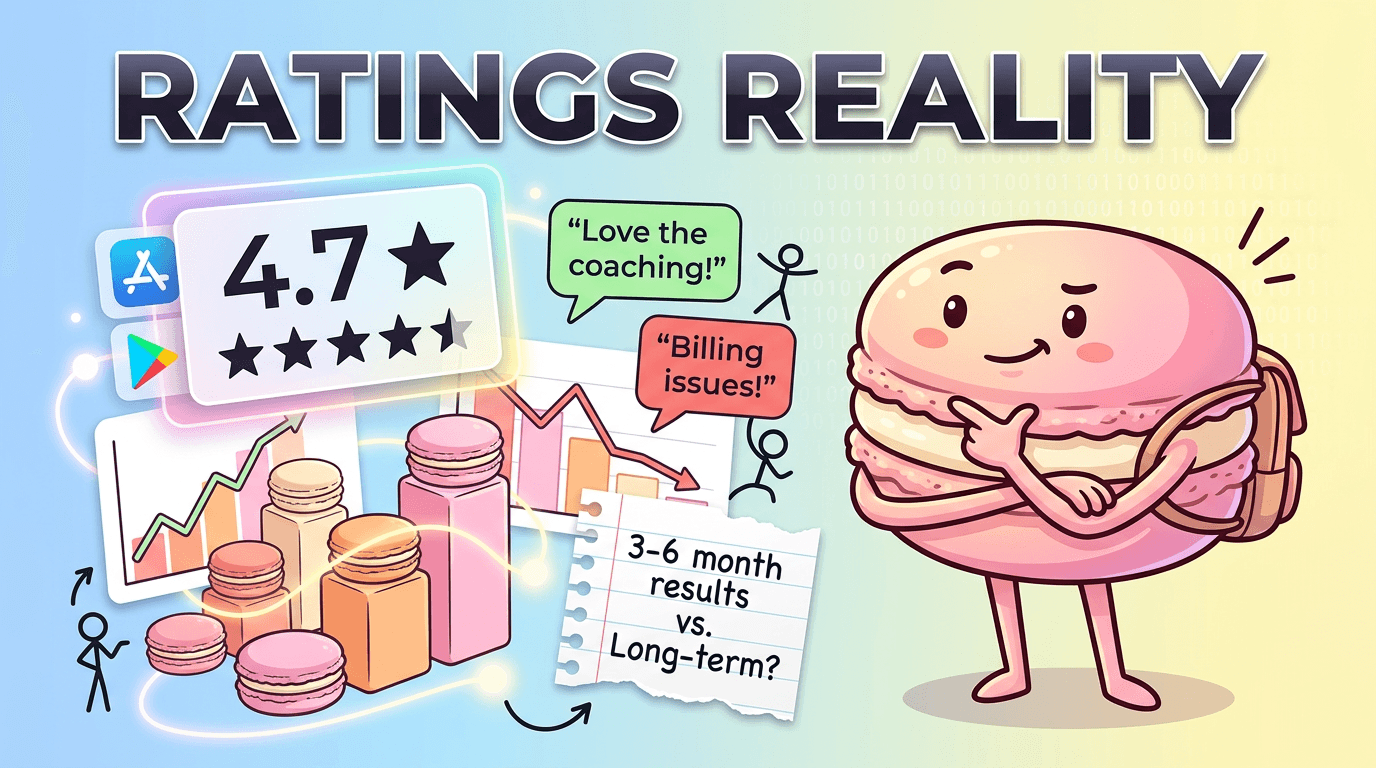
Simple Life's Public Review Signal
The public review picture is mixed in a way that matters for buyers. App store ratings are strong enough to suggest many users get value from the app, but detailed reviews reveal recurring trust issues around billing and support. That usually means the product is effective for a specific use case, not universally loved. If you want a structured, short-term fasting coach, Simple Life can be compelling. If you want a low-risk subscription with easy cancellation and predictable pricing, the review signal is much less reassuring.
What Some Users May Want Instead
Review comparisons suggest three common alternatives depending on the user’s goal. Zero is often preferred by people who want a pure fasting timer with minimal extras. MyFitnessPal tends to win for users who care more about detailed nutrition logging than coaching. Macaron is a frequent choice for people who want broader AI support without being locked into a rigid wellness program. The tradeoff is that each alternative gives up something: simplicity, depth, or fasting-specific structure. That makes the best choice depend on whether you value coaching, transparency, or control.
Frequently Asked Questions
Overall, the reviews are mixed rather than uniformly good or bad. App store ratings are strong, and many users genuinely like the coaching and fasting structure. But complaint sites and forum discussions show repeated concerns about billing, cancellation, and support. That means Simple Life can be a good fit for users who value guided accountability, but it is a riskier choice for anyone who wants a transparent, low-friction subscription experience.
The most praised part of Simple Life is Avo, the AI coach. Users like that it feels supportive without being overly harsh, and many say it makes fasting easier to stick with during the first few weeks. The app’s clean design and gentle reminders also get positive mentions. Compared with more clinical or minimalist fasting apps, Simple Life feels more conversational and motivating, which is a real advantage for beginners.
Billing and cancellation issues are the biggest complaints. Many negative reviews mention unexpected charges, confusion around the free trial, or difficulty stopping recurring payments. Support responsiveness is another common frustration. A second complaint is feature creep: some users feel the app has added too many wellness tools and lost the simplicity that made it appealing in the first place. Those issues can outweigh the app’s coaching benefits for some users.
Yes, it often works well for beginners because it provides structure without requiring much setup. The fasting plans, reminders, and coaching can help new users build a routine before they understand what habits work best for them. The downside is that beginners may also be the most vulnerable to subscription confusion if they do not read the trial terms carefully. So the app is beginner-friendly in design, but not always in pricing clarity.
Experienced fasters may find Simple Life less compelling. The app’s guidance can feel too basic if you already know your preferred fasting windows and tracking habits. Some advanced users also dislike the added wellness features because they make the app feel less focused. For people who want a simple timer or more control over their routine, a lighter app may be a better fit than Simple Life’s coach-led approach.
Many reviews suggest cancellation is not as straightforward as users expect. Some people report needing to dig through multiple menus, and others say they still saw charges after unsubscribing. That does not mean every cancellation fails, but it does mean the process has created enough frustration to become a major theme in reviews. If cancellation simplicity matters to you, it is worth checking the exact subscription flow before signing up. For a third-party check, The Simple Life LLC | BBB Complaints | Better Business Bureau at https://www.bbb.org/us/fl/boca-raton/profile/weight-loss/the-simple-life-llc-0633-92029225/complaints is worth comparing against the page summary.
Macaron is a common alternative for users who want more flexible AI support without a rigid fasting program. It is better suited to people who want broader life coaching and a clearer product experience, while Simple Life is more focused on structured wellness habits. The tradeoff is that Macaron may not offer the same fasting-specific framework, but it can be easier to adapt to different goals and routines. For another outside reference, We Tested the Simple App to See How It Helps With Intermittent ... at https://www.everydayhealth.com/diet-nutrition/simple-life-app-review/ adds a second perspective.
Zero is usually better if you want a pure fasting timer with minimal distractions. MyFitnessPal is stronger for detailed food logging and nutrition tracking. Simple Life sits between those two: it offers more coaching than Zero and more fasting structure than MyFitnessPal, but it is not as specialized in either direction. That middle position is useful for some users, yet it also means competitors can be better if you know exactly what you want.com is a useful reference point.com is a useful reference point.com is a useful reference point.com is a useful reference point.com is a useful reference point. For outside context, Read Customer Service Reviews of simple-life-app.com - Trustpilot at https://www.trustpilot.com/review/simple-life-app.com is a useful reference point.
Read & discover
AI Personal Assistant
Free calculators


