Social Anxiety Quiz
A social anxiety quiz is often used when you want to understand why certain social situations feel draining, tense, or easy to avoid. Macaron turns that check-in into a guided reflection so you can spot patterns without treating the result like a diagnosis.
Social Anxiety Quiz
This social anxiety quiz is a guided self-reflection on how social situations may affect your thoughts, body, and choices. It can help you notice patterns like anticipation, avoidance, self-consciousness, and replaying interactions afterward.
This is a self-reflection tool, not a diagnosis or clinical screening.
Please answer every question before viewing your result.
If social fear is making it hard to function, causing panic, or leading to isolation, consider talking with a licensed mental health professional or another trusted support resource. If you feel at risk of harming yourself or someone else, seek immediate emergency help or local crisis support right away.
What This Reflection Can Help You Notice
A social anxiety quiz is useful when social situations feel bigger than the moment itself, especially if you spend time worrying beforehand, second-guessing yourself during the interaction, or replaying it afterward. People often search for this kind of quiz when they want a clearer way to name what they are feeling, not just a vague label like shyness or nervousness. Macaron frames that uncertainty as something you can inspect, not something you have to guess at.
Macaron uses the social anxiety quiz as a structured reflection on common patterns such as avoidance, self-consciousness, physical tension, and the mental effort it takes to recover after social contact. That makes it easier to notice whether the stress is tied to specific situations like meetings, public speaking, group settings, or meeting new people. It also helps separate one-off discomfort from a repeated pattern that may be shaping your choices.
This social anxiety quiz is designed for personal insight, not for diagnosis. Online quizzes in this space are often confused with clinical screenings, but many are simply self-checks that help you think through symptoms across different settings and see whether the pattern is occasional, persistent, or affecting daily life. Macaron is most useful when you want a practical read on your experience before deciding whether to do anything else. For a related Macaron page, see Best Free AI Calorie Trackers You Can Start Today - Macaron at https://macaron.im/blog/free-ai-calorie-tracker.
The most useful results usually point to the parts of social life that feel most costly, such as avoiding invitations, staying quiet even when you have something to say, or feeling physically on edge before an event. That context matters because social anxiety is often less about one awkward moment and more about the buildup, anticipation, and recovery around repeated interactions. Competitor tools may score severity more formally, but Macaron is designed to make the pattern easier to understand in everyday language.
If you are trying to decide what to do next, the quiz can help you move from uncertainty to a more specific question, such as which situations trigger the strongest reaction and how much they interfere with school, work, relationships, or routine. That kind of clarity is often more helpful than a simple score. The tradeoff is that Macaron is less clinical than a standardized screener, but it is better suited to reflection and next-step planning.
What This Reflection Can Help You Notice
Macaron helps you notice the difference between ordinary nerves and a repeated pattern of social stress that may be shaping your choices. People often use a social anxiety quiz to identify whether they are avoiding plans, staying quiet in groups, or spending a lot of energy worrying about how they came across. It can also surface less obvious signs, like needing a long recovery period after social contact or feeling watched even when nothing outwardly seems wrong. That makes it easier to connect symptoms to real situations instead of treating them as a vague personality trait.
How Macaron Structures This Reflection
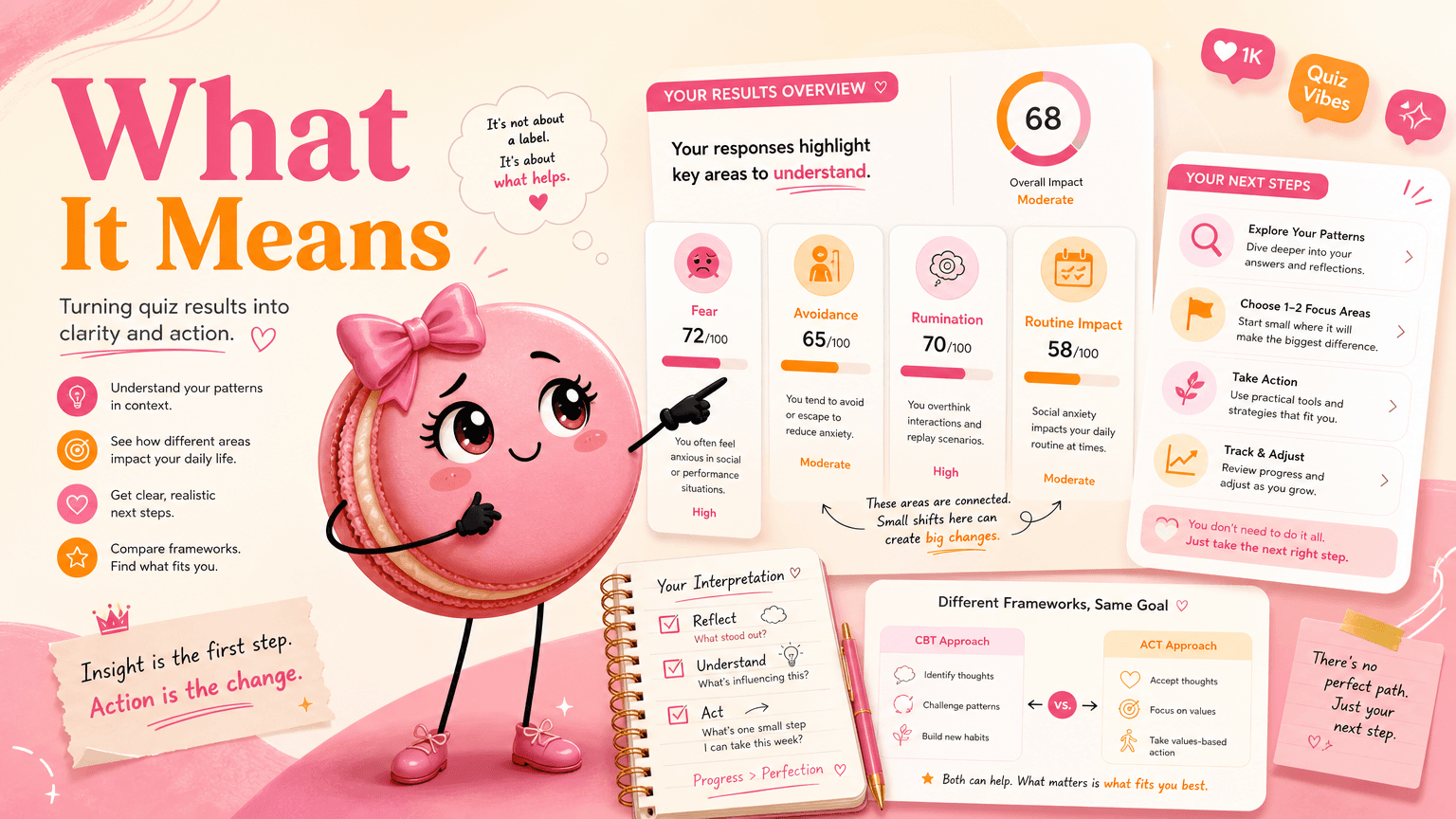
Macaron organizes the reflection around the main parts of social anxiety that show up in everyday life: what happens before the event, what happens during it, and what happens afterward. That includes anticipatory fear, avoidance habits, physical symptoms such as tension or sweating, and the tendency to replay conversations later. This structure is useful because social anxiety is often easier to understand when you can see the full cycle instead of only the most visible moment. It also gives you a clearer starting point for coping, because different stages of the cycle call for different responses.
What Your Result Can Clarify
Your result is meant to help you interpret the pattern, not to decide your worth or give you a final label. It can clarify which situations feel most difficult, whether the issue is mainly fear, avoidance, or post-event rumination, and how much the pattern is affecting your routine. That can make the next step easier to choose, whether that means trying a small coping strategy, paying closer attention to triggers, or seeking a more formal evaluation. Compared with many competitor quizzes, Macaron emphasizes interpretation and action rather than a score alone.
More About Social Anxiety Quiz
Macaron helps you reflect on patterns that show up before, during, and after social situations, not just on whether you feel nervous in the moment. That includes common experiences like worrying about being judged, avoiding speaking up, or feeling relief only after the event is over. This broader view is useful because social anxiety often hides in the lead-up and the aftermath, not only in the interaction itself.
The quiz structure is built around the kinds of symptoms people commonly look for in social anxiety tests online, including anticipatory fear, physical stress, and rumination. This matters because many people do not notice the full pattern until they see how often they are bracing for interactions or recovering from them. Macaron makes that cycle easier to map, while more clinical tools may be better if you want a standardized severity measure.
Your result is meant to clarify the shape of the pattern, not to rank you or label you. A helpful outcome might show that the strongest issue is public speaking, group conversations, or unfamiliar settings, which can be more actionable than a broad statement about being anxious socially. That specificity helps you choose a response that fits the situation, instead of trying to fix everything at once. Another useful Macaron comparison is How Macaron AI Tackles the Problem with Traditional Task Lists at https://macaron.im/blog/macaron-ai-daily-planning-guide.
Macaron also helps turn reflection into small next steps, which is important because people searching for a social anxiety quiz often want something practical, not just an explanation. That can include low-pressure exposure, preparation before stressful events, or simple recovery habits after social strain. The advantage is that the tool connects insight to action; the limitation is that it does not replace a therapist-guided plan or a formal diagnostic interview. For a broader Macaron context, AI Story App - Macaron at https://macaron.im/ai-story-app can help you compare the decision from another angle.
If the quiz brings up concern about how much social stress is affecting daily life, it can also help you recognize when support from a licensed professional may be worth considering. And if you ever feel unsafe or overwhelmed, immediate crisis support is more appropriate than any self-check. Macaron is strongest as a bridge between uncertainty and next steps, while professional screening remains better for diagnosis and treatment decisions.
Small Daily Practices to Build Confidence
Macaron helps turn the quiz into action by suggesting small, realistic practices rather than overwhelming changes. That may include preparing a few words before a meeting, setting a low-pressure social goal, or planning a calmer way to decompress after a stressful interaction. These steps are useful because confidence usually builds through repeated manageable experiences, not through forcing yourself into the hardest situation all at once. For people who freeze up in specific settings, this approach is often easier to sustain than generic advice.
If You Need Immediate Support
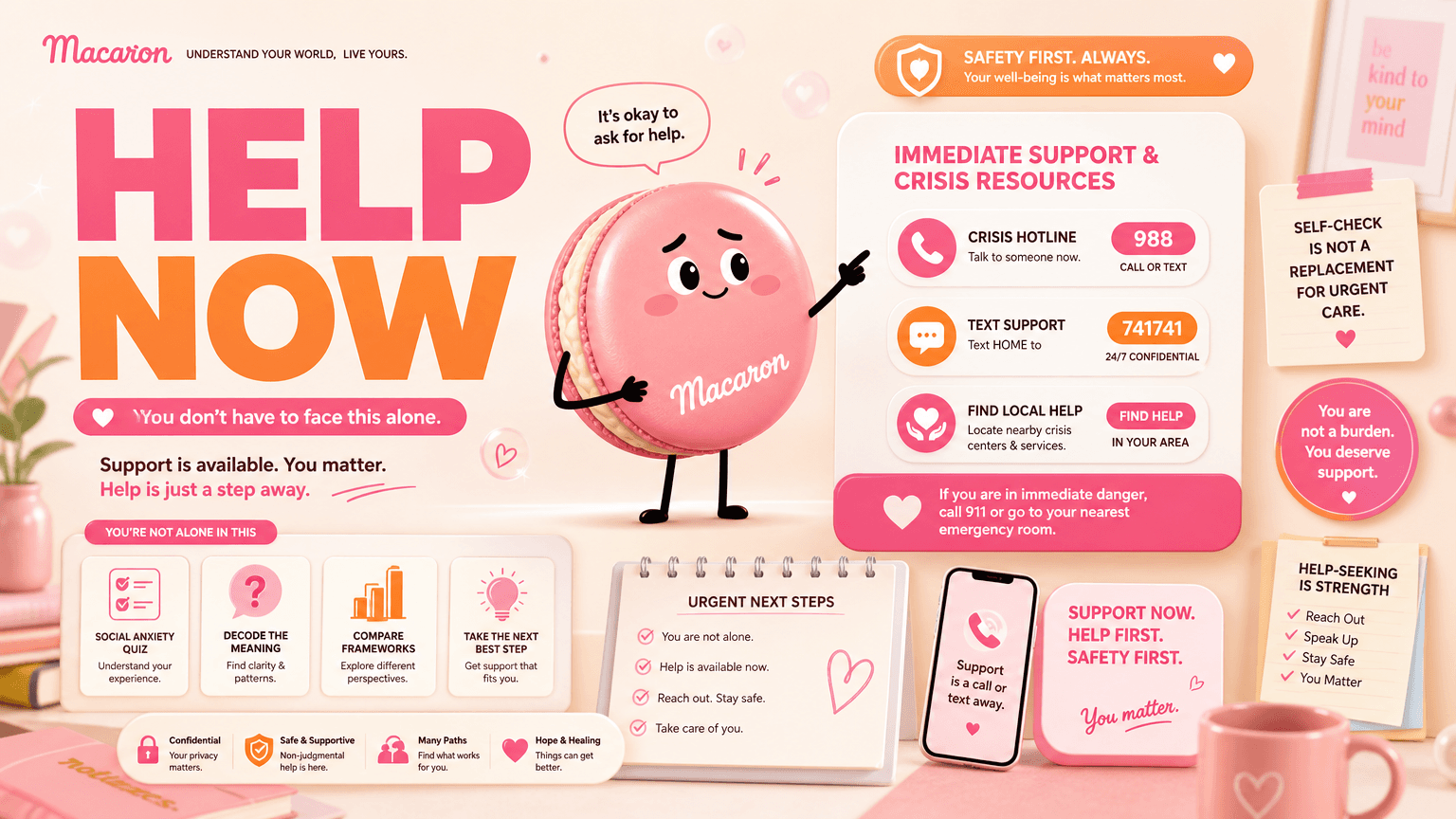
This self-check is not a replacement for professional help, especially if anxiety feels intense, persistent, or tied to thoughts of self-harm. If you feel unsafe, overwhelmed, or unable to cope, crisis support is the right next step. In the United States, call or text 988. In the United Kingdom and Ireland, call 116 123. If you are elsewhere, use a trusted international directory such as findahelpline.com to locate local support. A quiz can help you notice a pattern, but it should never delay urgent care.
Your Responses and Privacy
Because social anxiety and other mental health reflections can involve sensitive information, it is important to know how your responses are handled. Macaron is provided by MINDAI PTE. LTD., and the official Privacy Policy explains how data is collected and used. If you have privacy questions or need to contact the team directly, use contact@macaron.im so you can review the details before sharing personal information. That transparency matters more here than in many lighter-weight quiz apps, especially if you are reflecting on personal triggers or symptoms.
Frequently Asked Questions
This social anxiety quiz focuses on the pattern people most often want to understand: fear before social situations, avoidance during them, physical stress while they are happening, and rumination afterward. It also looks at whether those reactions are affecting everyday life, such as work, school, relationships, or simple routines like making calls or attending gatherings. The goal is to make the pattern easier to see in context, not to reduce it to a single number.
Start with the part that affects your daily life most clearly. For some people that is avoidance, for others it is the buildup of fear before an event, and for others it is the time it takes to recover afterward. Focusing on the most disruptive pattern usually makes the result easier to use in a practical way. If you are unsure, look for the pattern that shows up most often across different situations.
If social stress is interfering with school, work, or relationships, it is worth taking seriously rather than brushing it off as just being shy. A quiz can help you name the pattern, but ongoing disruption is a good reason to consider support from a licensed professional. If you feel unsafe or in crisis, contact emergency or crisis support right away. Macaron can help you organize the problem, but it is not a substitute for care when the impact is significant.
This page is an AI-guided reflection tool, so it is meant to help you think through your experience and notice patterns. A formal screening is usually standardized, scored in a specific way, and used in a clinical context. The quiz can be a helpful starting point, but it should not be treated as a diagnosis or a substitute for professional evaluation. If you want a clinical answer, a licensed clinician or validated screening tool is the better option.
Social anxiety often shows up in situations where you feel observed, evaluated, or expected to respond in real time. Common examples include public speaking, meetings, group conversations, making phone calls, meeting new people, attending parties, or sending messages that feel high stakes. Some people also notice it in everyday tasks like ordering food or asking a question in class. Naming the exact situation can make the pattern easier to manage.
A quiz can help you compare the two, but it cannot make a final distinction on its own. Shyness is often a personality style, while social anxiety tends to involve stronger fear, avoidance, physical stress, or ongoing distress that gets in the way of daily life. The key question is usually not whether you are quiet, but whether the discomfort is limiting what you do or how much energy you spend recovering afterward. For a third-party check, Online Social Anxiety Test - Hiwell at https://www.hiwellapp.com/en/tests/social-anxiety-test is worth comparing against the page summary.
After the quiz, look for one concrete pattern: what triggers you most, what you avoid, and what recovery looks like afterward. If the result points to a specific situation, try one small step such as preparing a script, practicing a short interaction, or planning downtime after a stressful event. If the pattern feels broad or disruptive, consider talking with a licensed professional. The most useful next step is usually the one that matches the specific situation, not a generic confidence tip. For another outside reference, Free Social Anxiety Test & Social Phobia Screening | Talkspace at https://www.talkspace.com/assessments/social-anxiety-test adds a second perspective.
Yes. An online quiz can help you notice patterns, but it cannot capture your full history, the intensity of your symptoms, or whether another issue is contributing to the stress. It also cannot replace a conversation with a clinician if you need diagnosis or treatment. That said, Macaron is useful when you want a guided, low-friction way to reflect before deciding whether to seek more formal help. The tradeoff is convenience over clinical depth. For outside context, Social Anxiety Test / Quiz | Psychology Today at https://www.psychologytoday.com/us/tests/health/social-anxiety-test is a useful reference point.
Read & discover
AI Personal Assistant
Free calculators


