Social Anxiety Test
A social anxiety test can help when everyday interactions leave you tense, avoidant, or stuck replaying what you said afterward. Macaron turns that self-check into a guided reflection so you can spot patterns, understand triggers, and decide what kind of support or next step fits best.
Social Anxiety Test
This self-reflection helps you notice how social situations affect your body, thoughts, and choices. It is designed to highlight patterns like avoidance, overthinking, and tension so you can decide what support feels useful next.
This is a self-reflection tool, not a diagnosis or clinical assessment.
Please answer every question before viewing your result.
If social fear is making it hard to work, study, connect, or leave the house, a licensed mental health professional can help you sort out what is going on. If you feel unsafe, overwhelmed, or at risk of harming yourself, seek urgent local support or emergency services right away.
What This Reflection Can Help You Notice
A social anxiety test is most useful when social situations do not just feel awkward, but start to shape your choices. People often search for one when they avoid calls, dread meetings, feel shaky before speaking, or spend a long time analyzing a small interaction afterward. That pattern can be confusing because it may look like shyness, stress, or low confidence from the outside, even when it feels much more intense on the inside.
Macaron treats the social anxiety test as a guided self-check rather than a label. The goal is to help you notice how fear shows up before, during, and after social contact, including whether you prepare excessively, withdraw from plans, or need a long recovery period after being around other people. That kind of reflection can make the experience easier to describe, especially if you are not sure whether the issue is occasional nervousness or something more persistent.
common user discussions for social anxiety test often mix different intentions, from informal quizzes to clinically informed screeners such as the LSAS or other symptom checklists. That is why it helps to be clear about what a page can and cannot do. A useful self-check should show you patterns across situations, but it should not pretend to diagnose you or replace a professional assessment when symptoms are severe or disruptive. For a related Macaron page, see Best Meal Planning Apps in 2026 - Macaron at https://macaron.im/blog/best-meal-planning-apps.
This page is designed for people who want a careful first look at their social stress without being pushed into alarm. It can help if you are trying to understand why certain settings feel harder than others, why you may be fine in one-on-one conversations but overwhelmed in groups, or why confidence drops after a negative experience. The value is in naming the pattern clearly enough that it becomes easier to respond to it.
If the result suggests that social anxiety is affecting your routines, relationships, work, or willingness to participate, that information can guide a more practical next step. For some people, that means preparing differently for stressful situations. For others, it means talking with a licensed professional, especially if the anxiety feels intense, long-lasting, or tied to safety concerns.
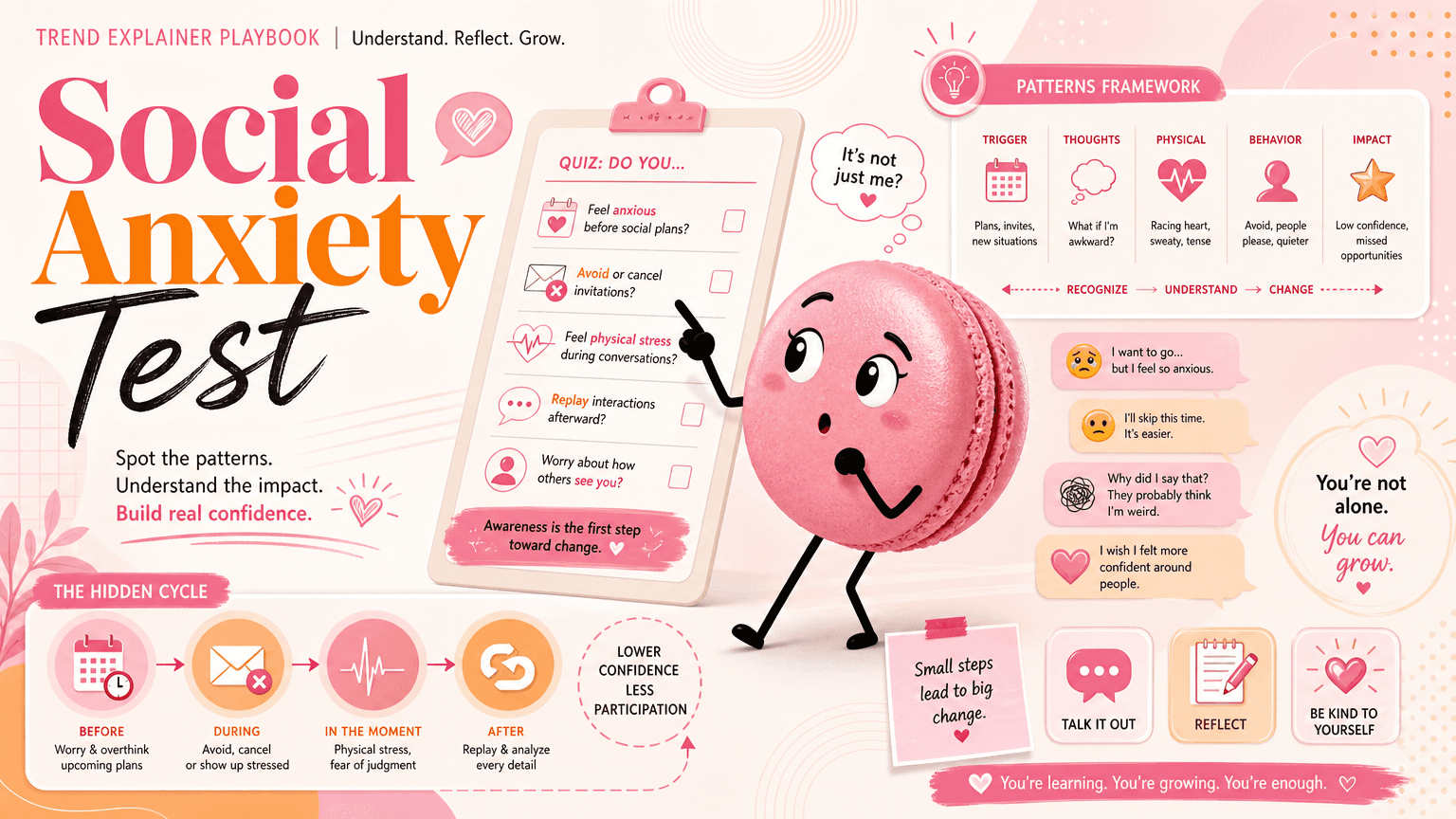
What This Reflection Can Help You Notice
Macaron helps you notice the patterns that often sit underneath a vague feeling of social discomfort. That includes worry before plans, avoiding invitations, physical stress such as a racing heart or tightness during conversations, and the mental replay that can happen long after the interaction ends. It also helps you see whether the pattern is affecting confidence, routines, or willingness to participate in ordinary situations, which is often what turns nervousness into a more meaningful concern.
How Macaron Structures This Reflection
Macaron organizes the self-check around the parts of social anxiety that people commonly describe in real life: anticipatory fear, avoidance habits, physical stress, post-interaction rumination, and the way the pattern affects daily functioning. This structure is useful because social anxiety is rarely just one feeling. It often shows up as a sequence, where fear leads to avoidance, avoidance reduces short-term discomfort, and the cycle becomes harder to interrupt over time.
What Your Result Can Clarify
Your result is designed to help you interpret the pattern more carefully, not to judge how serious you are. It can show where social stress appears most often, which situations seem to trigger the strongest reaction, and whether the impact is limited to a few moments or spread across work, school, relationships, and everyday errands. That kind of clarity can help you decide whether you want to focus on coping skills, gradual exposure, or a conversation with a professional.
More About Social Anxiety Test
Macaron helps you reflect on patterns such as fear before a conversation, hesitation about attending events, tension while speaking, and the habit of replaying interactions afterward. These are the kinds of details many people recognize only after they see them grouped together, which can make the experience feel less vague and more understandable.
The page also helps distinguish social anxiety from broader nervousness. Some people mainly struggle in public speaking, while others feel it in small groups, with authority figures, on phone calls, or in everyday tasks like eating in public or answering a message. That context matters because the trigger pattern often says more than a single yes or no question.
Your result is meant to clarify impact, not assign blame. A helpful social anxiety test should show whether the reaction is occasional, situation-specific, or affecting daily life in a wider way, such as avoiding opportunities, changing routines, or losing confidence after repeated stress. That makes it easier to decide whether self-help strategies are enough or whether outside support would be more appropriate. Another useful Macaron comparison is How Macaron AI Tackles the Problem with Traditional Task Lists at https://macaron.im/blog/macaron-ai-daily-planning-guide.
Macaron can turn the reflection into practical next steps by encouraging low-pressure goals, preparation before difficult interactions, and calmer recovery afterward. This matters because many people do not need a dramatic fix first. They need a way to reduce avoidance gradually, test what feels manageable, and build confidence through smaller, repeatable actions. For a broader Macaron context, AI Personal Assistant - Macaron at https://macaron.im/ai-personal-assistant can help you compare the decision from another angle.
The page also keeps safety and privacy in view. If anxiety feels overwhelming or you are in crisis, the right next step is immediate human support, not another quiz. And because mental health reflections are sensitive, it is reasonable to want clarity about how your information is handled before you begin.
Build Social Confidence More Gently
Macaron turns the test into a starting point for action by suggesting reflection prompts, low-pressure social goals, planning before stressful interactions, and calmer recovery afterward. The emphasis is on gradual progress rather than forcing yourself into situations that feel overwhelming. For many people, confidence grows through repeated small wins, especially when they can prepare in advance and review what helped afterward.
If You Need Immediate Support
This self-check cannot replace urgent help when anxiety feels overwhelming, you feel unsafe, or you are thinking about harming yourself. In those situations, the priority is immediate support from a crisis line, emergency service, or trusted person who can stay with you. If you are outside the United States or United Kingdom, an international helpline directory can help you find local support quickly.
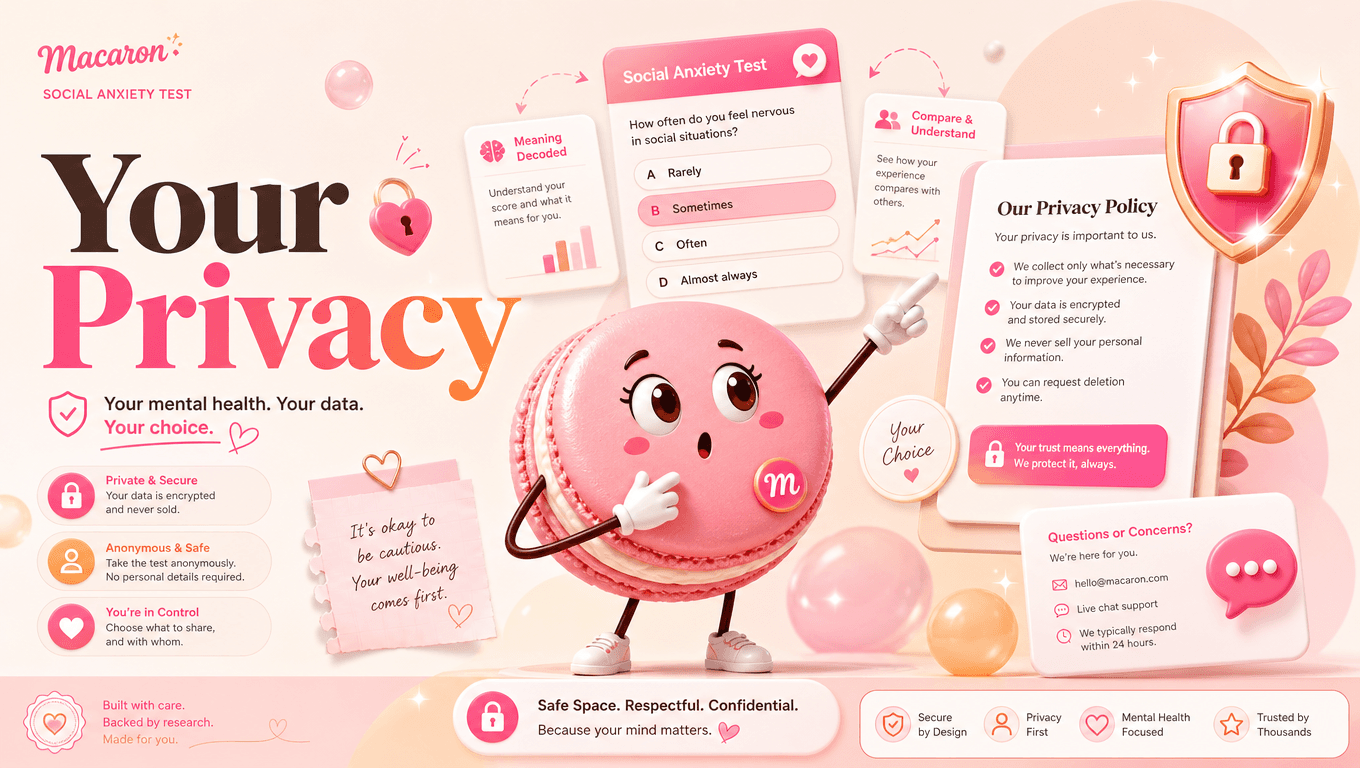
Your Responses and Privacy
Because a social anxiety test can involve sensitive mental health reflections, privacy matters. Macaron is provided by MINDAI PTE. LTD., and the official privacy policy explains how information is handled. If you want to review that before starting, the policy and privacy contact are available so you can make an informed choice about sharing personal details.
Frequently Asked Questions
This social anxiety test focuses on the pattern people usually mean when they search for social anxiety symptoms: fear before interactions, avoidance of certain situations, physical stress during contact, overthinking afterward, and the effect on everyday life. It is meant to help you see whether the issue is occasional nervousness or a more consistent pattern that changes how you behave.
After you finish, look at which part of the pattern stood out most. For some people, the main issue is anticipation before an event. For others, it is avoidance or the long mental replay afterward. Once you know that, choose one practical next step, such as preparing for a specific situation, trying a small exposure goal, or reaching out for support if the anxiety is getting in the way of daily life.
It is a good idea to talk to a licensed professional if social anxiety feels intense, keeps returning, affects work or relationships, or makes it hard to do ordinary things like speak up, attend events, or leave home. You should also seek immediate help if you feel unsafe or are thinking about harming yourself. A test can point to a pattern, but it cannot tell you whether you need clinical care.
This page is an AI-guided reflection tool, not a standardized clinical assessment. Formal assessments usually use validated scoring methods and are interpreted in a clinical context, while this kind of self-check is better for personal insight, pattern recognition, and deciding what to do next. It can be helpful for orientation, but it should not be treated as a diagnosis.
Common triggers include public speaking, small-group conversations, meeting new people, speaking with authority figures, eating in public, making eye contact, and answering calls or messages when you feel watched or judged. Some people only feel anxious in one setting, while others notice it across many situations. Looking at the trigger pattern is often more useful than focusing on a single symptom.
Yes. Shyness can involve caution or quietness without major disruption, while social anxiety usually includes stronger fear, avoidance, physical stress, or a lot of post-event rumination. The difference often shows up in impact: whether you can still do what matters to you, or whether anxiety keeps narrowing your choices. A self-check can help separate a personality style from a more impairing pattern. For a third-party check, liebowitz social anxiety scale: for adults (lsas) at https://nationalsocialanxietycenter.com/liebowitz-sa-scale/ is worth comparing against the page summary.
Yes. Social anxiety is often situation-specific, so it may show up only in public speaking, groups, dating, work meetings, or interactions with authority figures. A useful test should help you identify where the anxiety is strongest and whether it is spreading into other parts of life. That detail can guide more targeted coping strategies than a broad label alone. For another outside reference, Free Social Anxiety Test & Social Phobia Screening | Talkspace at https://www.talkspace.com/assessments/social-anxiety-test adds a second perspective.
Sometimes a self-check can make a pattern feel more real, which can be uncomfortable. If that happens, pause and focus on one grounding step, such as stepping away from the screen, breathing slowly, or talking to someone you trust. If the test brings up panic, hopelessness, or thoughts of self-harm, stop using the tool and seek immediate human support right away. For outside context, Social Anxiety Test / Quiz | Psychology Today at https://www.psychologytoday.com/us/tests/health/social-anxiety-test is a useful reference point.
Read & discover
AI Personal Assistant
Free calculators


