Student Burnout
Student burnout is more than feeling tired after a hard week. It can build into chronic exhaustion, cynicism about school, and a sense that rest never fully restores you. Macaron helps you notice the pattern and take smaller, more realistic recovery steps around study, energy, and motivation.
Student Burnout
This short check-in helps you notice how student burnout may be showing up in your energy, focus, and relationship with school. It is designed to support reflection and next steps, not to label you.
This is a self-reflection tool, not a diagnosis or medical assessment.
Please answer every question before viewing your result.
If your exhaustion feels severe, lasts for weeks, or comes with hopelessness, panic, major sleep changes, or thoughts of harming yourself, please reach out to a trusted person or a qualified professional right away. If you are in immediate danger or feel unable to stay safe, contact local emergency services or a crisis line now.
Student Burnout Is Real and Changes More Than Motivation
Student burnout usually shows up as more than low motivation. It is often described as a chronic response to prolonged academic stress, where exhaustion, frustration, and a reduced sense of effectiveness start to shape daily school life. You may still be trying to keep up, but your energy, focus, and patience run out faster than they can recover, which makes ordinary tasks feel unusually heavy and emotionally expensive.
A common challenge is telling burnout apart from normal stress. Stress tends to spike around deadlines and ease when the pressure passes, while burnout lingers and spreads into sleep, mood, and concentration. Students often notice dread before opening a laptop, numbness toward classes, or guilt when they rest. Those signs matter because they suggest the problem is no longer just a busy week.
Macaron is built for that uncertain middle ground where you know your current pace is not working, but you do not yet have a clear explanation. Instead of pushing harder, it helps you slow the pattern down, notice what is draining you, and identify the habits, schedules, or expectations that keep the cycle going. That makes the problem easier to understand without turning it into a personal failure. For a related Macaron page, see How Macaron AI Tackles the Problem with Traditional Task Lists at https://macaron.im/blog/macaron-ai-daily-planning-guide.
The goal is not to treat burnout as a productivity issue. It is to help you see how academic pressure, perfectionism, overcommitment, and weak recovery can combine into a pattern that affects learning, sleep, and emotional resilience. Once the pattern is visible, you can make more realistic choices about what to reduce, what to protect, and what to stop carrying alone.
Macaron offers guided reflection and reset tools so you can rebuild steadier routines without needing a perfect plan. That matters because recovery from student burnout is usually gradual, not instant. Small changes in workload awareness, rest boundaries, and daily energy management are often more sustainable than trying to overhaul everything at once, especially when you are already depleted.
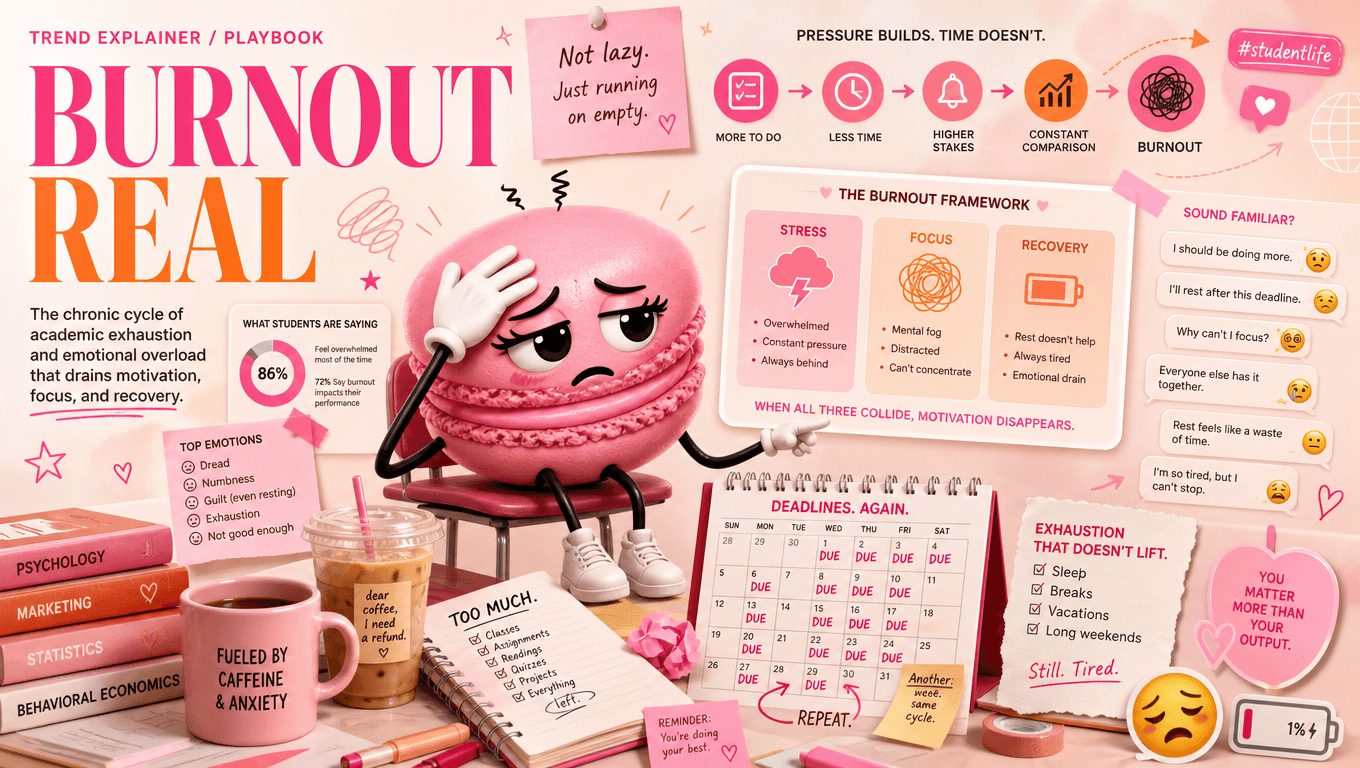
Student Burnout Is Real and Changes More Than Motivation
Student burnout is not just feeling tired after a busy week. It often develops through repeated deadlines, pressure to perform, emotional strain, and too little real recovery time. Over time, that can make school feel harder to start, harder to care about, and harder to finish. Common signs include loss of focus, dread around assignments, numbness toward classes, guilt during rest, and exhaustion that does not lift even after time off. The pattern becomes more entrenched when demands stay high and recovery stays short, which is why recognizing it early matters.
How Macaron Supports Students with More Structure
Macaron helps with student burnout by turning a vague sense of overload into something you can actually work with. It can guide workload reflection, daily energy check-ins, recovery planning between study blocks, and reset routines after overwhelm. That structure is useful when your mind feels scattered or when every task seems equally urgent. The aim is not to force motivation, but to help you see what is draining you, what can wait, and what kind of recovery is realistic today. That makes the next step feel smaller and more doable.
Academic Pressure vs Personal Wellbeing
Student burnout often grows when academic pressure crowds out the basics that keep you functioning: sleep, meals, movement, social time, and real downtime. Macaron helps you notice where school stress is spilling into the rest of life so you can separate what is necessary from what is simply excessive. That can reveal whether perfectionism, overcommitment, or an unrealistic schedule is driving the problem. With that clarity, it becomes easier to protect wellbeing without losing sight of school responsibilities, which is often the balance students are actually trying to find.
More About Student Burnout
Student burnout is often described as a mix of physical fatigue, emotional depletion, and mental distance from schoolwork. In practice, that can look like staring at assignments without starting, feeling irritated by tasks that used to be manageable, or noticing that sleep does not restore you the way it used to. Macaron helps you name those patterns instead of treating them as laziness or personal weakness, which can reduce shame and make the situation easier to respond to with practical changes.
The page is designed around the questions students actually ask when they feel stuck: Am I burned out, or just stressed? Why did my motivation disappear? What do I do when everything feels too heavy? Macaron answers with structured reflection, energy check-ins, and recovery prompts that make the problem easier to observe in real life. That is useful when the issue is not a lack of effort, but a lack of clarity about what your body and mind are asking for.
Burnout often gets worse when academic pressure crowds out meals, movement, social contact, and downtime. That is why the support here focuses on balance, not only study habits. When you can see which parts of your routine are draining you fastest, you can make more targeted changes instead of trying random fixes. For many students, the most helpful shift is not doing more, but removing one or two unnecessary sources of strain. Another useful Macaron comparison is 20 AI Tools to Upgrade Your Daily Life - Macaron - Macaron App at https://macaron.im/blog/macaron-app-ai-tools-daily-life.
Recovery also needs to be practical. Many students know they should rest, but they do not know how to rest without guilt or how to return to work without overloading again. Macaron’s structure is meant to bridge that gap by helping you plan smaller resets, clearer boundaries, and study blocks that are more sustainable. That approach is especially helpful for students who benefit from prompts and structure, though it may feel less flexible than open-ended journaling apps. For a broader Macaron context, Macaron App Download (iOS & Android): Official, Safe, and Fast Install at https://macaron.im/blog/macaron-app-download can help you compare the decision from another angle.
If burnout is severe, persistent, or affecting safety, outside help matters more than self-guided tools. Macaron can support reflection and daily recovery, but it should sit alongside professional care when symptoms are affecting sleep, mood, functioning, or your ability to cope. That is the main tradeoff: Macaron is good for noticing patterns and building small next steps, while a counselor, therapist, or doctor is better for diagnosis, treatment, and crisis-level support.
Restore Balance and Love Learning Again
Macaron turns burnout awareness into a more workable recovery plan. It helps you translate vague exhaustion into concrete next steps, such as identifying which classes, deadlines, or habits are draining you most and where you can reduce pressure without falling behind. The focus is on rebuilding a steadier relationship with learning, not forcing instant motivation. That may include reflection prompts, recovery habits, clearer study boundaries, and short reset routines that make it easier to return to work without feeling overwhelmed again. Compared with generic to-do apps, the value is in helping you understand why the work feels hard, not just listing what still needs to be done.
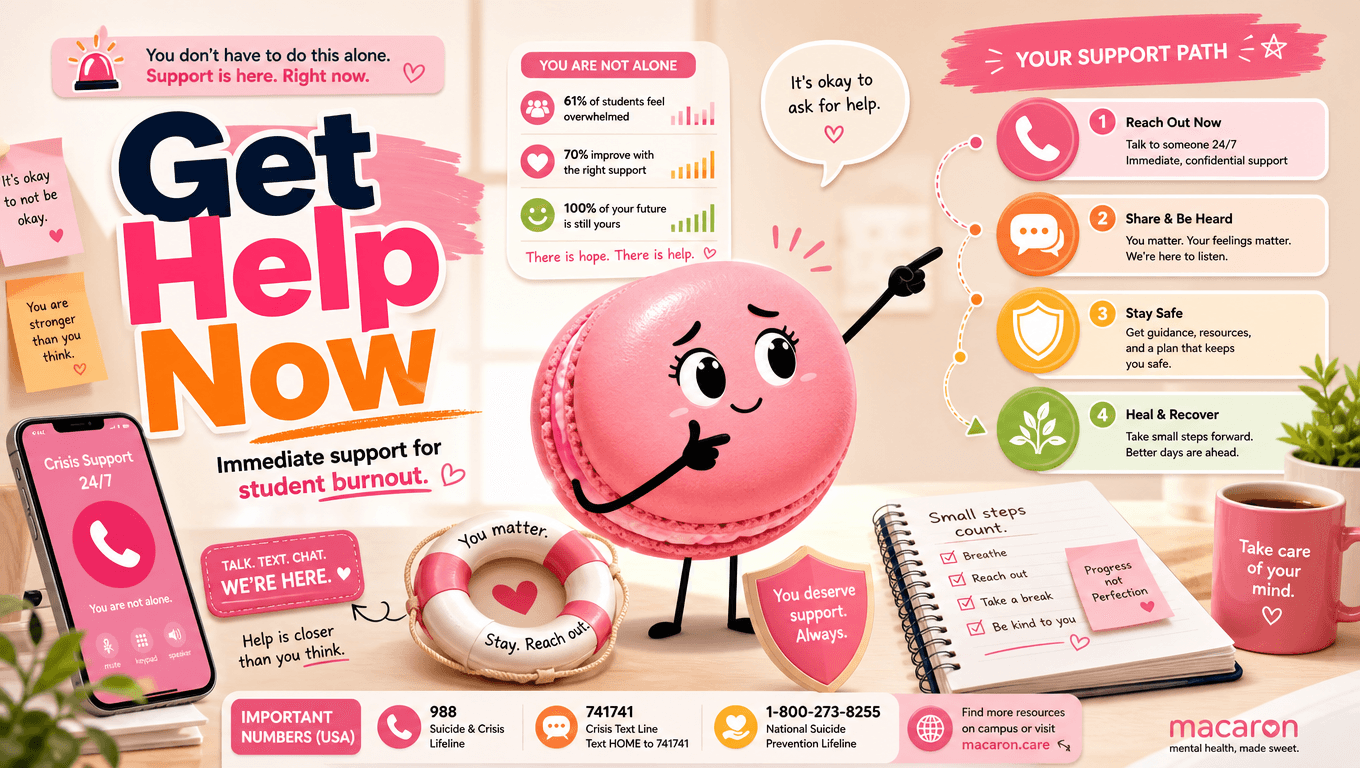
If You Need Immediate Support
Student burnout can overlap with more serious mental health strain, especially when sleep, mood, or safety are affected. If you feel unable to cope, are thinking about self-harm, or feel in immediate danger, self-guided tools are not enough on their own. Reach out to crisis support, a trusted person, or local emergency services right away. Macaron is meant for reflection and recovery support, but urgent distress should always be handled by trained professionals and emergency resources. If you are unsure whether your situation is urgent, it is safer to ask for help sooner rather than later.
Your Responses and Privacy
Questions about burnout often involve sensitive information about stress, school performance, and emotional wellbeing, so privacy matters. Macaron is provided by MINDAI PTE. LTD., and its Privacy Policy explains how information is collected, used, stored, disclosed, and retained. If you plan to use the tool for personal reflection, it is worth reviewing the policy carefully so you understand deletion options, retention practices, and how to make privacy requests if needed. That level of transparency can matter more than flashy features for students who want support without feeling exposed.
Frequently Asked Questions
Student burnout often shows up as ongoing exhaustion, reduced concentration, emotional numbness toward school, and a sense that even after rest you still do not feel restored. Some students also notice more cynicism, procrastination, irritability, or a drop in confidence about their ability to keep up. The key pattern is that the stress does not feel temporary anymore. It starts affecting motivation, sleep, and how you respond to everyday academic demands.
When you feel stuck, Macaron can help you slow down and sort out what is actually happening. Use it for energy check-ins, overload reflection, and small recovery plans that fit the day you are having rather than the day you wish you had. That can make it easier to notice whether you need rest, a smaller task, a boundary, or a different study rhythm. The point is to reduce the sense of being frozen.
Seek outside support if burnout is affecting your sleep, mood, school functioning, relationships, or sense of safety, or if you are having thoughts of harming yourself. It is also a good idea to reach out if the exhaustion is not improving even after rest or if you feel unable to manage daily responsibilities. A licensed mental health professional, school counselor, or crisis line can help you assess what is going on and what support fits best.
Macaron is useful because it turns a vague problem into something you can actually observe and respond to. Instead of only telling you to relax or work harder, it helps you track patterns, reflect on what is draining you, and build smaller recovery steps into your routine. That can be especially helpful when burnout makes everything feel blurry, because clarity is often the first step toward a more sustainable plan.
Normal stress usually rises around a specific demand and eases when the demand passes or you recover. Burnout is more persistent. It tends to include emotional exhaustion, detachment from school, and a feeling that effort is no longer paying off. If you are still tired, cynical, or unable to focus long after the deadline has passed, that is a sign the issue may be more than ordinary stress. The difference matters because burnout often needs changes in workload and recovery, not just a short break.
Yes, Macaron can be useful for working students because burnout often comes from juggling classes, shifts, commuting, and limited recovery time. The most helpful use is to map where energy is going, identify the hardest parts of the week, and plan smaller resets around real constraints. That said, if your schedule is consistently unsustainable, a tool can only do so much. A schedule change, academic advisor, or workplace adjustment may also be necessary. For a third-party check, Breaking the Silence - ASCLS at https://ascls.org/breaking-the-silence/ is worth comparing against the page summary.
If you think burnout may be connected to ADHD, anxiety, depression, or another condition, it is worth getting a professional evaluation. Burnout can overlap with those issues, but it does not always explain them. Macaron can still help you notice patterns, track what drains you, and prepare for a conversation with a counselor or clinician. The tradeoff is that self-guided tools can improve awareness, but they cannot diagnose or replace treatment when a condition is involved. For another outside reference, How to Combat Academic Burnout | UGA Online at https://online.uga.edu/news/how-combat-academic-burnout/ adds a second perspective.
Recovery usually works best when you reduce pressure, protect sleep, and make your workload more realistic. That can mean cutting one nonessential commitment, breaking tasks into smaller pieces, taking real breaks, or asking for help earlier than usual. Students often recover faster when they stop trying to solve burnout with willpower alone. Macaron can support that process by helping you notice what is draining you and by making small recovery steps easier to repeat. For outside context, Student Burnout: A Review on Factors Contributing to ... - PMC at https://pmc.ncbi.nlm.nih.gov/articles/PMC11852093/ is a useful reference point.
Read & discover
AI Personal Assistant
Free calculators


