Teacher Burnout
Teacher burnout often develops from sustained overload, emotional labor, and too little time to recover between demands. Macaron helps educators notice the pattern early and build practical daily support, while remaining a self-guided tool rather than therapy.
Teacher Burnout
This short check-in helps you notice how teacher burnout may be showing up in your day-to-day experience. It focuses on patterns like energy drain, emotional strain, and recovery habits so you can think about what support might help next.
This is a self-reflection tool, not a diagnosis or clinical assessment.
Please answer every question before viewing your result.
If you are feeling hopeless, unable to function, or worried about your safety, please seek immediate support from a trusted person, local emergency services, or a crisis line in your area. This module is for reflection only and cannot tell you whether you have a mental health condition.
Why Teacher Burnout Hits So Deeply
Teacher burnout is more than feeling tired after a hard week. It usually reflects a sustained pattern of emotional exhaustion, reduced patience, and a sense that the work never fully ends. Teachers may still care deeply about students while feeling increasingly unable to recover between demands, which is why burnout often feels heavier than ordinary stress or a temporary slump.
The pressure on educators is not limited to lesson delivery. Classroom management, parent communication, grading, planning, documentation, and the emotional work of staying calm for others can all stack up at once. When those demands repeat without enough pause, teachers may notice irritability, detachment, brain fog, or the feeling that even weekends are spent catching up rather than restoring energy.
Macaron is built to make that strain easier to see and respond to in daily life. Instead of asking teachers to push through or build a complicated self-care system, it helps surface what is draining energy, where work is spilling into personal time, and which small routines are realistic enough to repeat during a busy school week. For a related Macaron page, see AI Personal Assistant - Macaron at https://macaron.im/ai-personal-assistant.
This page uses teacher burnout in the practical sense most people search for: a sustained state of occupational exhaustion, detachment, and reduced effectiveness. That does not mean a teacher is failing or lacking commitment. In many cases, burnout reflects chronic overload, limited support, and too little room to reset before the next demand arrives.
Because burnout can overlap with anxiety, depression, or moral distress, it should be treated as a meaningful signal rather than something to ignore. Macaron can help organize what you are noticing and support small next steps, but if symptoms are severe, persistent, or affecting safety, outside professional support is important.
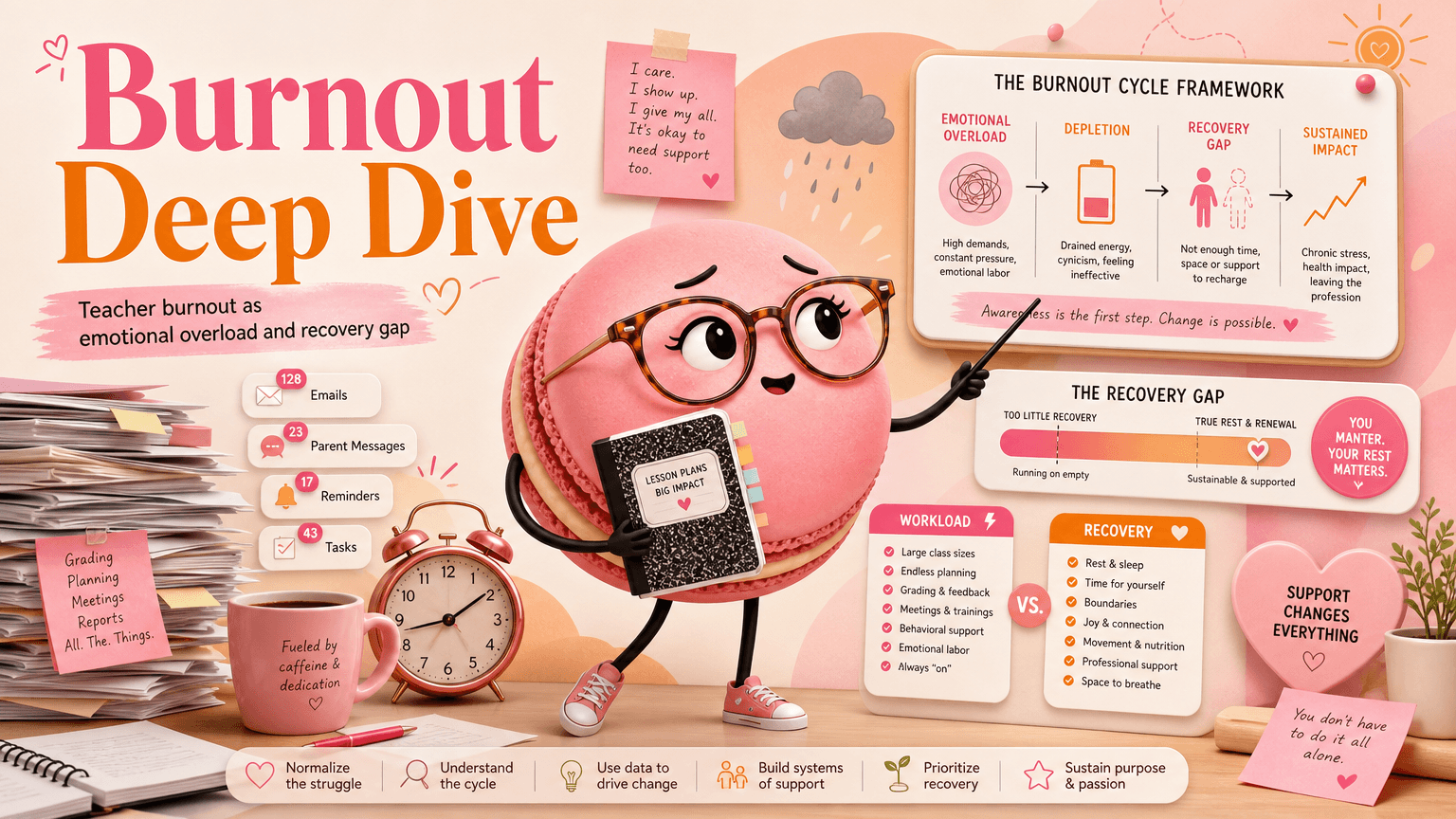
Why Teacher Burnout Hits So Deeply
Teacher burnout affects more than energy. It can change patience, focus, motivation, emotional steadiness, and the ability to recover after the workday ends. In educator reports and professional guidance, the most common drivers are not just workload, but also constant emotional labor, classroom pressure, limited support, and the sense that demands keep expanding faster than recovery time can keep up. That combination makes burnout feel personal even when the causes are structural. Teaching asks for sustained attention, empathy, and rapid decision-making throughout the day. When those demands repeat without enough pause, burnout can start to feel like detachment, irritability, or a reduced sense of effectiveness. It often reaches beyond the classroom and shows up in home life, sleep, and overall resilience, which is why many teachers describe it as a whole-life strain rather than a work-only problem.
How Macaron Supports Teachers with Burnout
Macaron helps with teacher burnout through guided tools such as daily energy check-ins, overload reflection prompts, after-work reset routines, boundary planning around work carryover, and small recovery habits you can repeat. These tools are meant to make the problem more visible and the next step more manageable, especially when you do not have the bandwidth for a complicated self-care plan or a long planning session after school. The goal is steadier support that fits daily life. Instead of asking you to fix everything at once, Macaron helps you notice what is draining you most, where the pressure is building, and which changes are realistic enough to keep using during a busy school week. The tradeoff is that it is self-guided, so it can support reflection and routine-building, but it does not replace a coach, therapist, or school-level change.
Early Warning Signs of Teacher Burnout
Teacher burnout often shows up as emotional numbness, constant exhaustion, reduced patience, dread before the workday starts, feeling detached from students or coworkers, and trouble recovering even after time off. Some educators also notice forgetfulness, lower confidence, more frequent mistakes, or a growing urge to withdraw from conversations and responsibilities that used to feel manageable. These signs can appear gradually, which makes them easy to dismiss at first. Recognizing the pattern early makes support easier to build. The earlier you can connect the symptoms to a broader burnout cycle, the easier it becomes to adjust expectations, protect recovery time, and avoid treating a deeper strain as if it were just a temporary rough patch. That matters because burnout often becomes harder to reverse once it starts shaping sleep, mood, and day-to-day functioning.
More About Teacher Burnout
Teacher burnout usually shows up in patterns, not one-off bad days. Common signals include emotional flatness, irritability, dread before the workday starts, and the feeling that even rest does not fully restore you. Macaron helps you track those patterns over time so the problem is easier to understand in context, not just in the moment. That makes it easier to separate a rough day from a repeating cycle that needs attention.
The most useful support for burnout is often practical and repeatable. That is why Macaron focuses on small actions such as energy check-ins, reflection prompts, and reset routines after work. These tools are meant to fit around a teacher’s schedule, especially when time, privacy, and attention are already limited. The advantage is low friction; the limitation is that it cannot remove workload or change school conditions for you.
Many teachers searching for burnout support are also trying to figure out whether the issue is stress, exhaustion, depression, or something more structural. Macaron does not diagnose, but it can help clarify what is happening by prompting you to notice triggers, recurring pressure points, and the parts of the day where recovery keeps getting interrupted. That kind of clarity can make it easier to decide whether you need rest, boundary changes, or outside support. Another useful Macaron comparison is AI Calorie Tracker: How It Works and Best Options - Macaron at https://macaron.im/blog/ai-calorie-tracker.
Burnout support also has to account for boundaries, because work often spills into evenings, weekends, and breaks. Macaron can help you think through where that spillover happens, what is truly urgent, and which habits or expectations may need to be reduced so recovery time becomes more protected and realistic. For many teachers, the most useful change is not a perfect routine but a smaller, more defensible one. For a broader Macaron context, What Macaron AI Can Do + Best Use Cases at https://macaron.im/blog/macaron-ai-hub can help you compare the decision from another angle.
For educators who feel stuck in the same cycle, the goal is not a perfect routine. It is a steadier one. Macaron is built to help you identify what restores energy, what quietly drains it, and which one small change is most likely to be sustainable when teaching already feels heavy. Competitor wellness apps may offer broader meditation libraries or generic stress content, but Macaron is more focused on translating burnout into concrete daily decisions.
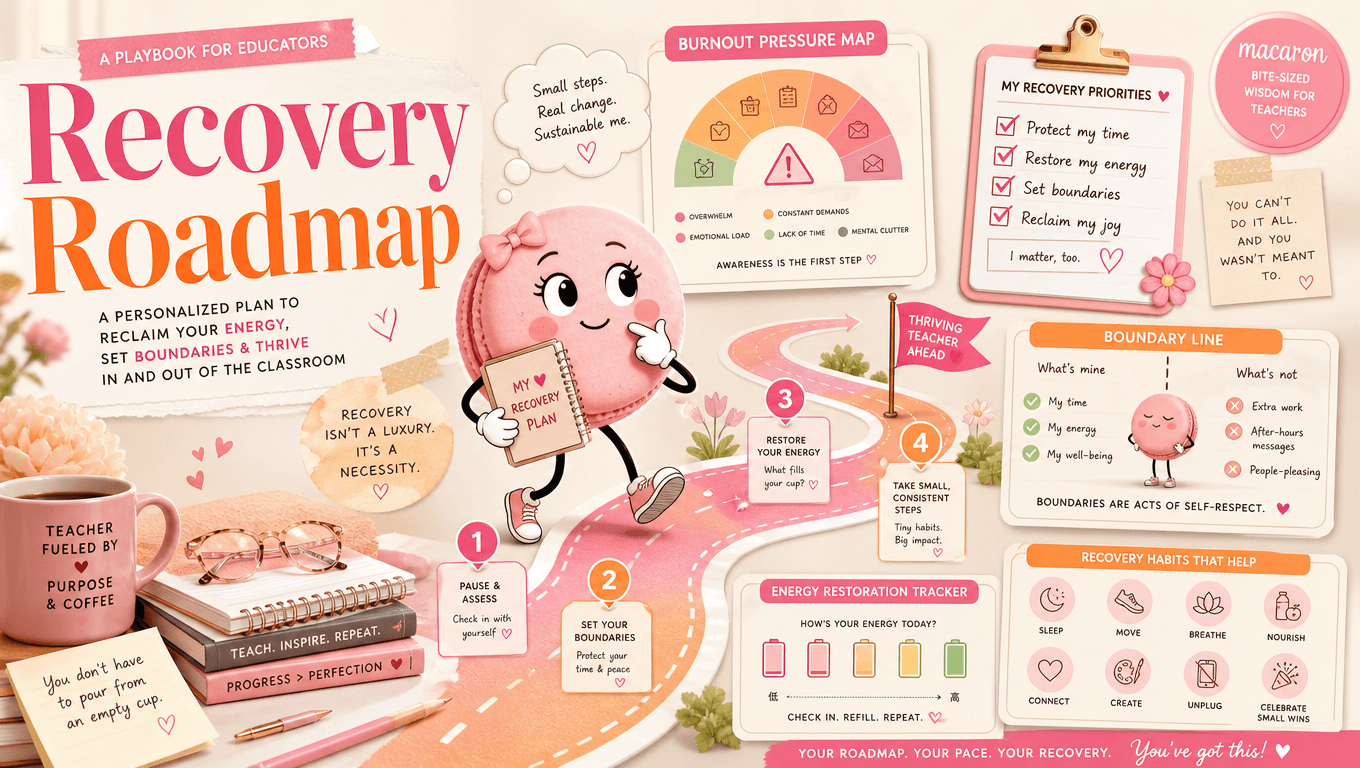
Personalized Recovery Roadmap for Educators
Macaron helps turn insight into practical recovery steps by helping you name the strongest burnout pressure, identify where work is leaking into recovery time, rebuild one small recovery habit, protect one clear boundary, and track what restores energy versus what drains it. This is useful when the problem feels too broad to solve all at once and you need a starting point that does not require a full life overhaul. A recovery roadmap works best when it is specific to the way burnout is showing up for you. For one teacher, that may mean reducing after-hours planning. For another, it may mean creating a short reset after school or noticing which tasks are most likely to trigger dread and fatigue. Compared with generic habit apps, Macaron is more useful when the issue is emotional overload rather than simple productivity.
If You Need Immediate Support
This self-guided support experience is not a substitute for professional help. If burnout is affecting your safety, if you feel overwhelmed to the point that you cannot cope, or if you are thinking about harming yourself, please contact crisis support right away. Burnout can overlap with more serious mental health concerns, so it is important not to wait if the situation feels urgent or if your symptoms are escalating. United States: Call or text 988. United Kingdom and Ireland: Call 116 123 (Samaritans). For other locations, use the international directory at findahelpline.com. If you are in immediate danger, contact your local emergency services. Macaron can help you organize thoughts and next steps, but emergency support is the right tool when safety is at stake.
Your Responses and Privacy
Emotional data is sensitive, especially when you are reflecting on stress, exhaustion, or work-related strain. Macaron is provided by MINDAI PTE. LTD., and its official Privacy Policy explains how information is collected, used, disclosed, protected, and retained. That matters for users who want to understand how personal reflections are handled before they begin using the tool, especially when those reflections may involve work pressure or mental health concerns. Review the policy for details on data collection, data use, retention, deletion, and privacy requests. If you have questions about privacy handling, you can contact contact@macaron.im. Compared with some larger wellness platforms, Macaron’s value is not in a huge content library; it is in giving users a more direct way to reflect while still being able to review the privacy terms first.
Frequently Asked Questions
Teacher burnout often looks like exhaustion, emotional flatness, reduced patience, dread before work, and trouble recovering outside school hours. It can also show up as irritability, detachment from students or coworkers, lower confidence, or the sense that even time off does not fully reset you. Because these signs can build gradually, people sometimes mistake burnout for a temporary rough week. The difference is that the pattern keeps repeating and starts affecting functioning, motivation, and overall well-being.
Use Macaron for energy check-ins, overload reflection, recovery planning, and small routines that support steadier days. A practical way to use it is to notice when your energy drops, what part of the day feels heaviest, and which tasks keep spilling into your personal time. That makes it easier to choose one realistic adjustment instead of trying to overhaul everything at once. The tool is most useful when you want structure without adding more pressure.
If burnout is affecting sleep, mood, functioning, safety, or your ability to cope, reach out to a licensed professional or crisis support. It is especially important to get help if you feel hopeless, unable to keep up with daily responsibilities, or worried about your safety. Macaron can support reflection and routine-building, but it is not a replacement for professional care when symptoms are severe, persistent, or escalating.
Macaron helps turn repeating burnout patterns into practical daily recovery steps, which makes support easier to start and easier to repeat. That matters because recurring burnout is often tied to the same pressure points, such as after-hours work, emotional overload, or unclear boundaries. By helping you identify the pattern and choose one small change at a time, Macaron can make the next step feel more concrete and less overwhelming.
Not exactly. Stress can be temporary and tied to a specific deadline or difficult week, while burnout is usually a longer-lasting pattern of exhaustion, detachment, and reduced effectiveness. Teachers may start with stress and then notice that recovery stops working the way it used to. That is often when burnout becomes more likely. If the feeling is persistent, affects sleep or mood, and keeps returning even after rest, it is worth taking seriously as more than ordinary stress.
Common causes include heavy workload, behavior management, emotional labor, limited administrative support, unclear expectations, and work that spills into evenings or weekends. Many teachers also describe burnout as being driven by the constant need to stay composed for others while having little time to recover. In some cases, the issue is not just workload but a mismatch between responsibilities and the support available to handle them. That is why burnout often feels structural, not personal. For a third-party check, Stress, Burnout, Anxiety and Depression among Teachers - PMC - NIH at https://pmc.ncbi.nlm.nih.gov/articles/PMC9518388/ is worth comparing against the page summary.
Yes. Macaron is most useful when you need a quick way to notice what is happening and choose one small next step. A short check-in can help you identify whether you are depleted, what is driving the strain, and whether you need a reset, a boundary, or a more serious conversation about workload. It is designed for low-friction use, which can matter when teachers are already short on time and mental bandwidth. For another outside reference, Teacher Burnout and How To Avoid It - Education Support at https://www.educationsupport.org.uk/resources/for-individuals/articles/teacher-burnout-and-how-to-avoid-it/ adds a second perspective.
Macaron is more focused on turning burnout into concrete daily decisions rather than offering a broad library of general wellness content. That can be helpful for teachers who do not need more advice in the abstract, but do need help noticing patterns, protecting recovery time, and choosing one realistic change. Generic apps may be better if you want meditation, sleep sounds, or a large content catalog. Macaron is better when you want structured reflection tied to a specific problem. For outside context, What's Causing Teacher Burnout? | NEA at https://www.nea.org/nea-today/all-news-articles/whats-causing-teacher-burnout is a useful reference point.
Read & discover
AI Personal Assistant
Free calculators


