Toxic Relationship Quiz
A toxic relationship quiz can be useful when the relationship feels draining, confusing, or hard to trust, but you are not sure whether the pattern is serious or just a rough patch. Macaron uses guided reflection to help you examine control, fear, blame, instability, and self-doubt without pretending a quiz can diagnose the whole situation.
Toxic Relationship Quiz
This self-reflection module helps you notice patterns that can make a relationship feel draining, confusing, or unsafe. It is designed to support clarity about control, blame, fear, and emotional steadiness, not to label your relationship for you.
This is a self-reflection tool, not a diagnosis or a substitute for professional advice.
Please answer every question before viewing your result.
If any part of this relationship involves threats, stalking, physical harm, sexual pressure, isolation, or fear of retaliation, treat that as a safety issue. A quiz cannot determine what is safe for you, so if you feel in danger or unsure, contact a trusted person, local support services, or emergency help now.
How Harmful Relationship Patterns Can Be Hard to Name
A toxic relationship quiz can help when your instincts keep telling you something is off, but you keep explaining it away, hoping it will improve, or wondering whether you are overreacting. That uncertainty is common because unhealthy dynamics often build gradually and can look different from obvious conflict. The goal is not to label every difficult relationship as toxic, but to help you notice whether the pattern is repeatedly leaving you anxious, diminished, or on edge.
Macaron treats the toxic relationship quiz as a structured reflection, not a verdict. It helps you look at recurring signs people often search for when they are trying to make sense of a relationship, including control, guilt pressure, emotional unpredictability, and the feeling that you have to manage someone else’s reactions. This matters because many people are not asking, “Is this perfect?” They are asking, “Why do I feel so unsettled here?”
common user discussions for this topic often mix serious self-check tools with lighter quizzes, which can make the term confusing. Some people want a quick score, while others want help understanding whether the relationship is unhealthy, abusive, manipulative, or simply incompatible. Macaron keeps the focus on clarity and context, so you can think about what the behaviors mean in daily life rather than chasing a single label too early. For a related Macaron page, see AI Calorie Tracker - Macaron at https://macaron.im/ai-calorie-tracker.
This toxic relationship quiz is also careful about boundaries. It is not a medical diagnosis, not legal advice, and not a substitute for professional support or emergency help. That distinction matters because relationship harm can range from poor communication and repeated disrespect to coercion or abuse, and the safest next step depends on how intense, frequent, and threatening the pattern is.
If you are trying to decide what to do next, the most useful outcome is often not a dramatic answer but a clearer view of what keeps happening. A good reflection can help you separate isolated conflict from a repeated pattern, notice where your confidence has been shrinking, and identify whether you need a conversation, outside support, distance, or a safety plan.
How Harmful Relationship Patterns Can Be Hard to Name
A toxic relationship quiz is useful because harmful behavior is often easier to rationalize when you are living inside it every day. You may notice that you are constantly adjusting your tone, avoiding certain topics, or bracing for criticism, but still struggle to call the relationship toxic because there are also good moments. Macaron helps you examine the pattern as a whole, including whether the relationship leaves you feeling drained, confused, or afraid to be fully honest. That broader view is helpful when the problem is not one dramatic event but a steady erosion of comfort, trust, and self-expression.
How Macaron Structures This Reflection
Macaron structures this reflection around the questions people usually need answered first: who holds the power, whether fear or pressure is shaping your choices, whether the harm is repeating, and whether you are starting to doubt your own perception. That structure matters because toxic relationships are rarely defined by one bad argument. They are usually identified by a pattern of control, instability, minimization, and a growing impact on your day-to-day wellbeing. The tradeoff is that reflection takes a little more time than a fast score, but the payoff is a clearer read on what is actually happening.
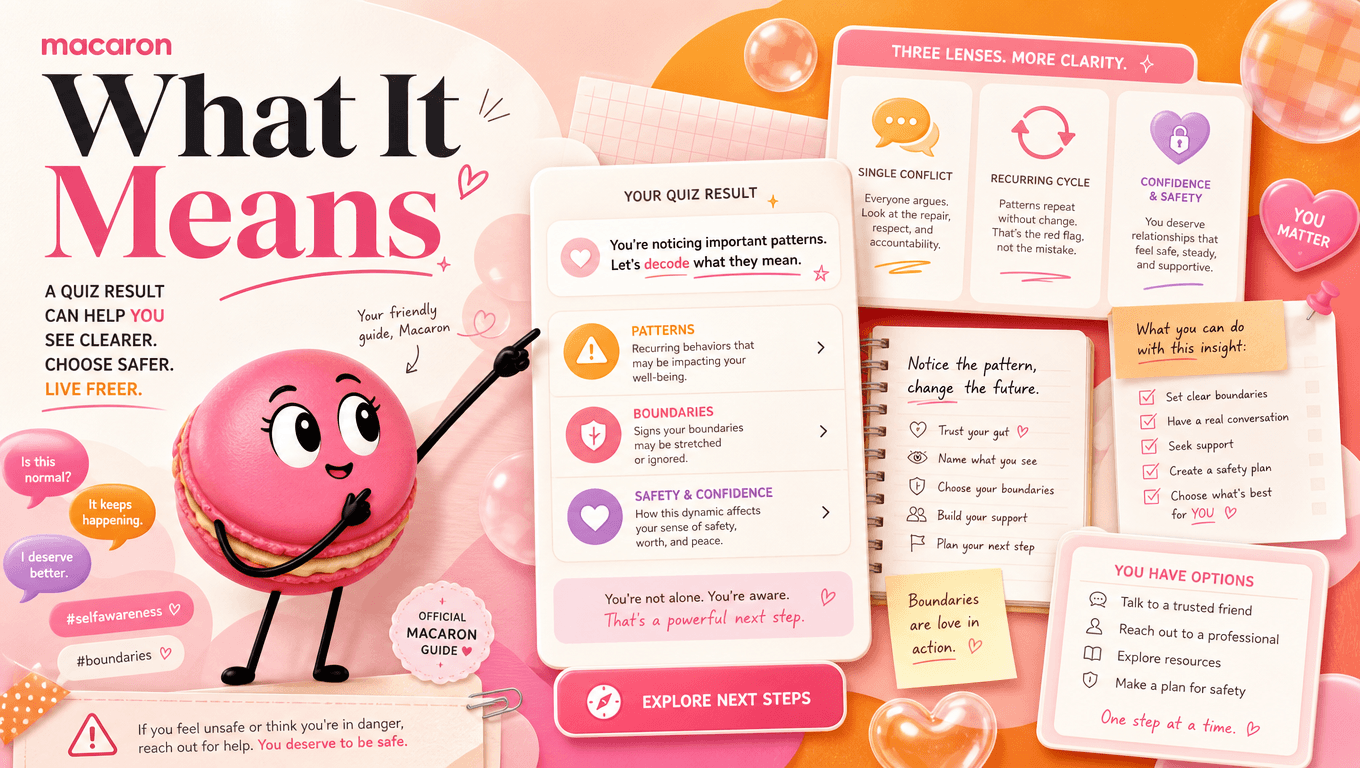
What Your Result Can Help You Notice
Your result is meant to sharpen your awareness, not to shame you into a conclusion. It can help you notice whether the problem is a single conflict, a recurring cycle, or something that is affecting your confidence and sense of safety more than you realized. Many people use a toxic relationship quiz to decide whether they need a conversation, a boundary, outside perspective, or a more protective plan. The result should support that decision, not replace it, and it is most useful when you compare it with specific examples from your own experience.
More About Toxic Relationship Quiz
A toxic relationship quiz is most helpful when you are stuck between doubt and recognition. Many people already sense that something feels wrong, but they are unsure whether the issue is occasional tension, a communication problem, or a deeper pattern of emotional harm. Macaron is designed to slow that process down so you can look at the relationship more carefully instead of relying only on a vague gut feeling. That makes it especially useful for people who keep second-guessing themselves after conflict.
The reflection centers on the kinds of patterns that commonly show up in toxic relationship searches and self-check articles: control, blame, fear, possessiveness, emotional volatility, and the sense that your needs are always secondary. These are not just abstract traits. In real life, they can appear as decisions being made for you, boundaries being ignored, or conversations that leave you feeling smaller rather than understood. Macaron helps you connect those patterns to everyday behavior, which is often where the real answer becomes visible.
One reason people keep searching for a toxic relationship quiz is that toxic dynamics are often normalized from the inside. If you have been told you are too sensitive, too demanding, or the problem in every conflict, it can become hard to tell whether you are reacting to genuine mistreatment or simply to ordinary relationship friction. Macaron helps you separate repeated patterns from one-off arguments and notice where self-doubt may be clouding your judgment. That can be especially valuable for users who have been gaslit, minimized, or trained to apologize first. Another useful Macaron comparison is How to Use AI as a Personal Assistant: 30 Prompts That Actually Work at https://macaron.im/blog/ai-personal-assistant-prompts.
The result is meant to be practical, not dramatic. Instead of forcing a yes-or-no label, it can help you identify what is most concerning, whether the pattern is escalating, and how much it is affecting your sleep, focus, confidence, or sense of safety. That kind of reading is often more useful than a simple score because it points toward the next decision, not just the diagnosis. Competitor quizzes may be faster or more entertaining, but Macaron is built to be more useful when the situation is emotionally complicated. For a broader Macaron context, AI Meal Planner Free: Best Free Options That Are Actually Useful at https://macaron.im/blog/ai-meal-planner-free can help you compare the decision from another angle.
From there, Macaron can support next steps that fit the situation, such as writing down patterns, preparing boundary language, thinking through a difficult conversation, or deciding whether to seek outside help. If the relationship is unsafe or coercive, the right response may be to prioritize support and safety rather than trying to fix the dynamic alone. The main tradeoff is that Macaron will not give you a simplistic answer on purpose; it is designed to help you think more clearly, not to flatten a serious issue into a score.
Safer Next Steps
Macaron turns the toxic relationship quiz into action by helping you think through what is realistic and safest next. That may include tracking specific incidents, writing down what happened before and after conflict, practicing boundary language, or planning how to create distance if the relationship is becoming overwhelming. If you are unsure whether to stay, leave, or ask for help, the most useful next step is often the one that increases clarity and reduces risk. This is especially helpful for people who know something feels wrong but have not yet organized the pattern into concrete examples.
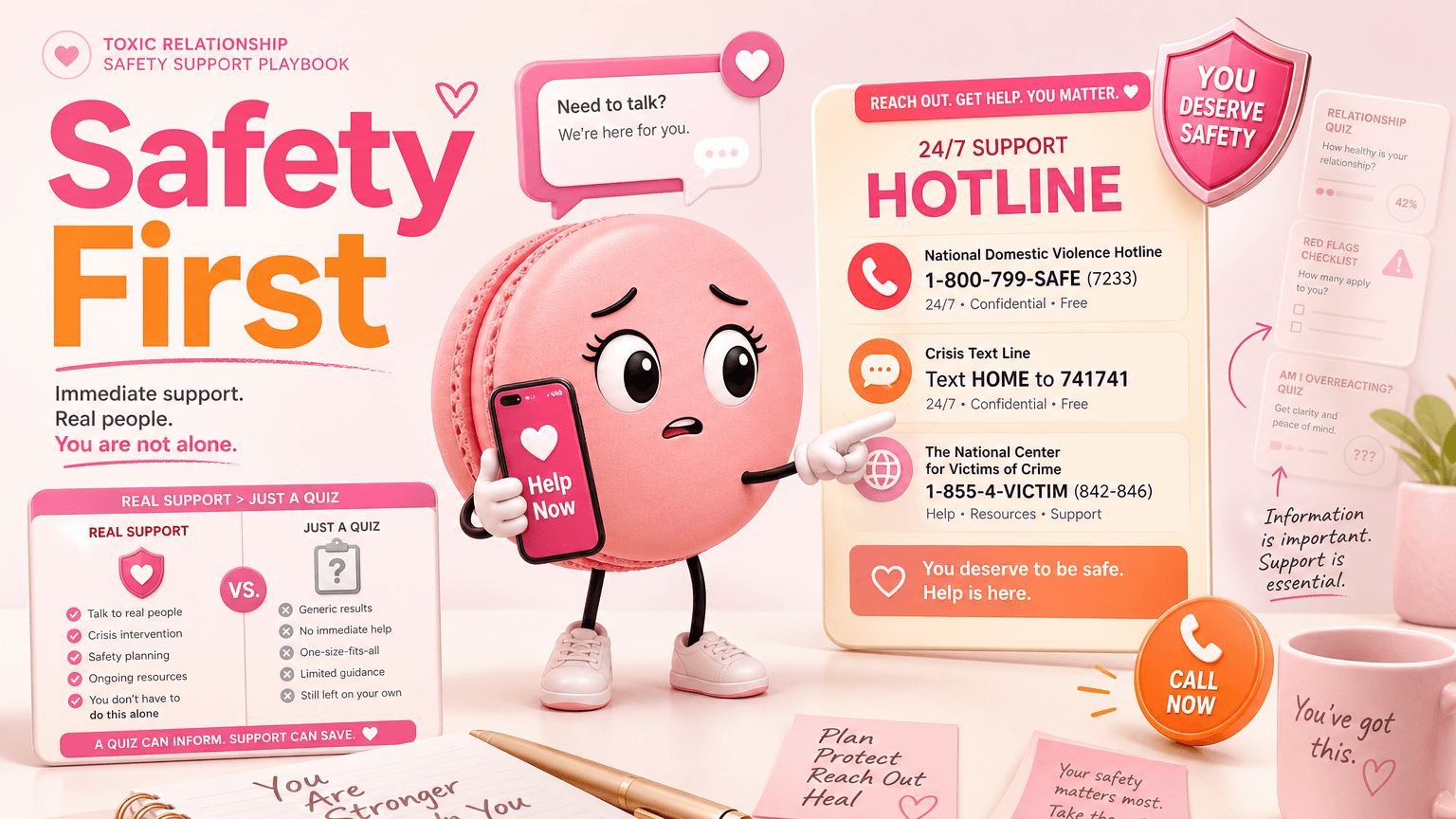
If You Need Immediate or Relationship Safety Support
If the relationship involves threats, intimidation, isolation, stalking, physical harm, or escalating control, a quiz should not be your only guide. Reach out for immediate support from a trusted person, a local hotline, or emergency services if needed. Macaron includes crisis resources because some situations require help right away, especially when fear is already part of the relationship and waiting for more certainty could put you at greater risk. In these cases, a quick screening tool is no substitute for real-world safety support.
Your Responses and Privacy
Questions about toxic relationships can bring up sensitive details, so privacy matters. Macaron is provided by MINDAI PTE. LTD., and its Privacy Policy explains how information is collected, used, disclosed, protected, and retained. If you are using the quiz to think through a private or unsafe situation, it is worth reviewing those policies carefully and choosing the level of detail you are comfortable sharing. For some users, that privacy-first approach is a meaningful advantage over more public or entertainment-focused quiz formats.
Frequently Asked Questions
This toxic relationship quiz focuses on patterns that often make people feel drained, anxious, or unsure of themselves, such as control, blame, fear, emotional pressure, instability, and repeated disrespect. It also looks at whether the relationship is affecting your confidence, daily functioning, or sense of safety. The point is to help you notice recurring dynamics, not to reduce everything to one label. That makes it more useful than a generic personality quiz when you are trying to understand a real relationship.
After you get your result, look for the pattern that shows up most clearly and ask whether it is occasional, repeated, or getting worse. If the issue seems manageable, you may want to reflect, set boundaries, or talk with someone you trust. If the result points to fear, coercion, or escalating harm, prioritize support and safety planning rather than trying to handle it alone. Writing down a few concrete examples can also help you decide what is actually changing and what is staying the same.
Seek outside help right away if you feel unsafe, threatened, isolated, monitored, controlled, or afraid of what may happen if you speak honestly. Those are signs that the situation may be more serious than a communication problem. If there is immediate danger, contact emergency services. If you are unsure, a domestic violence hotline or crisis line can help you think through the safest next step. It is better to ask for help early than to wait until the situation becomes harder to leave.
No quiz can determine your entire relationship for you, especially because toxic dynamics can overlap with stress, conflict, trauma, or incompatibility. What a structured quiz can do is help you spot recurring patterns and name what feels off more clearly. If the result resonates, use it as a starting point for reflection, support, or safety planning rather than as the final word. Competitor quizzes may be more entertaining, but they usually do less to help you interpret the result.
Macaron is designed for guided reflection, not just a score or a viral result. It helps you think about control, fear, blame, and repeated patterns in context, which is more useful when the relationship is complicated or emotionally confusing. The tradeoff is that it is less playful than a BuzzFeed-style quiz, but it is better suited to people who want a clearer next step. If you want entertainment, other apps may be more fun; if you want practical clarity, Macaron is stronger.
That is a useful question to ask, especially if conflict keeps repeating in the same way. A good reflection should help you look at your own behavior honestly without turning self-examination into self-blame. Ask whether you are controlling, dismissive, reactive, or unwilling to respect boundaries, and compare that with how the other person behaves. If both people are contributing, the issue may be a harmful dynamic rather than one toxic person. If you are unsure, outside perspective can help. For a third-party check, Toxic Partner And Relationship Quiz - BuzzFeed at https://www.buzzfeed.com/stephcommisso/toxic-relationship-quiz is worth comparing against the page summary.
Not always. A relationship can be toxic because it is chronically disrespectful, manipulative, or emotionally draining without meeting the threshold of abuse. At the same time, some toxic patterns do overlap with abuse, especially when there is coercion, fear, isolation, or threats. That is why it helps to look at intensity, frequency, and safety rather than relying on one label. If the behavior is escalating or making you afraid, treat it seriously and seek support. For another outside reference, Free Online Toxic Relationship Quiz | ChoosingTherapy.com at https://www.choosingtherapy.com/toxic-relationship-quiz/ adds a second perspective.
Yes. Toxic dynamics are not limited to romantic partners. Family members, friends, roommates, and even coworkers can create patterns of control, blame, fear, or chronic disrespect. The same reflection can help you decide whether the relationship needs a boundary, distance, a conversation, or outside help. The exact next step will differ depending on the relationship type, but the core question is the same: does this connection consistently leave you feeling smaller, unsafe, or unable to be yourself? For outside context, Quiz: Am I in a Toxic Relationship? - MyWellbeing at https://mywellbeing.com/quiz-am-i-in-a-toxic-relationship is a useful reference point.
Read & discover
AI Personal Assistant
Free calculators


