Trauma Response Test
A trauma response test can help you notice how your body and mind shift into protection mode under stress. Macaron offers a guided reflection, not a diagnosis, so you can explore patterns like shutdown, avoidance, hypervigilance, and people-pleasing with more clarity.
Trauma Response Test
This reflection helps you notice how your mind and body tend to protect you when something feels overwhelming, unsafe, or too much. It is meant to support self-understanding, not to label you or decide what your experience means.
This is a self-reflection tool, not a diagnosis or clinical assessment.
Please answer every question before viewing your result.
If your reactions feel intense, persistent, or linked to panic, dissociation, self-harm thoughts, or feeling unsafe, please reach out to a licensed mental health professional or local crisis support. This reflection is not meant to replace care, and getting support is a strong and valid next step.
What This Reflection Can Help You Notice
A trauma response test is usually less about proving whether trauma happened and more about noticing how your nervous system reacts when something feels threatening, overwhelming, or too familiar. People often search for this kind of test when they want language for reactions they already recognize, such as shutting down, scanning for danger, avoiding conflict, or trying to keep everyone else comfortable. That kind of naming can reduce confusion and make patterns feel less random.
Macaron frames the trauma response test as a guided reflection, which matters because many people are not looking for a clinical label first. They want a careful way to compare their day-to-day reactions with common protection patterns like fight, flight, freeze, and fawn, while also noticing less obvious signs such as emotional numbing, overexplaining, or difficulty recovering after activation. The value is in seeing the pattern clearly enough to respond with more choice.
This page is designed to stay clear about what the tool is and is not. It can help you think through patterns and triggers, but it is not a standardized trauma assessment, a PTSD diagnosis, or a replacement for a licensed clinician. That distinction matters because online trauma content often blurs self-checks, symptom lists, and formal screening, which can leave people overinterpreting a result or missing the need for real support. For a related Macaron page, see AI Story App - Macaron at https://macaron.im/ai-story-app.
The most useful result is often not a label but a pattern. For example, some people notice they move quickly into action and problem-solving, while others freeze, go quiet, or become highly accommodating when stressed. A good trauma response test helps you see what happens first, what tends to set it off, and how long it takes your system to settle afterward. That timing can be as informative as the response itself.
If you are using this reflection because something feels off, that alone is a valid reason to slow down and look more closely. The goal is not to force a story onto your experience, but to help you understand your responses with more precision, less self-blame, and a clearer sense of what kind of support may actually help. For some people, that means self-care and pacing; for others, it means talking with a clinician.
What This Reflection Can Help You Notice
Macaron helps you notice the protection patterns that often sit underneath a trauma response, especially when they are easy to miss in daily life. That can include fight, flight, freeze, and fawn, but also more subtle signs like emotional shutdown, urgency, avoidance, or recovering slowly after a stressful interaction. The goal is to make your reactions easier to name so you can see whether they show up in conflict, relationships, work pressure, or moments that feel emotionally loaded. That clarity can be especially useful if your stress response looks calm on the outside but feels intense internally.
How Macaron Structures This Reflection
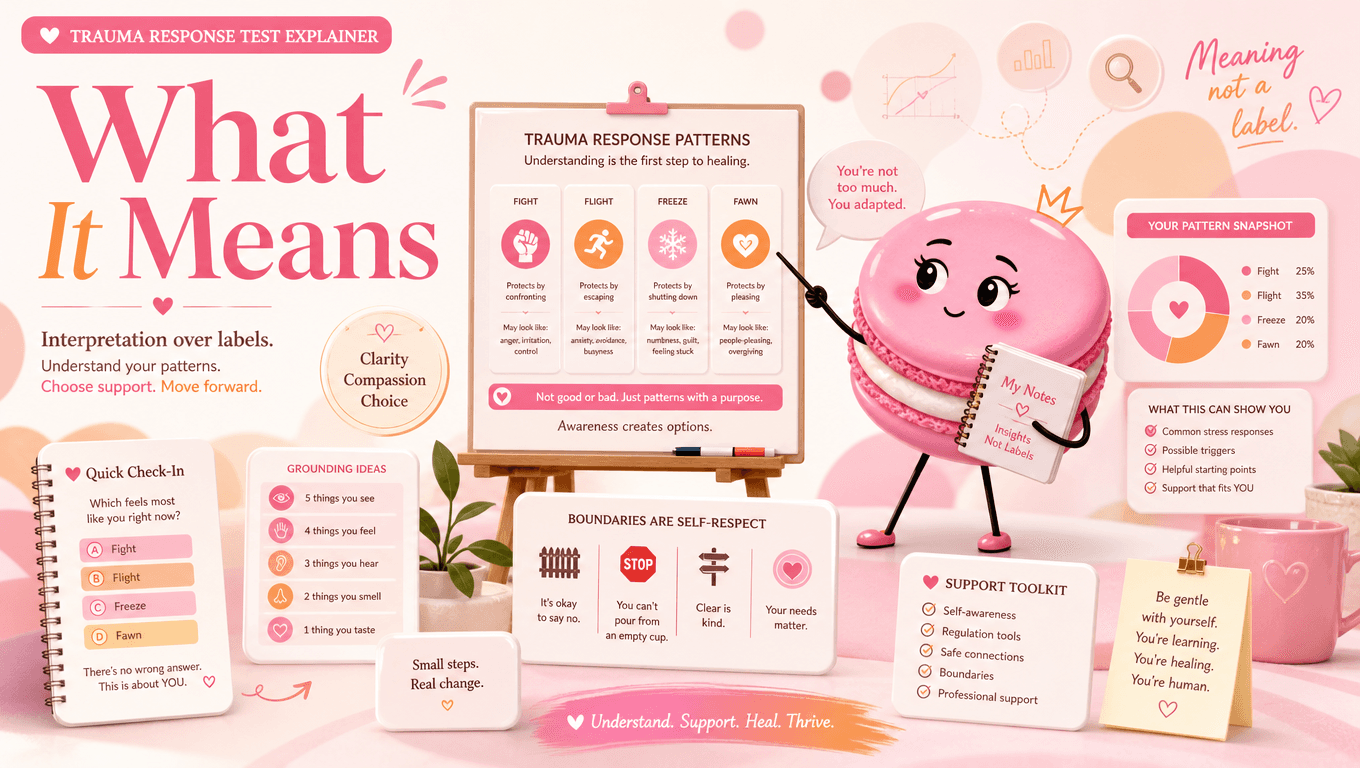
Macaron organizes the reflection around the parts of a trauma response that people usually struggle to sort out on their own. It looks at stress triggers, shutdown or avoidance, hypervigilance, people-pleasing under pressure, and what recovery looks like after activation. That structure matters because trauma responses are often mixed rather than neat, and many people do not fit only one category. The format helps you compare patterns instead of forcing a single label, which is useful if your response changes depending on the relationship, setting, or type of stress.
What Your Result Can Clarify
Your result is meant to clarify patterns, not define you. It can help you see which protection response tends to appear first, which situations make your reaction stronger, and whether your body settles quickly or stays on alert for a long time. It can also point to the kind of support that may be most useful next, such as grounding, pacing, boundary-setting, or a conversation with a professional if the pattern is affecting daily life. That makes the result more actionable than a simple label.
More About Trauma Response Test
Searchers often use the phrase trauma response test when they want a simple way to identify whether their reactions fit fight, flight, freeze, or fawn. Macaron keeps that core intent intact, but it also helps you notice the everyday forms these responses can take, such as irritability, withdrawal, people-pleasing, overcontrol, or feeling mentally blank when pressure rises. That broader view is helpful for people whose stress response is subtle, delayed, or easy to rationalize away.
Many trauma quizzes online focus only on symptoms or only on childhood history, which can leave people unsure how to interpret the result. This reflection is more useful when it connects the response to context, because the same behavior can mean different things depending on whether you are dealing with conflict, reminders of past harm, chronic stress, or a situation that simply feels unsafe to your body. Context helps separate a one-off reaction from a repeated pattern.
A helpful trauma response test should reduce confusion, not increase it. That is why Macaron emphasizes pattern recognition over diagnosis, and why the result is framed as a starting point for self-observation. You can use it to compare what you feel internally with what others may see externally, especially when your response is subtle, delayed, or easy to dismiss. That can be especially valuable if you have been told you are “fine” while still feeling activated or exhausted. Another useful Macaron comparison is Best AI Personal Assistant in 2025: A Test Suite You Can Reuse at https://macaron.im/blog/ai-personal-assistant-test.
The next step after a trauma response test is often practical, not theoretical. People usually want grounding ideas, ways to name triggers, and a better sense of what helps them recover after activation. Macaron is structured to support that follow-through so the reflection can lead to calmer check-ins, more informed conversations, and a clearer decision about whether outside support would be useful. The tradeoff is that it is less comprehensive than a clinician-led evaluation, but it is faster and easier to revisit. For a broader Macaron context, 20 AI Tools to Upgrade Your Daily Life - Macaron - Macaron App at https://macaron.im/blog/macaron-app-ai-tools-daily-life can help you compare the decision from another angle.
Because trauma-related reflection can bring up strong feelings, the page also keeps safety and privacy visible. If the process feels overwhelming, it is important to pause and seek human support rather than pushing through. And because this kind of self-reflection involves sensitive information, it should be handled with care and with a clear understanding of how your responses are stored and used. Competitor quizzes may feel more clinical or more entertaining, but Macaron is designed to stay more grounded and reflective.
Safe Next Steps
Macaron turns the trauma response test into something you can actually use after the result, rather than leaving you with a label and no direction. That includes reflection prompts that help you notice triggers more clearly, grounding ideas for moments of activation, and check-ins that make it easier to track patterns over time. It can also help you think through whether the next step is self-care, a trusted conversation, or outside support from a clinician or counselor. The benefit is continuity; the limitation is that it does not replace therapy or crisis care.
If You Need Immediate Support
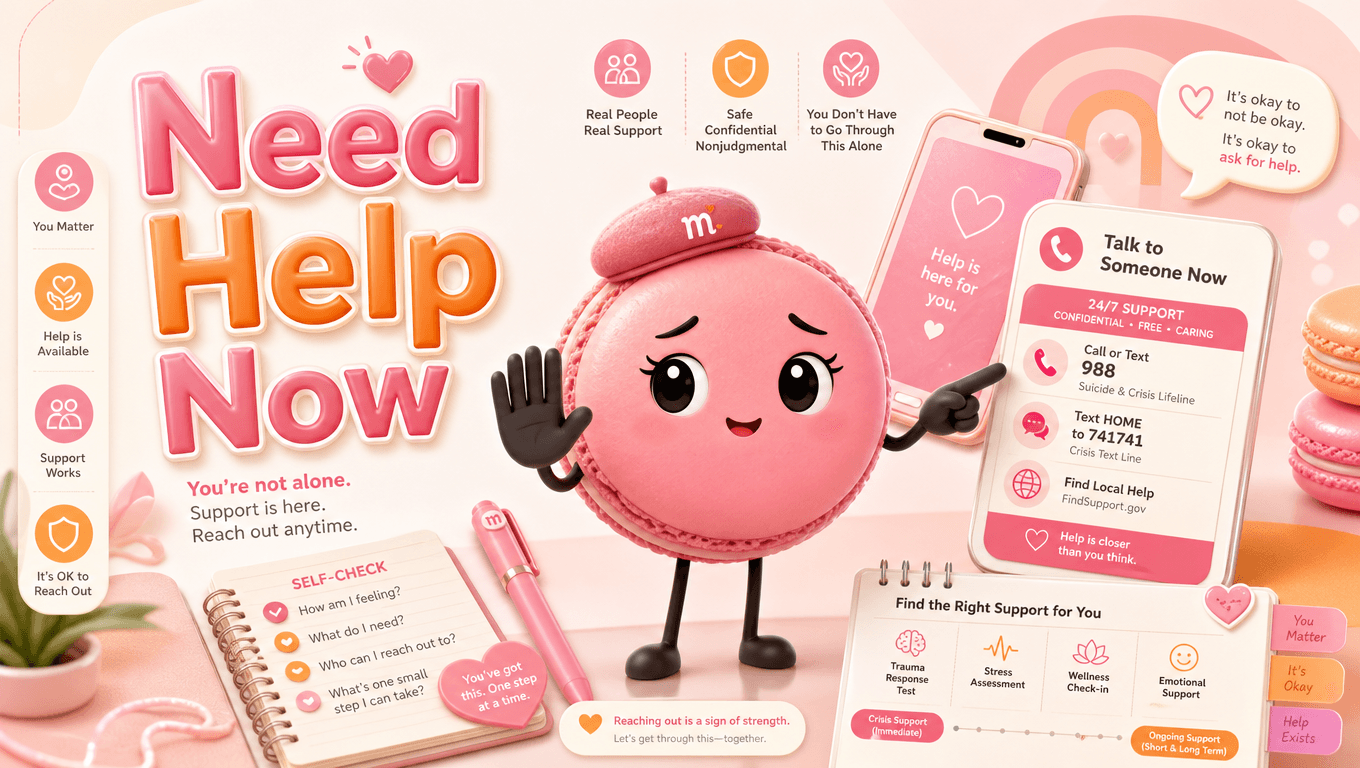
If the reflection brings up intense distress, a sense of danger, or thoughts of harming yourself, stop the self-check and reach out for immediate human support. A trauma response test can help with awareness, but it cannot replace crisis care or professional help when safety is a concern. If you are in the United States, call or text 988. If you are in the United Kingdom or Ireland, call 116 123. For other locations, use findahelpline.com to find local crisis resources. If you already have a therapist or trusted support person, contact them as soon as you can.
Your Responses and Privacy
Trauma-related reflection can involve highly sensitive information, so privacy should be treated as part of the experience, not an afterthought. Macaron is provided by MINDAI PTE. LTD., and the official Privacy Policy explains how data is handled. If you are deciding whether to use a trauma response test, it is reasonable to consider what you are sharing, how it may be stored, and whether you are comfortable with that before you begin. Compared with some competitor quizzes, Macaron’s value is in being a broader life tool, but users who want a dedicated clinical platform may prefer a specialist provider.
Frequently Asked Questions
This trauma response test focuses on common protection patterns that can appear when a person feels stressed, threatened, or emotionally overloaded. It looks at responses such as fight, flight, freeze, and fawn, along with related patterns like shutdown, hypervigilance, avoidance, and people-pleasing. The aim is to help you recognize how your system reacts in real situations, not to decide whether you have a diagnosis. It is best used as a reflection tool, especially if you want clearer language for what you already notice.
Use the result as a clue, not a conclusion. A trauma response test can highlight patterns that are worth noticing, but it should not become the whole story about who you are or what you have lived through. It is often most helpful when you compare the result with your real-life experiences, notice where it fits, and stay open to the fact that your responses may change across different situations. If a result feels too narrow, treat it as a starting point for more observation.
If the reflection leaves you feeling overwhelmed, unsafe, panicked, or unable to calm down, it is a good idea to contact a licensed professional or crisis support right away. The same is true if the process brings up thoughts of self-harm or makes it hard to stay grounded in the present. A trauma response test is only for reflection, so urgent distress should always be handled by a person who can provide immediate support. If possible, move away from the screen and reach out to someone you trust.
This page offers guided self-reflection with AI support, which can help you notice patterns and think more clearly about your reactions. A formal trauma assessment is different because it is clinical, standardized, and usually done by a qualified professional who can evaluate symptoms in context. In other words, this tool can help you prepare for understanding, but it is not a substitute for diagnosis or treatment. If you need documentation, treatment planning, or a clinical opinion, a professional assessment is the better option.
The four commonly discussed trauma responses are fight, flight, freeze, and fawn. Fight can show up as irritability, defensiveness, or a strong urge to regain control. Flight often looks like avoidance, overworking, or staying busy to escape discomfort. Freeze can feel like numbness, blankness, or being unable to act. Fawn usually involves people-pleasing, appeasing, or prioritizing others’ comfort to reduce conflict. Many people experience more than one response depending on the situation.
Yes. A person may look composed at work but become avoidant, hypervigilant, or highly accommodating in close relationships, or the reverse. Trauma responses are shaped by context, power dynamics, and what feels safest in the moment. That is why a useful trauma response test should not only ask what you feel, but also where it happens and what tends to trigger it. Looking across settings can reveal patterns that are easy to miss when you focus on only one part of life. For a third-party check, Quiz: Complex Trauma Test - Bay Area CBT Center at https://bayareacbtcenter.com/complex-trauma-quiz/ is worth comparing against the page summary.
Macaron is often better if you want a guided reflection that connects your answers to next steps, not just a score or label. It is designed to help you notice patterns, think about triggers, and decide whether grounding, boundaries, or professional support might help. A standard quiz may be simpler or more familiar, and some people prefer that. The tradeoff is that quizzes can be less nuanced, while Macaron asks for a little more reflection in exchange for more practical context. For another outside reference, Trauma Response Test: Identify Trauma Symptoms - re-origin at https://www.re-origin.com/trauma-response-quiz adds a second perspective.
That can happen, and it does not mean you answered incorrectly. Trauma responses are context-dependent, and a short reflection may not capture every layer of your experience. If the result feels off, compare it with specific situations rather than your life as a whole. You may notice that one response shows up only under certain kinds of stress, or that you use different strategies in different relationships. Treat the result as one lens, not the final word. For outside context, Free Trauma Quiz Response & Test - Mental Health Hope at https://mentalhealthhope.com/trauma-quiz/ is a useful reference point.
Read & discover
AI Personal Assistant
Free calculators


