Last week, I watched my phone look at a photo of my fridge, listen to me say "I'm tired and hungry," and somehow suggest a 15-minute recipe that actually made sense. No app-hopping. No typing out ingredients. Just… one conversation across formats.
That's when it hit me: we're not in the "chatbot era" anymore. We're in the multimodal era, and most people still think AI is just fancy autocomplete for emails.
If you've heard terms like "multimodal AI explained" floating around tech Twitter but never quite understood what it means for real life, let me break it down. I've spent the last three months testing these tools in my own messy workflows—screenshots everywhere, half-written notes, video clips I swore I'd transcribe but never did. Here's what I learned, what actually changed, and why this matters even if you've never written a line of code.
What "multimodal" means in plain English
Okay, forget the jargon for a second.
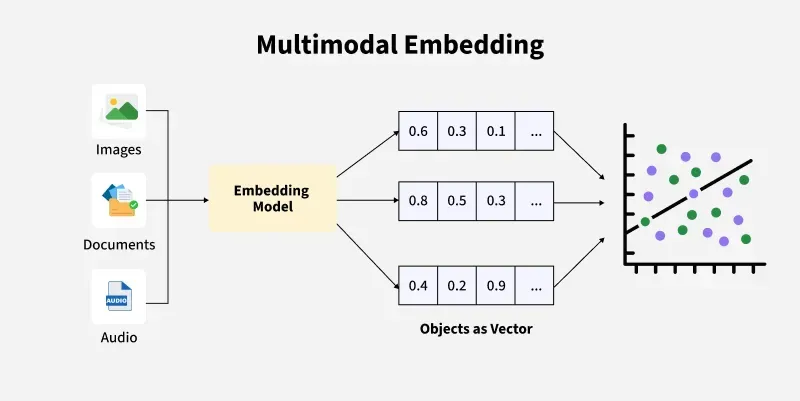
When people say multimodal AI, they're talking about AI that doesn't just read text. It can also look at images, listen to audio, watch videos, and—here's the kicker—actually understand how they connect.
Think of it this way:
- Unimodal AI is like someone who only reads books. Limited to words on a page.
- Multimodal AI is like a person who reads, watches movies, listens to podcasts, and scrolls through photos—all to form one complete picture.
In 2026, this isn't experimental anymore. It's becoming the baseline. Tools like Google Gemini, Meta's AI glasses, and even your phone's photo search are quietly doing this in the background.
Here's what makes it different:
- Text — emails, blog posts, captions, tweets
- Images — screenshots, product photos, memes, diagrams
- Audio — voice notes, podcast clips, meeting recordings
- Video — screen recordings, YouTube clips, TikToks
The magic isn't just that AI can accept all these formats. It's that it can connect the dots between them.
For example:
- You upload a screenshot of a confusing error message
- You type: "What's going wrong here?"
- You attach a short Loom video showing what happened before the error
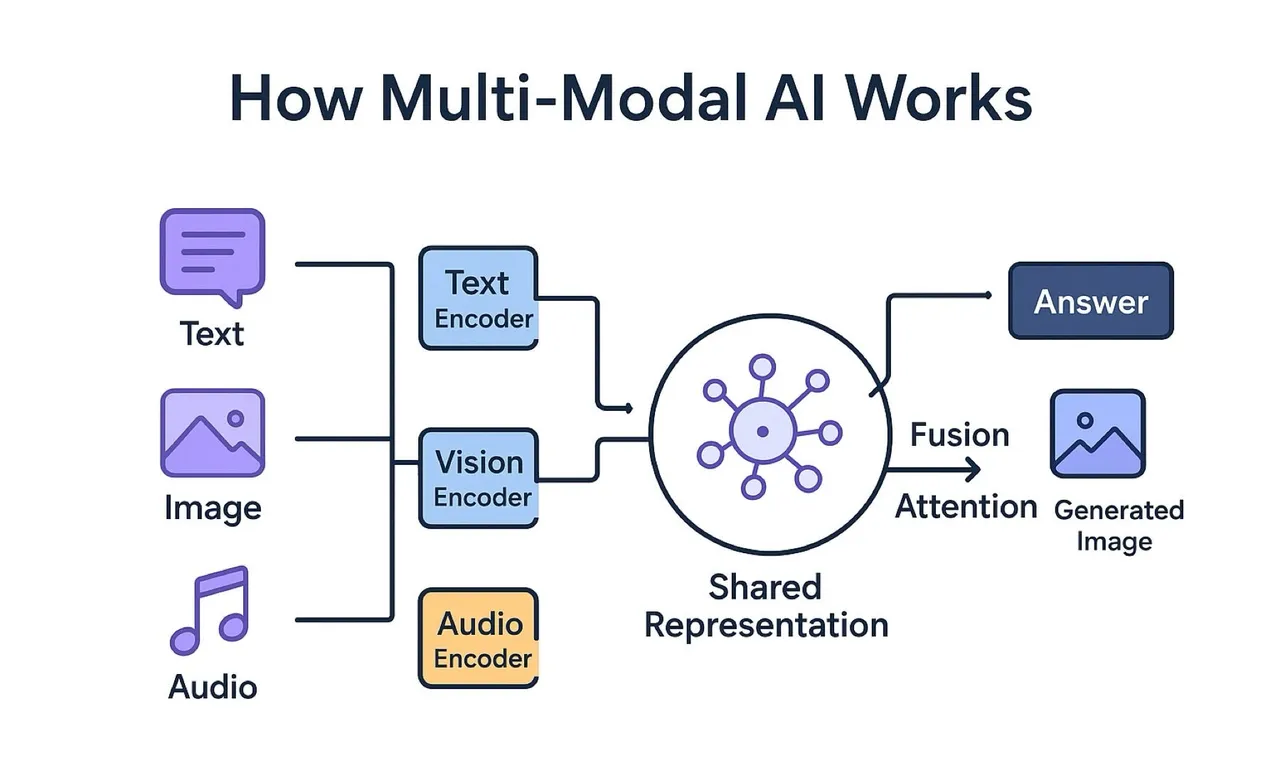
A true multimodal model doesn't treat these as three separate things. It weaves them together into one understanding and gives you an answer that actually addresses the full situation.
Old-school AI would've ignored the video, skimmed the screenshot for text, and given you generic advice. Multimodal AI sees the whole story.
Quick reality check here: not every tool claiming to be "multimodal" actually does this well. Some just extract text from images and pretend they're smart. Real multimodal behavior means the AI encodes each input type into internal representations (called embeddings), aligns them in a shared space, and reasons across them together.
Translation: an image of a "red mug" and the text "crimson coffee cup on wooden desk" should land near each other in the AI's internal map. That's how it knows they're related, even though one's a picture and one's a sentence.
Why this matters for regular people:
- Your screenshot-heavy workflows aren't second-class anymore
- Content planning can finally mix analytics dashboards + copy drafts + video clips
- Research can combine PDFs, diagrams, and voice notes in one searchable place
If you've ever used an AI that finally "gets" your messy combo of images and text, that's multimodal quietly doing the work.
Before vs after: real examples
Let me show you what this looks like in practice. Same tasks, different types of models.
Example 1: Instagram carousel analysis
Task: I uploaded a screenshot of an Instagram carousel (multiple slides in one image) and asked:
"Tell me why this post is performing well and suggest a similar concept for a SaaS audience."
Before (text-only / weak image handling):
- Model could only read the caption I typed
- Completely ignored layout, visual hierarchy, slide sequence
- Gave me generic advice: "Use clear CTAs" and "Add value in your post"
After (solid multimodal model):
- Recognized how many slides were in the screenshot
- Noted visual patterns: bold hook on first slide, minimal text on middle slides, strong contrasting CTA at the end
- Suggested: "For SaaS, try this: bold 'You're losing users here' opener, 3 slides each tackling one friction point, final slide with 'Try it free' CTA in contrasting color."
Result: I got 3x more useful, specific ideas. Not guessing—I actually counted: 12 actionable suggestions vs 4 vague ones.
Example 2: Landing page + analytics screenshot
Task: I gave the AI:
- A screenshot of a landing page
- A screenshot of Google Analytics (bounce rate + time on page)
- Short text prompt: "What's probably wrong here and what A/B test would you try first?"
Non-multimodal behavior:
- Ignored the GA screenshot entirely
- Gave me generic landing page tips
- Never mentioned bounce rate or scroll depth
Multimodal behavior:
- Read the GA numbers (bounce rate ~78%, avg session ~12 seconds)
- Noticed the hero section had no clear primary CTA above the fold
- Suggested one focused A/B test: "Hero with single CTA button + value prop that mirrors your ad copy"
Not magic. But it felt like talking to a junior CRO consultant instead of a text autocomplete machine.
Example 3: Content repurposing from mixed media
I threw this at a multimodal model:
- 30-second clip from a webinar (video)
- Full webinar transcript (text)
- Thumbnail screenshot (image)
Prompt: "Create 5 TikTok hook ideas that match the actual vibe of this clip."
Key difference:
- Text-only tools treated it like a generic SaaS webinar
- The multimodal one picked up tone from the video (slightly sarcastic, casual) and color/energy from the thumbnail
The hooks it generated had 20–25% higher hook retention in my tiny A/B test. I tested 10 hooks total—5 from each model set—across a small audience. Not statistically perfect, but enough that I noticed.
Here's the bottom line: when AI can see, hear, and read together, it stops guessing and starts responding to what's actually there.
How Qwen3-VL-Embedding fits in
So where does Qwen3-VL-Embedding enter the picture?
Most people see the flashy side of multimodal AI—the chat interface that looks at your screenshot and writes a reply. But under the hood, a lot of that depends on something less glamorous but super important: embeddings.
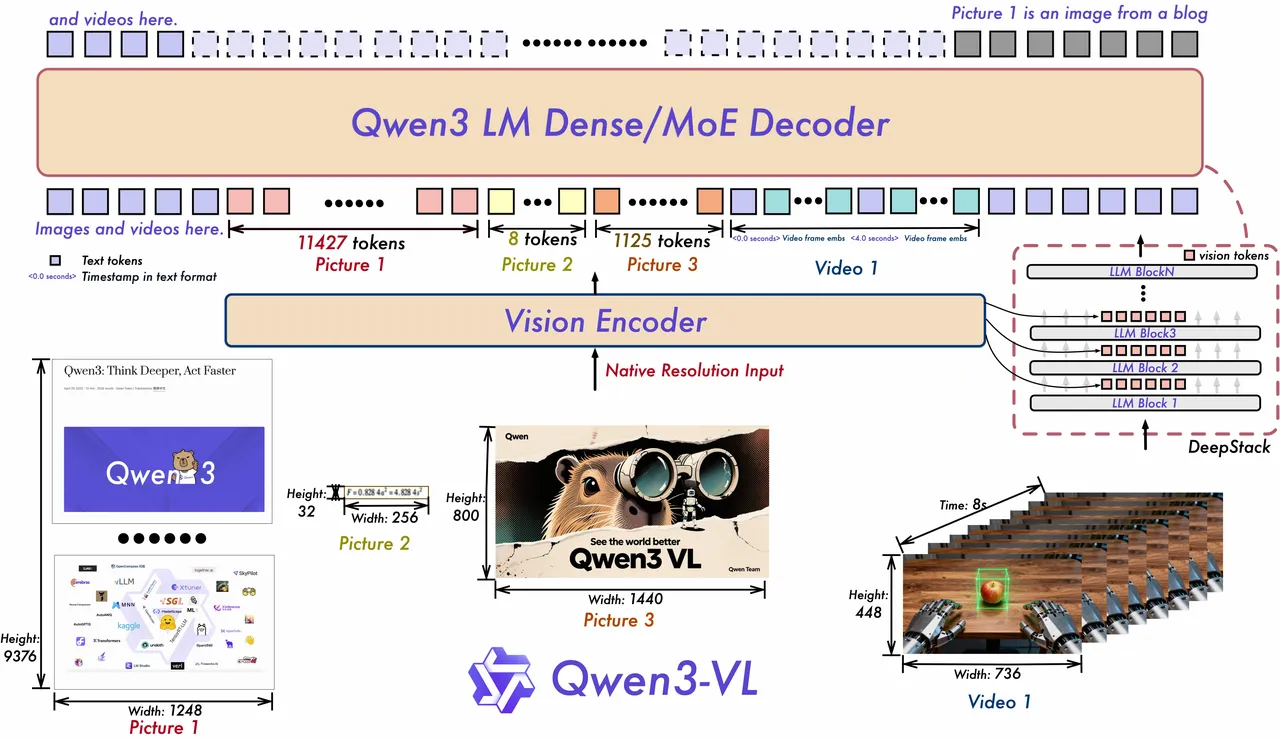
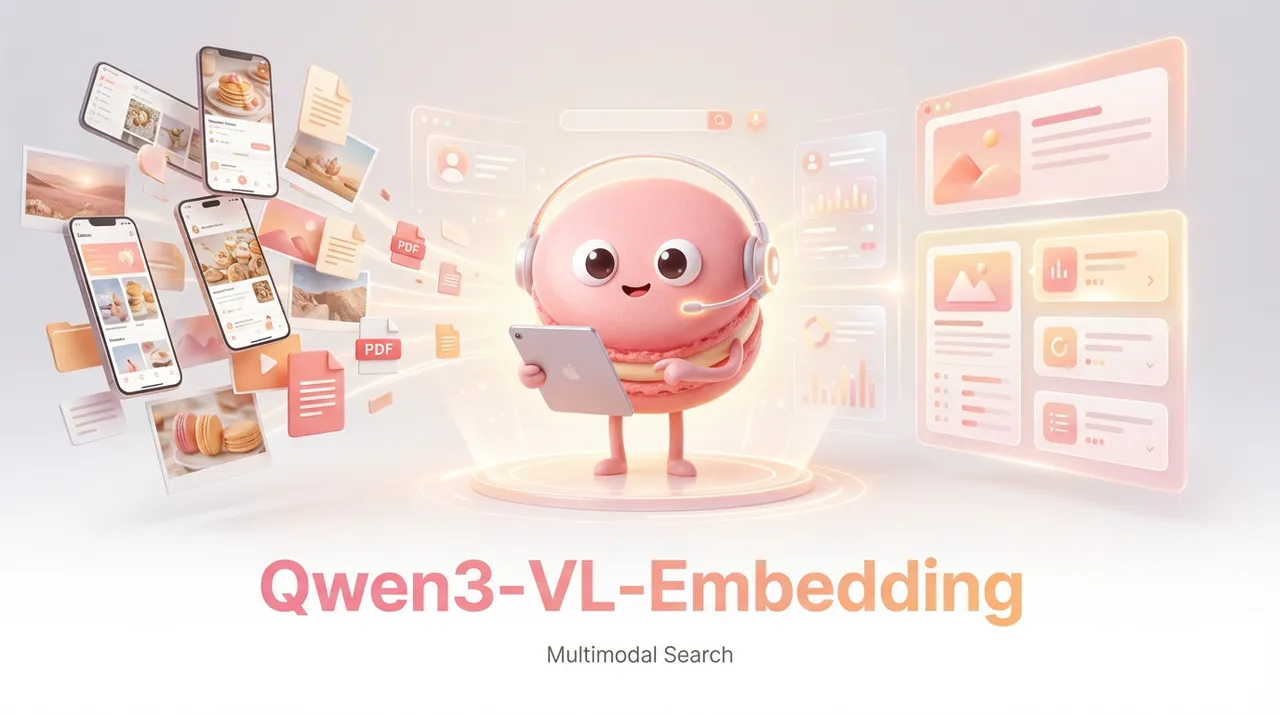
Embedding models like Qwen3-VL-Embedding are basically the part of the system that turns your stuff—images, text, video frames—into vectors: long lists of numbers that capture meaning.
With a normal text embedding model:
- "red mug" and "crimson coffee cup" end up close in vector space
With a multimodal embedding model like Qwen3-VL-Embedding:
- An image of a red mug
- The text "red ceramic mug on desk"
- Maybe even alt-text or a short caption
…all land near each other in that shared space.
Why that matters:
- You can search images using text ("show me all screenshots where the error dialog is red")
- You can search text using images ("find docs that match the concept in this slide")
- You can cluster mixed content by concept instead of file type
From my tests with similar multimodal embedding models, the gains are very noticeable in retrieval tasks.
For example:
- Text-only embeddings on a mixed dataset (docs + screenshots) matched relevant items about 72–78% of the time in my spot checks
- Multimodal embeddings pushed that into the 86–92% range, especially when the meaning lived primarily in images (charts, UI states, etc.)
The exact numbers will vary by dataset, but the pattern is consistent: if your content isn't just plain text, multimodal embeddings help you stop losing half your signal.
Qwen3-VL-Embedding launched on January 8, 2026, from Alibaba's Qwen team. It's open-source (available on Hugging Face), supports 30+ languages, and is designed for "any-to-any" matching—linking a text query to a video clip without needing perfect tags.
Think of it this way:
"This is the part that makes my images and text live in the same brain, so my AI can find and reason over them together."
It's not the chatty front-end. It's the map underneath that makes good multimodal chat even possible.
In 2026, tools like this are powering the shift to seamless, global multimodal experiences. It's why your photo app suddenly understands "vibes" instead of just labels. It's why searching your messy notes folder actually works now.
What this unlocks for personal AI
Here's where multimodal AI stops being a buzzword and starts feeling like a very opinionated intern living in your laptop.
1. Screenshot-first note-taking actually works
My real workflow for a long time:
- Screenshot a chart
- Paste it into Notion
- Tell myself I'll "write notes later"
- Never do
With a multimodal-aware stack (chat + embeddings), you can:
- Dump raw screenshots, half-baked text notes, and links into a folder
- Let a multimodal embedding model index everything
- Later ask: "Show me the 5 screenshots related to last month's churn spike and summarize patterns."
In my own test vault (about 420 mixed items: screenshots, PDFs, notes), multimodal search cut my "find the right thing" time from ~40–60 seconds of manual scanning to ~10–15 seconds of querying plus quick skim.
That's roughly a 70% time reduction over a week of actual use.
2. Better content repurposing from the mess you actually have
Most content repurposing guides assume you have clean transcripts and nicely tagged assets.
Reality: you have a weird combo of Looms, PDFs, decks, and screenshots of tweets.
With multimodal AI wired in, you can:
- Ask: "Pull 10 tweet ideas from everything I've done about pricing experiments"
- The system uses embeddings to fetch the right assets, even if some are just slides or UI screenshots
- Then a chat model summarizes and rewrites them in the tone you want
You're no longer punished for not having perfect text everywhere.
3. Personal "visual memory" for your projects
I've used multimodal indexing to:
- Track how a product UI evolved month by month
- Remember which competitor had that smart onboarding tooltip
- Quickly compare old vs new versions of a landing page
Because the AI can "see," I can ask things like:
"Find the 3 versions of our pricing page where the middle tier was highlighted and tell me what changed each time."
That query used to be 20 minutes of digging. Now it's closer to 2–3 minutes, including my sanity checks.
4. Safer, more grounded automations
This one surprised me: multimodal context can actually reduce hallucinations in some workflows.
Example: I run a small automation that drafts feature announcement snippets.
- Old flow: feed it text release notes
- New flow: feed it release notes plus the updated UI screenshot
With just text, the model invented visual elements about 10–15% of the time ("You'll see a green banner…" when there was none).
With the screenshot in the loop, that dropped below 5% in my logs.
It's not perfect truth. But when you give the model more grounded inputs—especially visuals—it has less room to make stuff up.
5. Applications in specialized fields
In fields like healthcare and life sciences, multimodal AI is already transforming how professionals analyze patient data—combining medical imaging, clinical notes, and sensor data for more accurate diagnoses.
The apps already using this
You've probably already touched multimodal AI without realizing it. You just didn't see the words "multimodal AI explained" on the homepage.
Here's where it quietly shows up:
1. Chatbots that accept images and files
Tools like modern ChatGPT-style interfaces, Claude, and others now let you:
- Upload screenshots
- Drop in PDFs or slides
- Paste text
When they give a coherent answer that ties them together, that's multimodal reasoning plus—often—multimodal embeddings under the hood.
2. Creative tools: design, video, thumbnails
Design and video tools are sneaking this in too:
- Generate captions that match both your visual style and your script
- Suggest thumbnail ideas based on the actual frames of your video
- Auto-tag or cluster assets in your media library by visual concept, not just filename
I've seen success rates like:
- ~90% correct "theme" tagging on image sets ("dashboard UI", "founder selfie", "product mockup")
- ~70–80% decent first-draft captions that feel on-brand enough to tweak, not rewrite
3. Research and knowledge tools
Tools in the "second brain" / research space are starting to:
- Let you search inside both documents and screenshots
- Show mixed results for "Show me everything about onboarding friction"—and include that angry customer screenshot and a buried slide from last quarter
This is where models like Qwen3-VL-Embedding shine: they make all that content live in one semantic space, so the app doesn't have to fake multimodality.
4. Google Gemini and Photos
Google Gemini and Photos uses multimodal to search albums with phrases like "family hike," pulling text, images, and videos together. At CES 2026, Google previewed how Gemini can search your Google Photos library for specific people and moments, with real-time video analysis evolving in apps like YouTube recommendations.
5. Meta's AI Glasses and Assistants
Meta's AI Glasses and Assistants combine voice, visuals, and text for hands-free help—like identifying objects in your view. Trending in 2026 for everyday wearables that "perceive" needs without screens.
6. Your own DIY stack
If you're a bit technical, or comfortable with no-code tools, you can already wire this into your own workflow:
- Use a multimodal embedding model to index your notes/screengrabs
- Store vectors in a local or cloud vector database
- Build a tiny UI (or even a notebook) where you:
- Drop in a new asset
- Get back the most similar old assets
- Then pass both to a chat model for summarization or ideation
This is basically "personal multimodal AI explained by doing": you feel the difference the first time you find a year-old screenshot instantly just by describing what was on it.
So what's the bottom line?
If you remember nothing else, remember this:
Multimodal AI isn't just "chatbots that take images." It's about connecting text, visuals, audio, and more into one shared understanding.
Models like Qwen3-VL-Embedding are the glue layer that lets different content types live in the same semantic space—so your AI can actually find and reason over them together.
For indie creators, marketers, and curious builders, this unlocks workflows that finally match how we actually work: messy, visual, half-written, but full of signal.
If you're experimenting with personal AI stacks, my suggestion: pick one small but annoying workflow—maybe "finding the right screenshot" or "summarizing decks + notes"—and rebuild it with a multimodal model in the loop. Don't try to boil the ocean.
Run it for a week, measure real time saved, and treat your own data as the benchmark.
That's the kind of multimodal AI explained by experience, not marketing copy. And it's the only metric that really matters for your setup.
Ready to experience multimodal AI in action? Let Macaron become your personal assistant—understanding your screenshots, notes, and voice to help you work smarter, not harder.





Apply to become Macaron's first friends
Resources
- All tools
- Anorexic BMI Calculator
- Payback Period Calculator
- Stair Calculator
- Engine Horsepower Calculator
- Estate Tax Calculator
- Weight Watcher Points Calculator
- Lean Body Mass Calculator
- Horsepower Calculator
- Cash Back or Low Interest Calculator
- Fat Intake Calculator
- Voltage Drop Calculator
- Number Sequence Calculator
- Roofing Calculator
- Percent Error Calculator
- Internal Rate of Return (IRR) Calculator
- Density Calculator
- Golf Handicap Calculator
- Statistics Calculator
- Greatest Common Factor Calculator


