What We Actually Need From AI When We're Burned Out
FAQ
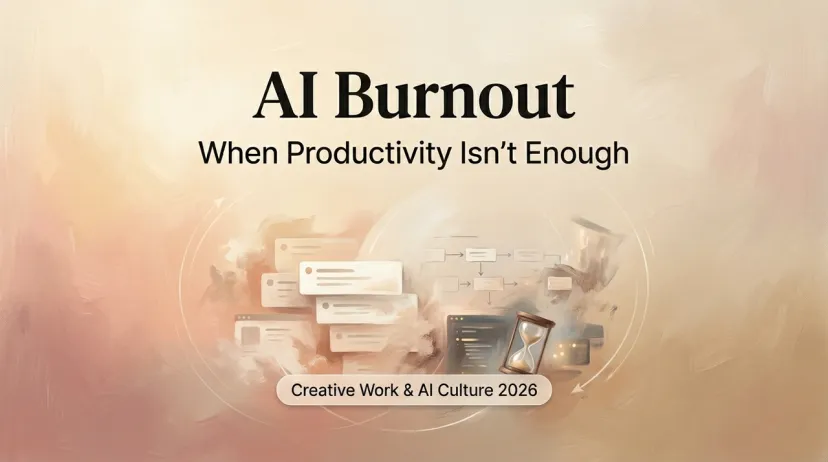
AI Burnout: When Productivity Isn't Enough
AI Burnout: When Productivity Isn't Enough
There was a week last month where I had seven AI tools open at the same time.
By Thursday, I wasn't getting more done. I was just… exhausted in a way I couldn't explain. Not tired like "I need sleep." More like the feeling after you've been in a loud room for too long — even once you leave, there's still a kind of buzzing.
If you've ever opened an AI tool and felt relief, then opened three more and felt worse — this might be something you recognize.
This isn't a piece about quitting AI. It's about noticing that more tools don't always mean more ease.
What Is AI Burnout?
AI burnout isn't a formal diagnosis. It's more of a description — one a lot of people seem to be reaching for at the same time.
The rough shape of it: you're using AI regularly, and instead of feeling lighter, you feel more drained. There's pressure to keep up, to use the right tool, to not fall behind.
It's different from regular burnout — the kind measured by Maslach's three-dimension framework across emotional exhaustion, depersonalization, and reduced personal accomplishment. AI burnout carries those same dimensions, but with a specific trigger. A 2025 peer-reviewed study in Frontiers in Psychology defined it as the negative psychosocial consequence of sustained interaction with generative AI — documenting a dual effect where these tools elevate both productivity and stress simultaneously, through overload, uncertainty, and loss of perceived control.
The stress doesn't always come from the work. It comes from the layer of AI sitting on top of it — the deciding, the switching, the supervising.
Why More People Are Experiencing AI Fatigue
Two studies published in Harvard Business Review in early 2026 help explain the scale and texture of what's happening.
The first, from BCG researchers Julie Bedard, Matthew Kropp, Megan Hsu, and colleagues (March 2026), surveyed 1,488 full-time U.S. workers at large companies across industries. Using validated measures of mental effort, fatigue, and information overload, they found that 14% of workers reported symptoms of what they formally define as "AI brain fry": mental fatigue from excessive use or oversight of AI tools beyond one's cognitive capacity. Symptoms included mental fog, headaches, and slower decision-making — and they were concentrated among workers managing four or more AI tools simultaneously.
The second, from UC Berkeley's Haas School of Business (February 2026), used a different method entirely: an eight-month embedded ethnography. Associate professor Aruna Ranganathan and PhD candidate Xingqi Maggie Ye spent two days per week on-site at a 200-person U.S. tech company from April to December 2025, closely observing 40 workers across engineering, product, design, research, and operations. Their finding cut against the standard productivity narrative: AI didn't free up time. It expanded what workers felt capable — and willing — to take on. As they wrote: "Employees worked at a faster pace, took on a broader scope of tasks, and extended work into more hours of the day, often without being asked to do so."
What began as excitement had quietly accumulated into something harder to sustain.
The Difference Between AI Overload and Just Being Tired of Tech
General tech fatigue responds to rest. AI overload is different — and the BCG researchers are careful to say so. Lead author Julie Bedard described it on record as distinct from traditional burnout: "Burnout is physical and mental exhaustion. It's more emotional. AI brain fry stems from the unusually high cognitive load required to supervise AI systems and evaluate their outputs."
That distinction maps onto what cognitive science has understood since John Sweller developed Cognitive Load Theory in 1988: working memory is sharply limited, holding roughly three to five chunks of new information at once. Each additional AI tool requiring active oversight doesn't just add one more task — it competes directly for the same finite cognitive workspace. A 2026 Springer review of CLT applied to human-AI systems confirmed that AI can reduce intrinsic cognitive load when it handles complexity, but sharply increases extraneous load when its outputs demand constant evaluation and correction. That's the asymmetry. It's not that AI is hard to use. It's that supervising AI is cognitively expensive in a specific way that rest alone doesn't address.
When Productivity AI Becomes Part of the Problem
This is slightly uncomfortable to say, because productivity AI is genuinely useful. I've relied on it. I still do, sometimes.
But there's a particular texture to it that — after enough time, after enough check-ins and reviews and optimization cycles — starts to feel heavy in a way that's hard to articulate. It's always somewhere in the background asking: What are you trying to accomplish? Are you on track? Have you reviewed your week?
Useful questions. Until they stop being useful and start being one more thing requiring a response.
Productivity AI vs Wellbeing AI — A Real Difference
Productivity AI is built around output. More content, faster summaries, higher throughput.
Wellbeing AI is built around a different question: what do you actually need? Not what can be automated, but what feels heavy, and whether anything can quietly take some of the weight.
The BCG study found a useful counterpoint: when AI replaced routine tasks rather than augmenting complex oversight, burnout scores dropped 15% and engagement rose. Same technology, different deployment — opposite effect. If I'm exhausted, adding a tool that requires more supervision isn't solving anything. It's changing the shape of the problem.
What the Slow Tech Movement Gets Right
There's a quiet movement that's been gaining ground — slow tech — and I find myself nodding at a lot of what it says.
Rooted in the same philosophy as slow food and slow living, slow tech isn't anti-technology. It's a human-centered design principle: that tools should enhance well-being and purpose rather than demand constant attention. The question it asks is simple: What if our devices helped us live better, not just faster?
When I evaluate an AI tool and ask "will this make me more productive," the answer is often yes — and then I abandon it two weeks later. When I ask "will this make today feel lighter," I'm asking something closer to what I actually need.
What We Actually Need From AI When We're Burned Out
The AI interactions that feel good are the ones that reduce decisions. Where something is simply handled — or remembered — or gently flagged at the right moment.
How AI Can Reduce Daily Overload Instead of Adding to It
The version that helps isn't necessarily the most powerful. It's the most fitted.
A tool that knows I don't like things too sweet suggests recipes without me having to filter. A tool that remembers I wanted to sleep earlier mentions it at 10pm without me needing a reminder to check my own reminders. That's not a productivity feature — it's closer to a quiet presence that's absorbed enough about you to show up accordingly.
This maps onto what cognitive science calls the difference between cognitive offloading (using external systems to reduce mental effort) and cognitive overload (when those systems create more work than they remove). The Frontiers research notes that when AI reduces decision fatigue through gentle prompting and context-awareness, it can act as a "resilience amplifier" — freeing mental resources rather than consuming them. The difference lies in oversight demand: low-oversight AI that acts on your behalf reduces load; high-oversight AI that waits for your evaluation adds to it.
Signs You Might Need a Different Kind of AI Interaction
When I dread opening tools I chose to make life easier. When I finish a session more tired than when I started — not from doing a lot, but from supervising and correcting for an hour. When the AI feels like a management problem instead of a quieter day.
The BCG researchers found that brain fry was significantly lower in teams where managers had developed explicit norms around AI use — clearly defining which tasks benefited from AI oversight and which didn't, and building in what the Berkeley researchers called "intentional pauses" to prevent role boundaries from blurring and task scope from silently expanding. That structure doesn't come from the AI itself. It comes from being honest about what each tool is actually costing you in attention.
FAQ
What is AI burnout and why are more people experiencing it?
AI burnout is the exhaustion that accumulates when AI tools feel like they're demanding something from you — constant engagement, self-monitoring, output review — rather than offering something. It's different from general screen fatigue because the source is specific: productivity-oriented AI that optimizes relentlessly. The WHO's burnout framework describes it as exhaustion, growing distance from the thing causing it, and reduced sense of efficacy. As AI has become embedded in more of daily life — especially through tools built around productivity — the cumulative cognitive demand has grown quietly, until one day the tab sits open and you don't want to read it.
How can AI actually help reduce daily overload instead of adding to it?
When AI replaced routine tasks in the BCG study, burnout scores dropped 15%. The key is whether the tool absorbs decisions or creates new ones. Low-oversight AI that remembers preferences and acts accordingly reduces load. High-oversight AI that generates outputs for you to evaluate often just relocates the work.
What is the difference between productivity AI and wellbeing AI?
Productivity AI is output-oriented: do more, faster, more measurably. Wellbeing AI is person-oriented: how are you actually doing right now. The Center for Humane Technology draws this line clearly — technology that extracts engagement versus technology that serves genuine human needs. In practice, wellbeing AI adapts to your state rather than requiring you to manage it. The interaction gives something back instead of opening a new item on your to-do list.
How does slow tech thinking fit with personal AI use?
Slow tech doesn't ask you to use less. It asks you to use with intention — choosing tools based on whether they fit your actual life, not whether they're new. Applied to AI specifically, that means being explicit about each tool's oversight cost, and building in the kind of intentional structure the Berkeley researchers found protective: clear task boundaries, deliberate pauses, and honest accounting of whether a tool is absorbing your decisions or creating new ones.
The buzzing eventually went away. I closed a few tabs, stopped using tools I'd been forcing myself to use. Things got quieter.
I'm still thinking about what "helpful" actually means. It might not be the same as "capable."
Hi, I'm Anna, an AI exploration blogger!
After three years in the workforce, I caught the AI wave—it transformed my job and daily life. While it brought endless convenience, it also kept me constantly learning. As someone who loves exploring and sharing, I use AI to streamline tasks and projects: I tap into it to organize routines, test surprises, or deal with mishaps. If you're riding this wave too, join me in exploring and discovering more fun!