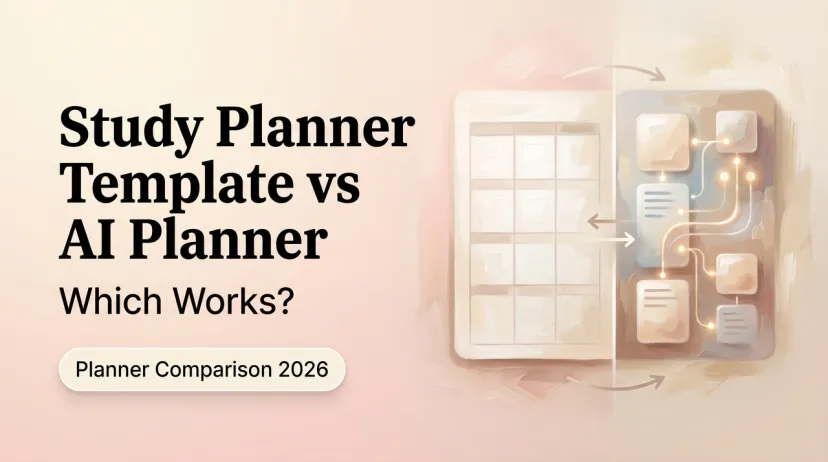
Study Planner Template vs AI Planner: Which Works?
Study Planner Template vs AI Planner: Which Works?
The question I keep hearing from friends: "Is a template enough, or do I need to pay for AI?" It's a fair question, and the answer isn't what you'd expect. Templates aren't outdated. AI planners aren't magic. Both are real tools with real trade-offs.
I'm Anna. This is an attempt to lay them side by side without pushing you toward either.
What a study planner template does well
A template is a pre-made structure — a weekly grid, a semester-at-a-glance calendar, a homework tracker. You fill it in. That's it. No syncing, no subscriptions, no algorithm guessing what you need.
Simplicity, control, and low cost
The case for templates is stronger than people give them credit for. Harvard's Academic Resource Center still recommends a printable weekly schedule broken into hour-long blocks as a starting point for students. That's not a nostalgic recommendation — it's because the act of physically mapping your week is the planning.
Three real advantages:
Simplicity. Nothing to set up. Print or Google Sheets copy, and you're going. Cognitive overhead of learning the tool: zero.
Control. You decide what matters. The plan reflects your judgment about your week, not an algorithm's guess.
Cost. Most templates are free. Paid ones are one-time. Compare to $230 a year for an AI planner, and if your budget is tight, the math changes fast.
One more thing people miss: writing something by hand activates a different kind of commitment than typing it into an app. The plan feels more like yours. Whether that matters is personal.
Where templates break
But templates do break. Pretending they don't is how people end up frustrated three weeks into a semester.
Missed days, changing deadlines, and burnout weeks
A template is static. Life isn't.
The classic failure mode: you skip a planned study block on Tuesday. Now Wednesday's plan is wrong too, because Tuesday's work is sitting on it. By Friday, the whole grid has drifted from reality, and you stop looking at it. The template didn't fail — the rebuild cost failed. Editing a paper planner or rewriting a spreadsheet every time something shifts is work, and when you're already burnt out, you won't do it.
There's cognitive science behind this. Working memory has real limits — that's the core of Sweller's Cognitive Load Theory, the foundational paper on how complex tasks exceed our mental capacity to process them. When your week turns chaotic — a professor shifts a deadline, a group project blows up, you get sick for three days — the mental effort of rearranging a static grid competes with the actual work you need to do. That's when people abandon the plan.
Templates also struggle with changing deadlines. If your assignment due date moves from the 15th to the 22nd, every downstream task in the grid is wrong. Burnout weeks amplify this. When you're already exhausted, the last thing you have energy for is re-gridding your life.
How AI planners differ
Adaptation, reminders, and schedule rebuilding
Where templates ask you to rebuild the grid, AI planners rebuild it for you. That's the main difference, and it's meaningful.
When a deadline shifts or you miss a block, tools like Motion or Reclaim.ai automatically redistribute remaining tasks across your available time. You don't re-plan — you just keep working. The Decision Lab describes how structured systems reduce extraneous cognitive load — the kind of mental effort spent on organizing information rather than doing the work itself. A good AI planner offloads that second kind of load. It also sends reminders, which, depending on who you are, is either helpful or annoying.
The trade-off: AI planners require upfront setup. You have to teach them your constraints, priorities, and deadlines. They cost money (most good ones are paid). And they can confidently generate bad schedules — placing deep work at 8am when you're useless before 10.
They also, subtly, change your relationship with the plan. You stop thinking about your week. The AI does.
Neither column is strictly better. The right choice depends on how volatile your schedule actually is and how much mental energy you can spare for rebuilding plans.
Best-fit scenarios
Who should choose template vs AI planner
A template is probably enough if:
Your schedule is stable week to week
You have 3–5 classes with predictable homework
You like the act of planning (or even find it calming)
Your budget for tools is low
You've tried AI planners before and abandoned them
Most students I know fall into this group. University learning centers like Dartmouth's Academic Skills Center publish weekly and term templates for exactly this audience — they work, and they're free.
An AI planner makes more sense if:
Your schedule genuinely shifts weekly (internships, part-time jobs, multiple group projects)
You've tried templates and the rebuild cost kept killing them for you
You have executive function challenges and the "what do I do next" decision is the hard part
You can absorb the monthly cost without stress
The honest middle ground most people land in: a template for the big picture (semester deadlines, weekly rhythm), plus an app or free AI tool (Google Calendar, ChatGPT) for the day-to-day reshuffles. You don't have to pick one.
Risks and trade-offs
Overdependence, clutter, and learning curve
Every tool comes with costs. Being honest about both sides:
Template risks. The main one is silent abandonment. You fill it out in week one, miss a day in week three, and it slowly becomes clutter. A paper planner half-full of crossed-out dates can start to feel like evidence of failure, even when you're actually doing fine. The fix is treating the template as disposable — one sheet per week, trash it Sunday — not as a log of your life.
AI planner risks. Overdependence is the real one. Research on human reliance on AI in decision-making shows people tend to trust algorithmic recommendations more than they should, even when the underlying logic is shaky. When a polished schedule appears on your screen, it's easy to treat it as authoritative. It isn't. It's a guess based on what you told it, and you told it incomplete information.
The learning curve of AI planners is real too. Most need a week or two before they're useful. If you try one the week before finals, you'll get the worst of it.
And there's a quieter cost: the more your schedule is managed for you, the less you practice managing it yourself. That skill — estimating how long things take, reading your own energy, protecting the evenings that matter — only develops through doing. Handing it over wholesale is convenient, and also a small loss.
FAQ
Is a template really enough for college? For many students, yes. If your week is stable and you have a habit of checking the plan, a template covers you. The rebuild cost is the deciding factor.
Can I use both? Yes, and many students do. A semester-at-a-glance template for the big view, a digital tool for weekly reshuffles. They're not mutually exclusive.
Why do AI planners cost so much? Scheduling algorithms are genuinely hard, and the good ones sit on top of cloud infrastructure. That said, $29 a month is a lot for a student. Free tiers (Reclaim Lite, ChatGPT planning prompts) cover the basics.
How do I know if a template is working for me? Check on a Sunday — did you look at it during the week? Did the plan match reality? If yes to both, it's working. If you stopped looking by Wednesday, the format isn't fitting your life.
What if I'm torn between the two? Start with a template for one month. If it works, save your money. If it keeps breaking, try a free AI tool before paying for one.
The most useful frame I've landed on: templates and AI planners aren't rivals. They're different solutions to different problems. Templates solve the "I need a structure to think in" problem. AI solves the "my week keeps changing faster than I can keep up" problem. If one of those is your actual problem, the answer is obvious. If neither is, don't buy a tool for a problem you don't have.
Hi, I'm Anna, an AI exploration blogger!
After three years in the workforce, I caught the AI wave—it transformed my job and daily life. While it brought endless convenience, it also kept me constantly learning. As someone who loves exploring and sharing, I use AI to streamline tasks and projects: I tap into it to organize routines, test surprises, or deal with mishaps. If you're riding this wave too, join me in exploring and discovering more fun!