Claude Opus 4.8 vs 4.7: Is It Better for Daily Use?
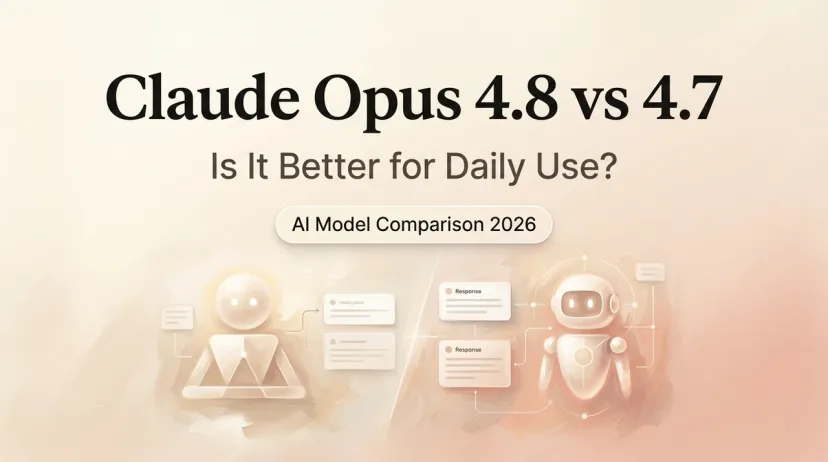
Claude Opus 4.8 vs 4.7: Is It Better for Daily Use?
I'm Anna — I write about living with AI in the small, ordinary ways. Not productivity hacks. Just what it actually feels like when a new model shows up and you have to decide whether to care.
Anthropic released Claude Opus 4.8 on May 28, 2026. I saw the announcement, skimmed it, and honestly thought: okay, another version number. Do I need to pay attention?
Then I noticed something in the release notes that wasn't about benchmarks or coding. It was about honesty — that 4.8 is designed to say I'm not sure more often instead of pressing forward like it definitely knows. That made me pause longer than any performance chart would have.
If you use Claude mainly for thinking out loud, planning your week, getting a second opinion on a decision — this is the comparison that mattered to me. Not numbers on a benchmark. Just: did anything actually change for how it feels to work with day-to-day?
Why Opus 4.7 Is the Right Comparison Point
There's a version of this article that compares 4.8 to every model in the lineup. I'm not writing that one.
For daily use, claude opus 4.7 was the version many people actually settled into. It was capable, it handled long conversations reasonably well, and it became a kind of default. But it also had a reputation — in communities I follow, at least — for being a little preachy. A little hedgy in ways that felt performative rather than genuinely careful. You'd ask a plain question and get a response that felt like it was managing you.
So when 4.8 launched, the comparison that mattered wasn't "how does it stack up against GPT-5.5?" It was: did it fix the things that were quietly annoying about 4.7?
What Changed According to Anthropic
The official Claude Opus 4.8 announcement describes this as "a modest but tangible improvement" on 4.7. Which is honest positioning, actually. They're not claiming a revolution.
Honesty and Uncertainty
This is the one that interested me most.
Anthropic says 4.8 is around four times less likely than 4.7 to let flaws in its own work pass without flagging them. The framing in the release notes is about code — but the underlying behavior matters beyond coding. What they're describing is a model that's more likely to say I'm not confident about this part rather than presenting everything with the same flat tone of certainty.
For daily use, that's meaningful. When I ask Claude to help me think through a decision — whether to take on a project, how to handle a conversation I'm dreading — I don't want it to sound certain when it isn't. I want it to reason out loud and flag where it's guessing. 4.8, at least in early reports, does that more. It tends to say things like "I'd caveat this with…" or flag when it's working from incomplete information rather than papering over the gap.
One reviewer at Simon Willison's notes that 4.8 achieved the lowest incorrect-rate across benchmarks mainly by abstaining on questions it wasn't confident about — rather than guessing and getting it right. That's the kind of behavior I actually prefer. Confident wrong answers are worse than admitted uncertainty.
Long-Context Behavior
The Claude Opus 4.8 release notes highlight improvements in long-context handling. Conversations that run long — lots of back and forth, accumulated context, notes you've shared — should hold together better. 4.7 could start to lose the thread. 4.8 is reportedly more consistent about carrying earlier context forward without prompting.
For someone using Claude as a thinking partner over the course of a week, this matters more than any single-turn benchmark.
Tool and Reasoning Reliability
There's a fix for what they describe as "skipping a tool call that the task required." More developer-facing, but the underlying behavior — following through on what was asked rather than quietly leaving a step out — shows up in everyday tasks too. If you ask Claude to help you structure a multi-step plan and work through it, 4.8 is less likely to hand you a skeleton and stop.
Daily-Use Differences You May Notice
Benchmarks tell you how a model performs on structured tests. They don't tell you how it feels to ask it a question at 9pm when you're trying to figure out whether to say yes to something.
Asking for Advice
This is where the honesty improvement shows up most noticeably for me.
With 4.7, advice could sometimes feel over-confident. You'd describe a situation, and you'd get a response that sounded authoritative — which is fine when the model has good information, and slightly annoying when it doesn't. 4.8 is more likely to lay out a few angles and flag where the answer depends on things it doesn't know about your situation.
For a claude opus 4.8 daily use situation like "should I take on this extra project?" — 4.8 is more likely to give you something that genuinely helps you think rather than something that sounds like a decision you didn't make yourself.
Writing and Editing
The improvement here is subtler. One of the testers quoted in Anthropic's announcement — a staff writer at a creative tools company — said 4.8 is "better at carrying context and style direction across a long session." That matches what I'd want for editing work: if I establish early on that I want a specific tone, 4.8 is more likely to hold that through a long session without drifting.
For the claude opus 4.8 review being written by someone who uses it for writing support: it's an improvement, but not a dramatic one. The gap between 4.7 and 4.8 on writing is smaller than the gap on honesty and reasoning.
Planning and Decision Support
Planning is where long-context handling makes the most difference. When you're working through something over multiple turns — mapping out a month, thinking through a complex situation with lots of moving parts — the ability to hold all of it without losing earlier details is what you're actually paying for.
4.8 handles this more gracefully than 4.7. Conversations don't feel like they're fighting against a context limit. The model references earlier parts of the conversation more naturally. For planning sessions that involve building on earlier ideas, this is where the upgrade earns its keep for ordinary users.
What Benchmarks Do Not Tell You
The numbers that get reported most with these claude 4.8 upgrade releases are about coding performance and agentic tasks. Useful if you're building software. Less useful if you're using Claude to think through your week.
The improvements that matter more for everyday use — honesty calibration, uncertainty handling, long-context consistency — are harder to put numbers on. They show up in feel, not charts.
Worth knowing: Anthropic's approach to training honesty, rooted in their Constitutional AI research, is built into how 4.8 behaves. The changes to uncertainty-flagging came from that foundation, not from surface-level prompt adjustments. That's worth understanding when you're deciding how much weight to put on the "more honest" framing.
Who Should Try Opus 4.8 Now
If you use Claude for planning, writing, or working through decisions — and you've sometimes felt like 4.7 was a little too confident, or lost the thread in longer conversations — 4.8 is worth switching to. The honesty improvements compound. A model that flags its own uncertainty is easier to calibrate against.
The price is the same as 4.7, so there's no cost reason to hold off. If you're on a plan that includes Opus, just check which model you're on and switch.
Who Can Wait
If you're happy with 4.7 and your use cases are mostly short, self-contained tasks — quick questions, one-off drafts — the difference may not be noticeable. The improvements in 4.8 compound over longer sessions and more complex tasks. For a quick question, both models are roughly equivalent.
One thing worth checking: Claude.ai automatically serves the current recommended model by default, so depending on your plan, you may already be on 4.8 without having switched manually.
FAQ
Is Claude Opus 4.8 better than 4.7?
For most use cases, yes — especially anything involving longer conversations, decision support, or situations where you want the model to flag its own uncertainty. The improvements are real but not dramatic. Anthropic's own description is "modest but tangible," which I think is accurate. Don't expect a completely different experience. Do expect a slightly more honest one.
The headline changes: improved honesty and uncertainty-flagging (around four times less likely to let its own errors pass unremarked), better long-context handling across extended conversations, more reliable tool use, and an adaptive reasoning system that only uses extended thinking when the task actually needs it. The price stayed the same. The context window is still 1 million tokens. Knowledge cutoff is January 2026 — same as 4.7. More detail is in the official Anthropic release notes.
Should I upgrade if I liked Opus 4.6 or 4.7?
If you liked 4.6, 4.8 is a meaningful upgrade — Anthropic fixed things that appeared in 4.7 specifically. One developer quoted in the launch notes said 4.8 "fixes the comment-verbosity and tool-calling issues we saw with Opus 4.7." If you liked 4.7, the upgrade is smaller but still worth it for the honesty improvements. No cost difference, so not much reason to wait.
Is Opus 4.8 better for personal planning and writing?
For planning — yes, mainly because of long-context improvements. For writing, it depends. Style consistency over long sessions is better. For short one-off drafts, you probably won't notice much difference versus 4.7.
I'm still thinking about the honesty part, honestly. There's something interesting about an AI model being trained to say "I don't know" more clearly. It makes it easier to trust the parts where it does sound confident. I'll keep noticing.
Hi, I'm Anna, an AI exploration blogger!
After three years in the workforce, I caught the AI wave—it transformed my job and daily life. While it brought endless convenience, it also kept me constantly learning. As someone who loves exploring and sharing, I use AI to streamline tasks and projects: I tap into it to organize routines, test surprises, or deal with mishaps. If you're riding this wave too, join me in exploring and discovering more fun!