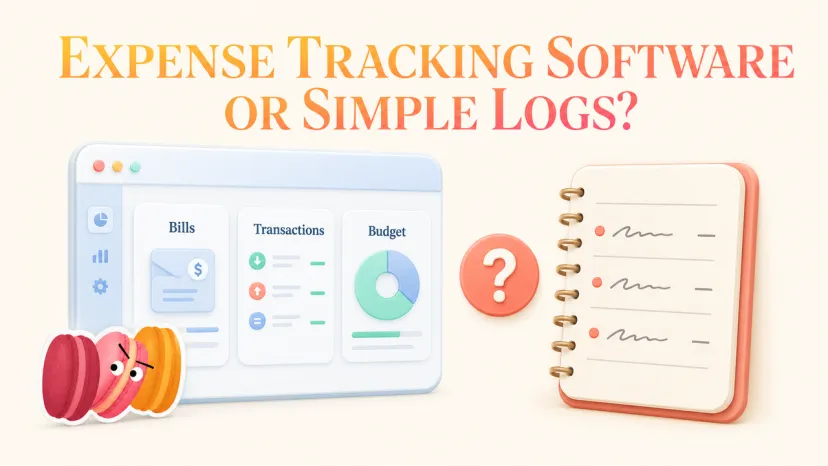
The export finished, and I sat there staring at forty auto-generated categories — "Merchandise," "Misc," "Service Fee," three different rows for the same coffee shop. I'd downloaded expense tracking software because I wanted to know where my money went. Instead I was now doing data cleanup on a Tuesday night, which is not a hobby I asked for.
Here's the split this whole piece is about: some people need expense tracking software, and some people just need a place to write things down. If your real goal is awareness — where is this going, and why does the end of the month always surprise me — a plain spending log might be all you need. This article gives you a way to tell which camp you're in, plus a lightweight method for keeping track of expenses that doesn't involve installing anything new.
"Maren, why are you still typing this into a notes app — just sync your bank," a coworker asked when she saw my screen. Fair question. The answer is that for what I actually wanted, the notes app won. But that's not true for everyone, and pretending it is would be the lazy version of this article.
When Expense Tracking Software Is Worth It
Software earns its place when you need the machine to do something a human writing in a notebook can't. The federal CFPB spending tracker is free and paper-simple, which is a useful baseline: if you find yourself wanting more than that, software starts making sense.
You need reports, categories, or shared budgets
If you're splitting costs with a partner, running a side gig alongside personal spending, or you genuinely want a pie chart of where your grocery money goes versus your eating-out money, that's a real job for a tool. A finance planner you build by hand will collapse under that weight. Category rollups, month-over-month comparisons, a shared money planner two people can both see — this is where a transaction register app pulls ahead of any notebook.
You want bank sync or receipt-level detail
The other clear case: you want every transaction pulled in automatically, tagged, and searchable. Bank-sync tools and a proper bill planner that pings you before the due date are worth real money if late fees or missed subscriptions are your actual problem. The catch I ran into — and it's worth naming — is that sync isn't free of effort. Someone still has to fix the miscategorized rows. The machine guesses; you correct. For some people that trade is obviously worth it. For me, on a quiet financial life, it wasn't.
When a Simple Spending Log Is Enough
A budget book planner from the dollar store has launched more successful money habits than most apps. University work on spending-control tracking found that the act of recording — not the sophistication of the tool — is what shifts behavior. The writing-down is the intervention.
You just want spending awareness
If your honest goal is "I want to stop being surprised," you need friction, not features. Writing "$14 lunch, didn't need it" by hand does something a silent auto-import doesn't: it makes you notice in the moment. A money planner that runs invisibly in the background can actually remove the one thing you were after — the small pause where you see the number and feel it.
A few bills and the occasional trip
When your financial life is a handful of recurring bills plus the odd travel splurge, software is a sledgehammer. CFPB's own research on why budgeting fails found most people abandon tools that feel like a hassle. A one-line bill pay planner — a sticky note, a recurring phone reminder, a single page in a notebook — survives precisely because it asks almost nothing of you. The simplest version is the one you'll still be doing in March.
How Macaron Helps You Stay Aware
I landed somewhere in the middle, and this is the part that actually stuck. Research on financial self-awareness suggests the feedback loop matters more than the format — so I built mine to be as low-effort as a feedback loop can get.
Remember the recurring costs you log
The thing I kept failing at wasn't tracking — it was remembering what I'd already noticed. I'd clock a sneaky $9 subscription, feel briefly responsible, then forget by next month. So I asked Macaron to hold onto the recurring costs I mention, and surface them when they're about to hit again. It doesn't connect to my bank. It just remembers what I told it, which is the part I was bad at.
A running note in plain language, no extra app
No new dashboard, no categories to maintain. I type "spent 30 on takeout, second time this week" the way I'd text a friend, and it keeps a running plain-language note I can ask about later. That's it. The whole appeal is that there's nothing to maintain.
A simple review habit you'll actually keep
Once a week I ask it what I logged. Not a report — a conversation. "What did I flag this week?" The honest failure here: the weeks I forgot to log anything, there's nothing to review, and it can't invent data I never gave it. It's a mirror, not a bank statement. If you don't write things down, it has nothing to reflect.
What This Article Won't Tell You
This is a tracking-awareness piece, full stop. A useful boundary to draw — the kind of bill calendar approach state consumer agencies recommend is about seeing your money, not deciding what to do with it.
Investing, debt, tax, or legal calls
I'm not telling you how to invest, how to prioritize which debt to pay, what's deductible, how to handle credit, or anything insurance- or legal-related. Those are real decisions with real consequences, and they belong with a licensed professional who knows your full situation — not a blog, and not a notes app. Awareness of where your money goes is the floor. The decisions you build on top of it are a different conversation, and an important one to have with someone qualified.
FAQ
Do I need expense software, or is a plain spending log enough?
The dividing line is shared accounts: a budget book planner can't reconcile two people's spending, while a transaction register app can. Unless you're splitting finances or need exportable tax records, the log usually wins on adherence. Solo spenders with simple lives rarely outgrow paper.
What's the simplest way to start tracking spending?
Skip categories entirely for the first stretch — a bare money planner with one column beats an elaborate finance planner you abandon by day four. Record only discretionary buys, not fixed rent or utilities; those don't need watching. Adding structure before the habit holds is the common trap.
When should I bring a financial professional in?
Bring in a fiduciary advisor the moment tracking surfaces a decision a bill planner can't hold — debt prioritization, tax-loss questions, insurance gaps. A CPA or CFP reads your full picture; a spending log only shows the past. Awareness is the trigger to escalate, not the answer itself.
If your life is genuinely complex — multiple accounts, shared finances, a business — get the software; it's built for you. If you just want to stop flinching at your statements, start with a notebook tonight and see how far the noticing gets you. You can always graduate up.
I’m Maren, a 27-year-old content strategist and perpetual self-experimenter. I test AI tools and micro-habits in real daily life, noting what breaks, what sticks, and what actually saves time. My approach isn’t about features—it’s about friction, adjustments, and honest results. I share insights from experiments that survive a real week, helping others see what works without the fluff.