TSA Checks Container Size, Not What Is Left Inside
What Counts as a Liquid, Gel, Cream, or Aerosol
Common Exceptions to Verify Before You Fly
How to Pack Liquids So Security Is Easier
Add Liquids to a Pre-Flight Memory Checklist
FAQ
How Many Ounces Can You Take on a Plane?
How Many Ounces Can You Take on a Plane?
The rule is simple. The way TSA actually enforces it is where most travelers get tripped up — and why people who think they followed the rule still end up handing over a half-empty bottle at the checkpoint.
Three numbers do most of the work: 3.4 ounces, one quart-sized bag, one bag per passenger. That's the entire framework. But if you're asking how many ounces can you take on a plane, the honest answer isn't just the number — it's the way TSA looks at your container, not what's inside it. That second part is where I've watched friends, family, and one extremely confident coworker lose perfectly good skincare at the bin.
A friend texted from the airport last week: "Maren, do they actually measure what's in the bottle, or just look at the label?" She was standing in the bin line at SFO holding a barely-used 6 oz lotion, trying to decide whether to dump half of it into a hotel cup. The answer is the label — and the rest of this piece is the version of that answer I wish someone had told me before my first denied bottle. Below: the rules behind 3-1-1, the exceptions worth knowing, and the part about container size that nobody seems to explain clearly.
The 2026 U.S. Carry-On Liquid Rule in One Answer
For travelers flying within the United States, the carry-on liquid rule is still theTSA 3-1-1 standard. As of mid-2026, this hasn't structurally changed, despite rumors that float around every time TSA updates checkpoint technology. According to TSA's liquids rule page, the policy is:
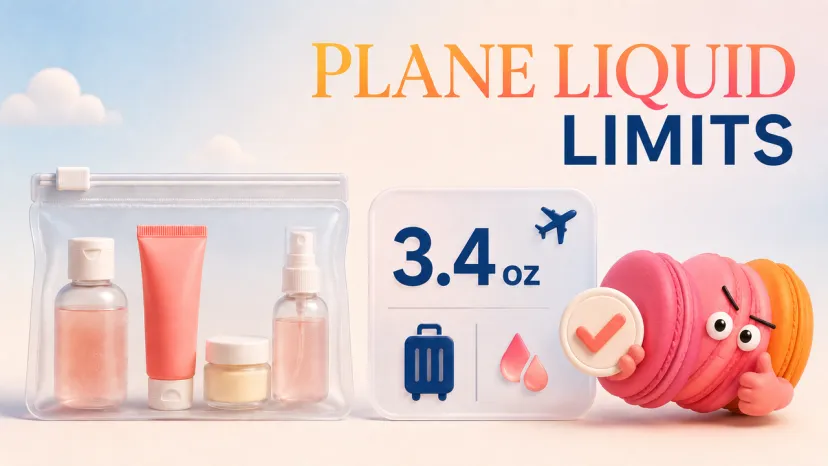
3.4 oz / 100 ml per container
Each liquid, gel, cream, paste, or aerosol container in your carry-on must be 3.4 ounces (100 milliliters) or smaller. This is the per-container limit, not a total volume cap on your liquids.
One quart-sized liquids bag
All those small containers go into one clear, quart-sized resealable bag (about 7" × 8"). The bag must close — if it bulges open, expect a second look or a discard.
One bag per passenger
You get one liquids bag per traveler. Children's items in the same bag are fine; a second adult-sized bag isn't. The bag comes out of your carry-on at screening unless you're in a TSA PreCheck lane or at a checkpoint with newer CT scanners that don't require removal.
So if someone asks how many oz can you take on a plane in a single container — 3.4. If they're asking how much liquid can you bring on a plane in total — as much as fits in one quart bag, in containers of 3.4 oz or less.
TSA Checks Container Size, Not What Is Left Inside
This is the part that breaks most people's mental model, and it's worth slowing down for.
Why a large bottle with a small amount may still fail
TSA officers evaluate the labeled capacity of the container, not the amount of liquid remaining inside it. A 6 oz shampoo bottle with one inch of shampoo left is still a 6 oz container. It can be denied. I've watched it happen at SFO twice — both times the traveler said some version of "but it's almost empty," and both times the bottle went in the bin.
The reasoning is operational: officers screen thousands of bags an hour. They can't measure remaining liquid in each bottle. The labeled or visible size of the container is the fast check.
Why travel-size containers matter
This is why reusable travel-size containers (1–3 oz silicone bottles, GoToob-style refillables) are worth the small upfront cost. You decant your full-size shampoo into a 2 oz bottle, and the container itself is now compliant — regardless of how full it is.
If you're packing for a trip and reaching for the half-used 8 oz lotion thinking it's only got a couple ounces left, that logic doesn't survive the checkpoint. Decant or pack it in checked luggage.
What Counts as a Liquid, Gel, Cream, or Aerosol
This category is broader than most travelers think. If it pours, spreads, sprays, or squeezes, TSA likely treats it as a liquid.
Toiletries
Shampoo, conditioner, body wash, lotion, sunscreen (including stick formulas in some cases), liquid soap, mouthwash, contact lens solution, hair gel, hair spray, deodorant in roll-on or aerosol form. Stick deodorant is generally fine in any size.
Drinks and spreadable foods
Water, juice, coffee, soda, alcohol — all liquid. Peanut butter, hummus, jam, yogurt, salsa, soft cheese, and even creamy soups are treated as liquids. This catches travelers off guard more than anything else. A jar of homemade jam from a farmer's market under 3.4 oz can fly carry-on; a 12 oz one cannot.
Makeup and skincare
Liquid foundation, mascara, lip gloss, liquid eyeliner, cream blush, serums, toners, and most "essence" products count. Powders, pressed makeup, solid lipstick, and balm sticks generally don't. Aerosol setting sprays follow standard liquid rules and the FAA PackSafe hazmat list also applies to flammable aerosols — some are restricted entirely regardless of size.
Common Exceptions to Verify Before You Fly
These are real exceptions, but they require declaration at the checkpoint. Don't assume they sail through silently — and don't assume airline staff at the gate know the rules better than TSA. DOT passenger protections cover what you're entitled to ask for at the airport.
Medication
Liquid medications (prescription and OTC) are exempt from the 3.4 oz rule in "reasonable quantities for the flight." This includes insulin, eye drops, liquid cough medicine, and contact lens solution if declared medical. You must tell the officer at the start of screening; they'll often inspect the bottle separately. TSA special procedures cover this in more detail, and bringing the original labeled container reduces friction.
Baby and child items
Breast milk, formula, juice for infants and toddlers, and baby food are exempt and can exceed 3.4 oz. Declare them. Ice packs to keep them cold are also allowed, even if partially melted at the time of screening.
Duty-free liquids
If you buy liquids at a duty-free shop after security or on an international leg, they may be allowed in larger sizes inside a sealed STEB (security tamper-evident bag) with the receipt visible. For connecting flights through the U.S., CBP duty-free guidance is the source to verify — the rules depend on origin country, connection time, and whether the bag is opened.
How to Pack Liquids So Security Is Easier
This is execution, not policy. Three habits move screening from a 4-minute fumble to under 90 seconds.
Keep them accessible
The liquids bag goes in the outermost pocket or top layer of your carry-on. Not buried under three packing cubes. If a CT scanner lane lets you keep it inside the bag, great. If not, you can pull it in two seconds rather than unpacking everything.
Use leak protection
Cabin pressure changes during ascent and descent. A bottle that didn't leak on the ground will sometimes leak at 35,000 feet because the air inside expands. Tighten caps, then add a small piece of plastic wrap under the lid before closing. Or use bottles designed for travel — the silicone tube types rarely fail.
Check airport and airline rules
Some airports (especially those with new CT scanner technology) have started piloting relaxed liquid rules, but this is not yet a nationwide policy as of 2026. Don't assume a story you read about one airport applies to your departure airport. Verify the day before.
Add Liquids to a Pre-Flight Memory Checklist
Most of the friction at security comes from forgetting which items count as liquids, not from breaking the rules deliberately. A small checklist solves it once.
Save personal toiletries
Whatever you usually carry — your shampoo, your contact solution, your specific moisturizer — list those once with their volumes. Next trip, you check the list instead of opening the bathroom cabinet at 6 a.m.
Flag items that need official rule checks
Anything you're unsure about (a new prescription, a powder-liquid hybrid, an unusual aerosol) gets a flag on the list to verify against TSA the day before. Mayo Clinic flight tips covers medication-specific packing well, especially for travelers with regular prescriptions.
Reuse the checklist before every flight
The point isn't a perfect list. The point is you stop re-deciding the same questions every trip. After three flights, you'll know your own liquids inventory better than the TSA officer screening it.
FAQ
Is the liquid limit per bottle or total?
Per bottle. Each container must be 3.4 oz / 100 ml or smaller. The total volume across all containers is limited by what fits in one quart-sized bag — usually 6–9 small containers depending on shape.
Does toothpaste count as a liquid on a plane?
Yes. Toothpaste is treated as a gel. A 6 oz tube doesn't qualify even if it's mostly empty. Use a travel-size tube (most drugstores sell 0.85–3 oz versions) or pack it in checked luggage.
Can I bring full-size shampoo in checked luggage?
Yes, with limits. Checked bags allow much larger liquid quantities. There's no 3.4 oz rule for checked baggage, though FAA hazmat rules still restrict aerosols, flammables, and some specific products. Wrap bottles in plastic bags to contain leaks from pressure changes.
Are medication liquids treated differently?
Yes. Prescription and necessary OTC liquid medications can exceed 3.4 oz in carry-on if declared at screening. Bring them in original labeled containers when possible and tell the officer before your bag goes through the scanner.
Where should I check the latest airport liquid rules?
TSA.gov is the source of truth. Some airports test new equipment that affects liquid screening, but unless TSA officially updates the national rule, 3-1-1 still applies. Check the day of your flight if you've heard about any recent changes at your departure airport.
If you're flying in the next two weeks, the checklist above is worth twenty minutes of setup tonight. Decant once, list once, then stop thinking about it. That's the whole win — not a perfect packing system, just one fewer thing to re-figure out at 5 a.m. the morning of a flight.
I’m Maren, a 27-year-old content strategist and perpetual self-experimenter. I test AI tools and micro-habits in real daily life, noting what breaks, what sticks, and what actually saves time. My approach isn’t about features—it’s about friction, adjustments, and honest results. I share insights from experiments that survive a real week, helping others see what works without the fluff.