Why Personalized Christmas Gifts Are Easy to Get Wrong
Christmas Gift Ideas by Relationship
Personalization Formats That Work
How to Plan Christmas Gifts Without Repeating Yourself
How Macaron Can Help With Holiday Gift Memory
FAQ
Personalized Christmas Gifts With Real Meaning
Personalized Christmas Gifts With Real Meaning
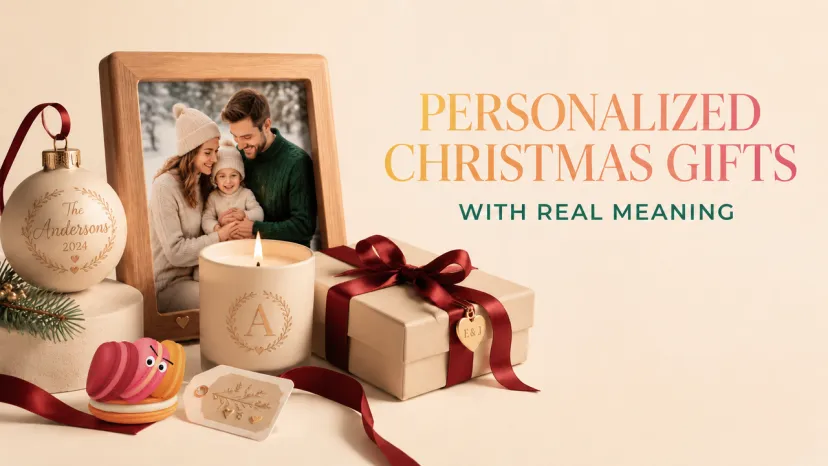
Most personalized Christmas gifts fail at the personalization step — not the gift step.
The problem is treating personalization as a feature instead of a connection. A name engraved on a generic mug is still a generic mug. A photo printed on a blanket of someone you see twice a year isn't a memory — it's a logistics decision made in late November. What follows is a relationship-by-relationship approach, four formats that actually carry meaning, and a way to stop starting from zero every December.
A friend started calling it "Maren's holiday memory problem" after the third year I asked her what I'd given her mother the Christmas before — between client briefs, in the same week I was supposed to be finalizing gifts for nine other people. The problem wasn't the gifts. It was that I had no system for remembering which year held which gift, which preference had shifted, and which idea I'd already used and quietly retired.
Why Personalized Christmas Gifts Are Easy to Get Wrong
The shortcut version of personalization is the part that fails. Add a name. Add a date. Add a photo. Done. The recipient opens it, says thank you, and the gift quietly joins the pile of objects with their name on them.
There's actual research on this. Studies on the psychology of gift-giving suggest givers consistently overestimate how much recipients value the "wow" factor and underestimate how much they value gifts that match stated preferences.
Generic personalization
A monogrammed leather notebook is a beautiful object. It's also the same beautiful object thousands of other people received this year. The personalization layer is real, but it's not specific. Specific means: this gift could only be for this person.
Last-minute choices
December 19th decisions are where personalization quality collapses. You pick the option that ships fastest, which means you pick from a smaller pool, which means you pick something close-enough rather than right.
Too many people to shop for
This is the one nobody talks about. Past five recipients, decision fatigue starts producing repeats — same scarf type, same candle range, same "safe" engraved item across multiple family members. The personalization gets thinner the deeper into the list you go.
Christmas Gift Ideas by Relationship
Different relationships ask for different kinds of attention. The APA holiday stress survey tracks how much of December's emotional load comes from trying to apply the same gift logic across very different relationships.
Partner
Research on experiential gift study findings consistently shows shared experiences outperform objects for romantic relationships, so a personalized planner for a trip you're actually going to take often lands better than a luxury keepsake.
Parents and family
Parents tend to value continuity over novelty. A personalized Christmas present for a parent often works best when it builds on something from last year — same format, evolved content. Year one: a photo book of the grandchildren. Year two: the next chapter. They're not looking for surprise. They're looking for proof you were paying attention.
Kids
Kids respond to gifts that acknowledge who they are right now, which is a moving target. The seven-year-old version of your niece is not the same person as the eight-year-old version. Personalized Christmas gifts for kids work when they reference current obsessions, not the general category of "things kids like."
Friends
Friends are where most people overshop and under-personalize. A small, specific, unique personalized Christmas gift — something that references a conversation, a shared frustration, a half-joke — almost always lands harder than a thoughtful-but-generic candle set.
Personalization Formats That Work
Format matters less than fit, but some formats consistently carry more meaning than others. A PMC study on memory value found that memories rich in social context produce stronger emotional response than those tied only to abstract sentiment.
Engraved gifts
Engraved gifts for Christmas work when the engraving is specific, not decorative. A name on a pen is decoration. A date that means something — a phrase from a real conversation, a coordinate of a place that matters — is a memory anchor. The engraving should be the kind of thing the recipient could explain to a stranger and have it actually mean something.
Photo gifts
Christmas photo gifts and photo xmas gifts fall apart when they use stock-feeling photos. They land when the photo references a moment, not a pose. A candid from a trip beats a posed family portrait nine times out of ten. The exception: posed photos of people who are no longer around. Those have their own weight.
Family-name gifts
Family-name gifts (the surname on a sign, the wedding-date wall art) work for new milestones — a first home, a first married Christmas, a new baby. They stop working when they're applied to relationships that have been stable for decades. The signal "this is new" is doing most of the emotional work.
Keepsake ornaments or decor
This is one of the few formats where the annual repetition is the point. A dated ornament from each Christmas builds a record over time. It's not the individual ornament that matters by year ten — it's the sequence.
How to Plan Christmas Gifts Without Repeating Yourself
The HBR on cognitive fatigue covers this well: by week three of December, most people are making gift decisions on a depleted budget of attention.
Track past gifts
A simple list — recipient, year, gift, reaction — saves you from the most common December mistake: re-giving a variant of something that already underwhelmed. The reaction column matters more than the gift column. A gift that landed well is a signal; a gift that didn't is an even louder one.
Save preferences
When someone mentions liking something in March, that's the actual gift research happening. The hard part is having a place to put it that you'll still be able to find in November. A notes app folder, a shared list, a dedicated tool — almost anything works as long as it survives nine months of life.
Build a yearly gift list
Not a December list. A January-onward list, added to whenever something occurs to you. By November you have material. By December you have options. The shift is from "panic-generation" to "curation."
How Macaron Can Help With Holiday Gift Memory
Holiday gifting is recurring memory work. Same recipients, same approximate windows, slightly different versions of the same people each year. That's a memory problem more than a creativity problem.
Remember what worked last year
A personal AI that actually remembers what you told it months ago is useful here in a specific way: you can mention in March that your sister loved a certain kind of gift, and it'll still be there in November when you need it. No spreadsheet to maintain. No list to lose.
Match gift tone
Different relationships need different tones — playful for some friends, sentimental for parents, specific-and-quiet for a partner. A tool that remembers your preferences and the recipient's history can suggest options that match the tone you've used before, instead of treating every gift query as a blank slate.
Build a Christmas gift mini-app
For people with longer lists, a small custom tool that tracks recipient, past gifts, reactions, current ideas, and budget can replace the December scramble. Not a spreadsheet — something that talks back when you ask "what did I give Dad in 2023?"
FAQ
What are good personalized Christmas gifts that feel meaningful?
Gifts that reference something specific to the recipient — a real memory, a shared moment, a stated preference — consistently feel more meaningful than gifts personalized only at the surface level (name, generic photo, monogram).
Are engraved or photo gifts good for Christmas?
Both work, but only when the engraving or photo is specific. A meaningful date, a real phrase, a candid photo from a shared moment all outperform decorative engravings and posed photos.
How do I plan personalized Christmas gifts without repeating myself every year?
Keep a year-round list of recipient preferences and past gifts with reactions. The reaction column matters more than the gift column. By November you have material to work with instead of starting from zero.
What should I consider when buying personalized gifts for multiple family members?
Decision fatigue produces repeats. The deeper you get into a long list, the more your gifts start to look similar. Either shorten the list or build the list in stages across the year rather than in one December push.
How can memory tools help track past Christmas gifts and preferences?
A tool that remembers what you told it months earlier — preferences mentioned in passing, gifts already given, reactions you logged — replaces the spreadsheet most people don't actually maintain. It turns gift planning from annual panic into ongoing curation.
Worth saying clearly: if your gift list is under three people and you already remember everything, none of this applies to you. A system for five recipients is overhead. A system for fifteen is the difference between thoughtful gifts and December panic. The line is somewhere around seven. Below that, your memory is fine. Above that, something has to carry the weight that your brain is no longer carrying for free.
I’m Maren, a 27-year-old content strategist and perpetual self-experimenter. I test AI tools and micro-habits in real daily life, noting what breaks, what sticks, and what actually saves time. My approach isn’t about features—it’s about friction, adjustments, and honest results. I share insights from experiments that survive a real week, helping others see what works without the fluff.