Hi, I'm Maren. I took it at 11:42 on a Tuesday night. I'd already closed three productivity apps, told myself I was going to sleep, and then my phone lit up with a friend's screenshot: a personality card that just said SHIT. Structure preferences still map better to MBTI P vs J explained. The description underneath it was so accurate that my friend had apparently screamed into a pillow.
I took the test in six minutes. Got CTRL. Read the result. Texted three people. Went to sleep 45 minutes later than planned.
That's the SBTI personality assessment. And if you searched for it expecting something clinical, this article has good news and bad news. The good news is you'll understand it completely by the end. The bad news — or maybe the better news — is that it has absolutely nothing to do with psychology.
SBTI Personality Assessment Overview
SBTI stands for Silly Big Personality Test. Sometimes rendered as "Shit-Based Type Indicator" depending on which version you encounter — and yes, that name is entirely intentional. It was created by a Bilibili content creator operating under the handle "Qrourchuanr," and it borrows the MBTI format but replaces introspection with absurd questions and irreverent personality types.
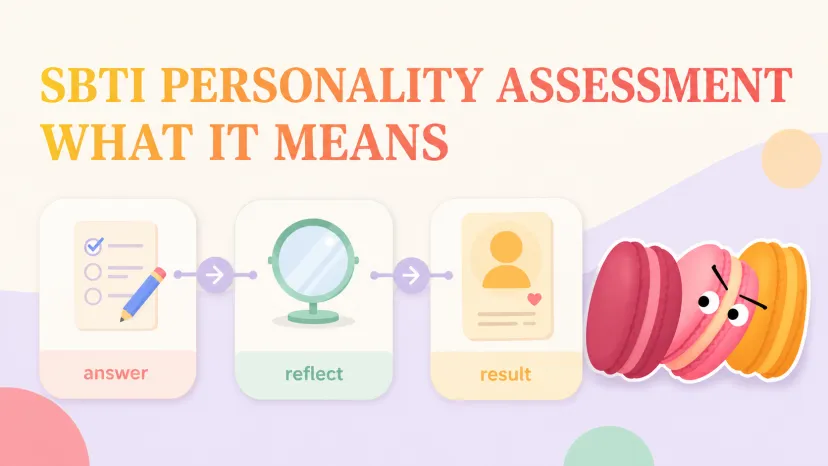
The basic structure will look familiar if you've ever taken any personality quiz online: answer a series of questions, get a result, screenshot it, send it to people who will immediately argue with the label. What's different is everything underneath that familiar shell.
Origin Story
SBTI was originally created as a lighthearted attempt to convince a friend to quit drinking. That's the actual origin. Not a psychology lab. Not a research team. A Bilibili creator who wanted to make a point to someone she knew, built something that accidentally became one of the most shared personality quizzes of 2026.
On April 9, searches for "sbti" on WeChat Index hit 40.85 million, while related discussions reportedly surpassed 20 million across social platforms. Traffic briefly crashed the original link before it was restored. The test went from niche inside joke to international phenomenon in roughly 72 hours.
The creator has stressed that the quiz is not rooted in psychology or science. In a note at the end of the test, she said: "I haven't balanced entertainment and professionalism well, so some personality interpretations are vague or completely inaccurate."
That disclaimer didn't slow anything down.
How the Assessment Works
The SBTI assessment runs on a question-and-answer format similar to the Myers-Briggs Type Indicator, except the Myers-Briggs was developed over decades by Katharine Cook Briggs and Isabel Briggs Myers building on Carl Jung's work, and SBTI was built by someone who wanted her friend to stop drinking. Different vibe.
The SBTI test contains 31 questions and takes less than five minutes. Each question presents four options that reflect different personality traits — choose the answer that feels most like you.
The test maps your responses across fifteen dimensions and produces one of 27 personality types. You get more than a single label — it analyzes things like how stable your self-evaluation is, how you behave in relationships, and whether your plans actually land.
Some of the questions are genuinely funny. One asks what you would do after sitting on the toilet for more than 30 minutes with constipation. Another states: "This question has no topic; please choose blindly."
That last one is peak SBTI. The test is aware of itself.
What Makes SBTI Different from Real Assessments
This is where you need to reset expectations — especially if you arrived here with a work context or any kind of clinical question in mind.
No Psychology, All Vibes
The SBTI personality test has zero scientific basis — it is built for self-deprecation, humor, and easy sharing. The result can feel uncomfortably familiar, but it is still a joke-first test. Treat the result as satire and self-observation, not as a serious decision tool.
That's not a criticism. It's a design feature.
Compare this to something like the MBTI, which Wikipedia documents as a self-report questionnaire with decades of psychometric development — itself subject to significant scientific debate, but at least grounded in a formal theoretical framework from Carl Jung's 1921 work on psychological types. The MBTI has 16 types built on four dichotomies. SBTI has 27 types built on whatever the creator felt captured something true about how people actually exist on the internet.
MBTI says "you're a creative visionary." SBTI says "you're a professional quitter." That raw honesty is exactly why it resonates. Many test-takers say the results are more accurate than paid psychological assessments — which says a lot about how we relate to humor versus science.
SBTI does not really try to tell users who they are in any stable or psychological sense. It works more like a snapshot of how they feel they are functioning at a given moment. The labels are funny, a little absurd, and sometimes a little harsh — but that is also what makes them so shareable.
People repost their SBTI results less as formal self-assessments and more as quick, recognizable jokes about their current state. Getting DEAD — described as someone who ignores hundreds of unread messages but slowly types "Received" when a deadline approaches — doesn't mean you need help. It means you've been recognized. There's a difference.
That small friction got Maren thinking. She'd taken actual personality frameworks before — the Big Five personality traits, career assessments, the MBTI twice. The results were always useful in a vague, nodding way. The SBTI result was different. It was useless as a tool and somehow more memorable than anything genuinely diagnostic had ever been.
Sample Questions and Format
The questions range from mundane to genuinely surreal. A few categories to set expectations:
Relationship scenarios — questions about how you handle silence, whether you check in with people, how many versions of yourself you present in different contexts.
Self-awareness prompts — questions about how confident you are in your own opinions, what you do when you're wrong, how you talk to yourself when things go badly.
Absurdist edge cases — the constipation question. The blind-pick question. A question about whether a friend-of-a-friend is your friend. The creator thoughtfully labeled every personality result "the rarest in all of China." All 27 of them. The rarest.
The format is clean: questions appear one at a time, no timer, no login required, no email to enter. No registration, no hidden fees — just answer 31 questions and get your result instantly.
Special prompts can appear mid-test. The test changes question order between runs, and hidden branch questions can appear in the middle. That makes each attempt feel a little different.
Which also means results can vary between runs. That's not a bug. It's consistent with the overall philosophy of the thing.
Who Is the SBTI Assessment For
Not for anyone making a significant life decision. Not for clinical contexts. Not for team-building if your team is going to take the results seriously. The American Psychological Association's resources on personality will be more useful for anything formal.
Yes for anyone who:
Wants to laugh, and possibly feel slightly exposed in a way that's oddly accurate
Has a group chat that needs something to argue about for 48 hours
Is curious about why a meme quiz can feel more honest than a legitimate framework
Has already taken the test and wants to understand what they actually experienced
SBTI's questions and result descriptions are full of internet slang and cultural references familiar to young people. The test naturally possesses powerful social propagation properties — everyone who finishes gets a shareable personality poster, and seeing a friend's result makes it hard to resist taking it yourself.
That's worth naming if you're thinking about why this spread so fast. It wasn't just the content. It was the social mechanics baked into the format.
Limitations and Criticisms
Worth naming a few things clearly.
The results are not stable. Results may vary each time, purely based on your mood. The test is not recommended for job applications, dating, breakups, fortune-telling, or any decision requiring a brain. You might get CTRL on Tuesday and DEAD on Friday. Both might feel accurate.
The types don't map to anything clinical. If you're hoping to use this for self-understanding in a meaningful psychological sense, you're working with the wrong tool. For that, something like the NEO Personality Inventory or other validated psychometric frameworks would be more appropriate.
The name carries cultural context that doesn't fully translate. Part of the appeal starts with the name itself. "SB" is shorthand for shabi, a crude and strongly offensive Chinese insult, which gives SBTI an irreverent tone from the outset. Some of that edge lands differently outside of its original cultural context.
The creator has been transparent about its limitations. That's actually worth crediting. Most viral quizzes don't include an acknowledgment that some results are "vague or completely inaccurate." This one does.
I ran it three times in a week. Got CTRL, then SEXY, then CTRL again. Showed the SEXY result to a friend who said "that tracks, actually." Showed her the CTRL result. She said "that also tracks." Showed her DEAD, which I got on a test run where I deliberately answered the opposite of my instinct. She said "kind of?"
Worth trying if your setup looks anything like mine — meaning you want to laugh, not diagnose.
FAQ
Is SBTI a legitimate personality assessment?
No, and it says so openly. SBTI is an entertainment quiz with no scientific or psychological basis. The creator explicitly notes the quiz was made for humor and that results are not accurate personality indicators. It's worth distinguishing this from frameworks like the MBTI, which has decades of formal development — even if the MBTI is itself subject to ongoing scientific debate.
Who created the SBTI assessment?
SBTI was created by Bilibili content creator, known for a unique humor style and profound insights into online culture. The creator is not a psychology professional and has not claimed to be. The test began as a personal project and spread organically through social media sharing.
How long does the SBTI assessment take?
Under ten minutes, usually closer to five. There are 31 questions and the whole experience takes less than five minutes for most people. No registration. No wait time. Result appears immediately when you finish.
Can you get a different result if you retake it?
Yes, and that's expected. Results can vary each time based on your mood. Collecting different personality types across attempts is part of the fun — like Pokémon, but the Pokémon are all slight variations of your own current mental state.
Should I use my SBTI result to make decisions?
No. Not career decisions. Not relationship decisions. Not anything requiring evidence-based reasoning. The test is built for entertainment and self-recognition, not for decision support. If you're looking for a personality framework to inform real choices, validated tools based on established psychological research are the better option.
I’m Maren, a 27-year-old content strategist and perpetual self-experimenter. I test AI tools and micro-habits in real daily life, noting what breaks, what sticks, and what actually saves time. My approach isn’t about features—it’s about friction, adjustments, and honest results. I share insights from experiments that survive a real week, helping others see what works without the fluff.