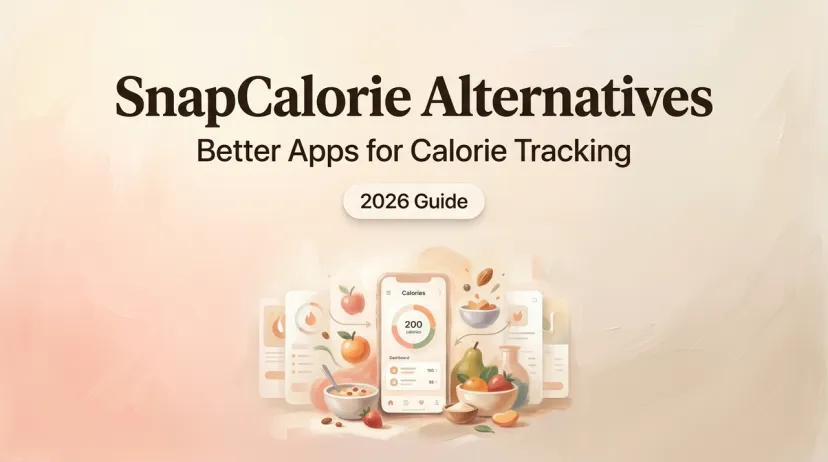
Best SnapCalorie Alternatives for Calorie Tracking
Best SnapCalorie Alternatives for Calorie Tracking
Hey, it’s Anna here!
I've tested six AI calorie trackers over the past 90 days — same meals, same conditions, documented every win and every miss.
The short version: SnapCalorie isn't the obvious choice it used to be. Several alternatives have quietly caught up, and a couple have passed it in ways that actually matter for daily use.
Here's what I found.
Why People Look for SnapCalorie Alternatives
Common Complaints
Let me be honest about what's actually frustrating people. After digging through Reddit threads and App Store reviews, the same issues come up again and again:
Photo recognition misses mixed dishes entirely. A bowl of homemade stir-fry? Good luck getting an accurate read.
The free tier is extremely limited, pushing users toward a subscription before they've seen enough value to commit.
No macro depth. If you care about more than calories — protein splits, net carbs, micronutrients — SnapCalorie feels thin.
Portion estimation is inconsistent. The same plate photographed at different angles returns different calorie counts. That's a trust-killer.
What to Look for in a Replacement
Here's the thing most comparison articles skip: the "best" app depends entirely on how you actually eat and log. Before you download anything, ask yourself:
Do you eat mostly whole foods or a lot of restaurant meals?
Are you tracking calories only, or full macros?
How much are you willing to pay per month?
Do you need barcode scanning as a backup?
Keep those answers in mind as we go through the options. According to Healthline's nutrition tracking research on consistent food logging habits, consistency of logging matters more than perfect accuracy — so the best app is the one you'll actually use daily.
Best SnapCalorie Alternatives Compared
Best for Photo Logging: Lose It!
Lose It! is the closest thing to a drop-in SnapCalorie replacement for photo-first users. Its Snap It feature uses computer vision to identify foods from a photo and has one of the largest verified food databases I tested — over 33 million entries.
What impressed me in real testing: it correctly identified a Thai green curry with jasmine rice on the first try, something two other apps completely whiffed on. The portion estimation slider is intuitive, and you can manually adjust serving size without losing the auto-identified food.Studies on calorie estimation accuracy in AI food recognition show that database size is one of the strongest predictors of overall logging reliability — which is where Lose It! has a real edge.
The free version covers basic logging, but the Premium tier ($39.99/year) unlocks the full AI photo feature. For most people switching from SnapCalorie, this is the most seamless transition.
Where it falls short: meal history learning is slow. It took about two weeks of consistent use before it started suggesting foods I actually eat regularly.
Best Free Option: MyFitnessPal
I know — MyFitnessPal is the obvious answer. But obvious doesn't mean wrong.
The free tier of MyFitnessPal is genuinely the most capable free calorie counter available. The barcode scanner is fast and accurate, the database is enormous, and the community-verified entries mean you'll find almost anything in there, including obscure regional brands.
The AI photo logging feature was added recently and is... fine. It's not as sharp as Lose It! for complex dishes, but for simple meals — a sandwich, a piece of fruit, a protein bar — it gets the job done without any friction. Per MyFitnessPal's own research, users who log consistently for 3+ weeks build habits that stick.
The honest downside: the free version now has more ads than it used to, and the Premium upsell is aggressive. If that friction bothers you, it might nudge you toward a paid alternative anyway.
Best for Macro Tracking: Cronometer
If you're following a specific protocol — keto, carnivore, high-protein cuts, or anything where micronutrients actually matter — Cronometer is in a different league. Given how common micronutrient deficiencies in typical Western diets actually are, having an app that surfaces this data automatically is more useful than most people expect.
It tracks over 80 micronutrients alongside macros, pulls from the USDA database by default (which is about as authoritative as it gets), and surfaces nutritional gaps you didn't know you had. I ran my usual week of eating through it and discovered I was consistently under on magnesium and potassium — data I never would have seen in a calorie-only tracker.
Photo logging isn't its strongest feature. Think of it as a precision instrument, not a quick-snap tool. It's best for people who are serious about the data, not people who want the fastest possible log.
Gold subscription is $9.99/month or $49.99/year — worth it if the micronutrient depth matters to you.
Best AI-Powered All-in-One: Macaron
Here's the one that surprised me most. Macaronisn't marketed as a pure calorie tracker — it's a personal AI that builds custom tools around your actual habits — but its food logging capability is genuinely impressive.
What makes it different: it remembers. After a few weeks of logging, it started prompting me before my usual lunch window, suggesting foods based on my patterns, and flagging when my protein was trending low mid-week. That kind of contextual memory is something the category-specific trackers just don't do.
The one-sentence tool creation is real. I typed "track my daily protein goal of 160g and remind me if I'm behind by 3pm" and had a functioning mini-app in about 30 seconds. No template browsing, no setup wizard. For people who've been frustrated by rigid app structures, this is a genuinely different experience.
It's the right choice if you want AI that adapts to you, rather than you adapting to the app. The community template library also has pre-built nutrition tools if you'd rather start from something than build from scratch.
Side-by-Side Comparison Table
App
Photo Logging
Free Tier
Macro Depth
AI Memory
Best For
Lose It!
⭐⭐⭐⭐⭐
Limited
Good
No
Photo-first users
MyFitnessPal
⭐⭐⭐
Strong
Moderate
No
Budget-conscious
Cronometer
⭐⭐
Basic
⭐⭐⭐⭐⭐
No
Micronutrient tracking
Macaron
⭐⭐⭐⭐
Yes
Good
⭐⭐⭐⭐⭐
AI-personalized habits
How to Choose the Right One
Quick reality check: no single app is the best for everyone. Here's how to cut through the noise.
Choose Lose It! if your primary frustration with SnapCalorie was photo accuracy and you want the most direct replacement. The learning curve is minimal.
Choose MyFitnessPal if you're cost-sensitive and mostly log packaged foods or restaurant meals where barcode scanning is faster than photography anyway.
Choose Cronometer if you're working with a nutritionist, following a therapeutic diet, or simply care deeply about what's happening below the calorie surface. The USDA FoodData Central database it draws from is the gold standard for nutritional accuracy.
Choose Macaron if you're tired of apps that require you to be consistent in a rigid, scheduled way. The memory-based approach means the more you use it, the less work it takes — which is the opposite of most tracker fatigue patterns.
One thing worth noting: logging accuracy matters less than logging consistency, according to nutrition researchers. A tracker you'll use 90% of the time beats a "perfect" tracker you abandon in week two.
Bottom Line
SnapCalorie had a good idea — photo-based AI logging should be effortless. The alternatives have caught up and, in most cases, passed it.
My honest pick after three months of real-world testing:
For pure photo accuracy: Lose It!
For free daily use: MyFitnessPal
For data depth: Cronometer
For an AI that actually learns your habits: Macaron
The best calorie tracking app is the one that fits your real life — not the one with the most impressive demo. Pick the one that matches how you actually eat, and give it a genuine 30-day test before you judge it.
FAQ
Q1: Is there a completely free SnapCalorie alternative with AI photo logging?
MyFitnessPal offers AI-assisted photo logging on its free tier, though with some limitations on daily scans. Macaron also offers a free version with AI capabilities. For full, unrestricted photo logging, most apps require a paid subscription — typically $40–$60 per year.
Q2: Which app is most accurate for mixed dishes and home-cooked meals?
Lose It! consistently performed best in my testing for complex, multi-ingredient dishes. That said, no AI photo tracker is fully accurate for homemade meals — the portion estimation gap is the real challenge. For home cooking, combining photo recognition with a manual portion adjustment tends to give the most reliable results.
Q3: Can I import my SnapCalorie history into another app?
Most major alternatives support CSV import for food logs, but the compatibility depends on what SnapCalorie exports. MyFitnessPal and Cronometer have the most robust import tools. Expect some manual cleanup, especially for custom foods.
Q4: What's the difference between calorie tracking and macro tracking apps?
Calorie-focused apps (like Lose It! in basic mode) prioritize the speed and simplicity of logging your daily energy intake. Macro tracking apps like Cronometer go deeper — tracking protein, fat, carbohydrates, and often micronutrients like iron, zinc, and B vitamins. If you're working toward body composition goals rather than just weight loss, macro tracking data is significantly more useful.
Q5: Is Macaron only for calorie tracking?
No — and that's actually its key differentiator. Macaron is a personal AI assistant that can be customized for nutrition tracking, habit building, and daily life management. You can build a nutrition-specific tool within it, or use community-created templates. It's the right fit if you want more than a single-purpose food logger.
Hi, I'm Anna, an AI exploration blogger!
After three years in the workforce, I caught the AI wave—it transformed my job and daily life. While it brought endless convenience, it also kept me constantly learning. As someone who loves exploring and sharing, I use AI to streamline tasks and projects: I tap into it to organize routines, test surprises, or deal with mishaps. If you're riding this wave too, join me in exploring and discovering more fun!