How to Notice Macros Without Turning Food Into Math
Where This Article Stops
Use Food Memory to Reduce Repetitive Tracking
FAQ
What Are Macros? A Simple Food Tracking Guide
What Are Macros? A Simple Food Tracking Guide
The same breakfast can leave you full till noon one week and starving by ten the next — same calories, different build. That mismatch is the quiet reason people start asking what are macros in the first place. Not because they want a diet. Because something about food stopped adding up.
So here's the plain version. Macros — short for macronutrients — are the three things your body uses in large amounts: protein, carbohydrates, and fat. Calories measure how much energy a food carries. Macros describe what that food is actually made of. Two different questions. This guide walks through what each macro is in everyday meals, why macros aren't the same as calories, and a loose three-step way to notice them without turning lunch into arithmetic. It also marks clearly where this article stops.
That gap between "how much energy" and "what it's built from" is the whole point, and it's easy to miss.
Maren keeps a running note of meals she actually repeats, not the ones she means to cook — and that note turned out to be the easiest way into this topic. More on that later.
What Macros Mean in Everyday Food
Every meal you eat is some mix of three nutrients. The way food breaks down works like this: your body digests it and uses each component differently. None of them is the villain. None is the hero either.
Protein
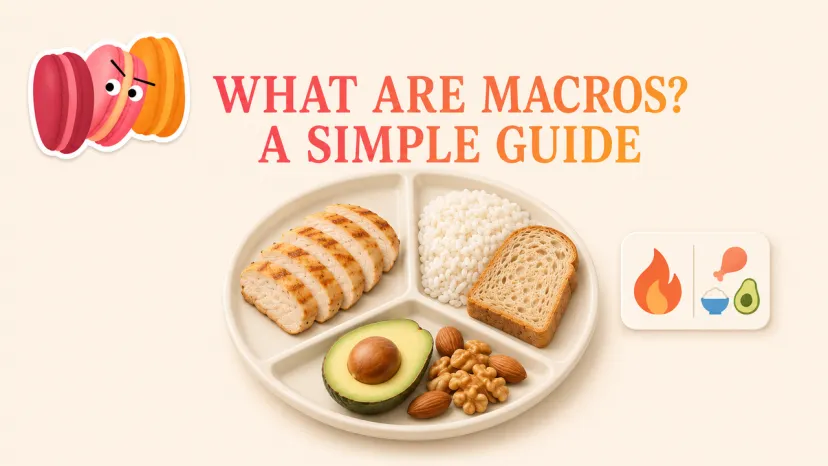
Protein is the repair-and-build material — muscle, skin, enzymes, the stuff that keeps cells doing their jobs. Eggs, chicken, fish, beans, lentils, yogurt, tofu. When a meal "holds you over" longer than you expected, protein is usually part of why.
Carbohydrates
Carbs are your body's quickest fuel. Rice, bread, oats, fruit, potatoes, the sugar in your coffee. They come in simple forms (digest fast) and complex ones (digest slower). If you've ever wondered why there are so many types of carbohydrates, it's because the category stretches from table sugar to a bowl of barley. Same macro. Very different behavior.
Fat
Fat is the slow, dense one — oils, butter, nuts, avocado, the marbling in meat. It carries the most energy per bite and helps you absorb certain vitamins. It's also the macro people fear most and understand least.
Why Macros Are Different From Calories
Here's where the confusion usually lives.
Energy vs composition
A calorie is just a unit of energy. But the three macros don't carry energy equally. The calories per gram split out like this: protein and carbs each give about 4 per gram, fat gives about 9 — more than double. So "300 calories" tells you nothing about whether you just ate a handful of almonds or a plate of rice. The number's the same. The build isn't.
Why the same calories can feel different
This is the part that surprised me. Two meals at identical calories can land in your body completely differently, and there's research on macros and appetite suggesting the macros — not just the calorie total — shape how full you feel and how long it lasts. That's why my "same breakfast, different hunger" mystery wasn't a mystery at all. One week the breakfast leaned carb-heavy. The other, more protein. Same calories on paper. Different afternoon entirely.
How to Notice Macros Without Turning Food Into Math
I tried the full tracking-app route once. Weighed my oatmeal on a kitchen scale. Lasted four days before I started resenting breakfast. So this is the version that actually stuck — no logging every bite.
Start with repeated meals
Most people eat maybe five to eight meals on rotation. You don't have a thousand foods to analyze — you have a short list. Look at the three or four meals you eat most weeks and just name what's in each: protein? carb? fat? That's it. No numbers.
Notice which macro is missing most often
Once you can see your regulars, a pattern shows up fast. For a lot of people it's protein that's thin — there's a PubMed review on protein and satiety pointing to why a protein-light meal can leave you rummaging the cupboard an hour later. You're not looking to "fix" anything. Just to see what's usually absent.
Keep the pattern loose, not perfect
Here's the honest failure part: the first time I did this, I overcorrected. Started mentally grading every meal, got twitchy about a lunch that was "all carbs," skipped the thing I actually wanted. That's the exact opposite of useful. The loose version — noticing, not scoring — is the one that lasts. Tight tracking lasted four days. Loose noticing, I still do.
Where This Article Stops
This matters, so I'm being blunt about it.
No personal macro targets
I'm not going to hand you grams-per-day numbers or a ratio to hit. Those depend on your body, your health, your goals, and a professional who actually knows your situation. A general article is the wrong place for personal prescriptions.
No weight-loss prescription
Macro awareness is not a diet plan. This piece is about understanding what are macros in food — the concept — not a method for changing your weight. If that's your goal, that's a conversation for a doctor or registered dietitian.
When tracking becomes stressful
If watching macros starts crowding out the pleasure of eating, or tips into anxiety, counting, or guilt — that's the signal to step back, not push harder. Awareness should make food clearer, not heavier. If it's becoming heavy, talking to a professional is the right move, and there's no failure in that.
Use Food Memory to Reduce Repetitive Tracking
This is where that note I mentioned comes back. The reason loose noticing beats strict logging is that you're not re-analyzing food you already understand — you're just remembering it.
Save meals you already repeat
Instead of logging fresh every day, keep a short memory of the meals you genuinely rotate through. Macaron leans on exactly this: a personal AI that remembers your repeated meals so you're not re-entering the same lunch for the fortieth time. The point isn't tracking more. It's tracking once and letting memory carry it.
Notice patterns across the week
When your regular meals are remembered rather than re-logged, the weekly pattern surfaces on its own — which macro shows up constantly, which one rarely. You see the shape without doing the spreadsheet.
Keep meals flexible instead of score-based
A memory of what you eat should stay descriptive, not turn into a scoreboard. The whole value is in seeing your real patterns gently, then deciding for yourself whether anything's worth a small adjustment. No grades.
FAQ
How do people usually notice their macro patterns without tracking every single meal?
Most rely on contrast, not counting. After a few days you start feeling the difference between a meal that carried you and one that left you foraging by mid-afternoon — that bodily feedback is more reliable than any log. Some people anchor it to energy dips, others to how soon hunger returns. The macros nutrition behind a meal announces itself through how the next few hours go, which is why awareness builds even when no one's writing anything down.
What makes one macro easier to overlook than the others in everyday eating?
Convenience foods decide it for you. Carbs and fat come pre-loaded into most grab-and-go options, so they accumulate without a single decision, while the third macro usually waits on a deliberate choice. Liquid calories and snacks deepen the blind spot, since drinks rarely register as eating at all. The macro that needs you to choose it is the one that quietly goes missing across a normal day.
When does paying attention to macros start to feel too rigid?
When describing turns into judging. Naming what's on the plate is fine; rigidity arrives when a meal earns a verdict — good, bad, off-limits — or when you're rehearsing tomorrow's food at night. The macros definition of a food shouldn't carry a moral grade.
How can someone combine macros awareness with regular calorie tracking without double work?
One glance, read two ways. The calories vs macros split isn't two chores: the number says how much, the rough protein-carb-fat shape says what kind. If you already noted the meal, the macro read is a two-second look at the same plate.
What should you do if tracking macros starts to affect your enjoyment of food?
Loosen first. If counting is draining the pleasure from meals, drop back to plain noticing or set it down entirely — awareness without numbers is a complete approach, not a lesser one. If the unease lingers, a doctor or registered dietitian is the right next step.
Macros are a sensitive area for some people — if any of this is brushing up against food stress or disordered eating for you, that's worth taking to a professional, and reaching out is a strong move, not a small one.
I’m Maren, a 27-year-old content strategist and perpetual self-experimenter. I test AI tools and micro-habits in real daily life, noting what breaks, what sticks, and what actually saves time. My approach isn’t about features—it’s about friction, adjustments, and honest results. I share insights from experiments that survive a real week, helping others see what works without the fluff.