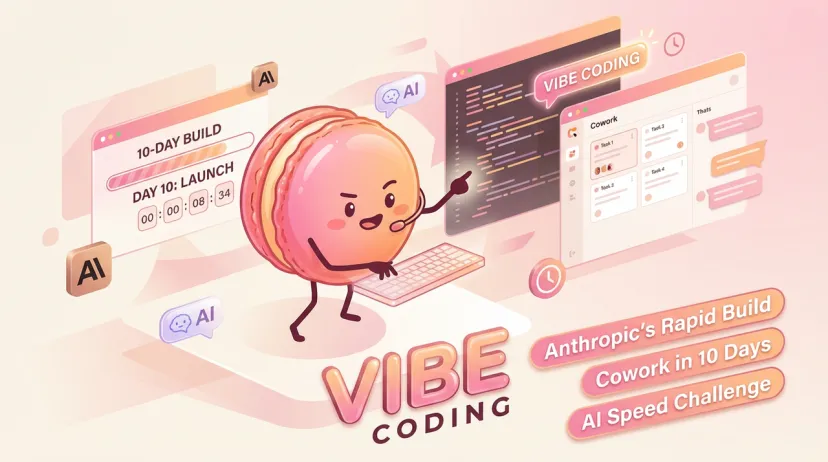
What Is Vibe Coding? How Anthropic Built Cowork in 10 Days
What Is Vibe Coding? How Anthropic Built Cowork in 10 Days
Last month, I watched Anthropic ship Cowork — a full AI agent — in about 10 days. Four engineers. Mostly AI-written code.
That's when "vibe coding" stopped being a buzzword for me.
When something this fast actually ships and works, I need to know: did they just get lucky, or is this repeatable? Can I use this approach in real projects without everything collapsing mid-sprint?
Here's what I found after rebuilding three of my own tools this way: vibe coding flips the script. You describe what you want. AI writes the code. You guide and verify. No syntax wrestling. No boilerplate hell.
The shift isn't subtle. I used to spend hours debugging syntax. Now I'm debugging logic — which is a completely different conversation. Hanks here, and this is the first time I've rebuilt my own workflow automation instead of just testing other people's tools.
Let's break down what's real and what's still risky.
What Is Vibe Coding?
Definition & Origin
Vibe coding is an AI-assisted software development practice where you describe what you want to build in natural language, and large language models (LLMs) generate the code for you.
Computer scientist Andrej Karpathy coined the term in February 2025. He described it as "a new kind of coding where you fully give in to the vibes, embrace exponentials, and forget that the code even exists."
The concept isn't about traditional pair programming. With vibe coding, you're not reviewing every line—you're setting direction, running tests, and asking for improvements based on results.
By March 2025, Merriam-Webster added "vibe coding" to their dictionary. That same month, Y Combinator reported that 25% of startups in their Winter 2025 batch had codebases that were 95% AI-generated.
The term captures something real: you're working by feel, not by syntax.
Instead of thinking "I need a for-loop that iterates through this array," you think "I want this data sorted by date and displayed in a table."
You describe the vibe of what you need. The AI handles implementation.
Karpathy's original framing was about letting go of code-level control and trusting the AI to execute. For experienced developers, this feels weird at first. But it's also freeing—you can focus on what the software should do, not how to write it.
The Claude Cowork Story
Built by 4 Engineers in 10 Days
In January 2026, Anthropic launched Cowork, a general-purpose AI agent that can manage files, create documents, and automate tasks on your computer.
Here's the part that made me stop: Boris Cherny, head of Claude Code at Anthropic, said his team built Cowork in approximately 1.5 weeks.
Four engineers. Ten days. A production-ready tool.
How? They used Claude Code—the same AI coding assistant that powers Cowork—to write most of the code.
This wasn't a demo. Cowork runs in a virtual machine, handles multi-step workflows, and integrates with Claude's existing Agent Skills framework. It's live for Max and Pro subscribers right now.
Claude Code Did Most of the Work
When I first read this, I thought: "Did they just use AI to build an AI tool?"
Yes. That's exactly what happened.
Claude Code isn't just an autocomplete assistant. It can spin up apps, run terminal commands, and execute multi-file edits. The Anthropic team gave it high-level instructions, reviewed outputs, and iterated.
They didn't write every function by hand. They guided the AI through architecture decisions, tested results, and shipped.
According to InfoQ's analysis, Cowork uses the same Claude Agent SDK as Claude Code, which means it inherited proven capabilities instead of building from scratch.
This is vibe coding at scale: describe the goal, let AI generate solutions, verify results, and keep moving.
How Vibe Coding Works
Describe What You Want
Traditional coding: "Write a Python function using Pandas to calculate a rolling average with a window of 5."
Vibe coding: "I need this dashboard to feel snappy and handle real-time data spikes without lagging. Use whatever stack makes that happen."
You're not specifying syntax. You're specifying outcomes.
The AI interprets intent, chooses tools, and generates working code.
AI Writes the Code
Once you describe the goal, the AI takes over.
It might:
Generate a complete React component
Set up API calls with error handling
Create database schemas and queries
Build terminal scripts for automation
You're not watching it type. You're waiting for results.
Modern tools like Claude Code, Cursor, and Replit Agent handle this end-to-end. They don't just suggest—they execute.
Human Reviews & Guides
This is the part people get wrong.
Vibe coding isn't "set it and forget it." You're still responsible for what ships.
You run the code. You test edge cases. You catch bugs. If something breaks, you describe the problem and ask the AI to fix it.
IBM's overview emphasizes this: "True creativity, goal alignment, and out-of-the-box thinking remain uniquely human. Human input and oversight cannot be overridden."
It's a command-line assistant that can read files, run tests, edit code across multiple files, and even execute terminal commands.
Unlike autocomplete tools, Claude Code operates autonomously. You give it a task, it creates a plan, and it executes step-by-step while keeping you updated.
TechCrunch reported that Claude Code has become one of Anthropic's most successful products, leading to web interfaces, Slack integrations, and now Cowork.
Cursor IDE
Cursor is an AI-native code editor built on VS Code.
What makes it different: it understands your entire codebase, not just the current file.
According to DigitalOcean's comparison, Cursor excels at multi-file refactoring and offers access to multiple AI models including GPT-4, Claude 4.5 Sonnet, and Gemini 2.5 Pro.
It costs $20/month for Pro, which includes 500 premium model requests. Teams pay $40/user/month.
GitHub Copilot
GitHub Copilot is the most widely adopted AI coding assistant.
It integrates directly into VS Code, JetBrains, Visual Studio, and other IDEs. You get inline code suggestions, chat features, and terminal assistance.
Copilot's advantage is ecosystem integration. If you're already working in GitHub, pull requests and CI/CD workflows feel native.
Pricing is $10/month for individuals, $19/user/month for businesses.
Second Talent's analysis notes that Copilot offers better compliance documentation and audit trails for enterprises.
Can Non-Coders Vibe Code?
Yes, with Limitations
I've seen people with zero programming background use Replit Agent to build working iOS apps.
New York Times journalist Kevin Roose experimented with vibe coding in February 2025 and created several small-scale applications. He called them "software for one" because they were highly personalized.
But here's the reality check: Roose also found the results were often limited and prone to errors. In one case, the AI fabricated fake reviews for an e-commerce site.
Non-coders can absolutely vibe code. But you need to:
Clearly articulate what you want
Test outputs thoroughly
Understand when results don't make sense
Know the limitations of AI-generated code
Best Starting Points
If you're new to coding but want to try vibe coding:
Start with Replit Agent – It's designed for non-technical users and handles deployment automatically
Use templates – Don't start from scratch; modify existing apps
Test everything – Run the app, click every button, try to break it
Ask for explanations – Have the AI explain what the code does
Google Cloud's guide recommends this approach for beginners: "Describe the goal, AI generates code, execute and observe, iterate and refine."
The Future of Software Development
Jobs Won't Disappear
I keep hearing: "Will AI replace programmers?"
No.
What's changing is the role. Instead of writing every line manually, developers are becoming orchestrators.
Gartner forecasts that 90% of enterprise software engineers will use AI coding assistants by 2028, up from 14% in early 2024.
That's not replacement—that's augmentation.
The developers I talk to who are thriving in 2026 are the ones who:
Understand AI tool capabilities deeply
Know when to trust AI output and when to rewrite
Focus on architecture and product decisions
Stay grounded in fundamentals to catch AI mistakes
But Roles Will Change
Traditional coding skills still matter. But the emphasis is shifting.
What matters less:
Memorizing syntax
Writing boilerplate code
Debugging line-by-line
What matters more:
Prompt engineering (describing goals clearly)
System design and architecture
Testing and validation
Understanding trade-offs and security
TATEEDA's analysis points out that in regulated sectors like healthcare, the conversation quickly turns to limitations: "The headline risk isn't that AI can't produce code—it's that it can produce plausible code faster than teams can validate it."
Speed without oversight creates technical debt.
The future isn't AI replacing humans. It's humans leveraging AI to build faster while maintaining quality.
Ready to Try Vibe Coding?
At Macaron, we built our workspace for exactly this kind of experimentation — where “describe what you want” isn’t just talk, it turns into real, repeatable workflows on your files, documents, and automations.
Start a real task, run it end-to-end, see how your processes behave, and iterate — no demo data, no fluff. Try it free and see what vibe coding really looks like on your own work.
Hey, I’m Hanks — a workflow tinkerer and AI tool obsessive with over a decade of hands-on experience in automation, SaaS, and content creation. I spend my days testing tools so you don’t have to, breaking down complex processes into simple, actionable steps, and digging into the numbers behind “what actually works.”