What Is a Personal AI Agent and How Is It Different?
What a Personal AI Agent Can Do for Everyday Life
What Should Everyday Users Realistically Expect?
FAQ
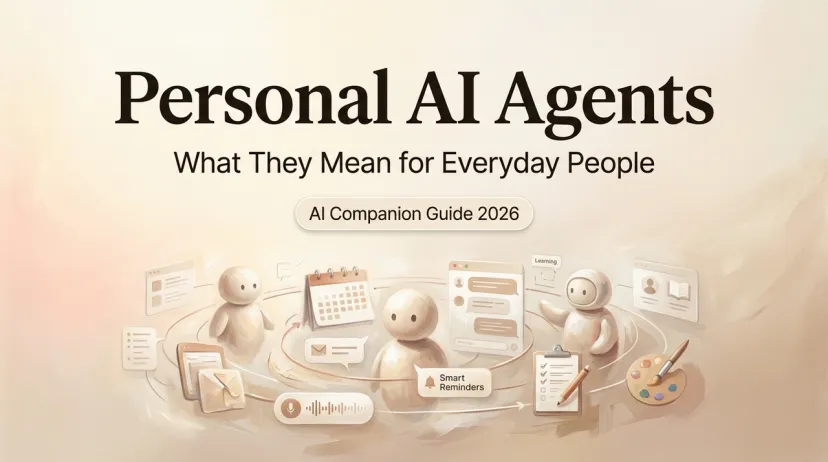
What Personal AI Agents Mean for Everyday People
What Personal AI Agents Mean for Everyday People
Something happened a few weeks ago that's been sitting with me.
I asked an AI to reschedule a dentist appointment. Instead of telling me what to type, it opened my calendar, found a gap, cross-referenced the clinic's booking page, and confirmed the slot. I didn't walk it through the process. I said what I needed, and it figured out the rest.
I closed my laptop and sat there for a second.
If you've been using AI for ages and still mostly treat it like a fast search engine — asking questions, copying answers — this might feel familiar. Because that moment wasn't about a feature. Something had shifted. The chatbot I'd been using was starting to behave like something else.
That "something else" is what people are calling a personal AI agent. In 2026, the term is everywhere. What it actually means for someone who isn't a developer is murkier than the hype suggests.
What Is a Personal AI Agent and How Is It Different?
Most people have encountered AI assistants already. You ask something, it answers. You ask again, it answers again — with no memory of the first time. That's the part that quietly drives people away.
AI Agent vs AI Assistant — The Real Distinction
The words "agent" and "assistant" sound almost identical. They aren't.
An AI assistant is reactive. You ask, it answers. You close the tab, it forgets you exist. The core distinction is autonomy and memory architecture: an assistant responds within a single session and waits for your next prompt. An agent pursues a goal across multiple steps, using tools — calendar access, browser search, email — without you scripting each one.
Under the hood, most personal AI agents today run on a loop called ReAct (Reasoning + Acting), introduced by Yao et al. in a 2023 paper from Google and Princeton. The cycle: the agent thinks about what it needs, acts by calling a tool, observes the result, then decides the next step. That self-checking loop reduces hallucination compared to a chatbot making a single guess — because the agent can verify its own output before moving on.
The other difference is memory. Most AI assistants reset between sessions — every new chat, you're a stranger again. Agents carry context forward through two layers: short-term (what's happening in this task right now) and long-term (your preferences, past conversations, recurring patterns). That accumulated understanding is what makes them feel less like a tool and more like something paying attention.
What Makes an Agent "Personal"
"Personal" means the agent is oriented around you specifically — your calendar, your communication patterns, your stated goals. Not a generic enterprise workflow. Yours.
Here's what I've noticed actually works, versus what sounds better than it is.
Everyday Tasks and Routines It Handles Well
Before reaching for it, it helps to know where the category actually performs. Here's a breakdown based on what's reliably working right now — and where the failure patterns appear.
Task type
What the agent does
Where it breaks
Scheduling & coordination
Checks calendar, finds conflicts, books across systems
Multi-party scheduling with external people it can't contact
Research synthesis
Pulls from multiple sources, surfaces what matches your preferences
Specialized or paywalled sources it can't access
Follow-up & memory
Recalls things you mentioned, surfaces them at relevant moments
Memory inconsistency across app versions or sessions
Admin backlog
Renewals, package tracking, subscription checks
Tasks requiring phone calls or CAPTCHAs
Draft communications
First-pass emails, summaries, replies
Anything requiring your voice or a delicate relationship
The follow-up piece deserves a note. I mentioned being tired of cooking elaborate dinners. Days later, the agent referenced that preference when suggesting recipes — without being asked again. That's the thing that makes a day feel lighter in a way that's hard to describe until it happens.
How It Balances Automation With Human Input
The better ones are built around what researchers call Human-in-the-Loop (HITL) — a threshold model where the agent acts independently below a defined risk level, and pauses for your confirmation above it. In practice: book the appointment, but confirm before sending. Draft the message, but don't send until you approve.
This matters for a specific, data-backed reason. A PwC survey on agentic AI trust found users were broadly comfortable with agents handling routine tasks autonomously — but trust dropped sharply for higher-stakes actions: only 20% trusted agents with financial transactions and 22% with autonomous employee-facing decisions. That gap tells you something about where to set your own thresholds.
The right mental model: a capable assistant who handles the logistics and pings you at the decisions that count.
What Should Everyday Users Realistically Expect?
This is the section I wish more articles to write.
What Personal AI Agents Are Good At Right Now
There's a frame I've started applying before using an agent for anything: is this task reversible, bounded, and low-stakes if wrong? If yes to all three — that's the sweet spot.
Reversible means a mistake can be undone. Bounded means a clear endpoint exists. Low-stakes means a wrong answer costs time, not money or a relationship.
Scheduling, research summaries, follow-ups, administrative tasks — these fit. Closing the capability gap between frontier AI and everyday use is happening, and where it shows most clearly is multi-source research tasks that used to require an hour of browser tabs. Now a prompt and a few minutes.
Where They Still Need You — Current Limitations
Personal AI agents are not reliable for tasks requiring judgment under genuine uncertainty — anything with meaningful financial, health, or relationship stakes. Surfacing options and making the right call are not the same thing.
Memory is inconsistent. Some agents carry context reliably across long stretches. Others forget things mentioned two days ago. Not yet stable enough to trust as a background system without spot-checking.
There's also what I'd call confident wrongness. Agents don't always flag uncertainty — they'll produce a clean-sounding answer when the underlying situation is murky. The International AI Safety Report 2026 — published February 2026, led by Turing Award winner Yoshua Bengio, representing 30+ countries — concluded that AI systems "remain unreliable in high-stakes or novel situations" and that "human oversight remains essential." That's scientific consensus, not a disclaimer.
A simple test: if you'd double-check a new colleague's work on this task before it went out — double-check the agent's too.
FAQ
What is a personal AI agent and how does it differ from regular assistants?
A personal AI agent takes action on your behalf across multiple steps without you guiding every one. Unlike a regular AI assistant — which responds and then waits — an agent pursues a goal, adapts as conditions change, and uses memory to make future interactions more relevant. The assistant answers. The agent does.
How can a personal AI agent help with everyday tasks and routines?
Scheduling, research synthesis, follow-ups, administrative backlog. The sweet spot: tasks that are repetitive, multi-step, reversible, and don't require judgment only you can provide. If you'd spend 20 minutes on it and feel mildly resentful, that's often a good candidate.
What should ordinary users expect from a personal AI agent?
Genuine relief on routine lower-stakes tasks. Real inconsistency on memory and complex judgment. A reduction in weekly friction — not a complete elimination of effort. The agentic AI for everyday use landscape is maturing in 2026, but the gap between what's marketed and what's consistently delivered is still real.
How does a personal AI agent balance automation with human input?
The best ones use HITL thresholds — acting autonomously within defined bounds, pausing when something is consequential. You set what "consequential" means, explicitly or through how you respond over time. Automation handles throughput. Your judgment handles what matters.
The question I keep coming back to isn't whether a personal AI agent can do more than I expected. It can. The question is whether it's doing things that make the day feel lighter — not just more automated.
Hi, I'm Anna, an AI exploration blogger!
After three years in the workforce, I caught the AI wave—it transformed my job and daily life. While it brought endless convenience, it also kept me constantly learning. As someone who loves exploring and sharing, I use AI to streamline tasks and projects: I tap into it to organize routines, test surprises, or deal with mishaps. If you're riding this wave too, join me in exploring and discovering more fun!