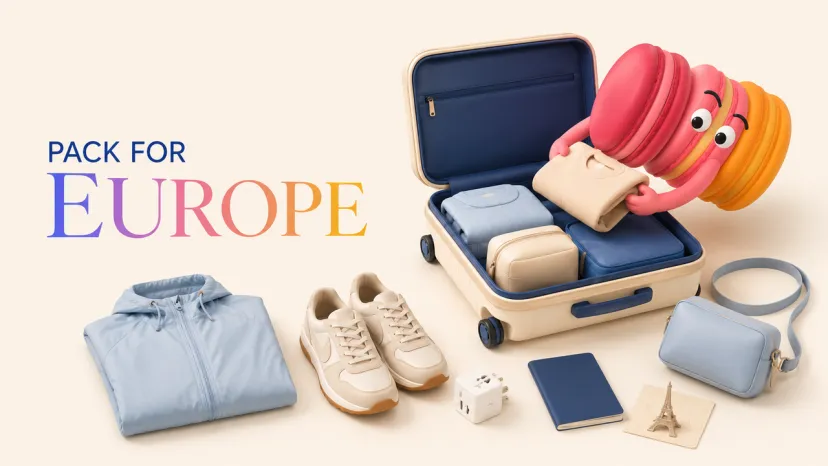
If you're booking a Europe trip in the next two months and you've already opened a suitcase to stare into it, this is for you. Most Europe packing lists fail not because they're incomplete, but because they treat every Europe trip as the same trip. A weekend in Lisbon and a two-week loop through Munich, Prague, and Vienna are not the same packing problem. One is sandals and a linen shirt. The other is layers, cobblestone-proof shoes, and a carry-on that fits a luggage rack above a train seat.
The packing lists I used for years assumed I'd be in a rental car going hotel-to-hotel. Europe is mostly the opposite of that — trains, stairs, walking, weather that changes mid-afternoon, and accommodations where you carry your own bag up three flights because the lift was installed in 1962 and has opinions. The list has to reflect that, or you end up dragging a 23-kilo suitcase across Florence at 8 p.m. wondering what exactly you were planning to wear that justified this.
Friends started forwarding what they were calling "Maren's Europe carry-on rule" after four Europe trips in two years — which is generous, because the rule was really just everything I'd stopped packing after watching it sit unused in a hotel drawer. What follows is the version that survived. A route-aware, season-aware, walking-aware packing list, plus the five categories of things I'd now actively leave out.
Pack for Your Actual Europe Itinerary
The first step isn't "make a list." It's deciding what kind of Europe trip you're actually taking. Three or four common shapes cover most of it, and each one changes the list underneath.
City-hopping
Multiple cities in one or two weeks, moving every two to four nights. This is where overpacking hurts most. Every transit day, your bag is on you — train platforms, taxi trunks, apartment stairs.
Pack for the smallest bag you can credibly close. A 40-liter carry-on is enough for ten days if you accept doing one sink-wash mid-trip. Bring 5 tops, 2 bottoms, 1 light layer, 1 jacket appropriate to the season, 1 pair of shoes you walk in, 1 pair you can dress up slightly.
Beach and summer travel
Southern Europe in July is hotter than people from cooler climates expect. Expect 32–38°C in inland cities like Seville, Rome, or Athens. Pack light cotton, linen, and one piece of sun protection you'll actually wear — a real hat, not a baseball cap that traps heat.
Skip the third swimsuit. You'll wear two on rotation.
Winter or shoulder season
October–March in Northern and Central Europe means wet feet are the real enemy, not cold. Waterproof shoes matter more than a heavier coat. A merino base layer, a mid-layer, and a wind-and-rain outer shell will get you through Berlin in November better than one giant down jacket that's too warm indoors and useless in drizzle.
Trains, stairs, and cobblestones
If your itinerary includes inter-city trains, check the Eurail luggage rules before you pack — most operators expect bags you can lift overhead or fit between seats, and there's no porter. The same logic applies to airlines: the IATA baggage guidance gives a sense of the standard carry-on envelope, though every airline tweaks it.
Cobblestones destroy hard-shell wheels and twisted ankles. Soft-sided bags with two big wheels or a backpack-convertible carry-on outperform four-wheel spinners on every street I've actually walked.
Clothing That Works Across Europe
The category where most overpacking happens. The fix is not "bring less" as a slogan. It's a real rule about what each piece does.
Layers
The single most useful Europe packing concept is the three-layer system: base (t-shirt or thin long-sleeve), mid (cardigan, light sweater, or overshirt), outer (rain jacket or coat). One mid-layer covers a 10°C swing. Two mid-layers cover almost any non-extreme European day.
Comfortable shoes
You will walk 15,000–25,000 steps a day. Bring one pair you've already broken in for daily walking, and one secondary pair for evenings or rain backup. New shoes bought the week before departure are how blisters happen on day two.
Smart-casual pieces
Most European restaurants and cultural sites are slightly more dressed-up than equivalent American or Australian places. You don't need formalwear, but one outfit that isn't gym-coded matters more than people expect. A pair of dark jeans or trousers plus a collared or knit top covers museums, dinners, and theaters.
Weather protection
A packable rain jacket is non-negotiable from September through May, and useful even in summer in places like Ireland, Scotland, the Alps, and the Baltic coast. Don't pack an umbrella — they break, get lost, and most cities sell €5 ones the moment it starts raining anyway.
Documents, Money, and Travel Admin
This category is small but failure here ruins the trip, so it gets its own attention.
Passport and copies
Passport with at least six months of validity from your return date — many European countries require this even if your nationality is visa-free. Keep a photo of the data page in your phone and a separate photo in your email, so you can access it even if your phone dies.
Cards and cash
Bring two cards from different networks (one Visa, one Mastercard or Amex) in case one gets locked. Notify your bank of travel dates, or pick a card that doesn't require it. Cash is still useful for small cafés, public toilets, and tipping — €100–€200 in local currency is enough for the first day before you find an ATM.
Insurance and confirmations
Travel insurance with medical coverage. Save your policy number offline. The UK foreign travel advice pages are a useful sanity check for country-specific entry requirements even if you're not British — the format is clean and updated regularly. Screenshot every booking confirmation and store them in a single folder on your phone.
Toiletries, Health, and Liquids
The category most affected by airline rules and the easiest to over-plan.
Carry-on liquids
If you're carrying on only, TSA's 3-1-1 liquids rule applies on the outbound and most European airports follow an equivalent 100ml-per-container, single quart-bag standard. Decant. Don't bring full-size shampoo. Hotels and apartments have shampoo. They do not have your specific moisturizer. Prioritize accordingly.
Medication
Bring prescription meds in original packaging with the label visible, and pack a small first-aid kit: painkillers, antihistamine, bandaids, electrolyte tablets. For destination-specific health notes — vaccines, water safety, regional considerations — the CDC travel health pages are a reasonable starting point, though they're general guidance, not personal medical advice.
Replaceable items
Toothpaste, sunscreen, deodorant, razors, tampons — all available in every European pharmacy and supermarket. Bring enough for two days. Buy the rest there. You free up half your toiletries bag this way.
Tech and Everyday Essentials
Less than people think they need, and one thing more than most lists mention.
Chargers and adapters
Two adapters are better than one — one stays by the bed, one charges the power bank during the day. Continental Europe uses Type C/F (two round pins). The UK and Ireland use Type G (three rectangular pins). If you're crossing the Channel, you need both.
Power bank
A 10,000 mAh power bank is the single most-used item in my Europe carry-on. Phone maps, train tickets, museum entries, restaurant bookings — your phone is the trip. Run out of battery in a city you don't know and the day stops working.
Offline notes and maps
Download Google Maps offline for every city before you arrive. Save metro maps as screenshots. Save your accommodation address as a note in your native language and the local language. The day your data plan fails, this is what saves you.
What Not to Pack for Europe
This is the part most packing lists skip, and it's where the actual weight savings live.
Too many shoes
Three pairs maximum. Most people overpack here. One walking, one dressier, one optional sandal or boot depending on season. Shoes are heavy and inflexible to pack around.
Heavy tools
Travel iron, travel hairdryer, full-size makeup palette, "in case" gym clothes for a gym you won't visit. Every one of these has lived in my suitcase for an entire trip without being touched. Apartments and hotels supply hairdryers. Clothes look fine without ironing if you hang them in a steamy bathroom.
Just-in-case outfits
The "what if there's a fancy dinner" outfit, the "what if it gets really cold" sweater on top of two other sweaters, the "what if I want to go running" full set. If you haven't worn it in the last three weeks at home, you won't wear it in Lisbon.
Turn This Into a Europe-Specific Checklist
A generic list isn't enough. The whole point is calibrating it to your actual trip.
Save your route and season
Write the cities, dates, and average temperatures at the top of your packing list. Every item on the list should justify itself against that header. If a sweater can't survive the question "where exactly will I wear this in Seville in July," it doesn't make the list.
Adjust for train travel and walking
If you're moving more than three times, downsize the bag by 20%. If your average walking day will exceed 15,000 steps, prioritize shoes over outfit variety. Comfort scales with movement; outfits don't.
Reuse the list for future Europe trips
After the trip, mark every item you didn't use and every item you wished you'd brought. That delta is the most valuable packing knowledge you have, and it only exists if you write it down within 48 hours of getting home, while it's still honest.
FAQ
Is a carry-on enough for a Europe trip?
For up to two weeks, yes — if you're willing to do one sink-wash or use a laundromat once. The bigger constraint is the trip type. City-hopping with trains and stairs almost always benefits from carry-on only. A single-base trip with a car can absorb a larger bag without much pain.
Do I need different adapters for the UK and Europe?
Yes. The UK and Ireland use Type G (three rectangular pins). Continental Europe uses Type C or F (two round pins). A universal adapter covers both, but two single-region adapters are often cheaper and lighter.
What shoes should I pack for Europe?
One broken-in walking pair, one slightly dressier pair you can also walk in, and optionally one season-appropriate third (sandals for summer, waterproof boots for winter). Three pairs maximum. Cobblestones reward flexible soles and discourage stilettos.
How do I pack for different climates in one trip?
Layer instead of bringing more pieces. A base layer, a mid-layer, and a rain-and-wind outer shell will cover most weather between 5°C and 25°C. Add one warm sweater for the cold end, one light dress or shirt for the warm end. The same five core pieces flex across a 20°C range.
What should I leave out of a Europe packing list?
Travel hairdryers, irons, three or more pairs of shoes, full-size toiletries, just-in-case outfits, and an umbrella. All of these are either supplied at your accommodation, available cheaply in pharmacies and shops on arrival, or things you packed for a version of the trip you're not actually taking.
If you're not sure which stage your list is failing at, the simplest test is the next trip itself. Pack it, take it, and mark what didn't get used by day three. That's the list. Everything else is hope.
I’m Maren, a 27-year-old content strategist and perpetual self-experimenter. I test AI tools and micro-habits in real daily life, noting what breaks, what sticks, and what actually saves time. My approach isn’t about features—it’s about friction, adjustments, and honest results. I share insights from experiments that survive a real week, helping others see what works without the fluff.